key PORSCHE CAYNNE 2004 1.G Repair Manual
[x] Cancel search | Manufacturer: PORSCHE, Model Year: 2004, Model line: CAYENNE, Model: PORSCHE CAYENNE 2004 1.GPages: 379, PDF Size: 13.91 MB
Page 271 of 379

Maintenance and Car Care
271
High-pressure cleaning equipment, steam
cleaners
Warning!
High-pressure cleaning equipment, steam
cleaners or similar can damage the following
components:
–Tires
– Logos, emblems
– Painted surfaces
– Widened fenders
– Lock and latch of the removable towing attach-
ment
– Seals of the electrically retractable ball hitch
– Alternator, valve covers
– ParkAssist sensors
fPlease see the operating instructions from the
unit manufacturer.
fAlways cover the lid over the brake fluid reser-
voir prior to cleaning. Never point the cleaning
jet directly at the lid.
fWhen cleaning with a flat-jet nozzle or the like,
maintain a minimum distance of 21 in.
(50 cm).fNever use high-pressure cleaning equipment,
steam cleaners, etc. with a round-jet nozzle.
High-pressure cleaning equipment with a round
nozzle will damage your vehicle. The tires are
particularly susceptible to damage.
fDo not point the cleaning jet directly at any of
the aforementioned components.
Decorative foils Caution!
Risk of damage due to separation of the de-
corative foils when using high-pressure clea-
ning equipment, steam cleaners or similar
cleaning equipment.
fDo not use high-pressure cleaning equipment, steam cleaners, etc. to clean decorative foils.
Door lockfTo prevent the door lock from freezing during
the cold season, cover the lock barrel with a
suitable adhesive tape during washing.
Should the locks freeze, use an ordinary de-icer.
In many cases, a well warmed key can help.
Never use excessive force.
WashingThe best protection for the car from the damaging
effects of the environment is frequent washing and
preservation. The underside of the car should also
be thoroughly washed for cinders, salt or sanding
at winter‘s end.
The longer salt, road dust, industrial dust, insect
remains, bird excrement, and tree exudations
(resin, pollen), etc. are allowed to remain on the
bodywork, the more serious is their harmful
effect.
New cars should be washed carefully with plenty
of clear water to protect the new paint work.
Dark paint finishes show up the smallest of sur-
face damage (e.g. scratches) more readily than
lighter colors.
Dark colors are also more susceptible to scrat-
ching because of the composition of their pig-
ments and require particularly careful paint care.
fDo not wash your car in bright sunlight or while
the bodywork is still hot.
fWhen washing by hand, use abundant water, a
soft sponge or wash brush and Porsche car
shampoo.
fBegin by spraying the body thoroughly with
water to rinse away loose dirt.
fAfter washing, rinse the car with plenty of
water and then dry with a chamois leather.
Do not use the same chamois leather for
drying as you use for cleaning the windshield
and windows.
10_Cayenne_21_KW17.book Seite 271 Donnerstag, 9. April 2009 3:33 15
Page 280 of 379

280
Minor Repairs
Exercise Extreme Caution when
Working on your Vehicle
Danger!
Ignoring the following instructions may cau-
se serious personal injury or death.
fThe engine compartment of any motor vehicle
is a potentially hazardous area. If you are not
fully familiar with proper repair procedures, do
not attempt the adjustments described on the
following pages.
This caution applies to the entire vehicle.
fO n l y w o r k o n y o u r v e h i c l e o u t d o o r s o r i n a w e l l
ventilated area.
fEnsure that there are no open flames in the
area of your vehicle at any time when fuel
fumes might be present. Be especially
cautious of such devices such as hot water
heaters which ignite a flame intermittently.
fBefore working on any part in the engine com-
partment, turn the engine off and let it cool
down sufficiently. Hot engine compartment
components can burn skin on contact.
fBe alert and cautious around engine at all
times while the engine is running.
If you have to work on the engine while it is run-
ning, always put the parking brake on and put
the gearshift lever in neutral or the Tiptronic
selector lever in position P or N.fIn particular, be very careful to ensure that
items of clothing (ties, shirt, sleeves etc.),
jewelry, long hair, hand or fingers cannot get
caught in the engine-compartment blower, fan,
belts or other moving parts.
The radiator and radiator fans are in the front
of the car.
The fans can start or continue running as a
function of temperature, even with the engine
switched off.
Carry out work in these areas only with the
engine off and exercise extreme caution.
fYour Porsche is equipped with an electronic
ignition system. When the ignition is on, high
voltage is present in all wires connected with
the ignition system; therefore, exercise
extreme caution when working on any part of
the engine while the ignition is on or the engine
is running.
fAlways support your car with safety stands if it
is necessary to work under the car. The jack
supplied with the car is not adequate for this
purpose.
For vehicles with air suspension with level
control and height adjustment:
Please see the chapter “RAISING VEHICLE
WITH THE JACK” on Page 192.fWhen working under the car without safety
stands but with the wheels on the ground,
make sure the car is on level ground, the
wheels are blocked, and that the engine can-
not be started.
Remove the ignition key.
fDo not smoke or allow an open flame around
the battery or fuel.
Keep a fire extinguisher close at hand.
fIncomplete or improper servicing may cause
problems in the operation of the car. If in doubt
about any servicing, have it done by your
authorized Porsche dealer.
Improper maintenance during the warranty
period may affect your Porsche warranty
coverage.
fSupplies of fluids, e.g. engine oil, brake fluid or
coolant, are hazardous to your health. Keep
these fluids out of children's reach and dispose
of them in accordance with the appropriate
regulations.
fSome countries require additional tools and
special spare parts to be carried in your vehi-
cle.
Please make enquiries before driving abroad.
10_Cayenne_21_KW17.book Seite 280 Donnerstag, 9. April 2009 3:33 15
Page 294 of 379

294
Minor Repairs Tightening torque
Tightening torque of the wheel bolts and wheel
nuts 118 ftlb. (160 Nm).
Security wheel boltsThe adapter (wrench socket) for the security
wheel bolts is located in the tool box.
To loosen or tighten the wheel bolt with anti-theft
protection, the adapter must be used between the
wheel bolt and the wheel bolt wrench.
fWhen positioning the wrench socket, ensure
that it engages fully in the teeth of the wheel
bolt.
Note on operation
fOn vehicles with 17 mm spacers on the rear
axle, the wheels are secured with steel nuts.
There is no anti-theft protection for the wheel
nuts.
fIf the wheels have to be removed at the work-
shop, please do not forget to hand over the
socket for the security wheel bolts along with
the car key.
Changing Wheels
Warning!
Failure to follow these instructions may result
in serious personal injury or death to you or
to bystanders.
Before changing the wheel
fIf you have a flat tire, move a safe distance off
the road. Turn the emergency flasher on and
use other warning devices to alert other
motorists.
fDo not park your vehicle where it may contact
dry grass, brush or other flammable materials.
The hot parts of the exhaust system could set
such materials on fire, thereby causing both
property damage and severe or fatal physical
injury.
fPassengers must not be in the vehicle when it
is jacked up.
fBefore you change a wheel, be sure the ground
is level and firm. If necessary, use a board
under the jack to ensure that the jack does not
sink into the ground.
fSet the parking brake and block the wheels
opposite the flat tire on the other side of the
vehicle.While operating the jack
fThe jack is only to be used for changing a
wheel. Do not use it as a support to work under
the car.
fThe car must be jacked up only at the illustra-
ted jacking points.Lifting at any other place
may damage the vehicle or may result in per-
sonal injury. Never jack the car up by the body
or the bumpers.
fFor safety reasons do not use tire inflating bot-
tles. Do not use commercially available sealant
bottles. Use only the tire inflating bottle
located in the luggage compartment.
10_Cayenne_21_KW17.book Seite 294 Donnerstag, 9. April 2009 3:33 15
Page 295 of 379
Minor Repairs
295
Sequence of operation
Warning!
The jack must be used only to raise the car
for wheel changing.The jack must never be
used as a support to work underneath the
vehicle. If the jack is accidentally dislodged,
you or bystanders could suffer severe
personal injury.
fNever jack up other vehicles or other loads
with the jack.
fAlways place the car on stable supports if you
have to work under it. When working under the
vehicle, always use safety stands specifically designed for this purpose.
fPlease use a suitable knee rest to protect your
clothing against soiling.
Flat TireNote
The tools required for changing a wheel (e.g. jack,
wheel bolt wrench, assembly aids, folding
wedges) are only supplied with the vehicle if the
vehicle comes with a collapsible spare wheel or
full-size spare wheel as standard. Your authorized
Porsche dealer will be pleased to advise you.
1. Stop the vehicle as far away from the driving
lane as possible.
The car must be parked on a firm and flat
surface offering adequate grip.
2. Switch on the emergency flashers.
3. Fully apply the parking brake.
4. Shift into 1st gear or move the Tiptronic
selector lever to position P.
5. Straighten the front wheels.
6. Withdraw the ignition key to lock the steering
and prevent the engine from being started.
7. Have any passengers leave the vehicle.
8. Set up a warning triangle at a suitable
distance.
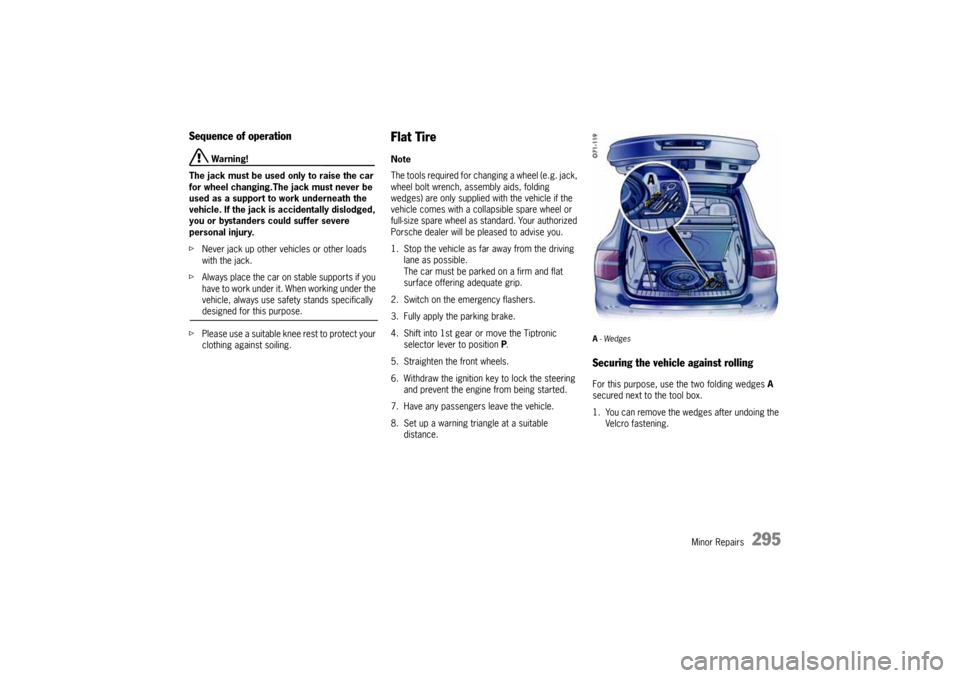
A-WedgesSecuring the vehicle against rollingFor this purpose, use the two folding wedges A
secured next to the tool box.
1. You can remove the wedges after undoing the
Velcro fastening.
10_Cayenne_21_KW17.book Seite 295 Donnerstag, 9. April 2009 3:33 15
Page 312 of 379
312
Minor Repairs
Electrical SystemIn order to avoid damage and faults in electrical or
electronic systems, electrical accessories should
be installed at your authorized Porsche dealer.
fUse only accessories authorized by Porsche.
Warning!
Risk of short circuit and fire, resulting in
serious personal injury or death.
Replacing fuses or relays with engine running
or the ignition on could cause electrical
shock.
fDisconnect the negative terminal on the
battery during all work on the electrical sys-tem.
RelaysRelays should be checked or changed only by an
authorized workshop.
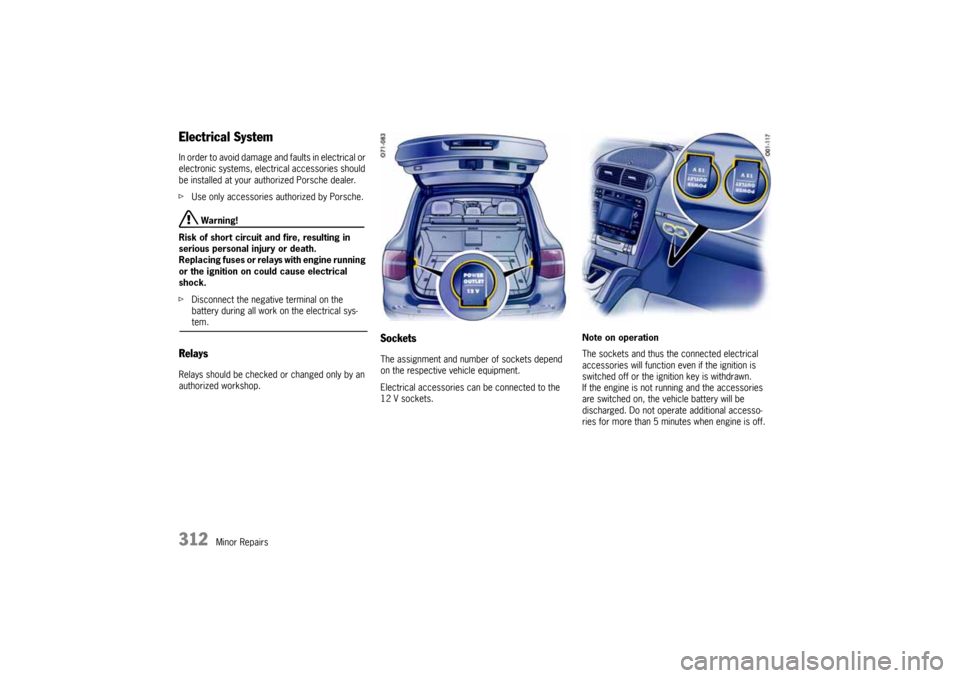
SocketsThe assignment and number of sockets depend
on the respective vehicle equipment.
Electrical accessories can be connected to the
12 V sockets.Note on operation
The sockets and thus the connected electrical
accessories will function even if the ignition is
switched off or the ignition key is withdrawn.
If the engine is not running and the accessories
are switched on, the vehicle battery will be
discharged. Do not operate additional accesso-
ries for more than 5 minutes when engine is off.
10_Cayenne_21_KW17.book Seite 312 Donnerstag, 9. April 2009 3:33 15
Page 313 of 379
Minor Repairs
313
Changing fusesIn order to prevent damage to the electrical
system due to short circuits and overloads, the
individual circuits are protected by fuses.
One fuse box is in the engine compartment. Two
additional fuse boxes are located in the outer ends
of the dashboard.
1. Switch off the consumer with the defective
fuse. Before replacing a fuse, switch off all
electrical consumers and remove the ignition
key.
2. Open the fuse-box lid.
3. Remove the corresponding fuse from its slot to
check it using the plastic gripper.
A blown fuse can be identified by the melted
metal strip.
4. Replace only with fuses with the same rated
current. We recommend using genuine
Porsche fuses for replacement.
Note
If a fuse blows repeatedly, please consult an
authorized Porsche dealer immediately, so that
the short circuit can be located and corrected.
fNever try to “repair“ fuses: you may cause
serious damage to other parts of the electrical
system.
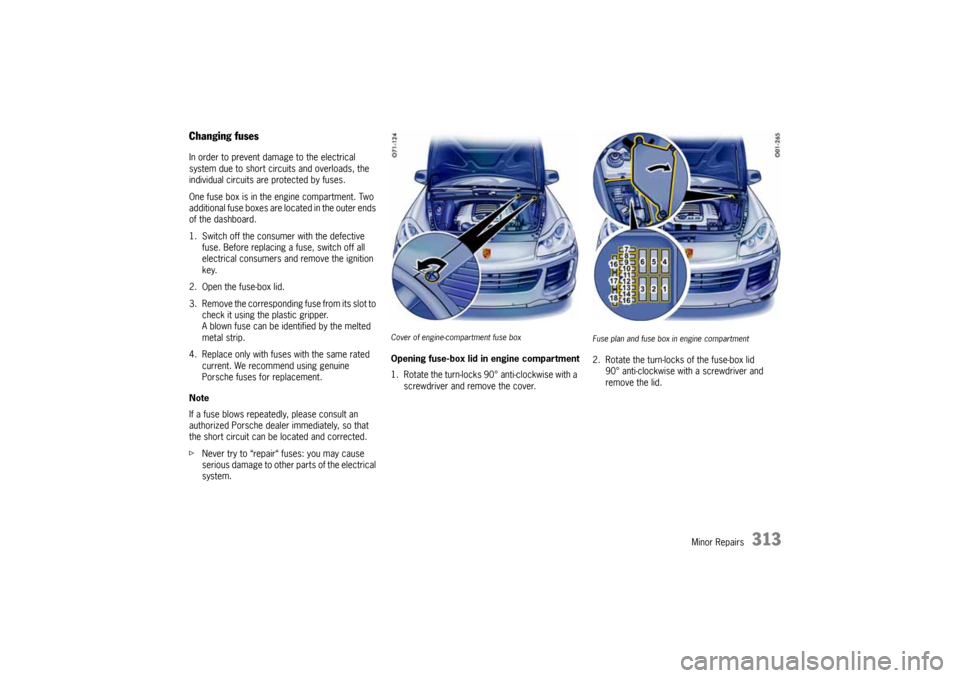
Cover of engine-compartment fuse boxOpening fuse-box lid in engine compartment
1. Rotate the turn-locks 90° anti-clockwise with a
screwdriver and remove the cover.
Fuse plan and fuse box in engine compartment2. Rotate the turn-locks of the fuse-box lid
90° anti-clockwise with a screwdriver and
remove the lid.
10_Cayenne_21_KW17.book Seite 313 Donnerstag, 9. April 2009 3:33 15
Page 320 of 379

320
Minor Repairs
Battery
Danger!
Risk of short circuit and fire, resulting in
serious personal injury or death.
fObserve all warning notes on the battery.
fDisconnect the negative terminal on the
battery during all work on the electrical sys-
tem.
fDo not lay tools or other metal objects on the
battery as they could cause a short circuit
across the battery terminal.
Hydrogen gas generated by the battery
could cause an explosion, resulting in
serious personal injury or death.
fCharge battery in a well vetilated area.
fNever charge a frozen battery. It may explode
because of gas trapped in the ice. Allow a fro-
zen battery to thaw out first.
fDo not expose the battery to an open flame,
electrical spark or a lit cigarette.
Risk of explosion as a result of static charge,
resulting in serious personal injury or death.
fDo not wipe the battery with a dry cloth.
fBefore touching the battery, discharge any
static electricity by touching the vehicle.Risk of serious personal injury or death and
damage to the fabric, metal or paint.
fWear eye protection.
fDo not allow battery acid to come in contact
with your skin, eyes, fabric or painted sur-
faces.
fIf you get electrolyte, which is an acid, in your
eyes or on your skin, immediately rinse with
cold water for several minutes and call a
doctor.
fSpilled electrolyte must be rinsed off at once
with a solution of baking soda and water to
neutralize the acid.
Battery posts, terminals and related acces-
sories contain lead and lead compounds,
chemicals known to the State of California to
cause cancer and reproductive harm.
fAlways protect your skin by washing
thoroughly with soap and water.
The battery is located in the battery box under the
left front seat.
Charge stateA well charged battery will not only prevent
starting problems but will also last longer.
In order to avoid unintended battery
discharge
fSwitch off unnecessary electrical loads in city
traffic, on short trips or in a line of traffic.
fAlways remove the ignition key from the igni-
tion switch when leaving the vehicle or
switch ignition off in vehicles with Porsche
Entry & Drive.
fAvoid using the Porsche Communication
Management system and the audio system
when the engine is not running.
Maintenance Note
In the cold season, in particular, or if you mainly
drive only short distances, it may become neces-
sary to recharge the battery from time to time.
10_Cayenne_21_KW17.book Seite 320 Donnerstag, 9. April 2009 3:33 15
Page 321 of 379

Minor Repairs
321
Battery carefEnsure that battery is securely mounted.
fKeep terminals and connections clean and
properly tightened. Corrosion can be preven-
ted by coating the terminals and connections
with petroleum jelly or silicone spray.
fEnsure that vent caps are securely tightened to
prevent spillage.
Checking the electrolyte fluid level
(only on low-maintenance batteries)
Generally, the electrolyte level must be checked
more often in summer than in the winter, and more
often when driving long distances.
fWhen adding water, use only clean containers.
In no case may alcohol (e.g. window cleaner
residues) be permitted to enter the battery.
fUnscrew and open the filler vent caps of each
cell.
With the car on a level surface, the fluid level
should meet the indicator mark in each cell.
fIf necessary, top up with distilled water. Do not
use acid. Only fill up to the mark, otherwise the
electrolyte will overflow when the battery is
being charged and cause damage.
Winter operationDuring the winter months, battery capacity tends
to decrease as temperatures drop. Additionally,
more power is consumed while starting, and the
headlights, heater, rear window defogger, etc.,
are used more frequently.
Let your Porsche dealer test the battery's capaci-
ty before winter sets in.Vehicle storageIf the car stands for long periods in the garage or
workshop, the doors and lids should be closed.
fRemove the ignition key and, if necessary, dis-
connect the battery.
Notes on operation
fWhen the battery is disconnected, the alarm
system ceases to function.
If the vehicle was locked before the battery
was disconnected, the alarm will be triggered
when the battery is reconnected.
To deactivate the alarm system:
fLock the vehicle and unlock it again.
Alarm system, central locking
The status of the central locking and alarm system
is not changed by disconnecting the battery.Maintenance Notes
Even if you put your vehicle out of operation, the
battery still discharges.
The battery will discharge more quickly if your ve-
hicle is not driven on a daily basis over a distance
of several miles. The more often you drive your ve-
hicle, and the longer the distance driven on each
trip, the more opportunity the vehicle‘s charging
system will have to recharge the batteries.
fTo preserve its efficiency, charge the battery
about every 6 weeks.
fCheck the battery acid level and top off with
distilled water if necessary.
fStore a battery that has been removed in a
dark, cool place, but not subject to freezing.
Replacing the batteryThe service life of the battery is subject to normal
wear; it depends greatly on care, climatic conditi-
ons, and driving conditions (distances, loads).
fOnly use an original Porsche battery, with the
correct part number, as a replacement. Only
this battery meets the specific requirements of
the vehicle.
fPlease observe the disposal instructions for
batteries.
10_Cayenne_21_KW17.book Seite 321 Donnerstag, 9. April 2009 3:33 15
Page 322 of 379
322
Minor Repairs
Putting vehicle into operationAfter the battery is connected or after a
completely discharged batterie is charged, the
PSM warning light lights up on the instrument
panel and a message appears on the multi-
purpose display of the instrument panel to indicate
a fault.
This fault can be remedied with a few simple
steps:
1. Start the engine.
To do this, turn the ignition key or the control
unit (on vehicles that have Porsche Entry &
Drive) to ignition lock position 2 twice.
2. Perform a few steering movements and drive
a short distance in a straight line until the PSM
warning light goes out and the message is
erased from the memory of the multi-purpose
display of the instrument panel.
3. If the warnings does not go out, then:
Drive carefully to the nearest authorized
Porsche dealer.
Have the fault remedied by an authorized
Porsche dealer.
4. After the warnings disappear:
Stop the vehicle in a suitable place.
5. Perform adaptation of the power windows:
Please see the chapter “STORING FINAL POSI-
TION OF THE DOOR WINDOWS” on Page 90.6. On vehicles with tire pressure monitoring:
Please see the chapter “SETTING THE TIRE
TYPE AND SIZE” on Page 134.
7. On vehicles with Panorama roof system:
Please see the chapter “SAVE FINAL POSITION
OF THE PANORAMA ROOF SYSTEM” on
Page 99.
Replacing the remote control
batteryNote
fPlease dispose of batteries in compliance with
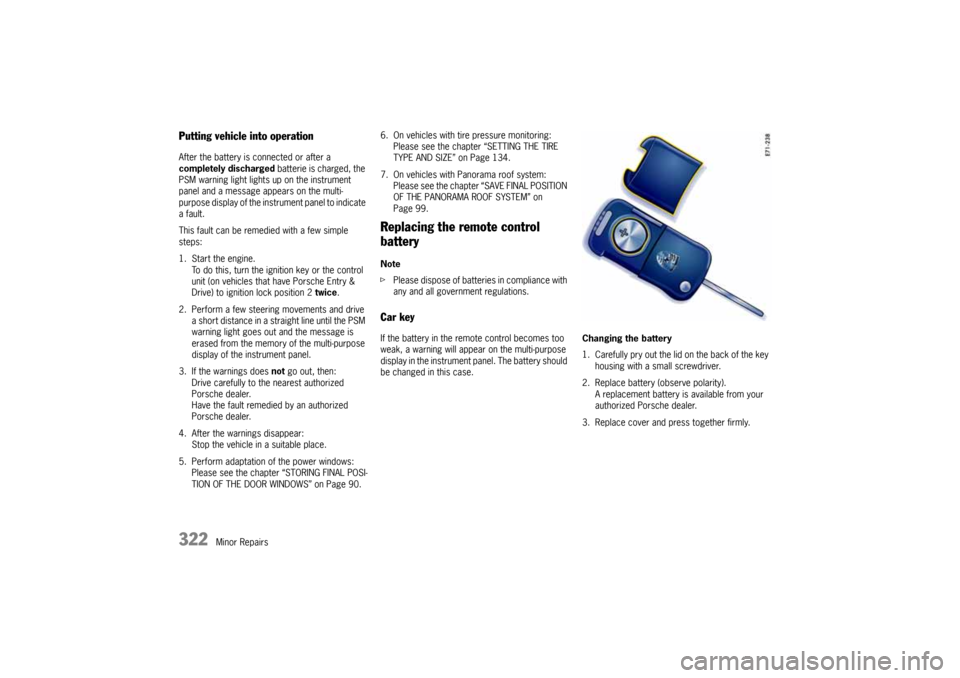
any and all government regulations.Car keyIf the battery in the remote control becomes too
weak, a warning will appear on the multi-purpose
display in the instrument panel. The battery should
be changed in this case.Changing the battery
1. Carefully pry out the lid on the back of the key
housing with a small screwdriver.
2. Replace battery (observe polarity).
A replacement battery is available from your
authorized Porsche dealer.
3. Replace cover and press together firmly.
10_Cayenne_21_KW17.book Seite 322 Donnerstag, 9. April 2009 3:33 15
Page 325 of 379

Minor Repairs
325
Battery chargingAutomotive batteries loose their efficiency when
not in use. The charge available in your battery can
be measured with a battery hydrometer. We
recommend that the battery voltage be tested by
your Porsche dealer who has the appropriate
equipment.
If the car is not driven for prolonged periods, the
battery must be charged at least every 6 weeks.
A discharged battery allows rapid formation of sul-
fates, leading to premature deterioration of the
plates.
Danger!
Hydrogen gas generated by the battery
could cause an explosion, resulting in
serious personal injury or death.
fCharge battery in a well ventilated area.
fNever charge a frozen battery. It may explode
because of gas trapped in the ice. Allow a fro-
zen battery to thaw out first.
fIf you get electrolyte, which is an acid, in your
eyes or on your skin, immediately rinse with
cold water for several minutes and call a doc-tor.Note
Your authorized Porsche dealer will be pleased to
advise you about a suitable charger.
fAlways observe the instructions of the charger
manufacturer.
fWhen charging the battery, ensure adequate
ventilation.
1. Check the acid level of a low-maintenance
battery.
2. Connect charger to the jump starting points.
Only plug into the mains and switch the
charger on when it has been correctly
connected up.
3. Switch on the charger.
4. After charging, switch off and disconnect the
charger.
5. Check the acid level of a low-maintenance
battery.
After charging the battery After the battery is connected or the completely
discharged battery is charged, the PSM warning
light lights up on the instrument panel and a
message appears on the multi-purpose display of
the instrument panel to indicate a fault.
This fault can be remedied with a few simple
steps:
1. Start the engine.
To do this, turn the ignition key or the control
unit (on vehicles that have Porsche Entry &
Drive) to ignition lock position 2 twice.
2. Perform a few steering movements to the left
and to the right when vehicle is standing and
drive a short distance in a straight line until the
PSM warning light goes out and the message
is erased from the memory of the multi-
purpose display of the instrument panel.
3. If the warnings does not go out, then:
Drive carefully to the nearest authorized
Porsche dealer.
Have the fault remedied by an authorized
Porsche dealer.
10_Cayenne_21_KW17.book Seite 325 Donnerstag, 9. April 2009 3:33 15