6 speed PORSCHE CAYNNE 2008 1.G Information Manual
[x] Cancel search | Manufacturer: PORSCHE, Model Year: 2008, Model line: CAYENNE, Model: PORSCHE CAYENNE 2008 1.GPages: 95, PDF Size: 3.37 MB
Page 26 of 95

There is one fuel that will always be free.
Which is why we make the most of it.
Air intake system.
The Cayenne models are all
equipped with a resonance air
intake system. This simple
technology uses the pressure
waves generated by the inlet
valves to ‘force’ air into the engine.
The effect is enhanced in
the Cayenne, Cayenne S and
Cayenne GTS by a two-stage
intake manifold. This combines all
the benefits of a long intake tube
(higher torque at low rpm) with
those of a shorter length (more
power at higher rpm). On theCayenne GTS, performance is
enhanced by optimised airflow
management in the intake manifold.
Although ‘naturally aspirated’,
the Cayenne, Cayenne S and
Cayenne GTS provide high torque
ratings across the entire engine
speed range.
Drive
Pressure is often the key to performance.
Turbocharging system in the Cayenne Turbo.
The Porsche Turbo is synonymous
with performance, exhilarating
acoustics and the finest engineering.
The Cayenne Turbo has twin
turbocharger units arranged in
parallel. The low-volume intake
pipes combine with short exhaust
manifolds to achieve a rapid,
emphatic response.
Incoming air is passed through a
filter and compressed by the turbine
units. Its temperature is then
reduced in the intercooler system,
which improves cylinder charging
and limits thermal loads on the
engine.
Boost pressure reaches 1.8 bar
(absolute pressure) under full
acceleration from just 2,500 rpm.In normal road driving (part-throttle
mode), the pre-throttle boost
pressure is reduced in order
to
maximise fuel economy. When
the car is driven more assertively,
the
turbines are ‘pre-spun’ so
as to increase the pressure
available. When the throttle is
finally opened, the boost can
be applied immediately.
Both turbo units are cooled by
dedicated circuits from the main
engine cooling system.This solutionprevents oil degradation due to
overheating.
For the driver, the result is
seamless delivery of phenomenal
power and torque.
· 55 · · 54 ·
Page 27 of 95

· 58 · · 57 · · 56 ·
Used to regulate /control Input data Used to regulate /control
Engine management system
(MED 9.1)
Engine load
Throttle-valve angle
Oxygen sensor signals
Engine speed (from crankshaft)
Inlet camshaft phase angle
Knock sensor signals
Vehicle speed
Air-conditioning settings
Throttle pedal position
Temperatures
– Coolant
– Intake air
– Engine oil
– Ambient air
Zündung
Direct fuel injection (DFI)
Idling via throttle valve and ignition
Heating elements in oxygen sensors
Demand-controlled fuel pump
Fuel-tank venting
CAN interface to PSM control unit, transmission control unit, engine immobiliser, instrument cluster,
air-conditioning control unit, ‘Sport’ button, on-board diagnostics, etc.
Input data
Camshaft phase angle
Engine fan
Starter
Fuel pressure
Throttle valve
Intake manifold resonance valve
Engine management functions in the Cayenne S, Cayenne GTS and Cayenne Turbo. Engine management functions in the Cayenne.
Drive
Maximum freedom requires total control.
Electronic engine management.
The electronic engine management
system provides coordinated
regulation of all engine functions
and associated systems in all
operating conditions.
The basic principle of engine
management is simple. Throughout
each journey, the system monitors
a range of input data and compares
it with corresponding sets of
reference values (‘maps’). Key
engine functions, such as ignition
and fuel injection, can be seamlessly
and automatically adjusted. The
results: optimum fuel economy and
lower emissions as well as greater
power and torque.One of the most important systems
controlled by engine management
is the electronic throttle, a
prerequisitefor Porsche Stability
Management
(PSM). Other major
functions include on-board diagnos-
tics and cylinder-specific knock
control featuring automatic compen-
sation for changes in fuel quality.
On the Cayenne, Cayenne S
and Cayenne GTS, the engine
management system controls
the variable-tract intake manifold.
On the Cayenne Turbo, it regulates
the turbo boost pressure.
Fuel pressure
Oil pressure
Engine management system
(EMS SDI 4.1)
Throttle-valve angle
Oxygen sensor signals
Engine speed (from crankshaft)
Inlet camshaft phase angle
Knock sensor signals
Vehicle speed
Air-conditioning settings
Throttle pedal position
Temperatures
– Coolant
– Intake air
– Engine oil
– Ambient air
Ignition
Direct fuel injection (DFI)
Idling via throttle valve and ignition
Heating elements in oxygen sensors
Demand-controlled fuel pump
Fuel-tank venting
CAN interface to PSM control unit, transmission control unit, engine immobiliser, instrument cluster,
air-conditioning control unit, ‘Sport’ button, on-board diagnostics, etc.
Valve lift (VarioCam Plus)
Engine fan
Starter
Fuel pressure
Throttle valve
Intake manifold resonance valve
(Cayenne S/Cayenne GTS)
Fuel pressure
Oil pressure
Wastegate frequency valve
(Cayenne Turbo only)
Bypass valves (Cayenne Turbo only)
Camshaft phase angle
Oil pressure
Engine load
Ignition
Cylinder-specific knock control
Cylinder-specific knock control
Page 29 of 95
Drive
Precision control on road and track.
Comfort and durability on all terrain.
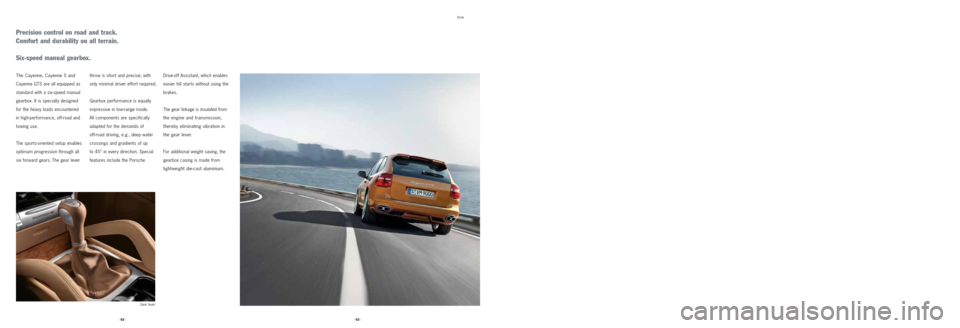
Six-speed manual gearbox.
Drive-off Assistant, which enables
easier hill starts without using the
brakes.
The gear linkage is insulated from
the engine and transmission,
thereby eliminating vibration in
the gear lever.
For additional weight saving, the
gearbox casing is made from
lightweight die-cast aluminium.
throw is short and precise, with
only minimal driver effort required.
Gearbox performance is equally
impressive in low-range mode.
All components are specifically
adapted for the demands of
off-road driving, e.g., deep water
crossings and gradients of up
to 45° in every direction. Special
features include the Porsche The Cayenne, Cayenne S and
Cayenne GTS are all equipped as
standard with a six-speed manual
gearbox. It is specially designed
for the heavy loads encountered
in high-performance, off-road and
towing use.
The sports-oriented setup enables
optimum progression through all
six forward gears. The gear lever
Gear lever
· 63 · · 62 ·
Page 30 of 95
Drive
The convenience of an automatic.
The excitement of a sequential gearbox.
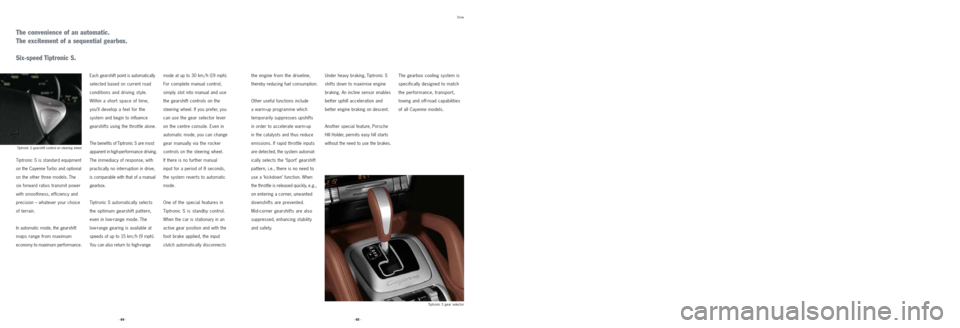
Six-speed Tiptronic S.
Each gearshift point is automatically
selected based on current road
conditions and driving style.
Within a short space of time,
you’ll develop a feel for the
system and begin to influence
gearshifts using the throttle alone.
The benefits of Tiptronic S are most
apparent in high-performance driving.
The immediacy of response, with
practically no interruption in drive,
is comparable with that of a manual
gearbox.
Tiptronic S automatically selects
the optimum gearshift pattern,
even in low-range mode. The
low-range gearing is available at
speeds of up to 15 km / h (9 mph).
You can also return to high-range
mode at up to 30 km / h (19 mph).
For complete manual control,
simply slot into manual and use
the gearshift controls on the
steering wheel. If you prefer, you
can use the gear selector lever
on the centre console. Even in
automatic mode, you can change
gear manually via the rocker
controls on the steering wheel.
If there is no further manual
input for a period of 8 seconds,
the system reverts to automatic
mode.
One of the special features in
Tiptronic S is standby control.
When the car is stationary in an
active gear position and with the
foot brake applied, the input
clutch automatically disconnects
the engine from the driveline,
thereby reducing fuel consumption.
Other useful functions include
a warm-up programme which
temporarily suppresses upshifts
in order to accelerate warm-up
in the catalysts and thus reduce
emissions. If rapid throttle inputs
are detected, the system automat-
ically selects the ‘Sport’ gearshift
pattern, i.e., there is no need to
use a ‘kickdown’ function. When
the throttle is released quickly, e.g.,
on entering a corner, unwanted
downshifts are prevented.
Mid-corner gearshifts are also
suppressed, enhancing stability
and safety.Under heavy braking, Tiptronic S
shifts down to maximise engine
braking. An incline sensor enables
better uphill acceleration and
better engine braking on descent.
Another special feature, Porsche
Hill Holder, permits easy hill starts
without the need to use the brakes.
The gearbox cooling system is
specifically designed to match
the performance, transport,
towing and off-road capabilities
of all Cayenne models.
Tiptronic S is standard equipment
on the Cayenne Turbo and optional
on the other three models. The
six forward ratios transmit power
with smoothness, efficiency and
precision – whatever your choice
of terrain.
In automatic mode, the gearshift
maps range from maximum
economy to maximum performance.
Tiptronic S gearshift control on steering wheel
Tiptronic S gear selector
· 65 · · 64 ·
Page 31 of 95
Drive
Applying power with intelligence.
Porsche Traction Management (PTM).
If one wheel loses traction, PTM
utilises the ABD function to apply
the corresponding brake. As a
result, more drive is automatically
transferred to the opposite wheel.
If both wheels on one axle lose
traction, ASR modifies engine output
to maintain drive.
All PTM functions are fully automatic.
All you have to do is choose high-
range mode for road and track or
low-range mode for greater off-road
traction. These are selected using
a single control on the centre
console. In low-range mode, the
gearing is reduced to enhance
off-road manoeuvrability or to
increase road traction when towing
heavy loads.
be automatically varied to match
changing driving conditions. For
the toughest off-road terrain, the
differential can be locked via the
PTM control on the centre console.
Other major features in PTM include
a two-speed transfer gearbox (with
low-range gearing for off-road use),
an automatic brake differential
(ABD) and anti-slip regulation (ASR).
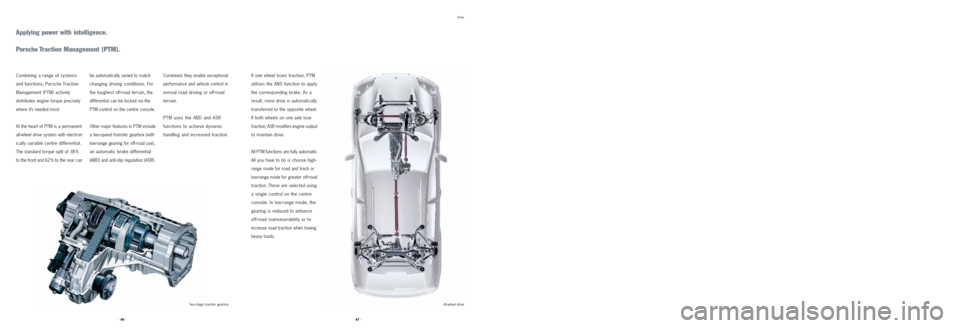
Combining a range of systems
and functions, Porsche Traction
Management (PTM) actively
distributes engine torque precisely
where it’s needed most.
At the heart of PTM is a permanent
all-wheel drive system with electron-
ically variable centre differential.
The standard torque split of 38 %
to the front and 62 % to the rear canCombined, they enable exceptional
performance and vehicle control in
normal road driving or off-road
terrain.
PTM uses the ABD and ASR
functions to achieve dynamic
handling and increased traction.
All-wheel drive Two-stage transfer gearbox
· 67 · · 66 ·
Page 35 of 95

Chassis
Exceptional power requires accurate direction.
Steering.Tough for off road, light for the track, stylish for any terrain.
Wheels.
The electrically adjustable steer-
ing column has a driver-selectable
‘Easy Entry’ function, which raises
the steering wheel towards the
dashboard whenever you enter
or leave the car. The comfort and
sports seat options (standard on
Cayenne GTS and Cayenne Turbo)
have a comfort memory package
that stores your preferred
wheel position as well as seat
and exterior mirror settings.
The steering column consists of
multiple collapsing sections linked
by three universal joints. A special
deformation element offering
70 mm of travel provides a high
level of safety in the event of front
impact.
Servotronic.
Servotronic is a speed-sensitive
power steering system available
as an option on all Cayenne
models.
At higher speeds, the steering
becomes firmer, inputs are more
precise and driver comfort is
greatly enhanced.
At lower speeds, it enables easy
manoeuvrability and parking. For optimum manoeuvrability, on
and off road, all Cayenne models
have variable-ratio steering
and special valve settings on
the power-steering system. Lock-
to-lock travel is a modest
2.65 turns, while the turning
circle is just 11.7 metres.
The steering wheel can be adjusted
by 50 mm for reach and 40 mm
for height. Both adjustment options
are electrically assisted on
the Cayenne GTS and Cayenne
Turbo. Electric adjustment is also
available as an option on the
Cayenne and Cayenne S as part
of the optional comfort or sports
seat package (each with comfort
memory package). The optional
padded steering wheel (standard
on Cayenne GTS) brings added
sporting style to each model.
the multi-purpose display in the
instrument cluster. Standard wheel fitments are as
follows: 17-inch Cayenne alloys on
the Cayenne, 18-inch Cayenne S II
on the Cayenne S, 21-inch
Cayenne Sport on the Cayenne
GTS and 19-inch Cayenne Design
on the Cayenne Turbo.
For a more personal touch, you
can choose from a range of
wheel options (see page 160).
Tyre Pressure Monitoring
(TPM).
The optional TPM warns of any
drop in pressure via the on-board
computer display. In addition,
the driver can check the individual
pressures in all four wheels via
17-inch Cayenne wheel 18-inch Cayenne S II wheel
21-inch Cayenne Sport wheel 19-inch Cayenne Design wheel
· 75 · · 74 ·
Page 37 of 95
Chassis
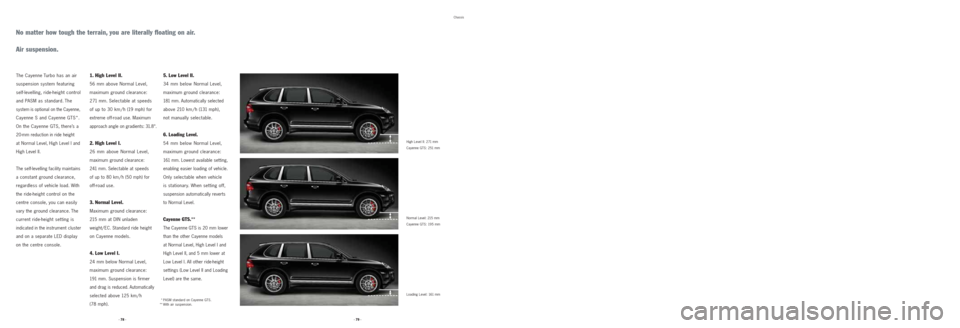
No matter how tough the terrain, you are literally floating on air.
Air suspension.
High Level II: 271 mm
Cayenne GTS: 251 mm
Normal Level: 215 mm
Cayenne GTS: 195 mm
Loading Level: 161 mm
1. High Level II.
56 mm above Normal Level,
maximum ground clearance:
271 mm. Selectable at speeds
of up to 30 km / h (19 mph) for
extreme off-road use. Maximum
approach angle on gradients: 31.8°.
2. High Level I.
26 mm above Normal Level,
maximum ground clearance:
241 mm. Selectable at speeds
of up to 80 km / h (50 mph) for
off-road use.
3. Normal Level.
Maximum ground clearance:
215 mm at DIN unladen
weight/ EC. Standard ride height
on Cayenne models.
4. Low Level I.
24 mm below Normal Level,
maximum ground clearance:
191 mm. Suspension is firmer
and drag is reduced. Automatically
selected above 125 km / h
(78 mph).
5. Low Level II.
34 mm below Normal Level,
maximum ground clearance:
181 mm. Automatically selected
above 210 km / h (131 mph),
not manually selectable.
6. Loading Level.
54 mm below Normal Level,
maximum ground clearance:
161 mm. Lowest available setting,
enabling easier loading of vehicle.
Only selectable when vehicle
is stationary. When setting off,
suspension automatically reverts
to Normal Level.
Cayenne GTS.**
The Cayenne GTS is 20 mm lower
than the other Cayenne models
at Normal Level, High Level I and
High Level II, and 5 mm lower at
Low Level I. All other ride-height
settings (Low Level II and Loading
Level) are the same.
The Cayenne Turbo has an air
suspension system featuring
self-levelling, ride-height control
and PASM as standard. The
system is optional on the Cayenne,
Cayenne S and Cayenne GTS*.
On the Cayenne GTS, there’s a
20-mm reduction in ride height
at Normal Level, High Level I and
High Level II.
The self-levelling facility maintains
a constant ground clearance,
regardless of vehicle load. With
the ride-height control on the
centre console, you can easily
vary the ground clearance. The
current ride-height setting is
indicated in the instrument cluster
and on a separate LED display
on the centre console.
** PASM standard on Cayenne GTS.
** With air suspension.
· 79 · · 78 ·
Page 38 of 95
Chassis
Active prevention of body roll when cornering.
For greater comfort and control.
Porsche Dynamic Chassis Control (PDCC).
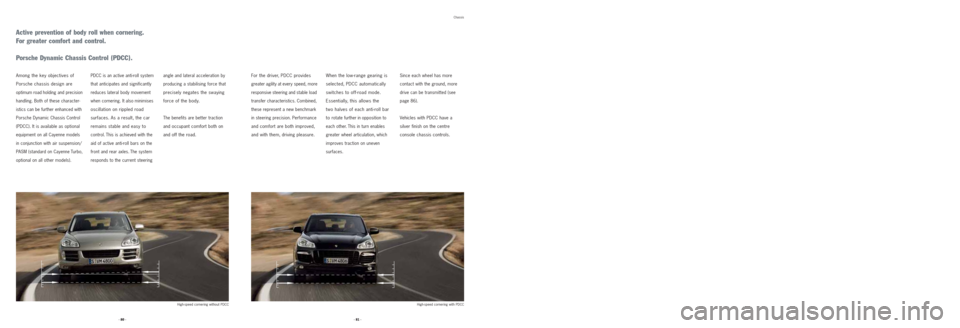
PDCC is an active anti-roll system
that anticipates and significantly
reduces lateral body movement
when cornering. It also minimises
oscillation on rippled road
surfaces. As a result, the car
remains stable and easy to
control. This is achieved with the
aid of active anti-roll bars on the
front and rear axles. The system
responds to the current steeringangle and lateral acceleration by
producing a stabilising force that
precisely negates the swaying
force of the body.
The benefits are better traction
and occupant comfort both on
and off the road.For the driver, PDCC provides
greater agility at every speed, more
responsive steering and stable load
transfer characteristics. Combined,
these represent a new benchmark
in steering precision. Performance
and comfort are both improved,
and with them, driving pleasure.
When the low-range gearing is
selected, PDCC automatically
switches to off-road mode.
Essentially, this allows the
two halves of each anti-roll bar
to
rotate further in opposition to
each other. This in turn enables
greater wheel articulation, which
improves traction on uneven
surfaces.Since each wheel has more
contact with the ground, more
drive can be transmitted (see
page 86).Vehicles with PDCC have a
silver finish on the centre
console chassis controls. Among the key objectives of
Porsche chassis design are
optimum road holding and precision
handling. Both of these character-
istics can be further enhanced with
Porsche Dynamic Chassis Control
(PDCC). It is available as optional
equipment on all Cayenne models
in conjunction with air suspension/
PASM (standard on Cayenne Turbo,
optional on all other models).
High-speed cornering without PDCC High-speed cornering with PDCC
· 81 · · 80 ·
Page 41 of 95
Off road
Porsche Hill Control (PHC) uses
engine braking to enable steady
descent on otherwise hazardous
gradients at speeds of up
to 20 km / h (12.5 mph). If one
or more wheels begin to lose
traction, PHC compensates by
applying increased engine braking
on those that retain contact withthe ground. With no need to
adjust braking, the driver can
concentrate fully on steering
the car.
With steel-sprung suspension,
the maximum wading depth is
500 mm.* With the optional air
suspension (standard on the
Cayenne Turbo), the car is secure
to a depth of 555 mm.**
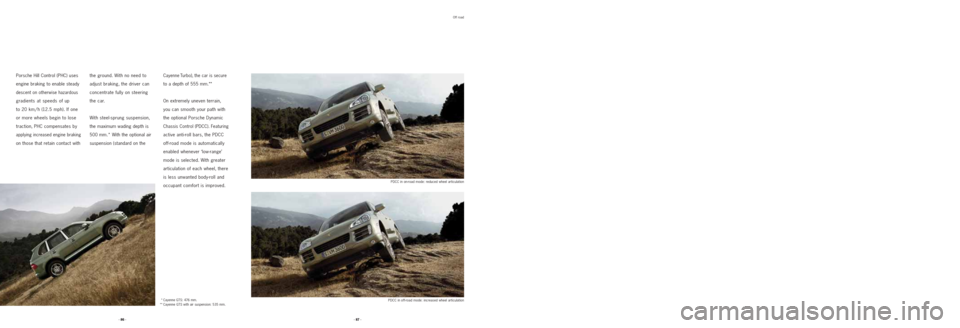
On extremely uneven terrain,
you can smooth your path with
the optional Porsche Dynamic
Chassis Control (PDCC). Featuring
active anti-roll bars, the PDCC
off-road mode is automatically
enabled whenever ‘low-range’
mode is selected. With greater
articulation of each wheel, there
is less unwanted body-roll and
occupant comfort is improved.
PDCC in on-road mode: reduced wheel articulation
PDCC in off-road mode: increased wheel articulation
**Cayenne GTS: 476 mm.** Cayenne GTS with air suspension: 535 mm.
· 87 · · 86 ·
Page 44 of 95
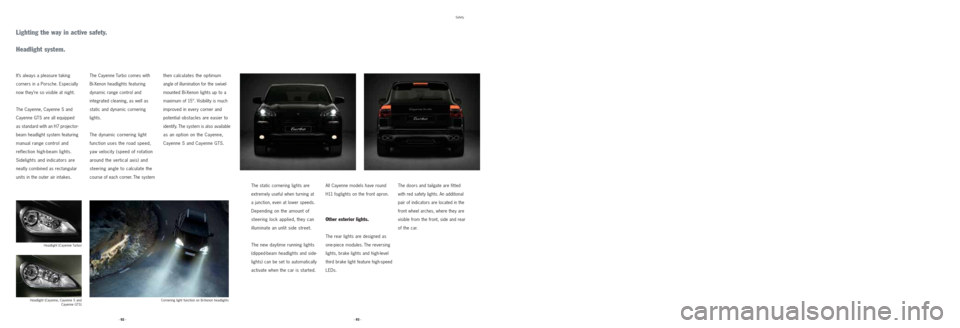
The Cayenne Turbo comes with
Bi-Xenon headlights featuring
dynamic range control and
integrated cleaning, as well as
static and dynamic cornering
lights.
The dynamic cornering light
function uses the road speed,
yaw velocity (speed of rotation
around the vertical axis) and
steering angle to calculate the
course of each corner. The system
Lighting the way in active safety.
Headlight system.
Safety
The static cornering lights are
extremely useful when turning at
a junction, even at lower speeds.
Depending on the amount of
steering lock applied, they can
illuminate an unlit side street.
The new daytime running lights
(dipped-beam headlights and side-
lights) can be set to automatically
activate when the car is started.
Headlight (Cayenne, Cayenne S and
Cayenne GTS)
All Cayenne models have round
H11 foglights on the front apron.
Other exterior lights.
The rear lights are designed as
one-piece modules. The reversing
lights, brake lights and high-level
third brake light feature high-speed
LEDs.The doors and tailgate are fitted
with red safety lights. An additional
pair of indicators are located in the
front wheel arches, where they are
visible from the front, side and rear
of the car.
Cornering light function on Bi-Xenon headlights
then calculates the optimum
angle of illumination for the swivel-
mounted Bi-Xenon lights up to a
maximum of 15°. Visibility is much
improved in every corner and
potential obstacles are easier to
identify. The system is also available
as an option on the Cayenne,
Cayenne S and Cayenne GTS.
Headlight (Cayenne Turbo)
It’s always a pleasure taking
corners in a Porsche. Especially
now they’re so visible at night.
The Cayenne, Cayenne S and
Cayenne GTS are all equipped
as standard with an H7 projector-
beam headlight system featuring
manual range control and
reflection high-beam lights.
Sidelights and indicators are
neatly combined as rectangular
units in the outer air intakes.
· 93 · · 92 ·