ESP PORSCHE CAYNNE 2008 1.G Information Manual
[x] Cancel search | Manufacturer: PORSCHE, Model Year: 2008, Model line: CAYENNE, Model: PORSCHE CAYENNE 2008 1.GPages: 95, PDF Size: 3.37 MB
Page 30 of 95
Drive
The convenience of an automatic.
The excitement of a sequential gearbox.
Six-speed Tiptronic S.
Each gearshift point is automatically
selected based on current road
conditions and driving style.
Within a short space of time,
you’ll develop a feel for the
system and begin to influence
gearshifts using the throttle alone.
The benefits of Tiptronic S are most
apparent in high-performance driving.
The immediacy of response, with
practically no interruption in drive,
is comparable with that of a manual
gearbox.
Tiptronic S automatically selects
the optimum gearshift pattern,
even in low-range mode. The
low-range gearing is available at
speeds of up to 15 km / h (9 mph).
You can also return to high-range
mode at up to 30 km / h (19 mph).
For complete manual control,
simply slot into manual and use
the gearshift controls on the
steering wheel. If you prefer, you
can use the gear selector lever
on the centre console. Even in
automatic mode, you can change
gear manually via the rocker
controls on the steering wheel.
If there is no further manual
input for a period of 8 seconds,
the system reverts to automatic
mode.
One of the special features in
Tiptronic S is standby control.
When the car is stationary in an
active gear position and with the
foot brake applied, the input
clutch automatically disconnects
the engine from the driveline,
thereby reducing fuel consumption.
Other useful functions include
a warm-up programme which
temporarily suppresses upshifts
in order to accelerate warm-up
in the catalysts and thus reduce
emissions. If rapid throttle inputs
are detected, the system automat-
ically selects the ‘Sport’ gearshift
pattern, i.e., there is no need to
use a ‘kickdown’ function. When
the throttle is released quickly, e.g.,
on entering a corner, unwanted
downshifts are prevented.
Mid-corner gearshifts are also
suppressed, enhancing stability
and safety.Under heavy braking, Tiptronic S
shifts down to maximise engine
braking. An incline sensor enables
better uphill acceleration and
better engine braking on descent.
Another special feature, Porsche
Hill Holder, permits easy hill starts
without the need to use the brakes.
The gearbox cooling system is
specifically designed to match
the performance, transport,
towing and off-road capabilities
of all Cayenne models.
Tiptronic S is standard equipment
on the Cayenne Turbo and optional
on the other three models. The
six forward ratios transmit power
with smoothness, efficiency and
precision – whatever your choice
of terrain.
In automatic mode, the gearshift
maps range from maximum
economy to maximum performance.
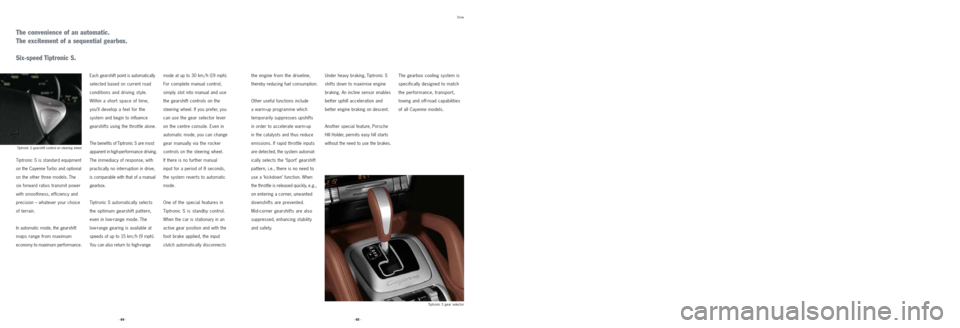
Tiptronic S gearshift control on steering wheel
Tiptronic S gear selector
· 65 · · 64 ·
Page 31 of 95
Drive
Applying power with intelligence.
Porsche Traction Management (PTM).
If one wheel loses traction, PTM
utilises the ABD function to apply
the corresponding brake. As a
result, more drive is automatically
transferred to the opposite wheel.
If both wheels on one axle lose
traction, ASR modifies engine output
to maintain drive.
All PTM functions are fully automatic.
All you have to do is choose high-
range mode for road and track or
low-range mode for greater off-road
traction. These are selected using
a single control on the centre
console. In low-range mode, the
gearing is reduced to enhance
off-road manoeuvrability or to
increase road traction when towing
heavy loads.
be automatically varied to match
changing driving conditions. For
the toughest off-road terrain, the
differential can be locked via the
PTM control on the centre console.
Other major features in PTM include
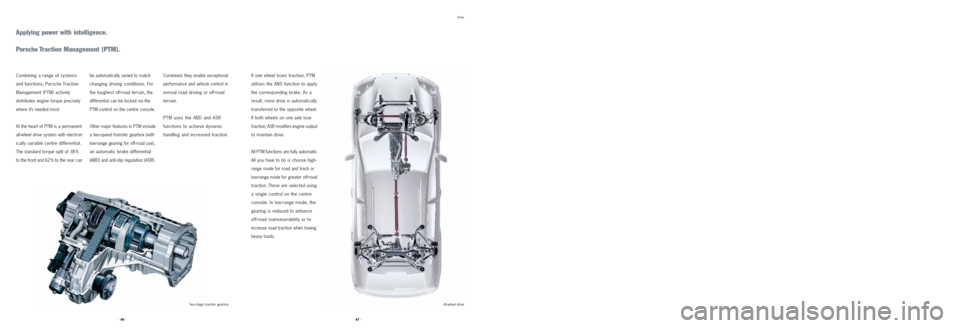
a two-speed transfer gearbox (with
low-range gearing for off-road use),
an automatic brake differential
(ABD) and anti-slip regulation (ASR).
Combining a range of systems
and functions, Porsche Traction
Management (PTM) actively
distributes engine torque precisely
where it’s needed most.
At the heart of PTM is a permanent
all-wheel drive system with electron-
ically variable centre differential.
The standard torque split of 38 %
to the front and 62 % to the rear canCombined, they enable exceptional
performance and vehicle control in
normal road driving or off-road
terrain.
PTM uses the ABD and ASR
functions to achieve dynamic
handling and increased traction.
All-wheel drive Two-stage transfer gearbox
· 67 · · 66 ·
Page 34 of 95
Chassis
Precision in design.
Precision on the road.
location is more accurate and
agility is enhanced, with minimal
disturbance on uneven surfaces.
The subframe is secured on
rubber mountings that minimise
road noise and thus enhance
the engine acoustics.
Made from lightweight high-
strength steel, the front
suspension subframe is specially
constructed to increase the
rigidity of the car.
The resulting benefits include
greater stability, greater comfort
and even greater active and
passive safety. In the event
of an accident, the subframe
deforms in a predefined manner
to provide additional protection
for the passenger compartment.
Front axle.
A powerful and responsive engine
requires an equally responsive
chassis.
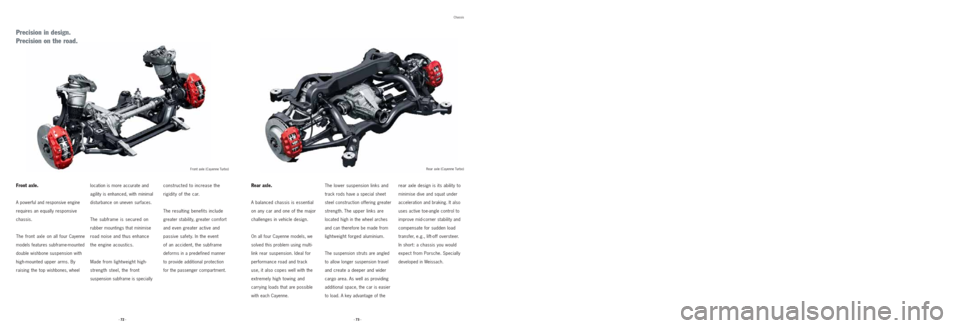
The front axle on all fourCayenne
models features subframe-mounted
double wishbone
suspension with
high-mounted upper arms. By
raising the top
wishbones, wheel
Rear axle.
A balanced chassis is essential
on any car and one of the major
challenges in vehicle design.
On all four Cayenne models, we
solved this problem using multi-
link rear suspension. Ideal for
performance road and track
use, it also copes well with the
extremely high towing and
carrying loads that are possible
with each Cayenne.
The lower suspension links and
track rods have a special sheet
steel construction offering greater
strength. The upper links are
located high in the wheel arches
and can therefore be made from
lightweight forged aluminium.
The suspension struts are angled
to allow longer suspension travel
and create a deeper and wider
cargo area. As well as providing
additional space, the car is easier
to load. A key advantage of the
rear axle design is its ability to
minimise dive and squat under
acceleration and braking. It also
uses active toe-angle control to
improve mid-corner stability and
compensate for sudden load
transfer, e.g., lift-off oversteer.
In short: a chassis you would
expect from Porsche. Specially
developed in Weissach.
Front axle (Cayenne Turbo) Rear axle (Cayenne Turbo)
· 73 · · 72 ·
Page 38 of 95
Chassis
Active prevention of body roll when cornering.
For greater comfort and control.
Porsche Dynamic Chassis Control (PDCC).
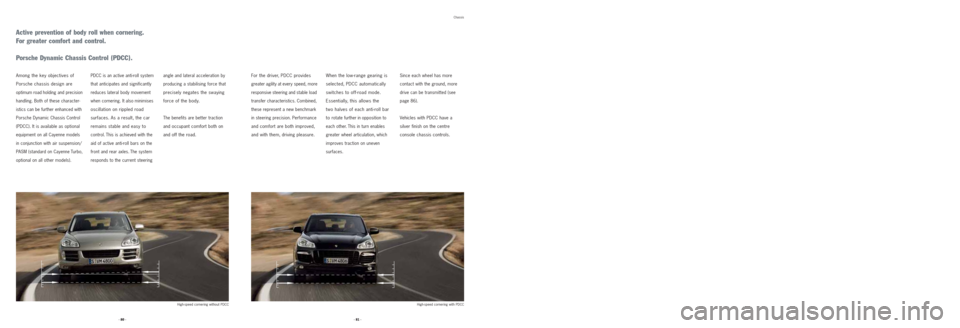
PDCC is an active anti-roll system
that anticipates and significantly
reduces lateral body movement
when cornering. It also minimises
oscillation on rippled road
surfaces. As a result, the car
remains stable and easy to
control. This is achieved with the
aid of active anti-roll bars on the
front and rear axles. The system
responds to the current steeringangle and lateral acceleration by
producing a stabilising force that
precisely negates the swaying
force of the body.
The benefits are better traction
and occupant comfort both on
and off the road.For the driver, PDCC provides
greater agility at every speed, more
responsive steering and stable load
transfer characteristics. Combined,
these represent a new benchmark
in steering precision. Performance
and comfort are both improved,
and with them, driving pleasure.
When the low-range gearing is
selected, PDCC automatically
switches to off-road mode.
Essentially, this allows the
two halves of each anti-roll bar
to
rotate further in opposition to
each other. This in turn enables
greater wheel articulation, which
improves traction on uneven
surfaces.Since each wheel has more
contact with the ground, more
drive can be transmitted (see
page 86).Vehicles with PDCC have a
silver finish on the centre
console chassis controls. Among the key objectives of
Porsche chassis design are
optimum road holding and precision
handling. Both of these character-
istics can be further enhanced with
Porsche Dynamic Chassis Control
(PDCC). It is available as optional
equipment on all Cayenne models
in conjunction with air suspension/
PASM (standard on Cayenne Turbo,
optional on all other models).
High-speed cornering without PDCC High-speed cornering with PDCC
· 81 · · 80 ·
Page 44 of 95
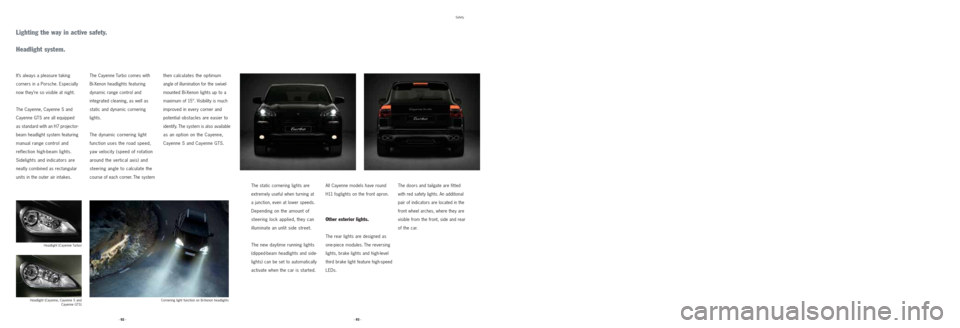
The Cayenne Turbo comes with
Bi-Xenon headlights featuring
dynamic range control and
integrated cleaning, as well as
static and dynamic cornering
lights.
The dynamic cornering light
function uses the road speed,
yaw velocity (speed of rotation
around the vertical axis) and
steering angle to calculate the
course of each corner. The system
Lighting the way in active safety.
Headlight system.
Safety
The static cornering lights are
extremely useful when turning at
a junction, even at lower speeds.
Depending on the amount of
steering lock applied, they can
illuminate an unlit side street.
The new daytime running lights
(dipped-beam headlights and side-
lights) can be set to automatically
activate when the car is started.
Headlight (Cayenne, Cayenne S and
Cayenne GTS)
All Cayenne models have round
H11 foglights on the front apron.
Other exterior lights.
The rear lights are designed as
one-piece modules. The reversing
lights, brake lights and high-level
third brake light feature high-speed
LEDs.The doors and tailgate are fitted
with red safety lights. An additional
pair of indicators are located in the
front wheel arches, where they are
visible from the front, side and rear
of the car.
Cornering light function on Bi-Xenon headlights
then calculates the optimum
angle of illumination for the swivel-
mounted Bi-Xenon lights up to a
maximum of 15°. Visibility is much
improved in every corner and
potential obstacles are easier to
identify. The system is also available
as an option on the Cayenne,
Cayenne S and Cayenne GTS.
Headlight (Cayenne Turbo)
It’s always a pleasure taking
corners in a Porsche. Especially
now they’re so visible at night.
The Cayenne, Cayenne S and
Cayenne GTS are all equipped
as standard with an H7 projector-
beam headlight system featuring
manual range control and
reflection high-beam lights.
Sidelights and indicators are
neatly combined as rectangular
units in the outer air intakes.
· 93 · · 92 ·
Page 46 of 95
piston units at the rear. The
resulting brake forces are not
only high, they are also extremely
Porsche Ceramic Composite Brake (PCCB).
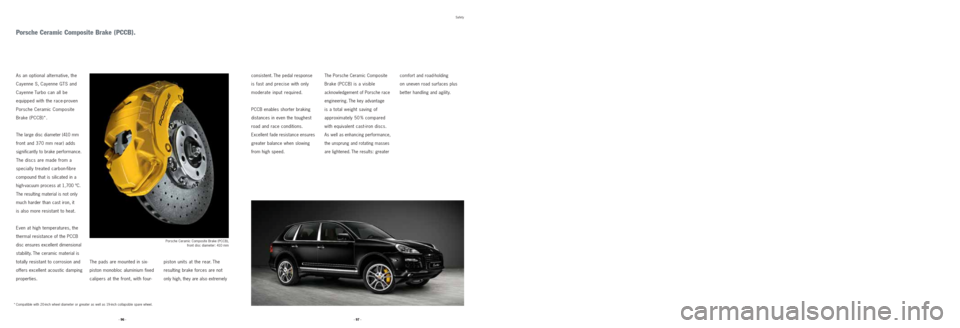
Porsche Ceramic Composite Brake (PCCB),
front disc diameter: 410 mm
The pads are mounted in six-
piston monobloc aluminium fixed
calipers at the front, with four-
Safety
As an optional alternative, the
Cayenne S, Cayenne GTS and
Cayenne Turbo can all be
equipped with the race-proven
Porsche Ceramic Composite
Brake (PCCB)*.
The large disc diameter (410 mm
front and 370 mm rear) adds
significantly to brake performance.
The discs are made from a
specially treated carbon-fibre
compound that is silicated in a
high-vacuum process at 1,700 ºC.
The resulting material is not only
much harder than cast iron, it
is also more resistant to heat.
Even at high temperatures, the
thermal resistance of the PCCB
disc ensures excellent dimensional
stability. The ceramic material is
totally resistant to corrosion and
offers excellent acoustic damping
properties.consistent. The pedal response
is fast and precise with only
moderate input required.
PCCB enables shorter braking
distances in even the toughest
road and race conditions.
Excellent fade resistance ensures
greater balance when slowing
from high speed.
· 97 · · 96 ·
The Porsche Ceramic Composite
Brake (PCCB) is a visible
acknowledgement of Porsche race
engineering. The key advantage
is a total weight saving of
approximately 50 % compared
with equivalent cast-iron discs.
As well as enhancing performance,
the unsprung and rotating masses
are lightened. The results: greater
comfort and road-holding
on uneven road surfaces plus
better handling and agility.
* Compatible with 20-inch wheel diameter or greater as well as 19-inch collapsible spare wheel.
Page 47 of 95
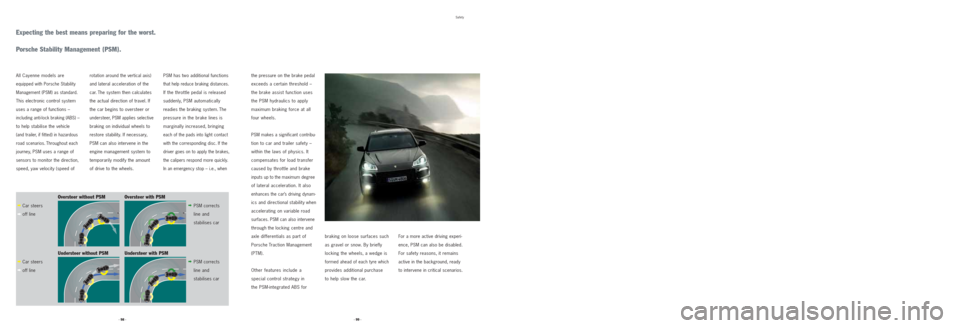
Oversteer with PSM
Understeer without PSM
Car steers
off line Car steers
off line PSM corrects
line and
stabilises car
PSM corrects
line and
stabilises car
Understeer with PSM Oversteer without PSM
All Cayenne models are
equipped with Porsche Stability
Management (PSM) as standard.
This electronic control system
uses a range of functions –
including anti-lock braking (ABS) –
to help stabilise the vehicle
(and trailer, if fitted) in hazardous
road scenarios. Throughout each
journey, PSM uses a range of
sensors to monitor the direction,
speed, yaw velocity (speed of
rotation around the vertical axis)
and lateral acceleration of the
car. The system then calculates
the actual direction of travel. If
the car begins to oversteer or
understeer, PSM applies selective
braking on individual wheels to
restore stability. If necessary,
PSM can also intervene in the
engine management system to
temporarily modify the amount
of drive to the wheels.PSM has two additional functions
that help reduce braking distances.
If the throttle pedal is released
suddenly, PSM automatically
readies the braking system. The
pressure in the brake lines is
marginally increased, bringing
each of the pads into light contact
with the corresponding disc. If the
driver goes on to apply the brakes,
the calipers respond more quickly.
In an emergency stop – i.e., when
the pressure on the brake pedal
exceeds a certain threshold –
the brake assist function uses
the PSM hydraulics to apply
maximum braking force at all
four wheels.
PSM makes a significant contribu-
tion to car and trailer safety –
within the laws of physics. It
compensates for load transfer
caused by throttle and brake
inputs up to the maximum degree
of lateral acceleration. It also
enhances the car’s driving dynam-
ics and directional stability when
accelerating on variable road
surfaces. PSM can also intervene
through the locking centre and
axle differentials as part of
Porsche Traction Management
(PTM).
Other features include a
special control strategy in
the PSM-integrated ABS for braking on loose surfaces such
as gravel or snow. By briefly
locking the wheels, a wedge is
formed ahead of each tyre which
provides additional purchase
to help slow the car.
For a more active driving experi-
ence, PSM can also be disabled.
For safety reasons, it remains
active in the background, ready
to intervene in critical scenarios.
Expecting the best means preparing for the worst.
Porsche Stability Management (PSM).
Safety
· 99 · · 98 ·
Page 49 of 95
With over 50 years in motorsport, we appreciate the importance of safety.
Airbags.
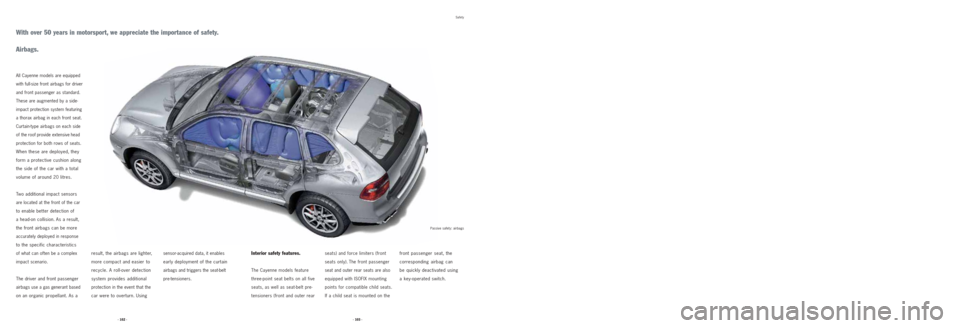
All Cayenne models are equipped
with full-size front airbags for driver
and front passenger as standard.
These are augmented by a side-
impact protection system featuring
a thorax airbag in each front seat.
Curtain-type airbags on each side
of the roof provide extensive head
protection for both rows of seats.
When these are deployed, they
form a protective cushion along
the side of the car with a total
volume of around 20 litres.
Two additional impact sensors
are located at the front of the car
to enable better detection of
a head-on collision. As a result,
the front airbags can be more
accurately deployed in response
to the specific characteristics
of what can often be a complex
impact scenario.
The driver and front passenger
airbags use a gas generant based
on an organic propellant. As aresult, the airbags are lighter,
more compact and easier to
recycle. A roll-over detection
system provides additional
protection in the event that the
car were to overturn. Using
sensor-acquired data, it enables
early deployment of the curtain
airbags and triggers the seat-belt
pre-tensioners.
Interior safety features.
The Cayenne models feature
three-point seat belts on all five
seats, as well as seat-belt pre-
tensioners (front and outer rearseats) and force limiters (front
seats only). The front passengerseat and outer rear seats are also
equipped with ISOFIX mounting
points for compatible child seats.
If a child seat is mounted on the
front passenger seat, the
corresponding airbag can
be quickly deactivated using
a key-operated switch.
Safety
· 103 · · 102 ·Passive safety: airbags
Page 50 of 95
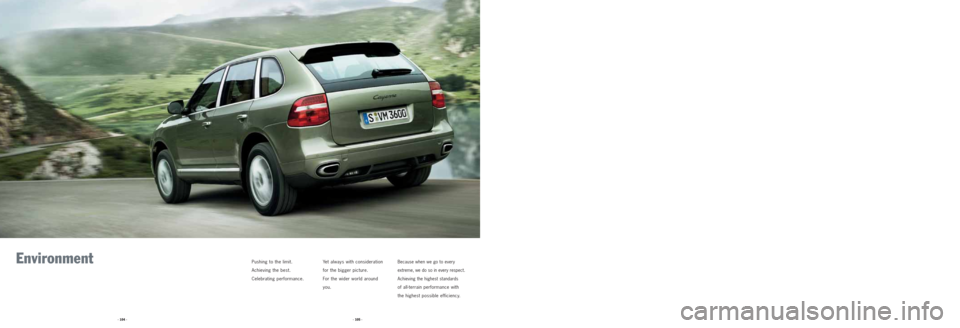
Environment Pushing to the limit.
Achieving the best.
Celebrating performance.Yet always with consideration
for the bigger picture.
For the wider world around
you.Because when we go to every
extreme, we do so in every respect.
Achieving the highest standards
of all-terrain performance with
the highest possible efficiency.
· 105 · · 104 ·
Page 53 of 95
Environment
Servicing.
Although every journey is a pleasure
in a Porsche, there’s one you won’t
have to make too often. Thanks to
the lengthy service intervals and
long-life components, we may not
be seeing you for some time.
In the case of the oil filter, for
example, all that’s replaced is an
easily recyclable paper element.
The oil filter casing remains on
the car.
All moving parts inside the engine
are fully self-adjusting. The valve
clearances, for example, feature
automatic hydraulic control.
All camshafts have a zero-
maintenance chain-drive system.With single-spark coils on each
of the cylinders, the entire ignition
system, with the exception of the
spark plugs, is maintenance-free.
These modest servicing require-
ments mean less waste disposal
and fewer demands on natural
resources. They also lower the
cost of ownership while keeping
your car on the road.
Service intervals for the Cayenne
models are dependent on a range
of factors, including local fuel
quality. For full details of service
intervals in your country/region,
please consult the relevant price
list or contact your Porsche Centre.
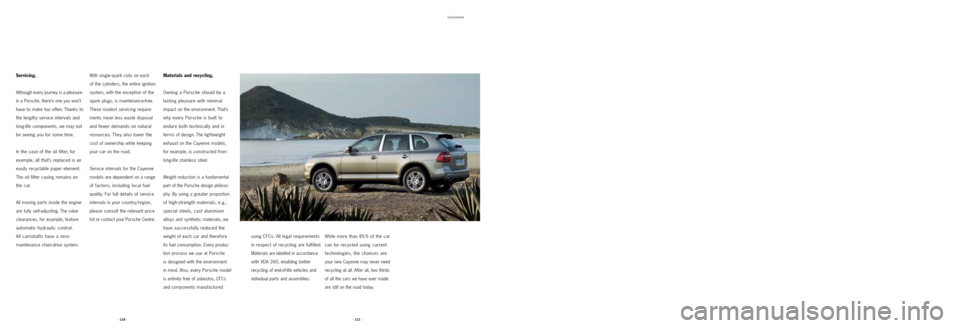
Materials and recycling.
Owning a Porsche should be a
lasting pleasure with minimal
impact on the environment. That’s
why every Porsche is built to
endure both technically and in
terms of design. The lightweight
exhaust on the Cayenne models,
for example, is constructed from
long-life stainless steel.
Weight reduction is a fundamental
part of the Porsche design philoso-
phy. By using a greater proportion
of high-strength materials, e.g.,
special steels, cast aluminium
alloys and synthetic materials, we
have successfully reduced the
weight of each car and therefore
its fuel consumption. Every produc-
tion process we use at Porsche
is designed with the environment
in mind. Also, every Porsche model
is
entirely free of asbestos, CFCs
and
components manufacturedusing
CFCs. All legal requirements
in respect of recycling are fulfilled.
Materials are labelled in accordance
with VDA 260, enabling better
recycling of end-of-life vehicles and
individual parts and assemblies.
While more than 85 % of the car
can be recycled using current
technologies, the chances are
your new Cayenne may never need
recycling at all. After all, two thirds
of all the cars we have ever made
are still on the road today.
· 111 · · 110 ·