wheel PORSCHE CAYNNE 2008 1.G Information Manual
[x] Cancel search | Manufacturer: PORSCHE, Model Year: 2008, Model line: CAYENNE, Model: PORSCHE CAYENNE 2008 1.GPages: 95, PDF Size: 3.37 MB
Page 31 of 95
Drive
Applying power with intelligence.
Porsche Traction Management (PTM).
If one wheel loses traction, PTM
utilises the ABD function to apply
the corresponding brake. As a
result, more drive is automatically
transferred to the opposite wheel.
If both wheels on one axle lose
traction, ASR modifies engine output
to maintain drive.
All PTM functions are fully automatic.
All you have to do is choose high-
range mode for road and track or
low-range mode for greater off-road
traction. These are selected using
a single control on the centre
console. In low-range mode, the
gearing is reduced to enhance
off-road manoeuvrability or to
increase road traction when towing
heavy loads.
be automatically varied to match
changing driving conditions. For
the toughest off-road terrain, the
differential can be locked via the
PTM control on the centre console.
Other major features in PTM include
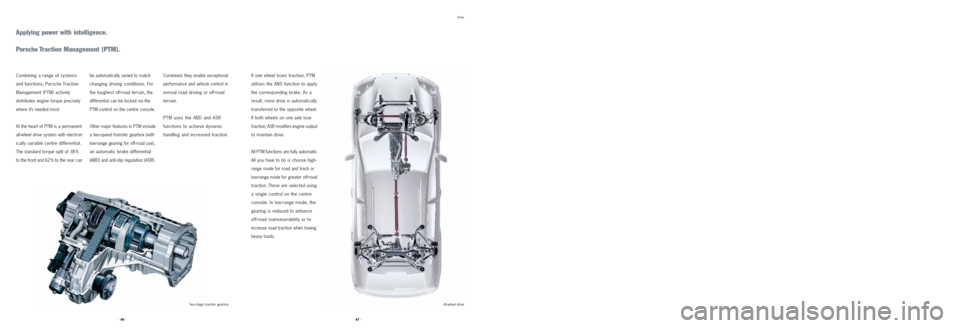
a two-speed transfer gearbox (with
low-range gearing for off-road use),
an automatic brake differential
(ABD) and anti-slip regulation (ASR).
Combining a range of systems
and functions, Porsche Traction
Management (PTM) actively
distributes engine torque precisely
where it’s needed most.
At the heart of PTM is a permanent
all-wheel drive system with electron-
ically variable centre differential.
The standard torque split of 38 %
to the front and 62 % to the rear canCombined, they enable exceptional
performance and vehicle control in
normal road driving or off-road
terrain.
PTM uses the ABD and ASR
functions to achieve dynamic
handling and increased traction.
All-wheel drive Two-stage transfer gearbox
· 67 · · 66 ·
Page 34 of 95
Chassis
Precision in design.
Precision on the road.
location is more accurate and
agility is enhanced, with minimal
disturbance on uneven surfaces.
The subframe is secured on
rubber mountings that minimise
road noise and thus enhance
the engine acoustics.
Made from lightweight high-
strength steel, the front
suspension subframe is specially
constructed to increase the
rigidity of the car.
The resulting benefits include
greater stability, greater comfort
and even greater active and
passive safety. In the event
of an accident, the subframe
deforms in a predefined manner
to provide additional protection
for the passenger compartment.
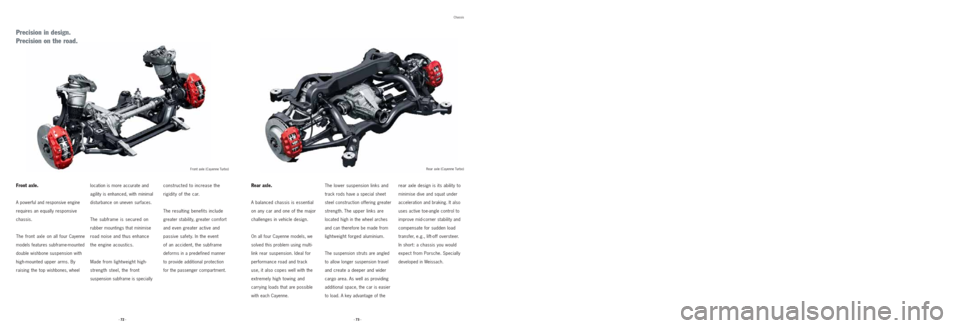
Front axle.
A powerful and responsive engine
requires an equally responsive
chassis.
The front axle on all fourCayenne
models features subframe-mounted
double wishbone
suspension with
high-mounted upper arms. By
raising the top
wishbones, wheel
Rear axle.
A balanced chassis is essential
on any car and one of the major
challenges in vehicle design.
On all four Cayenne models, we
solved this problem using multi-
link rear suspension. Ideal for
performance road and track
use, it also copes well with the
extremely high towing and
carrying loads that are possible
with each Cayenne.
The lower suspension links and
track rods have a special sheet
steel construction offering greater
strength. The upper links are
located high in the wheel arches
and can therefore be made from
lightweight forged aluminium.
The suspension struts are angled
to allow longer suspension travel
and create a deeper and wider
cargo area. As well as providing
additional space, the car is easier
to load. A key advantage of the
rear axle design is its ability to
minimise dive and squat under
acceleration and braking. It also
uses active toe-angle control to
improve mid-corner stability and
compensate for sudden load
transfer, e.g., lift-off oversteer.
In short: a chassis you would
expect from Porsche. Specially
developed in Weissach.
Front axle (Cayenne Turbo) Rear axle (Cayenne Turbo)
· 73 · · 72 ·
Page 35 of 95

Chassis
Exceptional power requires accurate direction.
Steering.Tough for off road, light for the track, stylish for any terrain.
Wheels.
The electrically adjustable steer-
ing column has a driver-selectable
‘Easy Entry’ function, which raises
the steering wheel towards the
dashboard whenever you enter
or leave the car. The comfort and
sports seat options (standard on
Cayenne GTS and Cayenne Turbo)
have a comfort memory package
that stores your preferred
wheel position as well as seat
and exterior mirror settings.
The steering column consists of
multiple collapsing sections linked
by three universal joints. A special
deformation element offering
70 mm of travel provides a high
level of safety in the event of front
impact.
Servotronic.
Servotronic is a speed-sensitive
power steering system available
as an option on all Cayenne
models.
At higher speeds, the steering
becomes firmer, inputs are more
precise and driver comfort is
greatly enhanced.
At lower speeds, it enables easy
manoeuvrability and parking. For optimum manoeuvrability, on
and off road, all Cayenne models
have variable-ratio steering
and special valve settings on
the power-steering system. Lock-
to-lock travel is a modest
2.65 turns, while the turning
circle is just 11.7 metres.
The steering wheel can be adjusted
by 50 mm for reach and 40 mm
for height. Both adjustment options
are electrically assisted on
the Cayenne GTS and Cayenne
Turbo. Electric adjustment is also
available as an option on the
Cayenne and Cayenne S as part
of the optional comfort or sports
seat package (each with comfort
memory package). The optional
padded steering wheel (standard
on Cayenne GTS) brings added
sporting style to each model.
the multi-purpose display in the
instrument cluster. Standard wheel fitments are as
follows: 17-inch Cayenne alloys on
the Cayenne, 18-inch Cayenne S II
on the Cayenne S, 21-inch
Cayenne Sport on the Cayenne
GTS and 19-inch Cayenne Design
on the Cayenne Turbo.
For a more personal touch, you
can choose from a range of
wheel options (see page 160).
Tyre Pressure Monitoring
(TPM).
The optional TPM warns of any
drop in pressure via the on-board
computer display. In addition,
the driver can check the individual
pressures in all four wheels via
17-inch Cayenne wheel 18-inch Cayenne S II wheel
21-inch Cayenne Sport wheel 19-inch Cayenne Design wheel
· 75 · · 74 ·
Page 38 of 95
Chassis
Active prevention of body roll when cornering.
For greater comfort and control.
Porsche Dynamic Chassis Control (PDCC).
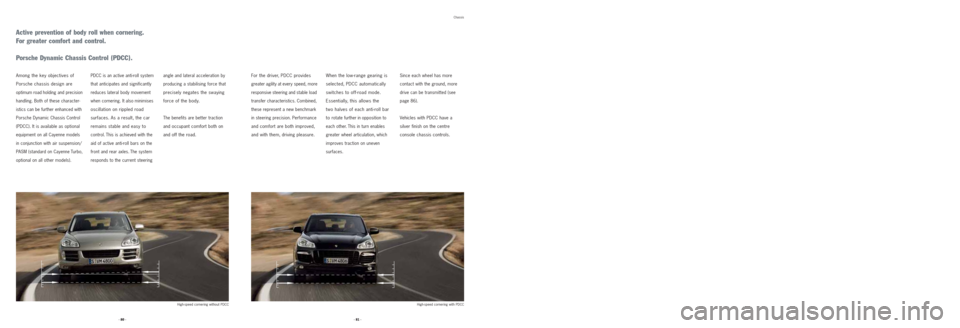
PDCC is an active anti-roll system
that anticipates and significantly
reduces lateral body movement
when cornering. It also minimises
oscillation on rippled road
surfaces. As a result, the car
remains stable and easy to
control. This is achieved with the
aid of active anti-roll bars on the
front and rear axles. The system
responds to the current steeringangle and lateral acceleration by
producing a stabilising force that
precisely negates the swaying
force of the body.
The benefits are better traction
and occupant comfort both on
and off the road.For the driver, PDCC provides
greater agility at every speed, more
responsive steering and stable load
transfer characteristics. Combined,
these represent a new benchmark
in steering precision. Performance
and comfort are both improved,
and with them, driving pleasure.
When the low-range gearing is
selected, PDCC automatically
switches to off-road mode.
Essentially, this allows the
two halves of each anti-roll bar
to
rotate further in opposition to
each other. This in turn enables
greater wheel articulation, which
improves traction on uneven
surfaces.Since each wheel has more
contact with the ground, more
drive can be transmitted (see
page 86).Vehicles with PDCC have a
silver finish on the centre
console chassis controls. Among the key objectives of
Porsche chassis design are
optimum road holding and precision
handling. Both of these character-
istics can be further enhanced with
Porsche Dynamic Chassis Control
(PDCC). It is available as optional
equipment on all Cayenne models
in conjunction with air suspension/
PASM (standard on Cayenne Turbo,
optional on all other models).
High-speed cornering without PDCC High-speed cornering with PDCC
· 81 · · 80 ·
Page 40 of 95
Off road
Every Porsche is designed and
built to the highest possible
standards – in dynamics, agility,
safety, comfort and everyday
practicality. Combined, the result
is pure driving pleasure. With the
Cayenne models: on any terrain.
All four cars were developed for
the road – and much of the land
beyond. Simply shift the transfer
gearbox into ‘low-range’ mode and
the car is ready for any terrain.
Porsche Traction Management
(PTM) and Porsche Stability
Management (PSM) make a range
of modifications, including auto-
matic
selection of low-range
gearing, a high-traction off-road
chassis
programme (with off-road
ABS and
ABD) and High Level I on
vehicles
with air suspension.
The centre differential, part of
the all-wheel drive system, can
be fully locked for the toughest
conditions.At High Level II, the ground
clearance is increased by a further
30 mm. All models can negotiate
gradients of up to 45° (100 %).
Hill-starts are easy with the Hill
Holder function in Tiptronic S and
Porsche Drive-off Assistant on
vehicles with manual gearbox.
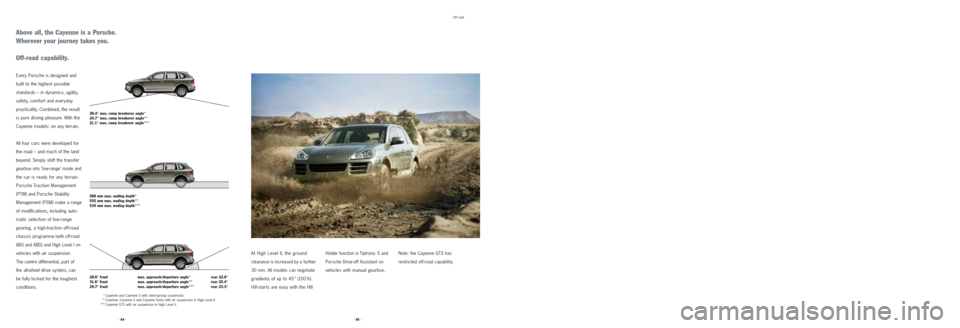
28.6° front max. approach /departure angle * rear 22.8°
31.8° front max. approach /departure angle * * rear 25.4°
29.7° front max. approach /departure angle * * * rear 23.3°
20.4° max. ramp breakover angle *
24.7° max. ramp breakover angle * *
21.1° max. ramp breakover angle***
500 mm max. wading depth *
555 mm max. wading depth * *
535 mm max. wading depth * * *
*** Cayenne and Cayenne S with steel-sprung suspension.
*** Cayenne, Cayenne S and Cayenne Turbo with air suspension in High Level II.
*** Cayenne GTS with air suspension in High Level II.
Note: the Cayenne GTS has
restricted off-road capability.
· 85 · · 84 ·
Above all, the Cayenne is a Porsche.
Wherever your journey takes you.
Off-road capability.
Page 41 of 95
Off road
Porsche Hill Control (PHC) uses
engine braking to enable steady
descent on otherwise hazardous
gradients at speeds of up
to 20 km / h (12.5 mph). If one
or more wheels begin to lose
traction, PHC compensates by
applying increased engine braking
on those that retain contact withthe ground. With no need to
adjust braking, the driver can
concentrate fully on steering
the car.
With steel-sprung suspension,
the maximum wading depth is
500 mm.* With the optional air
suspension (standard on the
Cayenne Turbo), the car is secure
to a depth of 555 mm.**
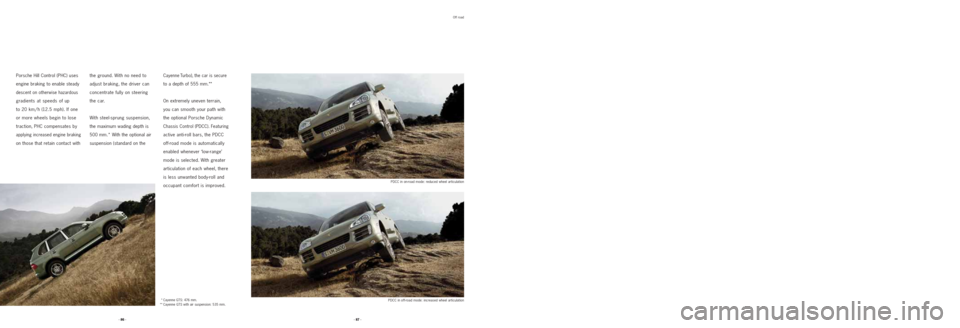
On extremely uneven terrain,
you can smooth your path with
the optional Porsche Dynamic
Chassis Control (PDCC). Featuring
active anti-roll bars, the PDCC
off-road mode is automatically
enabled whenever ‘low-range’
mode is selected. With greater
articulation of each wheel, there
is less unwanted body-roll and
occupant comfort is improved.
PDCC in on-road mode: reduced wheel articulation
PDCC in off-road mode: increased wheel articulation
**Cayenne GTS: 476 mm.** Cayenne GTS with air suspension: 535 mm.
· 87 · · 86 ·
Page 42 of 95
Off road
Applying power with sensitivity, protecting with strength.
Off-road Technology package.
The rear differential enables
optimum distribution of engine
torque in difficult off-road terrain.
A fully automated part of the
all-wheel system, its primary
function is to optimise traction.
If one of the rear wheels begins
to lose grip, the differential varies
the torque transmitted through
each drive shaft, thereby restoring
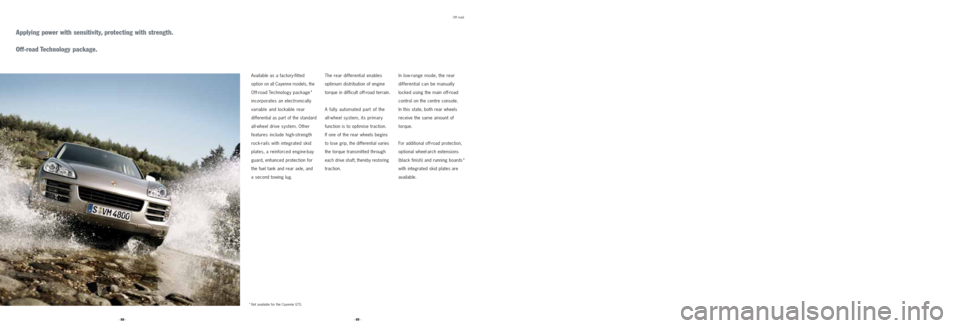
traction. Available as a factory-fitted
option on all Cayenne models, the
Off-road Technology package*
incorporates an electronically
variable and lockable rear
differential as part of the standard
all-wheel drive system. Other
features include high-strength
rock-rails with integrated skid
plates, a reinforced engine-bay
guard, enhanced protection for
the fuel tank and rear axle, and
a second towing lug.In low-range mode, the rear
differential can be manually
locked using the main off-road
control on the centre console.
In this state, both rear wheels
receive the same amount of
torque.
For additional off-road protection,
optional wheel-arch extensions
(black finish) and running boards*
with integrated skid plates are
available.
* Not available for the Cayenne GTS.
· 89 · · 88 ·
Page 44 of 95
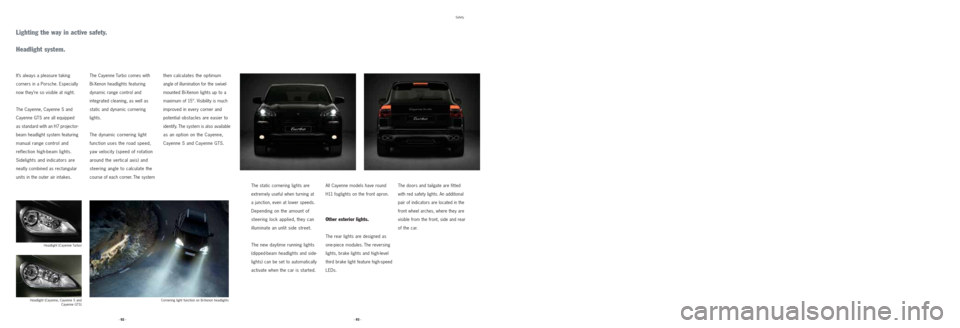
The Cayenne Turbo comes with
Bi-Xenon headlights featuring
dynamic range control and
integrated cleaning, as well as
static and dynamic cornering
lights.
The dynamic cornering light
function uses the road speed,
yaw velocity (speed of rotation
around the vertical axis) and
steering angle to calculate the
course of each corner. The system
Lighting the way in active safety.
Headlight system.
Safety
The static cornering lights are
extremely useful when turning at
a junction, even at lower speeds.
Depending on the amount of
steering lock applied, they can
illuminate an unlit side street.
The new daytime running lights
(dipped-beam headlights and side-
lights) can be set to automatically
activate when the car is started.
Headlight (Cayenne, Cayenne S and
Cayenne GTS)
All Cayenne models have round
H11 foglights on the front apron.
Other exterior lights.
The rear lights are designed as
one-piece modules. The reversing
lights, brake lights and high-level
third brake light feature high-speed
LEDs.The doors and tailgate are fitted
with red safety lights. An additional
pair of indicators are located in the
front wheel arches, where they are
visible from the front, side and rear
of the car.
Cornering light function on Bi-Xenon headlights
then calculates the optimum
angle of illumination for the swivel-
mounted Bi-Xenon lights up to a
maximum of 15°. Visibility is much
improved in every corner and
potential obstacles are easier to
identify. The system is also available
as an option on the Cayenne,
Cayenne S and Cayenne GTS.
Headlight (Cayenne Turbo)
It’s always a pleasure taking
corners in a Porsche. Especially
now they’re so visible at night.
The Cayenne, Cayenne S and
Cayenne GTS are all equipped
as standard with an H7 projector-
beam headlight system featuring
manual range control and
reflection high-beam lights.
Sidelights and indicators are
neatly combined as rectangular
units in the outer air intakes.
· 93 · · 92 ·
Page 45 of 95
by a tandem booster and large
brake master cylinder. The foot-
operated parking brake uses a
duo-servo system mounted on
each of the rear discs.
Porsche Stability Management
(PSM) features two additional
brake functions: electronic brake
Porsche braking systems are
renowned worldwide as the
benchmark in performance and
stability. The Cayenne models
continue this tradition, offering
excellent deceleration – even
when fully laden with five adult
Porsche has always been synonymous with acceleration.
That’s only half the story.
Braking system.
All Cayenne models have internally
vented discs all round. This simple
yet highly effective design ensures
consistent brake performance.
The front disc dimensions
(diameter/thickness) are 330 mm /
32 mm on the Cayenne, 350 mm /
34 mm on the Cayenne S and
Cayenne GTS, and 380 mm /
38 mm on the Cayenne Turbo.
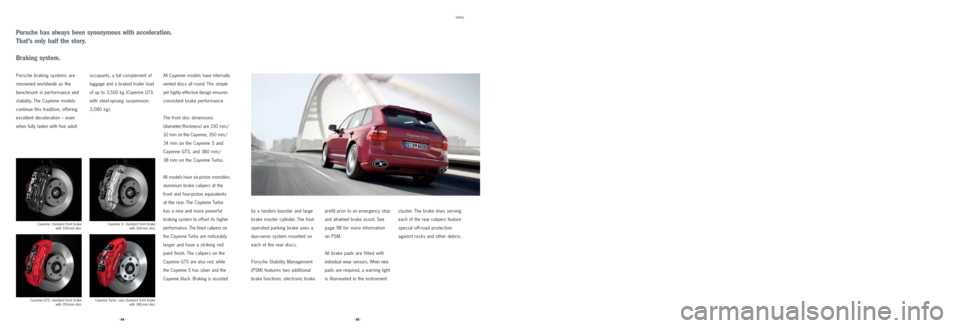
All models have six-piston monobloc
aluminium brake calipers at the
front and four-piston equivalents
at the rear. The Cayenne Turbo
has a new and more powerful
braking system to offset its higher
performance. The fixed calipers on
the Cayenne Turbo are noticeably
larger and have a striking red
paint finish. The calipers on the
Cayenne GTS are also red, while
the Cayenne S has silver and the
Cayenne black. Braking is assisted
Safety
occupants, a full complement of
luggage and a braked trailer load
of up to 3,500 kg (Cayenne GTS
with steel-sprung suspension:
3,080 kg).
prefill prior to an emergency stop
and all-wheel brake assist. See
page 98 for more information
on PSM.
All brake pads are fitted with
individual wear sensors. When new
pads are required, a warning light
is illuminated in the instrumentcluster. The brake lines serving
each of the rear calipers feature
special off-road protection
against rocks and other debris.
· 95 · · 94 · Cayenne: standard front brake
with 330-mm discCayenne S: standard front brake
with 350-mm disc
Cayenne GTS: standard front brake
with 350-mm discCayenne Turbo: new standard front brake
with 380-mm disc
Page 46 of 95
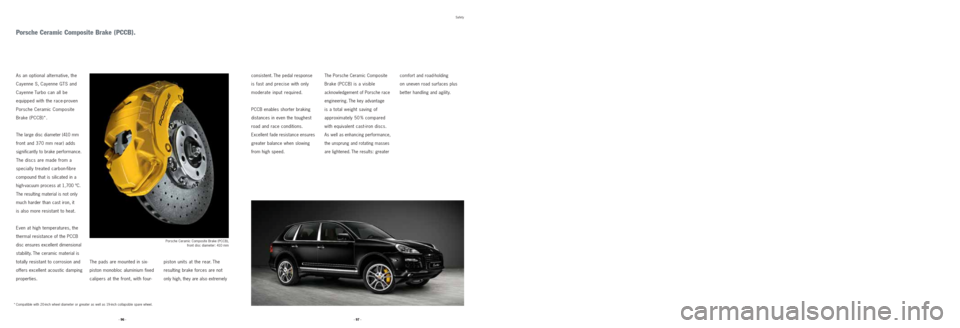
piston units at the rear. The
resulting brake forces are not
only high, they are also extremely
Porsche Ceramic Composite Brake (PCCB).
Porsche Ceramic Composite Brake (PCCB),
front disc diameter: 410 mm
The pads are mounted in six-
piston monobloc aluminium fixed
calipers at the front, with four-
Safety
As an optional alternative, the
Cayenne S, Cayenne GTS and
Cayenne Turbo can all be
equipped with the race-proven
Porsche Ceramic Composite
Brake (PCCB)*.
The large disc diameter (410 mm
front and 370 mm rear) adds
significantly to brake performance.
The discs are made from a
specially treated carbon-fibre
compound that is silicated in a
high-vacuum process at 1,700 ºC.
The resulting material is not only
much harder than cast iron, it
is also more resistant to heat.
Even at high temperatures, the
thermal resistance of the PCCB
disc ensures excellent dimensional
stability. The ceramic material is
totally resistant to corrosion and
offers excellent acoustic damping
properties.consistent. The pedal response
is fast and precise with only
moderate input required.
PCCB enables shorter braking
distances in even the toughest
road and race conditions.
Excellent fade resistance ensures
greater balance when slowing
from high speed.
· 97 · · 96 ·
The Porsche Ceramic Composite
Brake (PCCB) is a visible
acknowledgement of Porsche race
engineering. The key advantage
is a total weight saving of
approximately 50 % compared
with equivalent cast-iron discs.
As well as enhancing performance,
the unsprung and rotating masses
are lightened. The results: greater
comfort and road-holding
on uneven road surfaces plus
better handling and agility.
* Compatible with 20-inch wheel diameter or greater as well as 19-inch collapsible spare wheel.