ECO mode PORSCHE CAYNNE 2010 1.G User Guide
[x] Cancel search | Manufacturer: PORSCHE, Model Year: 2010, Model line: CAYENNE, Model: PORSCHE CAYENNE 2010 1.GPages: 379, PDF Size: 13.91 MB
Page 117 of 379
Multi-Purpose Display and Instruments
117
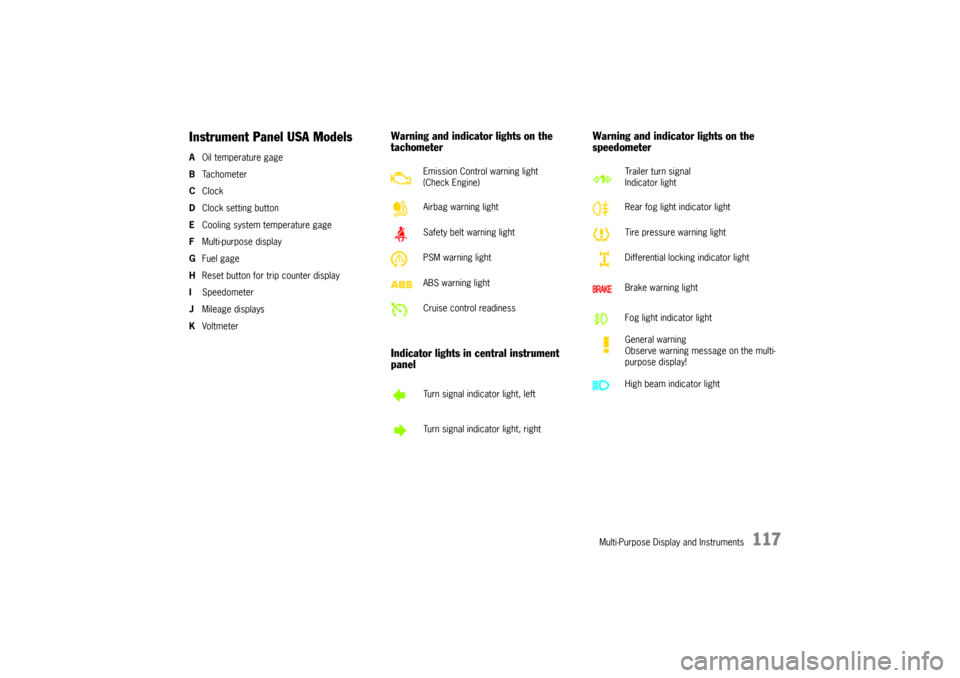
Instrument Panel USA ModelsAOil temperature gage
BTa c h o m e t e r
CClock
DClock setting button
ECooling system temperature gage
FMulti-purpose display
GFuel gage
HReset button for trip counter display
ISpeedometer
JMileage displays
KVoltmeter
Warning and indicator lights on the
tachometer
Indicator lights in central instrument
panelWarning and indicator lights on the
speedometer
Emission Control warning light
(Check Engine)
Airbag warning light
Safety belt warning light
PSM warning light
ABS warning light
Cruise control readiness
Turn signal indicator light, left
Turn signal indicator light, right
Trailer turn signal
Indicator light
Rear fog light indicator light
Tire pressure warning light
Differential locking indicator light
Brake warning light
Fog light indicator light
General warning
Observe warning message on the multi-
purpose display!
High beam indicator light
10_Cayenne_21_KW17.book Seite 117 Donnerstag, 9. April 2009 3:33 15
Page 119 of 379
Multi-Purpose Display and Instruments
119
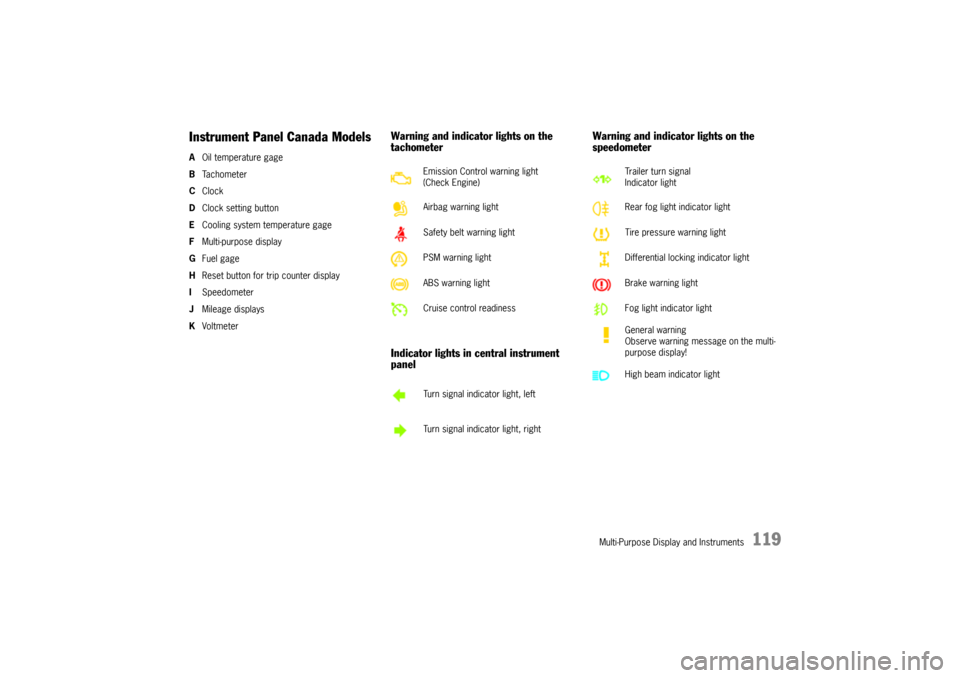
Instrument Panel Canada ModelsAOil temperature gage
BTa c h o m e t e r
CClock
DClock setting button
ECooling system temperature gage
FMulti-purpose display
GFuel gage
HReset button for trip counter display
ISpeedometer
JMileage displays
KVoltmeter
Warning and indicator lights on the
tachometer
Indicator lights in central instrument
panelWarning and indicator lights on the
speedometer
Emission Control warning light
(Check Engine)
Airbag warning light
Safety belt warning light
PSM warning light
ABS warning light
Cruise control readiness
Turn signal indicator light, left
Turn signal indicator light, right
Trailer turn signal
Indicator light
Rear fog light indicator light
Tire pressure warning light
Differential locking indicator light
Brake warning light
Fog light indicator light
General warning
Observe warning message on the multi-
purpose display!
High beam indicator light
10_Cayenne_21_KW17.book Seite 119 Donnerstag, 9. April 2009 3:33 15
Page 146 of 379
146
Multi-Purpose Display and Instruments
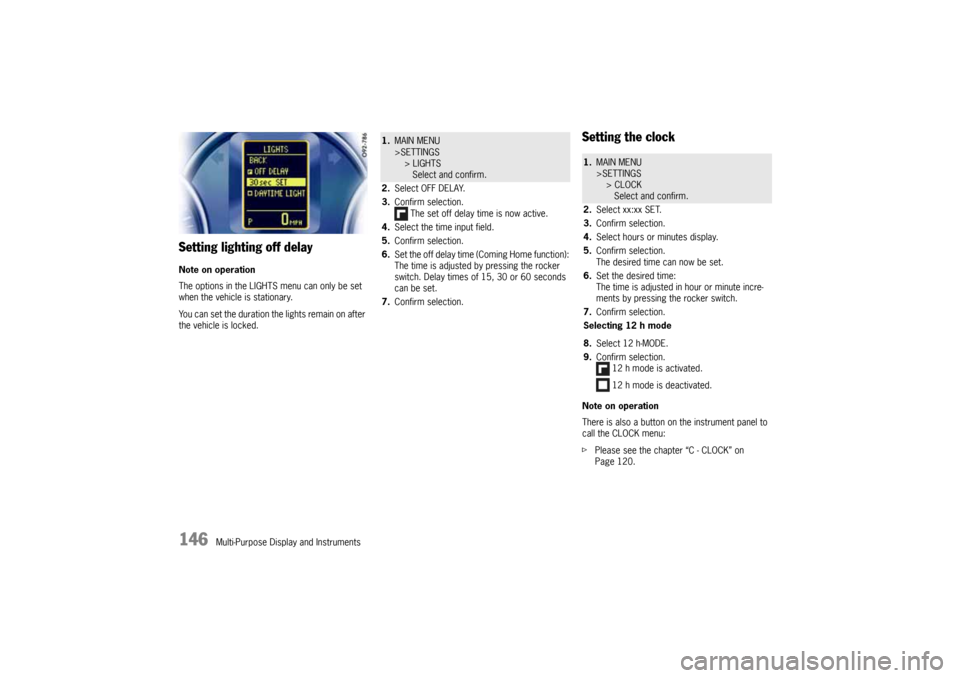
Setting lighting off delayNote on operation
The options in the LIGHTS menu can only be set
when the vehicle is stationary.
You can set the duration the lig hts re ma in on afte r
the vehicle is locked.
Setting the clockNote on operation
There is also a button on the instrument panel to
call the CLOCK menu:
fPlease see the chapter “C - CLOCK” on
Page 120.
1.MAIN MENU
>SETTINGS
> LIGHTS
Select and confirm.
2.Select OFF DELAY.
3.Confirm selection.
The set off delay time is now active.
4.Select the time input field.
5.Confirm selection.
6.Set the off delay time (Coming Home function):
The time is adjusted by pressing the rocker
switch. Delay times of 15, 30 or 60 seconds
can be set.
7.Confirm selection.
1.MAIN MENU
>SETTINGS
> CLOCK
Select and confirm.
2.Select xx:xx SET.
3.Confirm selection.
4.Select hours or minutes display.
5.Confirm selection.
The desired time can now be set.
6.Set the desired time:
The time is adjusted in hour or minute incre-
ments by pressing the rocker switch.
7.Confirm selection.
Selecting 12 h mode
8.Select 12 h-MODE.
9.Confirm selection.
12 h mode is activated.
12 h mode is deactivated.
10_Cayenne_21_KW17.book Seite 146 Donnerstag, 9. April 2009 3:33 15
Page 159 of 379
Driving and Driving Safety
159
Ignition lock position 1 - Ignition onfTurn ignition key to position 1.
Note on operation
All electrical equipment can be switched on.
The warning lights light up for a lamp check.
fPlease see the chapter “INSTRUMENT PANEL
USA MODELS” on Page 117.
If a load is not switched on for 10 minutes after
switching on the ignition, the ignition must be
switched on again.
Turn the ignition key to ignition lock position 3
(ignition off) first.Ignition lock position 2 - Starting enginefTurn ignition key to ignition lock position 2.Ignition lock position 3 - Ignition offfTurn ignition key to ignition lock position 3.
fFor further information on starting and stop-
ping the engine:
Please see the chapter “STARTING AND STOP-
PING THE ENGINE” on Page 160.
Locking the steering column Vehicles without Porsche Entry & Drive
The steering column is automatically locked
when the ignition key is withdrawn from the
ignition lock and is automatically unlocked
when the ignition key is inserted into the ignition
lock.
Vehicles with Porsche Entry & Drive
The steering column is automatically locked
when the ignition is switched off and the vehicle is
locked.
Manually locking the steering column on
vehicles with Porsche Entry & Drive
fDepress the clutch on vehicles with manual
transmission.
fOnce the ignition is switched off, turn the
control unit again to ignition lock position 3
and hold it there for 2seconds.
The steering column is automatically unlocked
by turning the control unit from ignition lock
position 0.
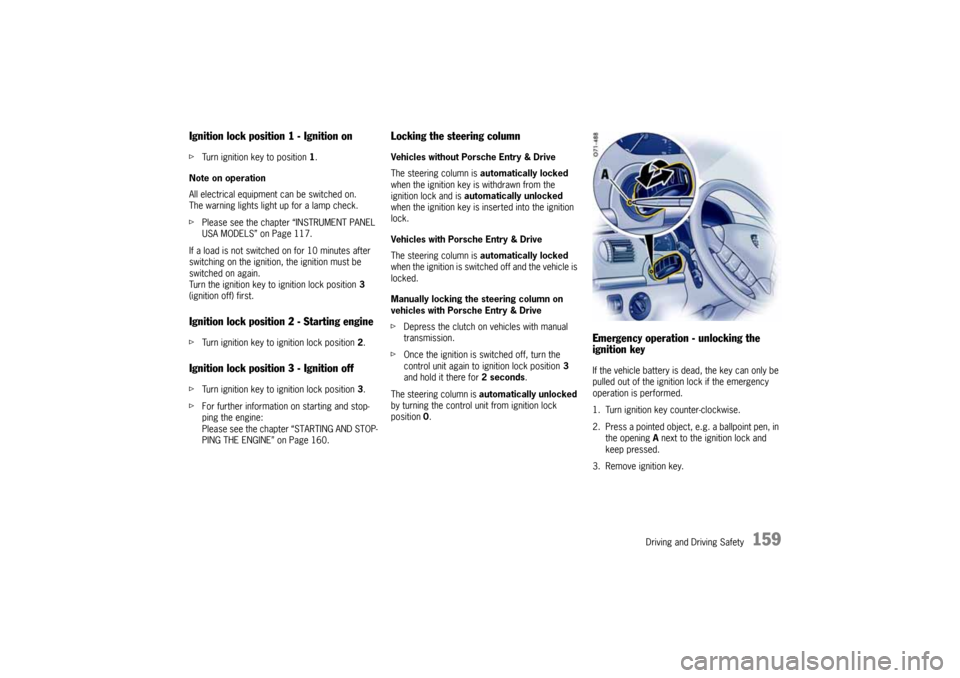
Emergency operation - unlocking the
ignition keyIf the vehicle battery is dead, the key can only be
pulled out of the ignition lock if the emergency
operation is performed.
1. Turn ignition key counter-clockwise.
2. Press a pointed object, e.g. a ballpoint pen, in
the opening A next to the ignition lock and
keep pressed.
3. Remove ignition key.
10_Cayenne_21_KW17.book Seite 159 Donnerstag, 9. April 2009 3:33 15
Page 172 of 379

172
Driving and Driving Safety The corner is taken in the right gear, and when you
accelerate out of the corner you do not have to
change down.
Shifting gear on the steering wheel
By shifting gear with the rocker switches on the
steering wheel, you can temporarily change from
automatic selection mode D to manual selection
mode M.
Advantages:
– Shifting down before corners and on entering
congested areas, on downward slopes (engine
braking) or for brief spurts of acceleration.
– Selecting 1st or 2nd gear for moving off.
The manual selection mode remains engaged:
– For cornering (depending on the lateral
acceleration) and passing,
– When the vehicle is stationary (e.g. at a
junction).
The system leaves manual selection mode:
– automatically after around 8 seconds
(unless car is cornering, passing or
stationary),
– if you depress the accelerator to kickdown.Temporary change-down
Precondition:
– Speed is higher than approx. 33 mph
(54 km/h).
fDepress accelerator quickly.
The Tiptronic changes temporarily to the
sportiest gear-changing map, i.e. to the
highest possible gear-changing points.
Correspondingly, the transmission shifts down
immediately by one, two or three gears.
Ending the function
fRelease the accelerator markedly (by approx.
25%).
Kickdown
The kickdown function is active in selector lever
position D.
fFor optimum acceleration, e.g. when over-
taking, depress the accelerator pedal beyond
the full-throttle point (kickdown).
The transmission shifts down depending on the
speed of travel and engine speed.
Upward shifts occur at the highest possible engine
speeds.
These gear-changing speeds remain active until
the accelerator is released to approx. 80% of the
full-throttle position.
D - Automatic selection mode (in the off-
road driving program)fUse selector lever position D for “normal”
driving.
The gears are shifted automatically according
to the accelerator position and speed.
The gear-changing points have been adjusted to
achieve the best possible vehicle control on diffi-
cult terrain.
Depending on the route profile, the gear-changing
points are shifted towards higher or lower engine-
speed ranges. On steep downhill stretches,
upward shifts are prevented until medium engine
speeds are reached (at least 2,500 rpm).
When the car is passing, an automatic upshift
does not occur when the engine speed limit is
reached.
Shifting gear on the steering wheel
By shifting gear with the rocker switches on the
steering wheel, you can temporarily change from
automatic selection mode D to manual selection
mode M.
Advantages:
– Shifting down on downward slopes (engine
braking) or for brief spurts of acceleration.
– Selecting 1st/2nd or 3rd gear for moving off.
10_Cayenne_21_KW17.book Seite 172 Donnerstag, 9. April 2009 3:33 15
Page 173 of 379
Driving and Driving Safety
173
The manual selection mode remains engaged:
– For passing
– Depending on lateral acceleration
– When the vehicle is stationary (e.g. at a
junction).
The system leaves manual selection mode:
– Automatically after around 8 seconds
(unless car is subject to high lateral accelera-
tion, is passing or stationary),
– if you depress the accelerator to kickdown.
Kickdown
The kickdown function is active in selector lever
position D.
fFor optimum acceleration, e.g. when overta-
king, depress the accelerator pedal beyond
the full-throttle point (kickdown).
The transmission shifts down depending on the
speed of travel and engine speed.
Upward shifts occur at the highest possible engine
speeds.
These gear-changing speeds remain active until
the accelerator is released to approx. 80% of the
full-throttle position.
Tip on driving
Unlike in the on-road driving program, an automa-
tic upshift is not performed in manual selection
mode M when the engine-speed limit is reached.
M - Manual selection mode (in the on-
road driving program)
Warning!
The kickdown function is not active in manual
selection mode “M”.
The kickdown function cannot be used to
downshift in manual selection mode “M”.
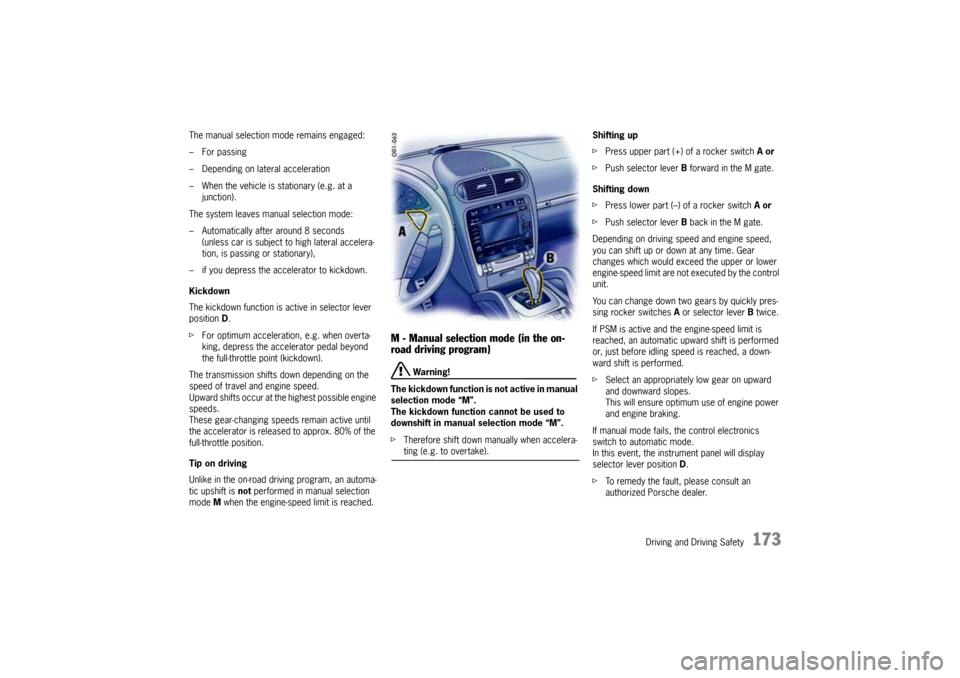
fTherefore shift down manually when accelera-ting (e.g. to overtake).Shifting up
fPress upper part (+) of a rocker switch A or
fPush selector lever B forward in the M gate.
Shifting down
fPress lower part (–) of a rocker switch A or
fPush selector lever B back in the M gate.
Depending on driving speed and engine speed,
you can shift up or down at any time. Gear
changes which would exceed the upper or lower
engine-speed limit are not executed by the control
unit.
You can change down two gears by quickly pres-
sing rocker switches A or selector lever B twice.
If PSM is active and the engine-speed limit is
reached, an automatic upward shift is performed
or, just before idling speed is reached, a down-
ward shift is performed.
fSelect an appropriately low gear on upward
and downward slopes.
This will ensure optimum use of engine power
and engine braking.
If manual mode fails, the control electronics
switch to automatic mode.
In this event, the instrument panel will display
selector lever position D.
fTo remedy the fault, please consult an
authorized Porsche dealer.
10_Cayenne_21_KW17.book Seite 173 Donnerstag, 9. April 2009 3:33 15
Page 180 of 379

180
Driving and Driving Safety Switching Sport mode on and off
Sport mode can be activated when the ignition is
switched on and when the on-road driving program
High Range (without reduction) is selected.
fPress SPORT button E in the center console.
When Sport mode is switched on, the light-
emitting diode F in the SPORT button is lit.
When Sport mode is switched on, the logo SPORT
appears on the multi-purpose display.
After the ignition is switched off, Sport mode is
automatically reset to Normal mode.
Warning messages
A warning appears on the multi-purpose display of
the instrument panel in the event of a fault.
fFor information on warning messages on the
multi-purpose display:
Please see the chapter “OVERVIEW OF
WARNING MESSAGES” on Page 149.Vehicles with air suspension
If you wish to use the characteristics of Sport
mode and the sports exhaust system, but would
like a more comfortable running-gear setup, you
can:
– switch PASM and PDCC separately to Normal
or Comfort mode and/or
– raise the ride height of the vehicle.
fPress the corresponding PASM button in the
center console. The light-emitting diode in the
button of the selected running-gear setup
lights up.
In addition, the selected running-gear setup is
shown on the multi-purpose display of the
instrument panel for approx. 12 seconds.
Please see the chapter “PORSCHE ACTIVE
SUSPENSION MANAGEMENT (PASM)” on
Page 193.
Please see the chapter “PORSCHE DYNAMIC
CHASSIS CONTROL (PDCC)” on Page 194.
Press the rocker switch in the center console for-
ward. The corresponding light-emitting diode next
to the rocker switch lights up continuously after
the adjustment process. The level change is also
indicated on the multi-purpose display of the in-
strument panel.
Please see the chapter “AIR SUSPENSION WITH
LEVEL CONTROL AND HEIGHT ADJUSTMENT” on
Page 190.
10_Cayenne_21_KW17.book Seite 180 Donnerstag, 9. April 2009 3:33 15
Page 182 of 379

182
Driving and Driving Safety
Warning!
In spite of the advantages of PTM or four-wheel dri-
ve, it is still the driver’s responsibility to adapt her/
his driving style and maneuvers in line with road
and weather conditions, as well as the traffic situ-
ation.
The increased safety that is provided should not
induce you to take greater risks with your safety.
The limits set by the physics of driving cannot be
overcome, even with PTM or four-wheel drive.
Risks of accident due to inappropriate speed
cannot be reduced by PTM.Porsche Traction Management (PTM)Porsche Traction Management is a full-time all-
wheel control system designed to influence the
longitudinal and lateral dynamics. It is closely
linked with the Porsche Stability Management
(PSM) system:
PTM ensures the best possible power distribution
to the four driven wheels at the front and rear
axles. The system realizes this optimal traction by
intervening in the lock control function of the trans-
fer case and rear differential. PTM is active at all
times and, unlike the PSM, cannot be switched off.Advantages of PTM
– Obvious improvement in traction, driving
stability and steering ability of the car.
– Vehicle is more manageable when driven at its
performance limits.
– Improved straight-ahead tracking and stability.
– The aforementioned features allow for a
sportier setup of the running gear.
– The TCS and ABD provide even better traction
for all wheels.
Full-time all-wheel drive
With the four-wheel drive, the drive power is
variably distributed to the front and rear wheels.
Power distribution and wheel speed compensation
between the front and rear axles is realized with a
transfer box.
Distribution of the drive power depends on the
wheel speed difference between the two axles.
The transfer box always controls power distribu-
tion in such a way that optimal propulsion is achie-
ved, even on an unfavorable road surface.
Full-time four-wheel drive ensures optimal handling
and greater stability.Automatic brake differential (ABD)
The ABD system controls the front and rear axles
separately. If one wheel of an axle starts to spin,
it is braked so that the other wheel on the same
axle can be driven.
The ABD recognizes different driving states, and it
features control strategies adapted to these
states. In situations in which little propulsive power
is required, such as when the car moves off on a
level gravel surface, traction control already
becomes active at low engine speeds. If great
propulsive power is required, e.g. when moving off
on an uphill slope or for rapid acceleration, the
ABD is adapted accordingly.
A special off-road program is used in Low Range
mode.
Traction control system (TCS)
The traction control system prevents the wheels
from spinning by adjusting the engine power,
thereby ensuring good lane-holding ability and a
stable driving behavior.10_Cayenne_21_KW17.book Seite 182 Donnerstag, 9. April 2009 3:33 15
Page 202 of 379

202
Driving and Driving Safety When driving on slopes with soft sand on vehicles
with Tiptronic S:
fUse the manual select mode M in addition to
the Low Range program.
If your vehicle becomes stuck nevertheless:
fDo not spin the wheels. Instead, use branches,
mats or similar items to provide adequate
traction so that you can drive out of the critical
area.
Track rutsOther vehicles leave ruts in many off-road courses
or gravel roads.
fPay attention to the ground clearance of the
car.
Please see the chapter “GROUND
CLEARANCE” on Page 357.
Caution!
Risk of damage to the vehicle floor when
driving through ruts that are too deep.
fAlways bear in mind the car's ground clearan-
ce.
fDo not drive over ruts that are too deep.
Note on operation
fActivate the Low Range program and engage
differential locks if necessary.
Tips on driving
fIn cases of doubt, drive with one wheel on the
strip of grass between the ruts.
fAvoid high engine speeds (max. 2,500 rpm).
fDrive slowly.
10_Cayenne_21_KW17.book Seite 202 Donnerstag, 9. April 2009 3:33 15
Page 286 of 379

286
Minor Repairs
Tire damage, puncturefPlease see the chapter “HIGH-PRESSURE
CLEANING EQUIPMENT, STEAM CLEANERS”
on Page 271.
Danger!
Risk of serious personal injury or death.
Driving the vehicle with low tire pressure
increases risk of a tire failure and resulting
loss of control. Furthermore, low tire pres-
sure increases rate of wear of the affected
tires.
fCheck tires – including sidewalls – regularly for
foreign bodies, nicks, cuts, cracks and bulges.
fAfter driving off road, examine tires for signs
of damage such as cuts, tears, bulges or
foreign objects stuck in the tread. Replace a
damaged tire if necessary.
fCross curb edges slowly and at right angles if
possible.
Avoid driving over steep or sharp curbs.
fIn cases of doubt, have the wheel (particularly
the inner side) checked by an authorized Porsche dealer.In case of tire damage, where it is uncertain
whether there is a break in the ply with all its con-
sequences or tire damage caused by thermal or
mechanical overloading due to loss of pressure or
any other prior damage, we recommend that the
tire be replaced for safety reasons.
I f o n e f a u l t y t i re i s re p l a c e d i t s h o u l d b e n o t e d t h a t
the difference in tread depth on one axle must not
exceed 30%. Handling inconsistencies may result.
fPerform a visual inspection if necessary.
Tire replacementsfUse only tire makes and types tested by
Porsche.
If you do not use a Porsche recommended
replacement tire, make sure that you
purchase your new tires from a reputable tire
dealer and that the dealer complies with all
manufacturers warnings for those tires.
Only tires with the same manufacturer and
with the same specification code (e.g. “N0”,
“N1”...) should be mounted on the vehicle.
Before mounting new tires, check with your
Porsche dealer about the current release
status.
Tires should be replaced no less than on one axle
at the time. Only tires of the same make and type
must be used. Mixed tires are not permissible and
will affect vehicle performance, safety, and can
affect vehicle warranty.Porsche dealers can recommend the most current
replacement tire options for your vehicle.
Initially, new tires do not have their full traction.
You should therefore drive at moderate speeds
during the first 60 - 120 miles (100 - 200 km).
Tires must always remain on the same side of
the vehicle.
When wheels are removed, the direction of rota-
tion and position of each wheel should be marked.
If new tires are installed only on one axle, a notice-
able change in handling occurs due to the different
tread depth of the other tires. This happens espe-
cially if only rear tires are replaced. However, this
condition disappears as the new tires are broken
in.
fPlease adjust your driving style accordingly.
Installation of new tires should only be done by a
qualified tire technician.
Valves
fUse only plastic valve caps.
fThe rubber valves must be replaced whenever
the tires are changed.
fThe fitting and replacement specifications
must be observed for metal valves.
fOnly use Original Porsche metal valves.
fProtect the valve inserts against soiling with
valve caps.
Soiled valve inserts can cause a gradual loss
of air.
10_Cayenne_21_KW17.book Seite 286 Donnerstag, 9. April 2009 3:33 15