check oil PORSCHE CAYNNE 2010 1.G User Guide
[x] Cancel search | Manufacturer: PORSCHE, Model Year: 2010, Model line: CAYENNE, Model: PORSCHE CAYENNE 2010 1.GPages: 379, PDF Size: 13.91 MB
Page 195 of 379

Driving and Driving Safety
195
Off-Road DrivingPlease read this chapter carefully before driving
off road with your Porsche.
The information provided will familiarise you with
the special advantages of your vehicle, allowing
you to arrive at your destination safely every time.
We recommend practicing on less rugged terrain.Vehicles with SportDesign package
Caution!
Risk of damage. On vehicles with Sport-
Design package, front, rear, and side
member trim are painted. Off-road driving
can seriously damage these trim parts.
fWhen driving off-road, make sure these parts
are not damaged.
fMake sure there is sufficient clearance
between obstacles and the underside of the
vehicle.
fAvoid driving through water.
fDo not use side member trims or rear wheel spoilers as a running board.Maintenance Note
Please bear in mind that off-road driving subjects
all vehicle components to considerably more wear
than normal use, making professional inspection
and maintenance after each use a vital precondi-
tion for functioning and safety.
Grains of sand, dirt particles and other abrasive
materials entering the brakes can cause exces-
sive wear or unpredictable braking action.
Rules for off-road drivingfEnsure vehicle is equipped with approved all-
terrain tires.
fPay attention to the ground clearance of the
vehicle.
Please see the chapter “GROUND
CLEARANCE” on Page 357.
fActivate Low Range.
Please see the chapter “SELECTING OFF-
ROAD DRIVING PROGRAM” on Page 178.
fStow or fasten luggage and loads securely.
Please see the chapter “LOADING
INFORMATION” on Page 231.
fIf unknown terrain is obscured from view,
examine it on foot first and traverse it with
extreme caution.
This way, obstacles are easier to recognize
and damage to the vehicle is avoided.fAlways drive with the engine running.
Power steering assistance is provided only
with the engine running.
fDrive slowly and uniformly.
fAlways make sure that the wheels touch the
ground.
fBefore driving through water, check the water
depth, the condition of the surface beneath it
and the speed of the water.
fLook out for obstacles such as boulders,
holes, tree stumps or ruts.
fAlways keep the sliding/lifting roof or
Panorama roof system and the side windows
closed while driving.
fDo not depart from marked routes or paths.
fRespect Nature.
Always obey off-limits signs.
10_Cayenne_21_KW17.book Seite 195 Donnerstag, 9. April 2009 3:33 15
Page 196 of 379

196
Driving and Driving Safety
Driving systems for off-road drivingSpecially adapted driving programs or power-
transmission and running-gear control systems
are available for off-road driving:
– Off-road program Low Range
–Off-road PSM
–Off-road ABS
– Center differential lock
– Rear differential lock
fPlease see the chapter “POWER-TRANSMISSI-
ON AND RUNNING-GEAR CONTROL SYSTEMS”
on Page 181.Before driving offTires
fCheck tread depth and tire pressure.
fCheck for damage and remove any foreign
objects (e.g. stones) from the tread.
fReplace missing valve caps.
Rims
fReplace dented or damaged rims before
driving off road.
Vehicles with SportDesign package
Caution!
Risk of damage. On vehicles with Sport-
Design package, front, rear, and side
member trim are painted. Off-road driving
can seriously damage these trim parts.
fWhen driving off-road, make sure these parts
are not damaged.
fMake sure there is sufficient clearance
between obstacles and the underside of the
vehicle.
fAvoid driving through water.
fDo not use side member trims or rear wheel spoilers as a running board.
After driving off roadOff-road driving places a greater burden on the
vehicle than does normal driving on roads.
We recommend inspecting the vehicle after off-
road driving. Potential damage poses an accident
risk and impairs driving comfort. Damage on the
car is recognized in good time if the car is
checked.
Caution!
Car damage poses an accident risk for the
vehicle occupants and other road users.
fIn cases of doubt, have your vehicle checked
by your authorized Porsche dealer.
fExamine tires for signs of damage such as
cuts, tears, bulges or foreign objects stuck in
the tread.
Replace a damaged tire if necessary.
fHave any damage to your vehicle repaired by an authorized Porsche dealer without delay.
10_Cayenne_21_KW17.book Seite 196 Donnerstag, 9. April 2009 3:33 15
Page 197 of 379

Driving and Driving Safety
197
Recommended procedure
fDeactivate the Low Range off-road driving
program.
fClean headlights and tail lights and check them
for signs of damage.
fClean the front and rear lincense plates.
fClean the tire tread with a jet of water and
remove any foreign objects.
fClean wheels, wheel housings and the under-
body with a jet of water.
fCheck whether the car has picked up plant
parts or branches.
These materials increase the risk of fire and
can damage fuel lines, brake hoses, boots of
the axle joints and drive shafts.
fAfter off-road driving, always check the entire
floor assembly, tires, body structure, steering
system, running gear and exhaust system for
signs of damage.fAfter driving for an extended period through
mud, sand, water or substances with a similar
soiling effect, check the brake discs, brake
pads, wheels and axle joints and have them
cleaned.
fIf you experience severe vibrations after
driving off road, check the wheels for foreign
substances.
These substances can produce an imbalance
which might be responsible for the vibrations.
Removing these deposits may remedy the
problem.
Uphill driving
Danger!
Danger of serious personal injury or death
and risk of damage if the vehicle should
overturn.
fDo not turn around when driving uphill.
fIf it is not possible to climb a gradient, the car
must be backed down in reverse gear.
fDo not drive over embankments or slopes at
steep diagonal angles.
fIf the vehicle starts to tilt, immediately steer in
the direction of the tilt (line of slope).
fWhen driving uphill, never let the vehicle roll
backward when in idle or not in gear.
Exclusive use of the footbrake is too risky in such situations.
10_Cayenne_21_KW17.book Seite 197 Donnerstag, 9. April 2009 3:33 15
Page 200 of 379

200
Driving and Driving Safety Soiling can impair the braking action.
fCheck and clean the brakes if they have been
soiled.
Danger of steering assistance failing during
a long journey in the water if the drive belt
slips.
fIf the steering assistance fails, more effort will
be required to steer.
Danger of damaging electrical systems
fAvoid driving through salt water.
Notes on operation
fActivate the Low Range program.
fSwitch the air conditioner off.
fSwitch the headlights off.Tips on driving
fAvoid high engine speeds (max. 2,500 rpm).
fDo not perform manual gear changes when
driving, and try to avoid stopping.
Moving off in the water can be difficult due to
the high resistance and the loose surface
involved.
fStart the water crossing at a shallow place at
walking speed.
fAfter checking the body of water, take the
shortest path through it.
fNever drive into the water at high speed. The
resulting “bow wave” could damage the engine
and its accessories.
fAdjust your driving style to the unfamiliar sur-
roundings.
fCross the body of water slowly and at a con-
stant speed.
fNever turn around when crossing a body of
water.
fIf it is not possible to cross the body of water,
the car must be backed out of it in reverse
gear.
The servo pump and alternator can fail if the car is
driven through water for an extended period.
fIf the servo pump fails, substantially more
force will have to be exerted in order to steer. Maintenance Note
The car requires a special check after the water
crossing.
fRemove mud from the tire tread.
fBriefly apply the brakes in order to dry them
after driving through the water.10_Cayenne_21_KW17.book Seite 200 Donnerstag, 9. April 2009 3:33 15
Page 219 of 379

Luggage Compartment, Loadspace and Storage
219
Compact disc player
Caution!
To avoid damage to compact disc player and
discs.
fUse only compact discs labeled as shown,
having no dirt, damage or warpage.
fNever attempt to disassemble or oil any part
of the player unit. Do not insert any object
other than a disc into the slot.Remember there
are no user-serviceable parts inside the
compact disc player.
fDo not allow the disc to sustain any finger-
prints, scrapes or stickers on the surfaces.
This may cause poor sound quality.
Hold the disc only on the edge or center hole.
fWhen not in use, take the disc out of the player,
put the disc back into its case and store it
away from dust, heat, damp and direct sun-
light.
Leaving the disc on the dashboard in the sun
can damage the disc.fIf the disc gets dirty, clean the disc by wiping
the surfaces from the center to the outside in
a radial direction with a soft cloth.
Do not use a conventional record cleaner or
anti-static record preservative.
Disc cleaners are available in audio stores.
Car Telephone and Aftermarket Alarms Important legal and safety information
regarding the use of cellular telephones
Some states may prohibit the use of cellular tele-
phones while driving a vehicle. Check the laws and
regulations on the use of cellular telephones in the
areas where you drive.
Danger!
Risk of an accident.
Severe personal injury or death can result in
the event of an accident.
Looking away from the road or turning your
attention away from your driving can cause
an accident and lead to serious personal
injury or death.
When using your cellular telephone, you should
always:
fGive full attention to your driving - pull off the
road and park before making or answering a
call if traffic conditions so require; andfKeep both hands on the steering wheel - use
hands-free operation (if available) - pull off the
road and park before using a hand-held tele-
phone.
It is essential to observe the telephone
manufacturer's instructions before operating
the telephone.
Any portable telephone or radio transmitter which
is used in a Porsche must be properly installed in
accordance with the technical requirements of
Porsche.
The transmission power must not exceed
10 W.
The devices must possess a type approval for
your vehicle and have an “e” symbol.
If you should require equipment with transmission
power values greater than 10 W, please consult
your authorized Porsche dealer for this purpose.
He is familiar with the technical requirements for
installing devices of this kind.
The antennas for all radios and telephones with a
transmitting antenna must be externally mounted.
The improper installation of radios or telephones
or use of a radio or telephone with a transmitting
antenna inside the car may cause the warning
lights to come on.
Improper installation of such equipment can
create a discharged battery or excessive current
draw from added equipment.
10_Cayenne_21_KW17.book Seite 219 Donnerstag, 9. April 2009 3:33 15
Page 249 of 379
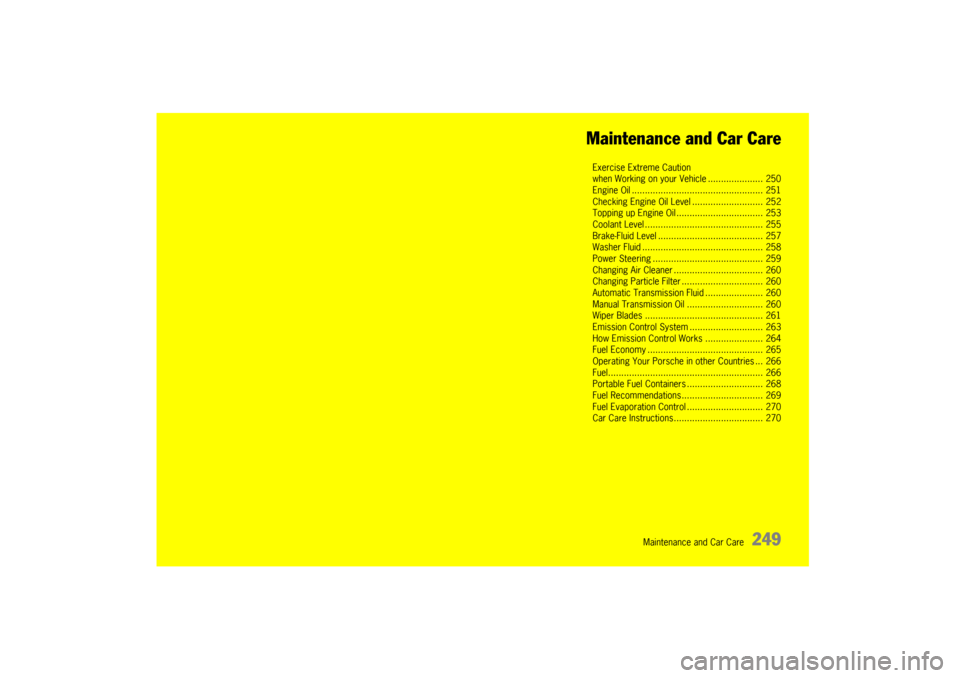
Maintenance and Car Care
249 Maintenance and Car Care
Exercise Extreme Caution
when Working on your Vehicle ..................... 250
Engine Oil .................................................. 251
Checking Engine Oil Level ........................... 252
Topping up Engine Oil ................................. 253
Coolant Level ............................................. 255
Brake-Fluid Level ........................................ 257
Washer Fluid .............................................. 258
Power Steering .......................................... 259
Changing Air Cleaner.................................. 260
Changing Particle Filter ............................... 260
Automatic Transmission Fluid ...................... 260
Manual Transmission Oil ............................. 260
Wiper Blades ............................................. 261
Emission Control System ............................ 263
How Emission Control Works ...................... 264
Fuel Economy ............................................ 265
Operating Your Porsche in other Countries ... 266
Fuel........................................................... 266
Portable Fuel Containers ............................. 268
Fuel Recommendations............................... 269
Fuel Evaporation Control ............................. 270
Car Care Instructions.................................. 270
10_Cayenne_21_KW17.book Seite 249 Donnerstag, 9. April 2009 3:33 15
Page 251 of 379

Maintenance and Car Care
251
Radiator fansThe radiator and radiator fans are in the front of
the car.
Warning!
Danger of injury. The fans can start running
as a function of temperature, even with the
engine switched off.
fExercise extreme caution when working in the area of the radiator fans.
Engine OilIt is important to perform oil changes regularly in
accordance with the intervals specified in your
Maintenance Schedule.Engine oil consumptionIt is normal for your engine to consume oil.
The rate of oil consumption depends on the quality
and viscosity of oil, the speed at which the engine
is operated, the climate, road conditions as well
as the amount of dilution and oxidation of the
lubricant.
If the vehicle is used for repeated short trips, and
consumes a normal amount of oil, the engine oil
measurement may not show any drop in the oil le-
vel at all, even after 600 miles (1000 km) or more.
This is because the oil is gradually becoming
diluted with fuel or moisture, making it appear that
the oil level has not changed.
The diluting ingredients evaporate out when the
vehicle is driven at high speeds, as on an express-
way, making it then appear that oil is excessively
consumed after driving at high speeds.
If the conditions you drive your vehicle in are
dusty, humid, or hot, the frequency of the oil
change intervals should be greater.If the vehicle is driven at a high rate of speed,
climatic conditions are warm, and the load is high,
the oil should be checked more frequently, as
driving conditions will determine the rate of oil
consumption.
– The engine in your vehicle depends on oil to lu-
bricate and cool all of its moving parts. There-
fore, the engine oil should be checked regular-
ly and kept at the required level.
– Make it a habit to have the engine oil level
checked with every refueling.
– The oil pressure warning light is not an oil level
indicator.
The oil pressure warning light indicates serious
engine damage may be occuring when lit, if
engine rpm is above idle speed.
10_Cayenne_21_KW17.book Seite 251 Donnerstag, 9. April 2009 3:33 15
Page 252 of 379

252
Maintenance and Car Care
Checking Engine Oil LevelfCheck the oil level regularly. I t i s b e s t t o d o t h i s
when refueling and before extended journeys.
Further important information concerning “mainte-
nance” can be found in a separate chapter.
fPlease see the chapter “EXERCISE EXTREME
CAUTION WHEN WORKING ON YOUR VEHICLE”
on Page 250.
fPlease see the chapter “OVERVIEW OF
WARNING MESSAGES” on Page 149.
Warning!
Engine oil is hazardous to your health and
may be fatal if swallowed.
fKeep engine oil out of children's reach.
Used engine oil contains chemicals that have
caused cancer in laboratory animals.
fAlways protect your skin by washing thoroughly with soap and water.
fIf you suspect an oil leak in the engine have
your authorized Porsche dealer check it out
immediately.If the oil level is too low, this is indicated by the oil-
level warning light lighting up on the multi-purpose
display.
fCheck the oil level using the oil dipstick as
soon as possible and add engine oil if neces-
sary.
Note on operation
fIf the engine compartment lid is opened and oil
is not added, the warning message appears
again after approximately 100 km.
Checking the oil level
Warning!
Danger of injury. The radiator fans can start
running as a function of temperature, even
with the engine switched off.
Risk of burning from hot parts in engine com-
partment.
fExercise extreme caution when working on the engine compartment.Conditions for measuring the oil level
correctly
– Vehicle must be level.
– Engine must be switched off and at operating
temperature.
– Before the oil-level measurement, allow the
engine oil to flow back into the oil pan for
around 3 minutes.
Checking oil level with the oil dipstick
1. Withdraw oil dipstick and wipe it with a clean,
lint-free cloth.
2. Push oil dipstick fully home, withdraw again
and read off the oil level.
The oil level must never fall below or
exceed the “Min.” and “Max.” marks on
the dipstick.
The difference between the marks is approx.
1.6 qt. (1.5 liters).
3. Push oil dipstick in as far as the stop.
Oil-level warning
10_Cayenne_21_KW17.book Seite 252 Donnerstag, 9. April 2009 3:33 15
Page 260 of 379

260
Maintenance and Car Care
Changing Air CleanerRegular replacement of the filter element is part of
servicing.
fIn dusty conditions, clean the filter element
more frequently and replace if necessary.
Further important information concerning “mainte-
nance” can be found in a separate chapter.
fPlease see the chapter “EXERCISE EXTREME
CAUTION WHEN WORKING ON YOUR VEHICLE”
on Page 250.Changing Particle FilterThe fresh air passing through the particle filter into
the passenger compartment is virtually free of
dust and pollen.
fIf the outside air is polluted by exhaust fumes,
press the recirculating-air button.
A dirty filter can be the cause of reduced air
throughput.
fHave filter replaced by your authorized
Porsche dealer.
fRegular replacement of the filter is part of
servicing.
Automatic Transmission Fluid The torque converter and the transmission are
lubricated with Automatic Transmission Fluid
(ATF).
fPlease see the chapter “CAPACITIES” on
Page 359.
Do not tow the car or run the engine without ATF
in the transmission. The automatic transmission
may be damaged by even a tiny speck of dirt, only
a clean funnel or spout must be used when adding
AT F.
The ATF and transmission oil has to be checked
and changed at the intervals listed in your Mainte-
nance Schedule.
We recommend that you have the ATF and trans-
mission oil changed at your Porsche dealer, who
has the required lubricants and the necessary fil-
ling equipment.
If you suspect an oil leak in the transmission, have
your authorized Porsche dealer check it out imme-
diately.
Manual Transmission OilThe transmission oil has to be checked and chan-
ged at the intervals listed in your Maintenance
Schedule.
fPlease see the chapter “CAPACITIES” on
Page 359.
We recommend that you have the transmission oil
changed at your Porsche dealer, who has the
required lubricants and the necessary filling equip-
ment.
If you suspect an oil leak in the transmission, have
your authorized Porsche dealer check it out imme-
diately.
10_Cayenne_21_KW17.book Seite 260 Donnerstag, 9. April 2009 3:33 15
Page 278 of 379

278
Maintenance and Car Care
Cleaning AlcantarafDo not use a leather care product to clean
Alcantara.
For regular care it is sufficient to clean the cover
with a soft brush. Heavy abrasion or rubbing when
cleaning causes a permanent change in the
surface.
Cleaning when lightly soiled
fWet a soft cloth with water or a neutral soap
solution and wipe off the dirt.
Cleaning when heavily soiled
fWet a soft cloth with lukewarm water or
thinned white spirit and dab the dirt from the
outside in.Cleaning safety beltsfUse mild detergent to clean soiled belts.
fWhen drying, avoid direct sunlight.
fOnly use suitable cleaning agents.
fDo not tint or bleach the belts.
The belt fabric could be weakened, thus affec-
ting safety.
Storing your PorscheIf you intend to store your Porsche for a prolonged
period, please consult your authorized Porsche
dealer. The staff will be glad to advise you on the
most suitable and necessary methods.
fClean your vehicle thoroughly inside and out-
side. Clean the engine compartment. The
under carriage and chassis components
should be free of dirt and salt deposits.
fFill up the fuel tank.
fChange the oil and oil filter, and run the engine
for several minutes.
fIncrease the tire pressure to 58 psi (4 bar). It
is not recommended to lift the vehicle, due to
the possibility of corrosion on shock absorber
piston shafts.The vehicle should be moved
slightly, approximately every four weeks, to
prevent flat spot on the tires.
Climate control
The air conditioning system should be in good
working condition and fully charged.
Windshield/Headlight washer
fCheck and correct antifreeze/cleaning solution
level as necessary.Electrical system
fRemove the battery from the vehicle and store
it in a cool dry place, not on a cement floor.
When the battery is disconnected, the alarm
system is deactivated.
fRecharge the battery every 3 months. If the
battery remains in the vehicle with the cables
connected, it is necessary to check, remove
and recharge the battery every 2-3 weeks.
Do not fast charge the battery.
fPlease see the chapter “CHARGE STATE” on
Page 320.
Vehicle interior
The interior must be dry, especially in the area of
the floor carpets. The use of drying agents (Silica-
Gel) is recommended in vehicles with leather inte-
rior and in areas with high humidity. The recom-
mended amount is 3 fabric bags of 1.1 lbs.
(500 grams) each placed on the floor carpets.
fWindows, doors, lids and roof must be closed.
The air vents should be opened.
10_Cayenne_21_KW17.book Seite 278 Donnerstag, 9. April 2009 3:33 15