headlights PORSCHE CAYNNE 2010 1.G User Guide
[x] Cancel search | Manufacturer: PORSCHE, Model Year: 2010, Model line: CAYENNE, Model: PORSCHE CAYENNE 2010 1.GPages: 379, PDF Size: 13.91 MB
Page 217 of 379
Luggage Compartment, Loadspace and Storage
217
Off-road roof-mounted Headlights
Cayenne S TranssyberiafPlease read the separate instructions for fitting
and operating the off-road roof-mounted
headlights.DisclaimerThe off-road roof-mounted headlights provided
with your Cayenne S Transsyberia have been
designed and manufactured solely for off-road
use. The use of these lights while on a public road
in your country may not be legal or may be legal
only under specified conditions. Check your
national, state/provincial and local laws or
regulations regarding any restrictions and/or
limitations for public highway use prior to
installation. It is common in many countries, for
example, that such roof-mounted headlights must
be hooded or covered while you are on a public
road.
Under no circumstances should the electrical
circuits for these lights be connected to the
circuits for the other lights provided with your
vehicle.
Safety Notes!
fCompletely remove the off-road roof-mounted
headlights before using an automatic car wash
– risk of damage to the vehicle!
fBefore every trip, and at regular intervals
during long trips, check that the off-road
roof-mounted headlights are secured to the
vehicle properly.
fWith the off-road roof-mounted headlights
fitted, do not exceed a maximum speed of
110 mph (180 km/h).
Nevertheless, Porsche recommends that you
do not exceed the posted speed limit.
fDriving, braking and steering behaviour
change due to the higher center of gravity and
the greater wind-resistant area. You should
adapt your driving style appropriately.
fSince fuel consumption and noise are
increased when the off-road roof-mounted
headlights are fitted, they should not remain on the vehicle when not in use.
Note on operation
If the engine is not running and the off-road
roof-mounted headlights are switched on, the
vehicle battery will be discharged.
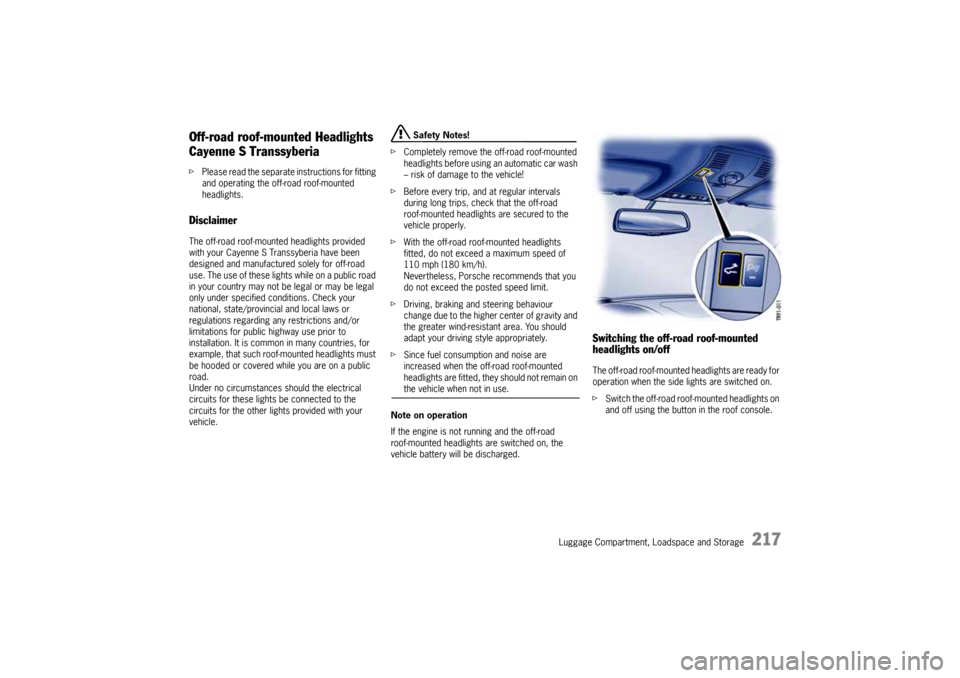
Switching the off-road roof-mounted
headlights on/offThe off-road roof-mounted headlights are ready for
operation when the side lights are switched on.
fSwitch the off-road roof-mounted headlights on
and off using the button in the roof console.
10_Cayenne_21_KW17.book Seite 217 Donnerstag, 9. April 2009 3:33 15
Page 234 of 379

234
Tr a i l e r H i t c h
Towing a trailer
Warning!
Driving with a trailer
fAlways see the permissible towing capacity,
vertical coupling load and rear-axle load.
Please see the chapter “WEIGHTS” on
Page 356.
fWhen connected, the trailer must always be
horizontal behind the towing vehicle. If neces-
sary, use a trailer with an adjustable drawbar.
fWhen the vehicle is driven in the mountains, the
engine output decreases as altitude increases.
The maximum weights stated are the values at
sea level. The total permissable weight of the
car-trailer combination must therefore be re-
duced by 10% for each increment of 3,280 ft.
(1,000 meters) altitude. A fractional increment
counts as the full 3,280 ft. (1,000 meters).
Please take this into consideration when plan-
ning your route.Distributing the load
fDistribute the load in the trailer so that heavy
objects are as close to the axle as possible.
Always safeguard all objects against slipping
and tie them down securely.
fYou should make the best possible use of the
trailer coupling's rated vertical coupling load
when loading the trailer, but never exceed it.
Tire pressure
fSelect the vehicle tire pressure for full load
when towing a trailer.
fPlease see the chapter “TIRE PRESSURES,
COLD (68 °F/20 °C)” on Page 354.
fCheck the tire pressure of the trailer's wheels
according to the manufacturer's instructions.Door mirrors
fIf the width of the trailer obstructs your view of
the traffic behind the trailer, you must have
additional door mirrors fitted.
Headlights, lights
fAlways check the headlight adjustment before
driving with a trailer.
If necessary, correct with the headlight beam
adjustment function.
fCheck whether the plug of the trailer is
plugged into the towing vehicle and whether all
lights function.
10_Cayenne_21_KW17.book Seite 234 Donnerstag, 9. April 2009 3:33 15
Page 258 of 379
258
Maintenance and Car Care
Changing the brake fluidBrake fluid absorbs moisture from the air over
time. This accumulation of water lowers the boi-
ling point and, under certain operating conditions,
can affect the braking performance.
fTherefore, have the brake fluid changed in
accordance with the change intervals stated in
the “Maintenance” booklet.
The warning light in the instrument panel and the
warning message on the multi-purpose display of
the instrument panel indicate
– indicate the brake level fluid is too low or,
– in conjunction with large pedal travel could
indicate a braking-circuit failure.
Note on operation
If the warning lights should light up while driving:
fStop immediately in a suitable place.
fDo not continue driving.
Please have the fault remedied at your nearest
authorized Porsche dealer.
Washer FluidWarning message on the multi-purpose
displayA message is shown on the multi-purpose display
of the instrument panel if the washer-fluid level is
too low.
In this case, the residual quantity is only around
0.85 quarts (0.8 liter).
fAdd washer fluid at the next opportunity.
The capacity is approx. 7.9 quarts (7.5 liters).
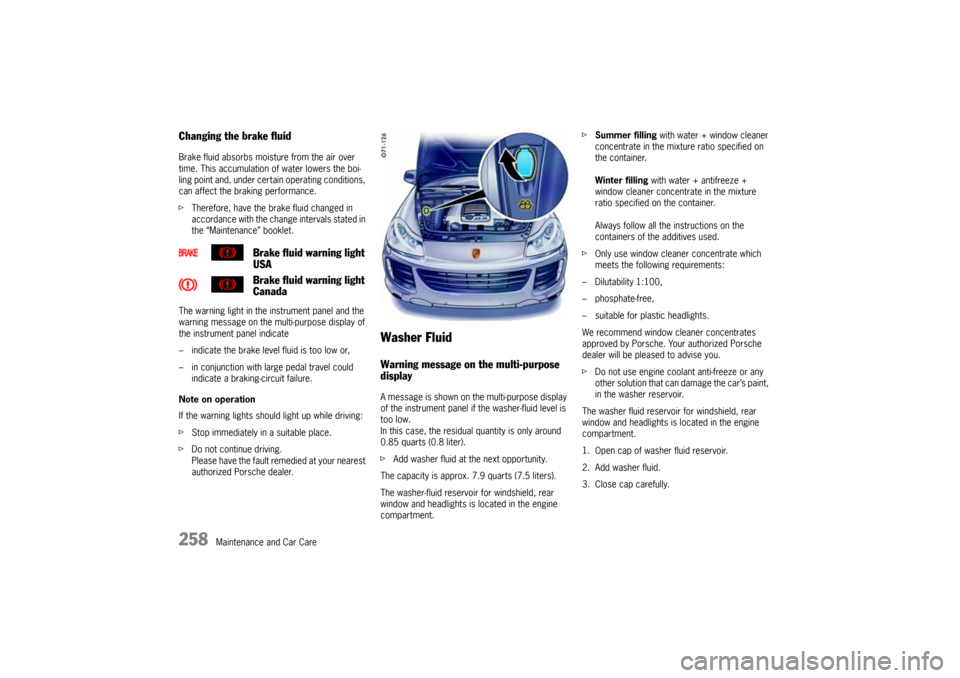
The washer-fluid reservoir for windshield, rear
window and headlights is located in the engine
compartment.fSummer filling with water + window cleaner
concentrate in the mixture ratio specified on
the container.
Winter filling with water + antifreeze +
window cleaner concentrate in the mixture
ratio specified on the container.
Always follow all the instructions on the
containers of the additives used.
fOnly use window cleaner concentrate which
meets the following requirements:
– Dilutability 1:100,
– phosphate-free,
– suitable for plastic headlights.
We recommend window cleaner concentrates
approved by Porsche. Your authorized Porsche
dealer will be pleased to advise you.
fDo not use engine coolant anti-freeze or any
other solution that can damage the car’s paint,
in the washer reservoir.
The washer fluid reservoir for windshield, rear
window and headlights is located in the engine
compartment.
1. Open cap of washer fluid reservoir.
2. Add washer fluid.
3. Close cap carefully.
Brake fluid warning light
USA
Brake fluid warning light
Canada
10_Cayenne_21_KW17.book Seite 258 Donnerstag, 9. April 2009 3:33 15
Page 272 of 379

272
Maintenance and Car Care
Warning!
Moisture which gets on the brakes during a
car wash can reduce braking efficiency or
make the brake pull unevenly which could
increase the danger of an accident, causing
serious personal injuries or death.
fAfter washing the vehicle, test the brakes and
steering and briefly brake the discs dry.
When doing so, make sure that vehicles travel-ling behind you are not affected.
Automatic car washes
fPlease see the chapter “WIPER BLADES” on
Page 261.
Optional add-on parts or parts which project be-
yond the contours of the vehicle may be damaged
by design features (e.g. brushes) of automatic car
washes.The following parts are particularly
susceptible to damage:
– Windshield wipers and rear wiper (always
switch them off – wiper stalk in position0 – to
prevent them wiping unintentionally in intermit-
tent or sensor operation).
– Door mirrors (always fold in).
– External antennas (always unscrew).
– Roof Transport System (always remove com-
pletely).
– Off-road roof-mounted headlights (always
remove completely).
– Spoiler.
– Wheels (the wider the rim and the lower the tire
height, the greater the risk of damage).
fPlease consult the operator before using
automatic car washes.
fWash and dry by hand all points not reached by
a car wash, such as door and lid seams or
door sills.
Note
Automatic car washes spray water at odd angles
and high pressures, which are not seen in normal
driving. Therefore, water can sometimes find its
way into the passengers compartment during or
shortly after the car wash.
10_Cayenne_21_KW17.book Seite 272 Donnerstag, 9. April 2009 3:33 15
Page 275 of 379

Maintenance and Car Care
275
UndercoatingThe underside of your car is durably protected
against chemical and mechanical influences.
As it is not possible to exclude the risk of damage
to this protective coating in day to day driving, it
is advisable to have the underside of the car
inspected at certain intervals - preferably before
the start of winter and again in spring - and the
undercoating restored as necessary.
Your authorized Porsche dealer is familiar with the
bodyseal treatment procedures and has the ne-
cessary equipment for applying factory approved
materials. We recommend that you entrust them
with such work and inspections.
Unlike conventional spray oils, undercoating and
rust-proofing compounds based on bitumen or
wax do not attack the sound-proofing materials
applied at the factory.
Warning!
Danger of fire resulting in serious personal
injury or death.
fDo not apply additional undercoating or rust-
proofing on or near the exhaust manifold,
exhaust pipes, catalytic converters or heat
shields. During driving the substance used for undercoating could overheat and ignite.fBefore applying fresh underseal, carefully re-
move deposits or dirt and grease. Once it has
dried, the new undercoating compound forms
a tough protective coating which provides effi-
cient rust-proofing of the floor panels and com-
ponents.
fAlways apply a fresh coating of suitable pre-
servative to unprotect areas after cleaning the
underside of the body, the transmission, the
engine or carrying out repairs to underbody,
engine or transmission components.
Effective rust-proofing is particularly important
during the cold weather season. If your car is
driven frequently in areas where salt has been
spread on the roads, the whole engine compart-
ment should be cleaned thoroughly after the
winter to prevent salt from causing any lasting
damage. A full under-body wash should also be
performed at the same time.
Cleaning headlights, lights, interior and
exterior plastic parts, adhesive filmsObserve the following points:
fUse only clean water and a little dishwashing
detergent or interior window cleaner to clean
headlights, lights, plastic parts, adhesive films
and surfaces.
Use a soft sponge or a soft, lint-free cloth.
Note
An interior window cleaner can also be used to
clean plastic surfaces (observe cleaning instruc-
tions on the container!).
We recommend the Porsche interior window
cleaner.
fGently wipe the surface without applying too
much pressure.
fDo not clean when dry.
fNever use other chemical cleaners or
solvents.
Rinse cleaned surfaces with clear water.
10_Cayenne_21_KW17.book Seite 275 Donnerstag, 9. April 2009 3:33 15
Page 279 of 379
Minor Repairs
279 Minor Repairs
Exercise Extreme Caution
when Working on your Vehicle ..................... 280
Tires/Wheels ............................................. 281
Jack .......................................................... 291
Tool Kit ..................................................... 292
Compressor .............................................. 292
Spacers .................................................... 293
Wheel Bolts ............................................... 293
Changing Wheels........................................ 294
Flat Tire ..................................................... 295
Lifting the Vehicle
with a Lifting Platform or Garage lift ............. 298
Electrical System ....................................... 312
Battery ...................................................... 320
Replacing the remote control battery ........... 322
Emergency Starting with Jumper Cables ...... 323
Replacing Bulbs ......................................... 326
Headlights ................................................. 327
Tail light .................................................... 336
License Plate Lights................................... 338
Headlight Adjustment.................................. 339
Changing headlights
from left to right-hand traffic ....................... 340
Bulb Chart ................................................. 342
Towing ...................................................... 342
10_Cayenne_21_KW17.book Seite 279 Donnerstag, 9. April 2009 3:33 15
Page 315 of 379
Minor Repairs
315
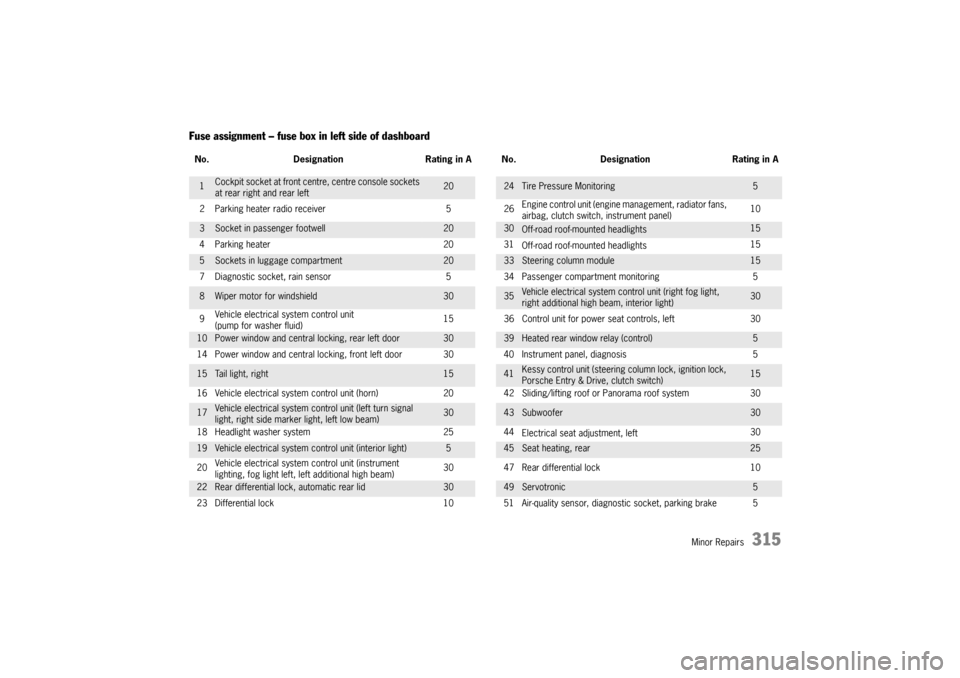
Fuse assignment – fuse box in left side of dashboardNo. Designation Rating in A No. Designation Rating in A1
Cockpit socket at front centre, centre console sockets
at rear right and rear left
20
24
Tire Pressure Monitoring
5
2 Parking heater radio receiver 5 26Engine control unit (engine management, radiator fans,
airbag, clutch switch, instrument panel)10
3
Socket in passenger footwell
20
30
Off-road roof-mounted headlights
15
4 Parking heater 20 31
Off-road roof-mounted headlights15
5
Sockets in luggage compartment
20
33
Steering column module
15
7 Diagnostic socket, rain sensor 5 34 Passenger compartment monitoring 5
8
Wiper motor for windshield
30
35
Vehicle electrical system control unit (right fog light,
right additional high beam, interior light)
30
9Vehicle electrical system control unit
(pump for washer fluid)15 36 Control unit for power seat controls, left 30
10
Power window and central locking, rear left door
30
39
Heated rear window relay (control)
5
14 Power window and central locking, front left door 30 40 Instrument panel, diagnosis 5
15
Tail light, right
15
41
Kessy control unit (steering column lock, ignition lock,
Porsche Entry & Drive, clutch switch)
15
16 Vehicle electrical system control unit (horn) 20 42Sliding/lifting roof or Panorama roof system 30
17
Vehicle electrical system control unit (left turn signal
light, right side marker light, left low beam)
30
43
Subwoofer
30
18 Headlight washer system 25 44
Electrical seat adjustment, left30
19
Vehicle electrical system control unit (interior light)
5
45
Seat heating, rear
25
20Vehicle electrical system control unit (instrument
lighting, fog light left, left additional high beam)30 47 Rear differential lock 10
22
Rear differential lock, automatic rear lid
30
49
Servotronic
5
23 Differential lock 10 51 Air-quality sensor, diagnostic socket, parking brake 5
10_Cayenne_21_KW17.book Seite 315 Donnerstag, 9. April 2009 3:33 15
Page 321 of 379

Minor Repairs
321
Battery carefEnsure that battery is securely mounted.
fKeep terminals and connections clean and
properly tightened. Corrosion can be preven-
ted by coating the terminals and connections
with petroleum jelly or silicone spray.
fEnsure that vent caps are securely tightened to
prevent spillage.
Checking the electrolyte fluid level
(only on low-maintenance batteries)
Generally, the electrolyte level must be checked
more often in summer than in the winter, and more
often when driving long distances.
fWhen adding water, use only clean containers.
In no case may alcohol (e.g. window cleaner
residues) be permitted to enter the battery.
fUnscrew and open the filler vent caps of each
cell.
With the car on a level surface, the fluid level
should meet the indicator mark in each cell.
fIf necessary, top up with distilled water. Do not
use acid. Only fill up to the mark, otherwise the
electrolyte will overflow when the battery is
being charged and cause damage.
Winter operationDuring the winter months, battery capacity tends
to decrease as temperatures drop. Additionally,
more power is consumed while starting, and the
headlights, heater, rear window defogger, etc.,
are used more frequently.
Let your Porsche dealer test the battery's capaci-
ty before winter sets in.Vehicle storageIf the car stands for long periods in the garage or
workshop, the doors and lids should be closed.
fRemove the ignition key and, if necessary, dis-
connect the battery.
Notes on operation
fWhen the battery is disconnected, the alarm
system ceases to function.
If the vehicle was locked before the battery
was disconnected, the alarm will be triggered
when the battery is reconnected.
To deactivate the alarm system:
fLock the vehicle and unlock it again.
Alarm system, central locking
The status of the central locking and alarm system
is not changed by disconnecting the battery.Maintenance Notes
Even if you put your vehicle out of operation, the
battery still discharges.
The battery will discharge more quickly if your ve-
hicle is not driven on a daily basis over a distance
of several miles. The more often you drive your ve-
hicle, and the longer the distance driven on each
trip, the more opportunity the vehicle‘s charging
system will have to recharge the batteries.
fTo preserve its efficiency, charge the battery
about every 6 weeks.
fCheck the battery acid level and top off with
distilled water if necessary.
fStore a battery that has been removed in a
dark, cool place, but not subject to freezing.
Replacing the batteryThe service life of the battery is subject to normal
wear; it depends greatly on care, climatic conditi-
ons, and driving conditions (distances, loads).
fOnly use an original Porsche battery, with the
correct part number, as a replacement. Only
this battery meets the specific requirements of
the vehicle.
fPlease observe the disposal instructions for
batteries.
10_Cayenne_21_KW17.book Seite 321 Donnerstag, 9. April 2009 3:33 15
Page 326 of 379

326
Minor Repairs 4. After the warnings disappear:
Stop the vehicle in a suitable place.
5. Perform adaptation of the power windows:
Please see the chapter “STORING FINAL POSI-
TION OF THE DOOR WINDOWS” on Page 90.
6. On vehicles with tire pressure monitoring:
Please see the chapter “SETTING THE TIRE
TYPE AND SIZE” on Page 134.
7. On vehicles with Panorama roof system:
Please see the chapter “SAVE FINAL POSITION
OF THE PANORAMA ROOF SYSTEM” on
Page 99.
Replacing Bulbs
Warning!
Danger of short circuit.
fAlways switch off the relevant consumer when
changing bulbs.
Risk of serious personal injury or death. The
headlights are under high voltage when
installed.
fExercise extreme caution when working in the
area of the headlights.
Risk of damage. Bulbs of a higher wattage
can damage the light housing.
fOnly use the bulbs specified in the bulb chart.
fBulbs must be clean and free from oil, grease
or fingerprints.
fNever touch bulbs with your bare hands.
Use a cloth or soft paper when replacing bulbs.
fAlways carry spare bulbs with you.
In certain countries, the carrying of spare
bulbs is mandatory.
Caution!
Risk of damage to headlights due to exces-
sive temperatures and abrasion.
fAttach no coverings (e.g. films, “stone
guards”) in the area of the headlights.
fUse soapy water only to clean light lenses and
plastic headlight lenses. In no case may chemi-
cal cleaners or other volatile cleaning fluids be
used.
fTo prevent scratches, do not rub with a dry or merely moist cloth, tissue or insect sponges.
10_Cayenne_21_KW17.book Seite 326 Donnerstag, 9. April 2009 3:33 15
Page 327 of 379
Minor Repairs
327
HeadlightsNote
The headlights can mist up depending on the
temperature and humidity.
fTo ensure optimum ventilation, do not cover
the gap between headlight and body.
Caution!
Risk of damage to headlights due to abrasion
and excessive temperatures.
fDo not affix any coverings (e.g. “stone guards” or films) in the area of the headlights.
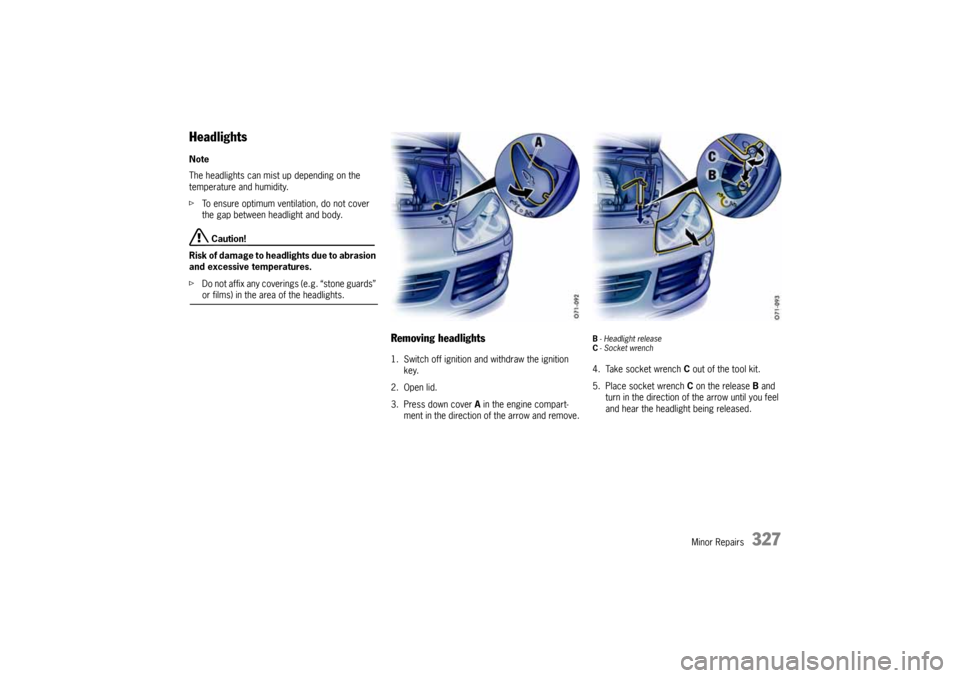
Removing headlights1. Switch off ignition and withdraw the ignition
key.
2. Open lid.
3. Press down cover A in the engine compart-
ment in the direction of the arrow and remove.
B- Headlight release
C- Socket wrench4. Take socket wrench C out of the tool kit.
5. Place socket wrench C on the release B and
turn in the direction of the arrow until you feel
and hear the headlight being released.
10_Cayenne_21_KW17.book Seite 327 Donnerstag, 9. April 2009 3:33 15