height PORSCHE CAYNNE 2010 1.G User Guide
[x] Cancel search | Manufacturer: PORSCHE, Model Year: 2010, Model line: CAYENNE, Model: PORSCHE CAYENNE 2010 1.GPages: 379, PDF Size: 13.91 MB
Page 180 of 379

180
Driving and Driving Safety Switching Sport mode on and off
Sport mode can be activated when the ignition is
switched on and when the on-road driving program
High Range (without reduction) is selected.
fPress SPORT button E in the center console.
When Sport mode is switched on, the light-
emitting diode F in the SPORT button is lit.
When Sport mode is switched on, the logo SPORT
appears on the multi-purpose display.
After the ignition is switched off, Sport mode is
automatically reset to Normal mode.
Warning messages
A warning appears on the multi-purpose display of
the instrument panel in the event of a fault.
fFor information on warning messages on the
multi-purpose display:
Please see the chapter “OVERVIEW OF
WARNING MESSAGES” on Page 149.Vehicles with air suspension
If you wish to use the characteristics of Sport
mode and the sports exhaust system, but would
like a more comfortable running-gear setup, you
can:
– switch PASM and PDCC separately to Normal
or Comfort mode and/or
– raise the ride height of the vehicle.
fPress the corresponding PASM button in the
center console. The light-emitting diode in the
button of the selected running-gear setup
lights up.
In addition, the selected running-gear setup is
shown on the multi-purpose display of the
instrument panel for approx. 12 seconds.
Please see the chapter “PORSCHE ACTIVE
SUSPENSION MANAGEMENT (PASM)” on
Page 193.
Please see the chapter “PORSCHE DYNAMIC
CHASSIS CONTROL (PDCC)” on Page 194.
Press the rocker switch in the center console for-
ward. The corresponding light-emitting diode next
to the rocker switch lights up continuously after
the adjustment process. The level change is also
indicated on the multi-purpose display of the in-
strument panel.
Please see the chapter “AIR SUSPENSION WITH
LEVEL CONTROL AND HEIGHT ADJUSTMENT” on
Page 190.
10_Cayenne_21_KW17.book Seite 180 Donnerstag, 9. April 2009 3:33 15
Page 181 of 379

Driving and Driving Safety
181
Power-Transmission and Running-Gear Control SystemsA complex interconnection of all control systems acting in power transmission and in the running gear has been realized in your Porsche.
All control systems have been linked with the aim of combining the best possible driving performance with maximum safety.
The following systems are involved:
System/designation Scope
PTM
Porsche Traction Management– Full-time all-wheel drive
– Electronically controlled center differential lock
– Automatic brake differential (ABD)
– Traction control system (TCS)
– Reduction gear/Low Range
PTM Plus
Porsche Traction ManagementIn addition to the PTM features, PTM Plus also includes:
– Electronically controlled rear differential lock
PSM
Porsche Stability Management– Stability management system
– Anti-lock brake system (ABS)
– Brake system prefilling
– Brake booster
– Traction control system (TCS)
– Automatic brake differential (ABD)
– Engine drag torque control (MSR)
Air suspension
with level control and height adjustment– Fully load bearing air spring struts with integral shock absorbers
– Air supply system with pressure accumulator
PAS M
Porsche Active Suspension Management– Shock absorber system with adaptive, continuous shock absorber control
PDCC
Porsche Dynamic Chassis Control– Active chassis control system to stabilize roll tendency of vehicle body when driving
10_Cayenne_21_KW17.book Seite 181 Donnerstag, 9. April 2009 3:33 15
Page 190 of 379
190
Driving and Driving Safety
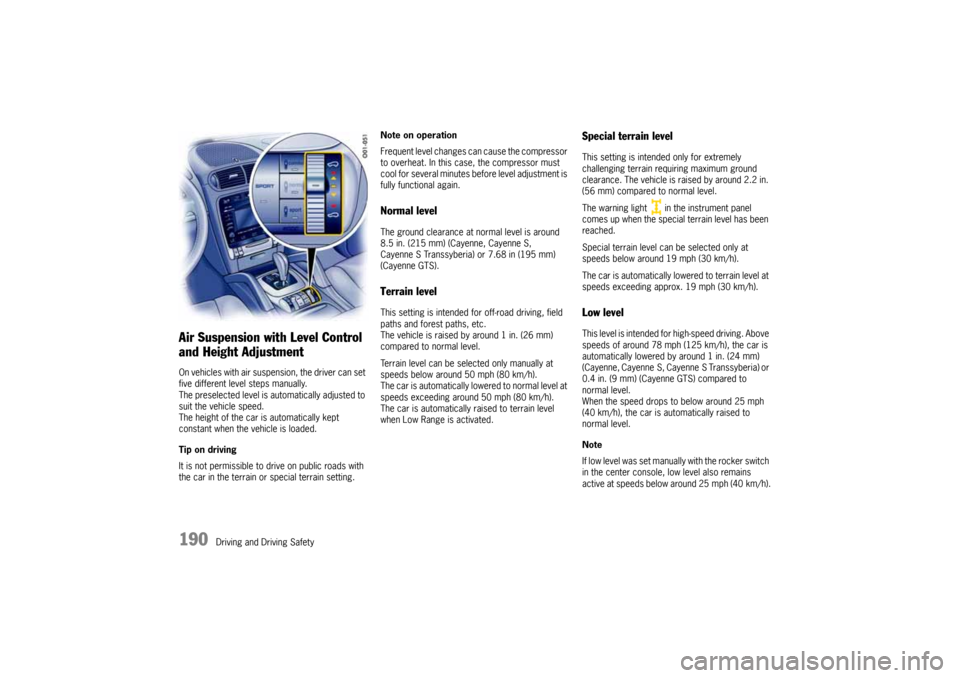
Air Suspension with Level Control
and Height AdjustmentOn vehicles with air suspension, the driver can set
five different level steps manually.
The preselected level is automatically adjusted to
suit the vehicle speed.
The height of the car is automatically kept
constant when the vehicle is loaded.
Tip on driving
It is not permissible to drive on public roads with
the car in the terrain or special terrain setting.Note on operation
Frequent level changes can cause the compressor
to overheat. In this case, the compressor must
cool for several minutes before level adjustment is
fully functional again.
Normal levelThe ground clearance at normal level is around
8.5 in. (215 mm) (Cayenne, Cayenne S,
Cayenne S Transsyberia) or 7.68 in (195 mm)
(Cayenne GTS).Terrain levelThis setting is intended for off-road driving, field
paths and forest paths, etc.
The vehicle is raised by around 1 in. (26 mm)
compared to normal level.
Terrain level can be selected only manually at
speeds below around 50 mph (80 km/h).
The car is automatically lowered to normal level at
speeds exceeding around 50 mph (80 km/h).
The car is automatically raised to terrain level
when Low Range is activated.
Special terrain levelThis setting is intended only for extremely
challenging terrain requiring maximum ground
clearance. The vehicle is raised by around 2.2 in.
(56 mm) compared to normal level.
The warning light in the instrument panel
comes up when the special terrain level has been
reached.
Special terrain level can be selected only at
speeds below around 19 mph (30 km/h).
The car is automatically lowered to terrain level at
speeds exceeding approx. 19 mph (30 km/h).Low levelThis level is intended for high-speed driving. Above
speeds of around 78 mph (125 km/h), the car is
automatically lowered by around 1 in. (24 mm)
(Cayenne, Cayenne S, Cayenne S Transsyberia) or
0.4 in. (9 mm) (Cayenne GTS) compared to
normal level.
When the speed drops to below around 25 mph
(40 km/h), the car is automatically raised to
normal level.
Note
If low level was set manually with the rocker switch
in the center console, low level also remains
active at speeds below around 25 mph (40 km/h).
10_Cayenne_21_KW17.book Seite 190 Donnerstag, 9. April 2009 3:33 15
Page 199 of 379
Driving and Driving Safety
199
ObstaclesfPay attention to the ground clearance of the
car.
Please see the chapter “GROUND
CLEARANCE” on Page 357.
Note on operation
fActivatethe Low Range program and engage
differential locks if necessary.
Tips on driving
fJust before reaching the obstacle, ease off the
accelerator slightly and use the car's momen-
tum to cross the obstacle. This will prevent the
car from jumping over the obstacle and landing
on the following downward slope at an exces-
sive speed.
fAvoid high engine speeds (max. 2,500 rpm).
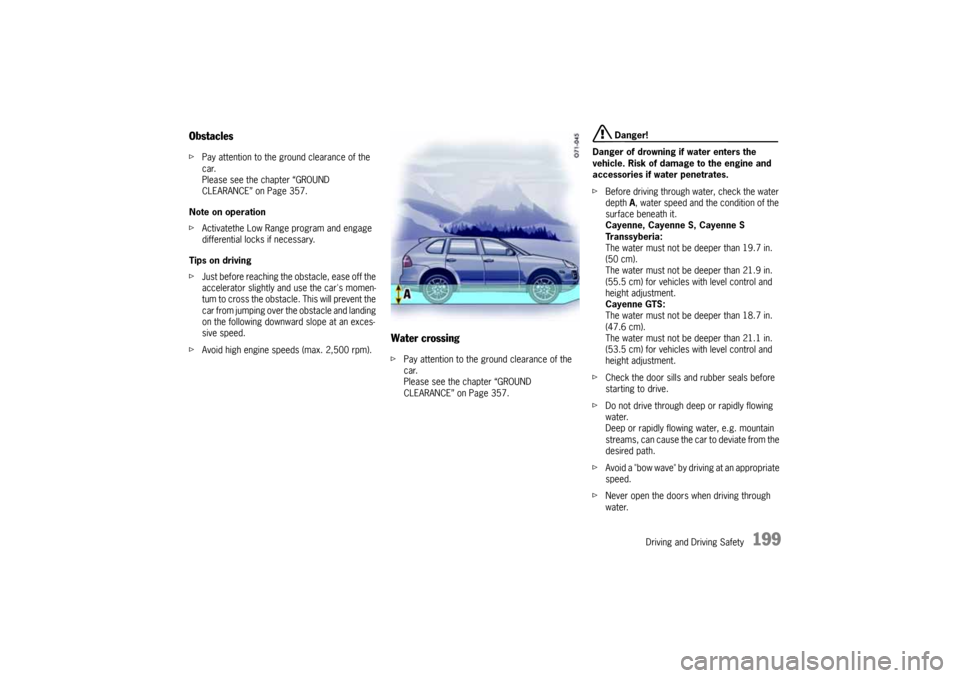
Water crossingfPay attention to the ground clearance of the
car.
Please see the chapter “GROUND
CLEARANCE” on Page 357.
Danger!
Danger of drowning if water enters the
vehicle. Risk of damage to the engine and
accessories if water penetrates.
fBefore driving through water, check the water
depth A, water speed and the condition of the
surface beneath it.
Cayenne, Cayenne S, Cayenne S
Tr a n s s y b e r i a :
The water must not be deeper than 19.7 in.
(50 cm).
The water must not be deeper than 21.9 in.
(55.5 cm) for vehicles with level control and
height adjustment.
Cayenne GTS:
The water must not be deeper than 18.7 in.
(47.6 cm).
The water must not be deeper than 21.1 in.
(53.5 cm) for vehicles with level control and
height adjustment.
fCheck the door sills and rubber seals before
starting to drive.
fDo not drive through deep or rapidly flowing
water.
Deep or rapidly flowing water, e.g. mountain
streams, can cause the car to deviate from the
desired path.
fAvoid a "bow wave" by driving at an appropriate
speed.
fNever open the doors when driving through
water.
10_Cayenne_21_KW17.book Seite 199 Donnerstag, 9. April 2009 3:33 15
Page 225 of 379
Luggage Compartment, Loadspace and Storage
225
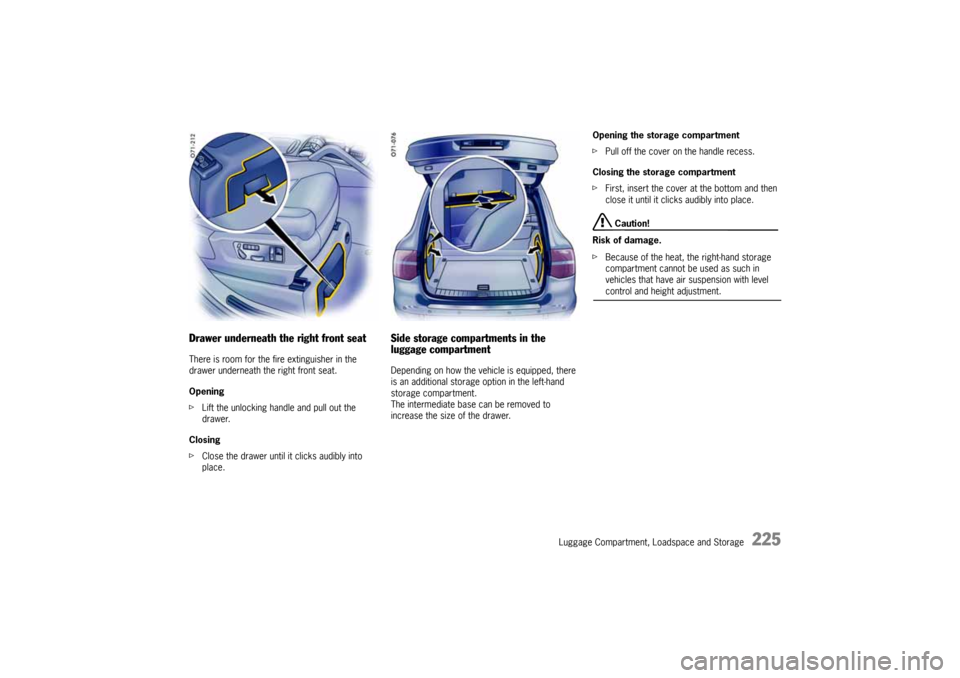
Drawer underneath the right front seatThere is room for the fire extinguisher in the
drawer underneath the right front seat.
Opening
fLift the unlocking handle and pull out the
drawer.
Closing
fClose the drawer until it clicks audibly into
place.
Side storage compartments in the
luggage compartmentDepending on how the vehicle is equipped, there
is an additional storage option in the left-hand
storage compartment.
The intermediate base can be removed to
increase the size of the drawer.Opening the storage compartment
fPull off the cover on the handle recess.
Closing the storage compartment
fFirst, insert the cover at the bottom and then
close it until it clicks audibly into place.
Caution!
Risk of damage.
fBecause of the heat, the right-hand storage
compartment cannot be used as such in
vehicles that have air suspension with level control and height adjustment.
10_Cayenne_21_KW17.book Seite 225 Donnerstag, 9. April 2009 3:33 15
Page 238 of 379

238
Parking
Front ultrasound sensorsSensors
Six ultrasound sensors in the front and rear
bumpers measure the distance to the closest
obstacle.
– Range of outer sensors
(front and rear):
approx. 24 in. (60 cm)
– Range of front middle sensors (arrow):
approx. 48 in. (120 cm)
Rear ultrasound sensors– Range of rear middle sensors (arrow)
(only in vehicles without spare wheel bracket):
approx. 59 in. (150 cm)
– Range of rear middle sensors
(only in vehicles with spare wheel bracket):
approx. 48 in. (120 cm)
Obstacles cannot be detected in the “blind” sen-
sor area (above and below the sensors).Maintenance Notes
fThe sensors must always be kept free of dust,
ice and snow in order to ensure that they are
fully functional.
fDo not damage sensors by abrasion or
scratching.
fMaintain sufficient distance when cleaning with
steam-jet units.
The sensors will be damaged if the pressure is
too high.
Note on operation
The rear ultrasound sensors may not function
correctly if tires that have not been recommended
by Porsche are fitted on the spare wheel bracket.
If the spare wheel bracket is open, this may impair
the function of the rear ultrasound sensors.
In vehicles that have air suspension with level
control and height adjustment, the system may
not recognize obstacles near the ground at terrain
level or special terrain level.
10_Cayenne_21_KW17.book Seite 238 Donnerstag, 9. April 2009 3:33 15
Page 246 of 379
246
Alarm System and Theft Protection
Switching onfLock the vehicle.
The alarm system and passenger compart-
ment monitoring system are switched on.
fPlease see the chapter “UNLOCKING AND
LOCKING FROM OUTSIDE” on Page 19.Switching offfUnlock the vehicle.
The alarm system and passenger compart-
ment monitoring system are switched off auto-
matically.
Note on operation
If you unlock the vehicle with the key at the door
lock, you must switch the ignition on (ignition lock
position 1) within 15 seconds of opening the door
in order to prevent the alarm system from being
triggered.
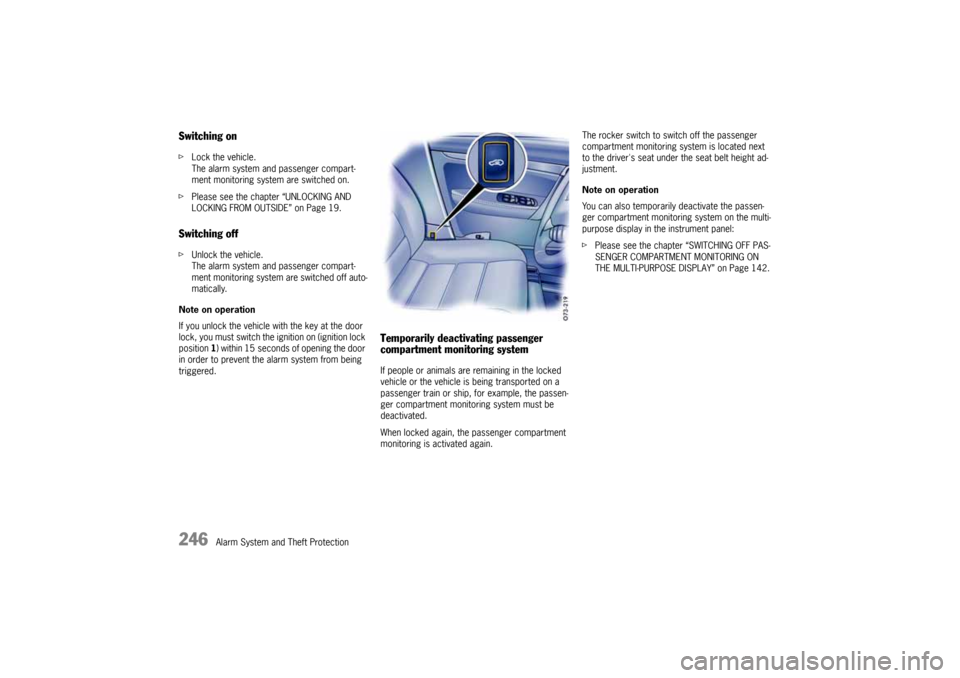
Temporarily deactivating passenger
compartment monitoring systemIf people or animals are remaining in the locked
vehicle or the vehicle is being transported on a
passenger train or ship, for example, the passen-
ger compartment monitoring system must be
deactivated.
When locked again, the passenger compartment
monitoring is activated again. The rocker switch to switch off the passenger
compartment monitoring system is located next
to the driver's seat under the seat belt height ad-
justment.
Note on operation
You can also temporarily deactivate the passen-
ger compartment monitoring system on the multi-
purpose display in the instrument panel:
fPlease see the chapter “SWITCHING OFF PAS-
SENGER COMPARTMENT MONITORING ON
THE MULTI-PURPOSE DISPLAY” on Page 142.
10_Cayenne_21_KW17.book Seite 246 Donnerstag, 9. April 2009 3:33 15
Page 250 of 379

250
Maintenance and Car Care
Exercise Extreme Caution when
Working on your Vehicle
Danger!
Ignoring the following instructions may cau-
se serious personal injury or death.
fThe engine compartment of any motor vehicle
is a potentially hazardous area. If you are not
fully familiar with proper repair procedures, do
not attempt the adjustments described on the
following pages.
This caution applies to the entire vehicle.
fO n l y w o r k o n y o u r v e h i c l e o u t d o o r s o r i n a w e l l
ventilated area.
fEnsure that there are no open flames in the
area of your vehicle at any time when fuel
fumes might be present. Be especially
cautious of such devices such as hot water
heaters which ignite a flame intermittently.
fBefore working on any part in the engine
compartment, turn the engine off and let it cool
down sufficiently. Hot engine compartment
components can burn skin on contact.
fBe alert and cautious around engine at all
times while the engine is running.
If you have to work on the engine while it is
running, always put the parking brake on and
put the gearshift lever in neutral or the
Tiptronic selector lever in position P or N.fIn particular, be very careful to ensure that
items of clothing (ties, shirt, sleeves etc.),
jewelry, long hair, hand or fingers cannot get
caught in the fan, belts or other moving parts.
The radiator and radiator fans are in the front
of the car.
The fans can start or continue running as a
function of temperature, even with the engine
switched off.
Carry out work in these areas only with the
engine off and exercise extreme caution.
fYour Porsche is equipped with an electronic
ignition system. When the ignition is on, high
voltage is present in all wires connected with
the ignition system; therefore, exercise
extreme caution when working on any part of
the engine while the ignition is on or the engine
is running.
fAlways support your car with safety stands if it
is necessary to work under the car. The jack
supplied with the car is not adequate for this
purpose.
For vehicles with air suspension with level
control and height adjustment switch off level
control.
Please see the chapter “RAISING VEHICLE
WITH THE JACK” on Page 192.fWhen working under the car without safety
stands but with the wheels on the ground,
make sure the car is on level ground, the
wheels are blocked, and that the engine can-
not be started.
Withdraw ignition keys (switch ignition off in
vehicles that have Porsche Entry & Drive).
fDo not smoke or allow an open flame around
the battery or fuel.
Keep a fire extinguisher close at hand.
fIncomplete or improper servicing may cause
problems in the operation of the car. If in doubt
about any servicing, have it done by your
authorized Porsche dealer.
Improper maintenance during the warranty
period may affect your Porsche warranty
coverage.
fSupplies of fluids, e.g. engine oil, washer fluid,
brake fluid or coolant, are hazardous to your
health.
Keep these fluids out of children's reach and
dispose of them in accordance with the appro-
priate regulations.
fSome countries require additional tools and
special spare parts to be carried in your
vehicle. Please make enquiries before driving
abroad.
10_Cayenne_21_KW17.book Seite 250 Donnerstag, 9. April 2009 3:33 15
Page 272 of 379

272
Maintenance and Car Care
Warning!
Moisture which gets on the brakes during a
car wash can reduce braking efficiency or
make the brake pull unevenly which could
increase the danger of an accident, causing
serious personal injuries or death.
fAfter washing the vehicle, test the brakes and
steering and briefly brake the discs dry.
When doing so, make sure that vehicles travel-ling behind you are not affected.
Automatic car washes
fPlease see the chapter “WIPER BLADES” on
Page 261.
Optional add-on parts or parts which project be-
yond the contours of the vehicle may be damaged
by design features (e.g. brushes) of automatic car
washes.The following parts are particularly
susceptible to damage:
– Windshield wipers and rear wiper (always
switch them off – wiper stalk in position0 – to
prevent them wiping unintentionally in intermit-
tent or sensor operation).
– Door mirrors (always fold in).
– External antennas (always unscrew).
– Roof Transport System (always remove com-
pletely).
– Off-road roof-mounted headlights (always
remove completely).
– Spoiler.
– Wheels (the wider the rim and the lower the tire
height, the greater the risk of damage).
fPlease consult the operator before using
automatic car washes.
fWash and dry by hand all points not reached by
a car wash, such as door and lid seams or
door sills.
Note
Automatic car washes spray water at odd angles
and high pressures, which are not seen in normal
driving. Therefore, water can sometimes find its
way into the passengers compartment during or
shortly after the car wash.
10_Cayenne_21_KW17.book Seite 272 Donnerstag, 9. April 2009 3:33 15
Page 280 of 379

280
Minor Repairs
Exercise Extreme Caution when
Working on your Vehicle
Danger!
Ignoring the following instructions may cau-
se serious personal injury or death.
fThe engine compartment of any motor vehicle
is a potentially hazardous area. If you are not
fully familiar with proper repair procedures, do
not attempt the adjustments described on the
following pages.
This caution applies to the entire vehicle.
fO n l y w o r k o n y o u r v e h i c l e o u t d o o r s o r i n a w e l l
ventilated area.
fEnsure that there are no open flames in the
area of your vehicle at any time when fuel
fumes might be present. Be especially
cautious of such devices such as hot water
heaters which ignite a flame intermittently.
fBefore working on any part in the engine com-
partment, turn the engine off and let it cool
down sufficiently. Hot engine compartment
components can burn skin on contact.
fBe alert and cautious around engine at all
times while the engine is running.
If you have to work on the engine while it is run-
ning, always put the parking brake on and put
the gearshift lever in neutral or the Tiptronic
selector lever in position P or N.fIn particular, be very careful to ensure that
items of clothing (ties, shirt, sleeves etc.),
jewelry, long hair, hand or fingers cannot get
caught in the engine-compartment blower, fan,
belts or other moving parts.
The radiator and radiator fans are in the front
of the car.
The fans can start or continue running as a
function of temperature, even with the engine
switched off.
Carry out work in these areas only with the
engine off and exercise extreme caution.
fYour Porsche is equipped with an electronic
ignition system. When the ignition is on, high
voltage is present in all wires connected with
the ignition system; therefore, exercise
extreme caution when working on any part of
the engine while the ignition is on or the engine
is running.
fAlways support your car with safety stands if it
is necessary to work under the car. The jack
supplied with the car is not adequate for this
purpose.
For vehicles with air suspension with level
control and height adjustment:
Please see the chapter “RAISING VEHICLE
WITH THE JACK” on Page 192.fWhen working under the car without safety
stands but with the wheels on the ground,
make sure the car is on level ground, the
wheels are blocked, and that the engine can-
not be started.
Remove the ignition key.
fDo not smoke or allow an open flame around
the battery or fuel.
Keep a fire extinguisher close at hand.
fIncomplete or improper servicing may cause
problems in the operation of the car. If in doubt
about any servicing, have it done by your
authorized Porsche dealer.
Improper maintenance during the warranty
period may affect your Porsche warranty
coverage.
fSupplies of fluids, e.g. engine oil, brake fluid or
coolant, are hazardous to your health. Keep
these fluids out of children's reach and dispose
of them in accordance with the appropriate
regulations.
fSome countries require additional tools and
special spare parts to be carried in your vehi-
cle.
Please make enquiries before driving abroad.
10_Cayenne_21_KW17.book Seite 280 Donnerstag, 9. April 2009 3:33 15