maintenance PORSCHE CAYNNE 2010 1.G User Guide
[x] Cancel search | Manufacturer: PORSCHE, Model Year: 2010, Model line: CAYENNE, Model: PORSCHE CAYENNE 2010 1.GPages: 379, PDF Size: 13.91 MB
Page 189 of 379

Driving and Driving Safety
189
Engine Braking Support
(Assistance when heading downhill)The Porsche Down-Hill Assistant is an assistance
system which helps the driver at slower downhill
driving up to approx. 12 mph (20 km/h), e.g., on
steep slopes or on wintry mountain roads.
As long as the gas pedal is not used when
traveling downhill, the Porsche Down-Hill Assistant
is active and brakes the vehicle.
If road grip is lost on one or more wheels, the
system brakes the wheels which have good road
contact.
The braking ability of the Engine Braking Support
is affected by slippery surfaces (e.g., on icy or
loose surfaces), like all brakes.
Warning!
Risk of accident, resulting in serious perso-
nal injury or death. Reduced braking ability
on a slippery surface.
fAlways adjust your driving style to the driving situation.
Conditions:
– The gas pedal must not be used when
travelling downhill.
– The speed must not exceed 12 mph
(20 km/h).–Vehicles with Tiptronic S:
The Tiptronic selector lever position D, M or R
must be engaged.
–Vehicles with manual transmission:
The reverse gear or any other gear (1. - 6. )
must be engaged. The clutch pedal must not
be used when travelling downhill.
Tip on driving
The Porsche Down-Hill Assistant is active when
driving downhill either forwards or backwards.
Checks on test standsBrake tests
Brake tests must be carried out only in High Range
and on plate-type test stands or roller test stands.
The following limit values must not be exceeded
on roller test stands:
– Testing speed 4.7 mph (7.5 km/h)
– Test duration 20 seconds
Parking brake test
Parking brake tests on the brake tester must be
performed only with the ignition switched off and
the Tiptronic selector lever in position N or the
gearshift lever in neutral.Balancing wheels on the vehicle
During finish balancing of the wheels, the entire
vehicle must be lifted and the wheels must be free
to turn.
Dynamometer testing procedure Some U.S. states and Canadian provinces con-
duct emissions inspection/maintenance testing
involving the use of two-wheel dynamometer.
A two-wheeled dynamometer is a treadmill type
device upon which a single axle of the car, the dri-
ving axle of the vehicle, rotates to simulate vehicle
operation on the road while the vehicle remains
stationary.
Your Porsche Cayenne has a full-time four-wheel
drive system which cannot be disabled. Severe
d a m a g e t o t h e p o w e r t r a i n c a n re s u l t i f t e s t e d o n a
two-wheel dynamometer.
Warning!
To avoid severe powertrain damage and a
possible unexpected movement of the vehic-
le.
fYour Porsche Cayenne vehicle must never be
tested on a two-wheel dynamometer.
fAdvise the emission station of this warning before testing the vehicle.
10_Cayenne_21_KW17.book Seite 189 Donnerstag, 9. April 2009 3:33 15
Page 194 of 379

194
Driving and Driving Safety
Porsche Dynamic
Chassis Control (PDCC)FunctionPorsche Dynamic Chassis Control (PDCC) is a sys-
tem for roll stabilization of the vehicle body when
driving. Driving comfort and driving safety are im-
proved by active intervention of the anti-roll bars
on the front and rear axles.
No separate controls are available for the PDCC
system.
After selection of a running-gear setup in Porsche
Active Suspension Management (PASM):
–comfort
–normal
–sport
PDCC automatically activates the corresponding
on-road driving program.
fFor information on selecting a running-gear
setup:
Please see the chapter “PORSCHE ACTIVE
SUSPENSION MANAGEMENT (PASM)” on
Page 193.
PDCC automatically activates the off-road driving
program if Low Range reduction is switched on.fFor information on switching Low Range
reduction on and off:
Please see the chapter “DRIVING PROGRAMS
FOR ON-ROAD AND OFF-ROAD DRIVING” on
Page 177.
Warning messageA warning message appears on the multi-purpose
display of the instrument panel if there is a system
fault.
fFor further information on warning messages
on the multi-purpose display:
Please see the chapter “OVERVIEW OF
WARNING MESSAGES” on Page 149.
fAdapt your driving style to the changed
conditions.
fConsult an authorized Porsche dealer in order
to remedy the fault.
Checking hydraulic fluidRegular checking and changing of the hydraulic
fluid takes place as part of servicing.
Further important information on “Maintenance”
can be found in a separate chapter.
fPlease see the chapter “CAR CARE
INSTRUCTIONS” on Page 270.
10_Cayenne_21_KW17.book Seite 194 Donnerstag, 9. April 2009 3:33 15
Page 195 of 379

Driving and Driving Safety
195
Off-Road DrivingPlease read this chapter carefully before driving
off road with your Porsche.
The information provided will familiarise you with
the special advantages of your vehicle, allowing
you to arrive at your destination safely every time.
We recommend practicing on less rugged terrain.Vehicles with SportDesign package
Caution!
Risk of damage. On vehicles with Sport-
Design package, front, rear, and side
member trim are painted. Off-road driving
can seriously damage these trim parts.
fWhen driving off-road, make sure these parts
are not damaged.
fMake sure there is sufficient clearance
between obstacles and the underside of the
vehicle.
fAvoid driving through water.
fDo not use side member trims or rear wheel spoilers as a running board.Maintenance Note
Please bear in mind that off-road driving subjects
all vehicle components to considerably more wear
than normal use, making professional inspection
and maintenance after each use a vital precondi-
tion for functioning and safety.
Grains of sand, dirt particles and other abrasive
materials entering the brakes can cause exces-
sive wear or unpredictable braking action.
Rules for off-road drivingfEnsure vehicle is equipped with approved all-
terrain tires.
fPay attention to the ground clearance of the
vehicle.
Please see the chapter “GROUND
CLEARANCE” on Page 357.
fActivate Low Range.
Please see the chapter “SELECTING OFF-
ROAD DRIVING PROGRAM” on Page 178.
fStow or fasten luggage and loads securely.
Please see the chapter “LOADING
INFORMATION” on Page 231.
fIf unknown terrain is obscured from view,
examine it on foot first and traverse it with
extreme caution.
This way, obstacles are easier to recognize
and damage to the vehicle is avoided.fAlways drive with the engine running.
Power steering assistance is provided only
with the engine running.
fDrive slowly and uniformly.
fAlways make sure that the wheels touch the
ground.
fBefore driving through water, check the water
depth, the condition of the surface beneath it
and the speed of the water.
fLook out for obstacles such as boulders,
holes, tree stumps or ruts.
fAlways keep the sliding/lifting roof or
Panorama roof system and the side windows
closed while driving.
fDo not depart from marked routes or paths.
fRespect Nature.
Always obey off-limits signs.
10_Cayenne_21_KW17.book Seite 195 Donnerstag, 9. April 2009 3:33 15
Page 200 of 379

200
Driving and Driving Safety Soiling can impair the braking action.
fCheck and clean the brakes if they have been
soiled.
Danger of steering assistance failing during
a long journey in the water if the drive belt
slips.
fIf the steering assistance fails, more effort will
be required to steer.
Danger of damaging electrical systems
fAvoid driving through salt water.
Notes on operation
fActivate the Low Range program.
fSwitch the air conditioner off.
fSwitch the headlights off.Tips on driving
fAvoid high engine speeds (max. 2,500 rpm).
fDo not perform manual gear changes when
driving, and try to avoid stopping.
Moving off in the water can be difficult due to
the high resistance and the loose surface
involved.
fStart the water crossing at a shallow place at
walking speed.
fAfter checking the body of water, take the
shortest path through it.
fNever drive into the water at high speed. The
resulting “bow wave” could damage the engine
and its accessories.
fAdjust your driving style to the unfamiliar sur-
roundings.
fCross the body of water slowly and at a con-
stant speed.
fNever turn around when crossing a body of
water.
fIf it is not possible to cross the body of water,
the car must be backed out of it in reverse
gear.
The servo pump and alternator can fail if the car is
driven through water for an extended period.
fIf the servo pump fails, substantially more
force will have to be exerted in order to steer. Maintenance Note
The car requires a special check after the water
crossing.
fRemove mud from the tire tread.
fBriefly apply the brakes in order to dry them
after driving through the water.10_Cayenne_21_KW17.book Seite 200 Donnerstag, 9. April 2009 3:33 15
Page 212 of 379
212
Luggage Compartment, Loadspace and Storage
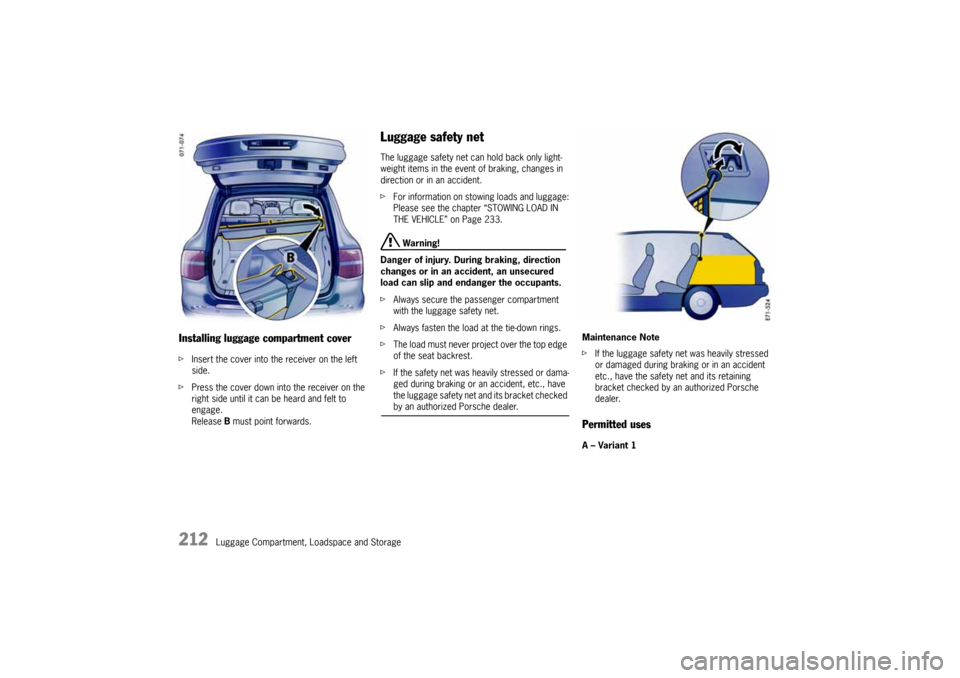
Installing luggage compartment coverfInsert the cover into the receiver on the left
side.
fPress the cover down into the receiver on the
right side until it can be heard and felt to
engage.
Release B must point forwards.
Luggage safety netThe luggage safety net can hold back only light-
weight items in the event of braking, changes in
direction or in an accident.
fFor information on stowing loads and luggage:
Please see the chapter “STOWING LOAD IN
THE VEHICLE” on Page 233.
Warning!
Danger of injury. During braking, direction
changes or in an accident, an unsecured
load can slip and endanger the occupants.
fAlways secure the passenger compartment
with the luggage safety net.
fAlways fasten the load at the tie-down rings.
fThe load must never project over the top edge
of the seat backrest.
fIf the safety net was heavily stressed or dama-
ged during braking or an accident, etc., have
the luggage safety net and its bracket checked by an authorized Porsche dealer.Maintenance Note
fIf the luggage safety net was heavily stressed
or damaged during braking or in an accident
etc., have the safety net and its retaining
bracket checked by an authorized Porsche
dealer.
Permitted usesA – Variant 1
10_Cayenne_21_KW17.book Seite 212 Donnerstag, 9. April 2009 3:33 15
Page 235 of 379

Trailer Hitch
235
Driving with a trailer
When towing a trailer you must under all circum-
stances adapt your speed to prevailing road and
driving conditions. Towing at excessive speed can
result in loss of control. Observe country-specific
laws for driving with trailers.
fCarefully and gradually familiarize yourself with
the handling and braking behavior of the car-
trailer combination.
fDo not drive with the towing vehicle empty and
the trailer loaded.
If this unfavorable combination is unavoidable,
please drive especially slowly.
fBear in mind the different vehicle handling and
size in situations such as braking, parking,
cornering and overtaking, etc.
fThe driving stability of the car-trailer combina-
tion worsens as the speed increases. There-
fore, drive especially slowly on downhill
stretches and in the case of unfavorable road
and weather conditions (such as wind).
fDrive in an appropriately low gear on downhill
stretches in order to make use of the engine
braking effect.fSlow down immediately if the trailer starts to
sway. Do not countersteer; brake if necessary.
Never attempt to straighten out the car-trailer
combination by accelerating.
fActivate Low Range when moving off on steep
slopes.
fUnder no circumstances may people, animals
or objects be in the space between the trailer
and the towing vehicle when the vehicle is
moving.
fWhen reversing, bear in mind that ParkAssist is
not active.
fAlways see the permissible towing capacity,
vertical coupling load and rear-axle load.
Please see the chapter “WEIGHTS” on
Page 356.
Maintenance Note
fPlease take into consideration that driving with
a trailer places markedly greater stress on all
vehicle components. Expert inspection and
maintenance after every use are indispensable
prerequisites for proper functioning and safety.
10_Cayenne_21_KW17.book Seite 235 Donnerstag, 9. April 2009 3:33 15
Page 238 of 379

238
Parking
Front ultrasound sensorsSensors
Six ultrasound sensors in the front and rear
bumpers measure the distance to the closest
obstacle.
– Range of outer sensors
(front and rear):
approx. 24 in. (60 cm)
– Range of front middle sensors (arrow):
approx. 48 in. (120 cm)
Rear ultrasound sensors– Range of rear middle sensors (arrow)
(only in vehicles without spare wheel bracket):
approx. 59 in. (150 cm)
– Range of rear middle sensors
(only in vehicles with spare wheel bracket):
approx. 48 in. (120 cm)
Obstacles cannot be detected in the “blind” sen-
sor area (above and below the sensors).Maintenance Notes
fThe sensors must always be kept free of dust,
ice and snow in order to ensure that they are
fully functional.
fDo not damage sensors by abrasion or
scratching.
fMaintain sufficient distance when cleaning with
steam-jet units.
The sensors will be damaged if the pressure is
too high.
Note on operation
The rear ultrasound sensors may not function
correctly if tires that have not been recommended
by Porsche are fitted on the spare wheel bracket.
If the spare wheel bracket is open, this may impair
the function of the rear ultrasound sensors.
In vehicles that have air suspension with level
control and height adjustment, the system may
not recognize obstacles near the ground at terrain
level or special terrain level.
10_Cayenne_21_KW17.book Seite 238 Donnerstag, 9. April 2009 3:33 15
Page 249 of 379
Maintenance and Car Care
249 Maintenance and Car Care
Exercise Extreme Caution
when Working on your Vehicle ..................... 250
Engine Oil .................................................. 251
Checking Engine Oil Level ........................... 252
Topping up Engine Oil ................................. 253
Coolant Level ............................................. 255
Brake-Fluid Level ........................................ 257
Washer Fluid .............................................. 258
Power Steering .......................................... 259
Changing Air Cleaner.................................. 260
Changing Particle Filter ............................... 260
Automatic Transmission Fluid ...................... 260
Manual Transmission Oil ............................. 260
Wiper Blades ............................................. 261
Emission Control System ............................ 263
How Emission Control Works ...................... 264
Fuel Economy ............................................ 265
Operating Your Porsche in other Countries ... 266
Fuel........................................................... 266
Portable Fuel Containers ............................. 268
Fuel Recommendations............................... 269
Fuel Evaporation Control ............................. 270
Car Care Instructions.................................. 270
10_Cayenne_21_KW17.book Seite 249 Donnerstag, 9. April 2009 3:33 15
Page 250 of 379

250
Maintenance and Car Care
Exercise Extreme Caution when
Working on your Vehicle
Danger!
Ignoring the following instructions may cau-
se serious personal injury or death.
fThe engine compartment of any motor vehicle
is a potentially hazardous area. If you are not
fully familiar with proper repair procedures, do
not attempt the adjustments described on the
following pages.
This caution applies to the entire vehicle.
fO n l y w o r k o n y o u r v e h i c l e o u t d o o r s o r i n a w e l l
ventilated area.
fEnsure that there are no open flames in the
area of your vehicle at any time when fuel
fumes might be present. Be especially
cautious of such devices such as hot water
heaters which ignite a flame intermittently.
fBefore working on any part in the engine
compartment, turn the engine off and let it cool
down sufficiently. Hot engine compartment
components can burn skin on contact.
fBe alert and cautious around engine at all
times while the engine is running.
If you have to work on the engine while it is
running, always put the parking brake on and
put the gearshift lever in neutral or the
Tiptronic selector lever in position P or N.fIn particular, be very careful to ensure that
items of clothing (ties, shirt, sleeves etc.),
jewelry, long hair, hand or fingers cannot get
caught in the fan, belts or other moving parts.
The radiator and radiator fans are in the front
of the car.
The fans can start or continue running as a
function of temperature, even with the engine
switched off.
Carry out work in these areas only with the
engine off and exercise extreme caution.
fYour Porsche is equipped with an electronic
ignition system. When the ignition is on, high
voltage is present in all wires connected with
the ignition system; therefore, exercise
extreme caution when working on any part of
the engine while the ignition is on or the engine
is running.
fAlways support your car with safety stands if it
is necessary to work under the car. The jack
supplied with the car is not adequate for this
purpose.
For vehicles with air suspension with level
control and height adjustment switch off level
control.
Please see the chapter “RAISING VEHICLE
WITH THE JACK” on Page 192.fWhen working under the car without safety
stands but with the wheels on the ground,
make sure the car is on level ground, the
wheels are blocked, and that the engine can-
not be started.
Withdraw ignition keys (switch ignition off in
vehicles that have Porsche Entry & Drive).
fDo not smoke or allow an open flame around
the battery or fuel.
Keep a fire extinguisher close at hand.
fIncomplete or improper servicing may cause
problems in the operation of the car. If in doubt
about any servicing, have it done by your
authorized Porsche dealer.
Improper maintenance during the warranty
period may affect your Porsche warranty
coverage.
fSupplies of fluids, e.g. engine oil, washer fluid,
brake fluid or coolant, are hazardous to your
health.
Keep these fluids out of children's reach and
dispose of them in accordance with the appro-
priate regulations.
fSome countries require additional tools and
special spare parts to be carried in your
vehicle. Please make enquiries before driving
abroad.
10_Cayenne_21_KW17.book Seite 250 Donnerstag, 9. April 2009 3:33 15
Page 251 of 379

Maintenance and Car Care
251
Radiator fansThe radiator and radiator fans are in the front of
the car.
Warning!
Danger of injury. The fans can start running
as a function of temperature, even with the
engine switched off.
fExercise extreme caution when working in the area of the radiator fans.
Engine OilIt is important to perform oil changes regularly in
accordance with the intervals specified in your
Maintenance Schedule.Engine oil consumptionIt is normal for your engine to consume oil.
The rate of oil consumption depends on the quality
and viscosity of oil, the speed at which the engine
is operated, the climate, road conditions as well
as the amount of dilution and oxidation of the
lubricant.
If the vehicle is used for repeated short trips, and
consumes a normal amount of oil, the engine oil
measurement may not show any drop in the oil le-
vel at all, even after 600 miles (1000 km) or more.
This is because the oil is gradually becoming
diluted with fuel or moisture, making it appear that
the oil level has not changed.
The diluting ingredients evaporate out when the
vehicle is driven at high speeds, as on an express-
way, making it then appear that oil is excessively
consumed after driving at high speeds.
If the conditions you drive your vehicle in are
dusty, humid, or hot, the frequency of the oil
change intervals should be greater.If the vehicle is driven at a high rate of speed,
climatic conditions are warm, and the load is high,
the oil should be checked more frequently, as
driving conditions will determine the rate of oil
consumption.
– The engine in your vehicle depends on oil to lu-
bricate and cool all of its moving parts. There-
fore, the engine oil should be checked regular-
ly and kept at the required level.
– Make it a habit to have the engine oil level
checked with every refueling.
– The oil pressure warning light is not an oil level
indicator.
The oil pressure warning light indicates serious
engine damage may be occuring when lit, if
engine rpm is above idle speed.
10_Cayenne_21_KW17.book Seite 251 Donnerstag, 9. April 2009 3:33 15