towing PORSCHE CAYNNE 2010 1.G User Guide
[x] Cancel search | Manufacturer: PORSCHE, Model Year: 2010, Model line: CAYENNE, Model: PORSCHE CAYENNE 2010 1.GPages: 379, PDF Size: 13.91 MB
Page 233 of 379

Trailer Hitch
233
Stowing load in the vehicle
Warning!
Danger of injury.
An unsecured or incorrectly positioned cargo
can slip out of place or endanger the vehicle
occupants during braking, direction changes
or in accidents.
Never transport objects which are not
secured.
fAlways transport cargo in the cargo area,
never in the passenger compartment (e.g. on
or in front of the seats).
fSupport the cargo on the seat backrests
whenever possible. Always lock the backrests
into place.
fPlace the cargo behind unoccupied seats
whenever possible.
fStow heavy objects as close to the front of the
cargo area as possible, with lightweight ob-
jects behind them.
fThe cargo must never project over the top
edge of the seat backrest.
fAlways protect the passenger compartment
with a luggage safety net and a luggage
compartment cover.
Do not drive with objects on top of the luggage
compartment cover.fIf the rear seats are not occupied, the back-
rests can be additionally secured with the safe-
ty belts. Simply cross the outer safety belts
and insert each into the opposite buckle.
fMake sure that the cargo cannot damage the
heating filaments of the rear window and the
TV antenna of the side window.
Luggage net
fLuggage must be stowed completely covered
by the luggage net.
The luggage net can prevent only lightweight
objects from slipping.
Tie-down belts
fDo not use elastic belts or straps to tie down
cargo.
fDo not place belts and straps over sharp
edges.
fObserve the directions for use and information
for the tie-down equipment.
fUse only belts with a tear strength of at least
1543 lbs. (700 kg) and a maximum width of
1in. (25mm).
fCross the belts over the load.Driving
fThe car's handling changes depending on the
vehicle loading. Adapt your driving style to the
changed driving behavior.
fDo not exceed the maximum gross weight and
the axle load.
fPlease see the chapter “WEIGHTS” on
Page 356.
fNever drive with the rear window or rear lid
open.
Exhaust gases can enter the passenger
compartment.
fAdapt the tire pressure to the load.
fPlease see the chapter “SETTING VEHICLE
LOADING AND ADJUSTING TIRE PRESSURE”
on Page 135.
fPlease see the chapter “TIRE PRESSURES,
COLD (68 °F/20 °C)” on Page 354.
10_Cayenne_21_KW17.book Seite 233 Donnerstag, 9. April 2009 3:33 15
Page 234 of 379

234
Tr a i l e r H i t c h
Towing a trailer
Warning!
Driving with a trailer
fAlways see the permissible towing capacity,
vertical coupling load and rear-axle load.
Please see the chapter “WEIGHTS” on
Page 356.
fWhen connected, the trailer must always be
horizontal behind the towing vehicle. If neces-
sary, use a trailer with an adjustable drawbar.
fWhen the vehicle is driven in the mountains, the
engine output decreases as altitude increases.
The maximum weights stated are the values at
sea level. The total permissable weight of the
car-trailer combination must therefore be re-
duced by 10% for each increment of 3,280 ft.
(1,000 meters) altitude. A fractional increment
counts as the full 3,280 ft. (1,000 meters).
Please take this into consideration when plan-
ning your route.Distributing the load
fDistribute the load in the trailer so that heavy
objects are as close to the axle as possible.
Always safeguard all objects against slipping
and tie them down securely.
fYou should make the best possible use of the
trailer coupling's rated vertical coupling load
when loading the trailer, but never exceed it.
Tire pressure
fSelect the vehicle tire pressure for full load
when towing a trailer.
fPlease see the chapter “TIRE PRESSURES,
COLD (68 °F/20 °C)” on Page 354.
fCheck the tire pressure of the trailer's wheels
according to the manufacturer's instructions.Door mirrors
fIf the width of the trailer obstructs your view of
the traffic behind the trailer, you must have
additional door mirrors fitted.
Headlights, lights
fAlways check the headlight adjustment before
driving with a trailer.
If necessary, correct with the headlight beam
adjustment function.
fCheck whether the plug of the trailer is
plugged into the towing vehicle and whether all
lights function.
10_Cayenne_21_KW17.book Seite 234 Donnerstag, 9. April 2009 3:33 15
Page 235 of 379

Trailer Hitch
235
Driving with a trailer
When towing a trailer you must under all circum-
stances adapt your speed to prevailing road and
driving conditions. Towing at excessive speed can
result in loss of control. Observe country-specific
laws for driving with trailers.
fCarefully and gradually familiarize yourself with
the handling and braking behavior of the car-
trailer combination.
fDo not drive with the towing vehicle empty and
the trailer loaded.
If this unfavorable combination is unavoidable,
please drive especially slowly.
fBear in mind the different vehicle handling and
size in situations such as braking, parking,
cornering and overtaking, etc.
fThe driving stability of the car-trailer combina-
tion worsens as the speed increases. There-
fore, drive especially slowly on downhill
stretches and in the case of unfavorable road
and weather conditions (such as wind).
fDrive in an appropriately low gear on downhill
stretches in order to make use of the engine
braking effect.fSlow down immediately if the trailer starts to
sway. Do not countersteer; brake if necessary.
Never attempt to straighten out the car-trailer
combination by accelerating.
fActivate Low Range when moving off on steep
slopes.
fUnder no circumstances may people, animals
or objects be in the space between the trailer
and the towing vehicle when the vehicle is
moving.
fWhen reversing, bear in mind that ParkAssist is
not active.
fAlways see the permissible towing capacity,
vertical coupling load and rear-axle load.
Please see the chapter “WEIGHTS” on
Page 356.
Maintenance Note
fPlease take into consideration that driving with
a trailer places markedly greater stress on all
vehicle components. Expert inspection and
maintenance after every use are indispensable
prerequisites for proper functioning and safety.
10_Cayenne_21_KW17.book Seite 235 Donnerstag, 9. April 2009 3:33 15
Page 271 of 379

Maintenance and Car Care
271
High-pressure cleaning equipment, steam
cleaners
Warning!
High-pressure cleaning equipment, steam
cleaners or similar can damage the following
components:
–Tires
– Logos, emblems
– Painted surfaces
– Widened fenders
– Lock and latch of the removable towing attach-
ment
– Seals of the electrically retractable ball hitch
– Alternator, valve covers
– ParkAssist sensors
fPlease see the operating instructions from the
unit manufacturer.
fAlways cover the lid over the brake fluid reser-
voir prior to cleaning. Never point the cleaning
jet directly at the lid.
fWhen cleaning with a flat-jet nozzle or the like,
maintain a minimum distance of 21 in.
(50 cm).fNever use high-pressure cleaning equipment,
steam cleaners, etc. with a round-jet nozzle.
High-pressure cleaning equipment with a round
nozzle will damage your vehicle. The tires are
particularly susceptible to damage.
fDo not point the cleaning jet directly at any of
the aforementioned components.
Decorative foils Caution!
Risk of damage due to separation of the de-
corative foils when using high-pressure clea-
ning equipment, steam cleaners or similar
cleaning equipment.
fDo not use high-pressure cleaning equipment, steam cleaners, etc. to clean decorative foils.
Door lockfTo prevent the door lock from freezing during
the cold season, cover the lock barrel with a
suitable adhesive tape during washing.
Should the locks freeze, use an ordinary de-icer.
In many cases, a well warmed key can help.
Never use excessive force.
WashingThe best protection for the car from the damaging
effects of the environment is frequent washing and
preservation. The underside of the car should also
be thoroughly washed for cinders, salt or sanding
at winter‘s end.
The longer salt, road dust, industrial dust, insect
remains, bird excrement, and tree exudations
(resin, pollen), etc. are allowed to remain on the
bodywork, the more serious is their harmful
effect.
New cars should be washed carefully with plenty
of clear water to protect the new paint work.
Dark paint finishes show up the smallest of sur-
face damage (e.g. scratches) more readily than
lighter colors.
Dark colors are also more susceptible to scrat-
ching because of the composition of their pig-
ments and require particularly careful paint care.
fDo not wash your car in bright sunlight or while
the bodywork is still hot.
fWhen washing by hand, use abundant water, a
soft sponge or wash brush and Porsche car
shampoo.
fBegin by spraying the body thoroughly with
water to rinse away loose dirt.
fAfter washing, rinse the car with plenty of
water and then dry with a chamois leather.
Do not use the same chamois leather for
drying as you use for cleaning the windshield
and windows.
10_Cayenne_21_KW17.book Seite 271 Donnerstag, 9. April 2009 3:33 15
Page 279 of 379
Minor Repairs
279 Minor Repairs
Exercise Extreme Caution
when Working on your Vehicle ..................... 280
Tires/Wheels ............................................. 281
Jack .......................................................... 291
Tool Kit ..................................................... 292
Compressor .............................................. 292
Spacers .................................................... 293
Wheel Bolts ............................................... 293
Changing Wheels........................................ 294
Flat Tire ..................................................... 295
Lifting the Vehicle
with a Lifting Platform or Garage lift ............. 298
Electrical System ....................................... 312
Battery ...................................................... 320
Replacing the remote control battery ........... 322
Emergency Starting with Jumper Cables ...... 323
Replacing Bulbs ......................................... 326
Headlights ................................................. 327
Tail light .................................................... 336
License Plate Lights................................... 338
Headlight Adjustment.................................. 339
Changing headlights
from left to right-hand traffic ....................... 340
Bulb Chart ................................................. 342
Towing ...................................................... 342
10_Cayenne_21_KW17.book Seite 279 Donnerstag, 9. April 2009 3:33 15
Page 311 of 379
Minor Repairs
311
Closing spare wheel bracket
Warning!
Danger of injury and risk of accident if the
spare wheel bracket is operated improperly.
fOperate the spare wheel bracket only using
button B.
fIf the vehicle is tilted to the side, more effort
will be required to swing the spare wheel
bracket.
fMake sure that no persons or animals are
within the range of movement of the spare wheel bracket.
1. Check whether additional lock C is engaged. If
necessary, slide additional lock C to the right.
2. Swing spare wheel bracket closed with force.
3. Check lock and observe indication on the multi-
purpose display of the instrument panel.
The indicator light must go out when the spare
wheel bracket is locked.
Automatic locking
In the multi-purpose display of the instrument
panel, you can set different variants of locking and
unlocking the doors and the rear lid as well as the
check-back signal when locking and unlocking the
vehicle and save them on the respective remote
control.
fPlease see the chapter “SETTING REAR LID
LOCKING” on Page 144.
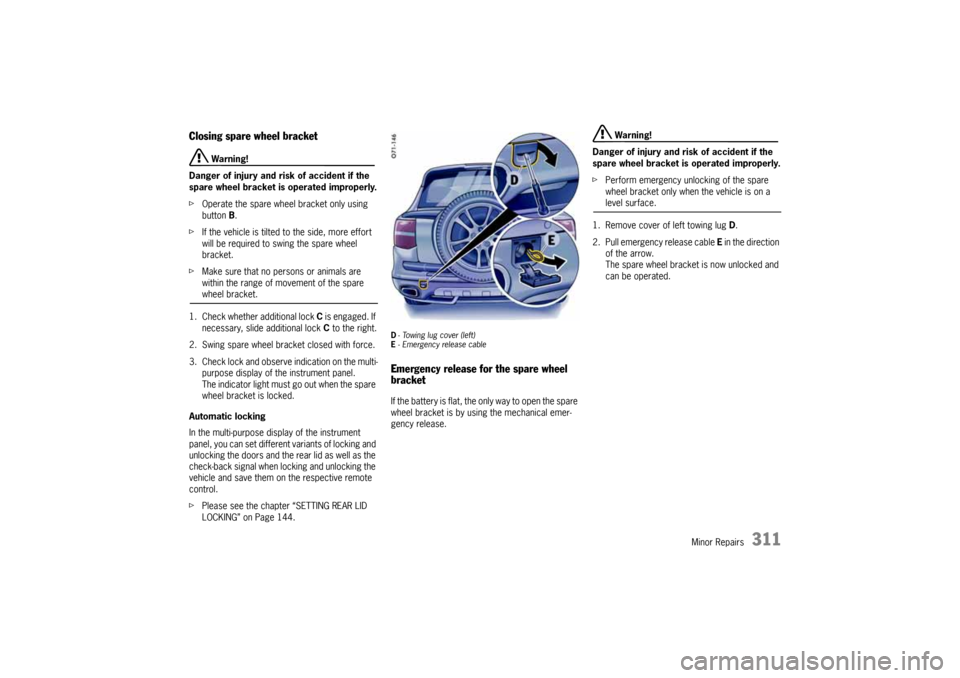
D- Towing lug cover (left)
E- Emergency release cableEmergency release for the spare wheel
bracketIf the battery is flat, the only way to open the spare
wheel bracket is by using the mechanical emer-
gency release.
Warning!
Danger of injury and risk of accident if the
spare wheel bracket is operated improperly.
fPerform emergency unlocking of the spare
wheel bracket only when the vehicle is on a level surface.
1. Remove cover of left towing lug D.
2. Pull emergency release cable E in the direction
of the arrow.
The spare wheel bracket is now unlocked and
can be operated.
10_Cayenne_21_KW17.book Seite 311 Donnerstag, 9. April 2009 3:33 15
Page 323 of 379

Minor Repairs
323
Emergency Starting with Jumper
CablesIf the battery is discharged, e.g. in winter or after
the car has been parked for a long time, the bat-
tery of another car can be used for starting with
the help of jumper cables.
Make sure the voltage of both batteries is the
same.
The capacity (Ampere hours, Ah) of the booster
battery must not be substantially less than that of
the discharged battery.The discharged battery
must be correctly connected to the vehicle's elec-
trical system.
fPlease see the chapter “BATTERY” on
Page 320.
Note
Do not try to start the car by pushing or towing.
Damage to the catalytic converters and other
components of the car may result.
Danger!
Risk of short circuit, damage and explosion,
resulting in serious personal injury or death.
fUse only jumper cables of adequate diameter
cross-section and fitted with completely
insulated alligator clips.
fFollow all warnings and instructions of the
jumper cable manufacturer.
fWhen connecting jumper cables, make sure
that they cannot get caught in any moving
parts in the engine compartment.
The jumper cables must be long enough so
that neither vehicles nor cables touch another.
fThe vehicles must not be in contact, otherwise
current might flow as soon as the positive
terminals are connected.
fThe cable clamps must not be allowed to con-
tact each other when one end of the jumper ca-
bles are connected to a battery.
fCarefully ensure that tools or conductive jewe-
lery (rings, chains, watch straps) do not come
into contact with the positive jumper cable or
the positive battery post.
fImproper hook-up of jumper cables can ruin
the alternator.
Danger of caustic burns.
fDo not lean over the battery.Danger of gas explosion.
fImproper use of booster battery to start a
vehicle may cause an explosion, resulting in
serious personal injury or death.
fKeep sources of ignition away from the
battery, e.g. open flame, burning cigarettes or
sparking due to cable contact or welding work.
fA discharged battery can freeze even at
14 °F (−10 °C). Before connecting jumper
cables, a frozen battery must be thawed out.
10_Cayenne_21_KW17.book Seite 323 Donnerstag, 9. April 2009 3:33 15
Page 342 of 379
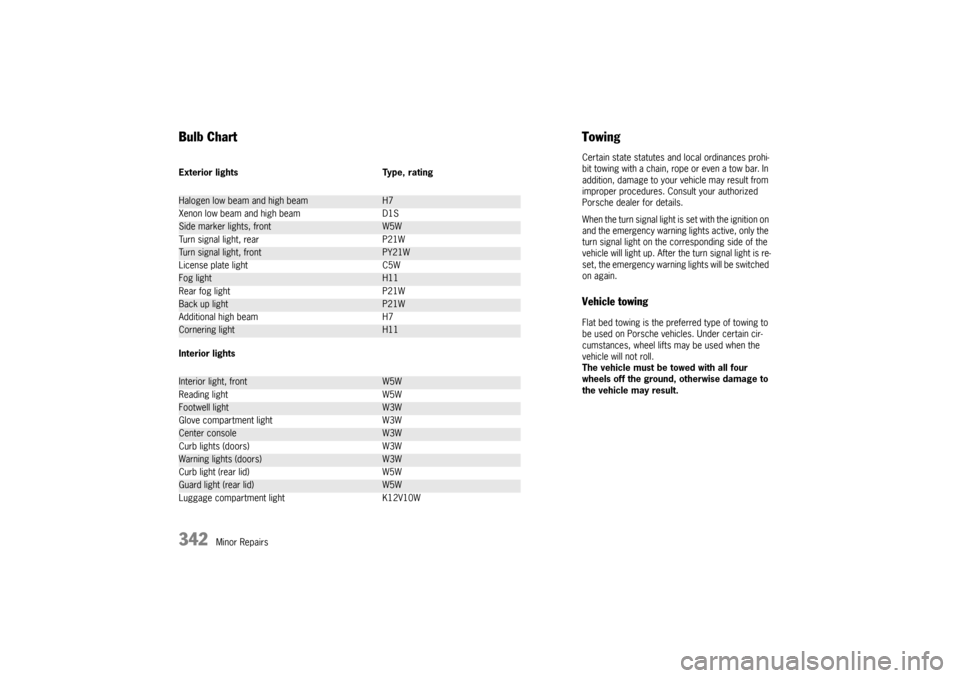
342
Minor Repairs
Bulb ChartExterior lights Type, ratingHalogen low beam and high beam
H7
Xenon low beam and high beam D1S
Side marker lights, front
W5W
Turn signal light, rear P21W
Turn signal light, front
PY21W
License plate light C5W
Fog light
H11
Rear fog light P21W
Back up light
P21W
Additional high beam H7
Cornering light
H11
Interior lights
Interior light, front
W5W
Reading light W5W
Footwell light
W3W
Glove compartment light W3W
Center console
W3W
Curb lights (doors) W3W
Warning lights (doors)
W3W
Curb light (rear lid) W5W
Guard light (rear lid)
W5W
Luggage compartment light K12V10W
TowingCertain state statutes and local ordinances prohi-
bit towing with a chain, rope or even a tow bar. In
addition, damage to your vehicle may result from
improper procedures. Consult your authorized
Porsche dealer for details.
When the turn signal light is set with the ignition on
and the emergency warning lights active, only the
turn signal light on the corresponding side of the
vehicle will light up. After the turn signal light is re-
set, the emergency warning lights will be switched
on again.Vehicle towingFlat bed towing is the preferred type of towing to
be used on Porsche vehicles. Under certain cir-
cumstances, wheel lifts may be used when the
vehicle will not roll.
The vehicle must be towed with all four
wheels off the ground, otherwise damage to
the vehicle may result.
10_Cayenne_21_KW17.book Seite 342 Donnerstag, 9. April 2009 3:33 15
Page 343 of 379
Minor Repairs
343
Towing hookDepending on the vehicle equipment, the spare-
wheel well contains one or two towing hooks.
Caution!
Risk of damage to the vehicle.
fUse the towing hook only for an emergency to
remove the vehicle off the road. The towing
hook is to be used only to pull the vehicle onto
the flat bed, tractor or towing aparatus if the
vehicle will roll freely. Under no circumstances
is the vehicle to be secured using the towing
hook.
fNever use the towing hook to tow this or any other vehicle.
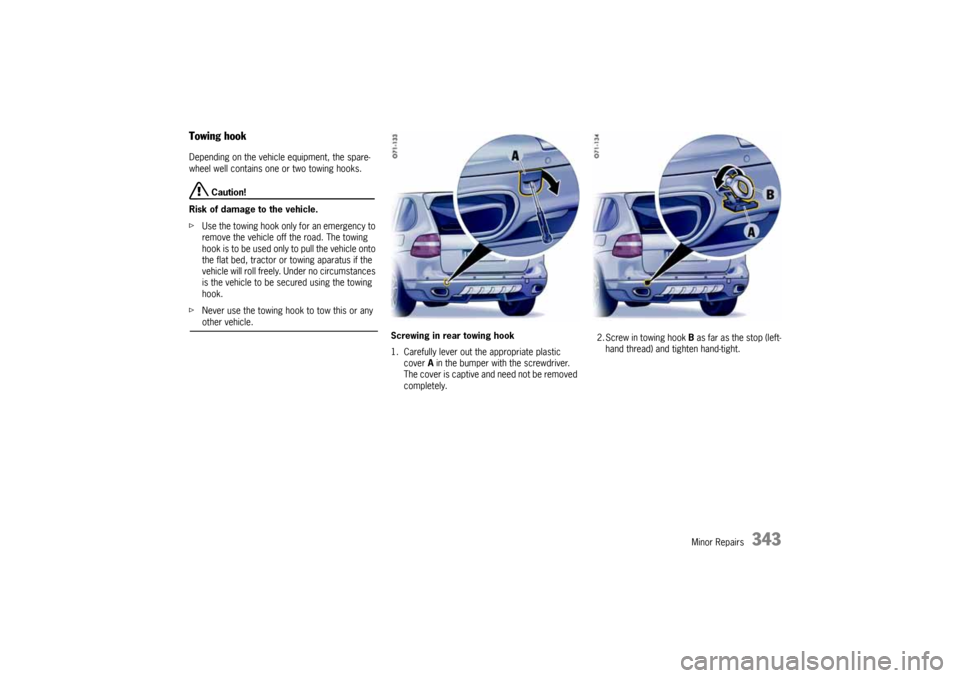
Screwing in rear towing hook
1. Carefully lever out the appropriate plastic
cover A in the bumper with the screwdriver.
The cover is captive and need not be removed
completely.2. Screw in towing hook B as far as the stop (left-
hand thread) and tighten hand-tight.
10_Cayenne_21_KW17.book Seite 343 Donnerstag, 9. April 2009 3:33 15
Page 344 of 379
344
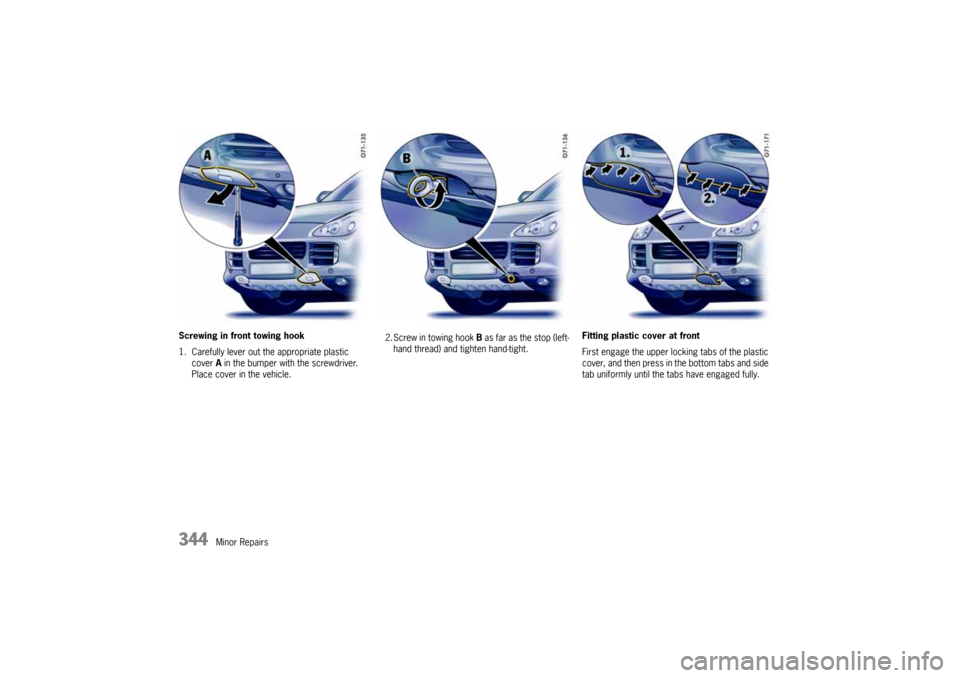
Minor Repairs Screwing in front towing hook
1. Carefully lever out the appropriate plastic
cover A in the bumper with the screwdriver.
Place cover in the vehicle.2. Screw in towing hook B as far as the stop (left-
hand thread) and tighten hand-tight.Fitting plastic cover at front
First engage the upper locking tabs of the plastic
cover, and then press in the bottom tabs and side
tab uniformly until the tabs have engaged fully.
10_Cayenne_21_KW17.book Seite 344 Donnerstag, 9. April 2009 3:33 15