battery PORSCHE CAYNNE 2010 1.G Owner's Manual
[x] Cancel search | Manufacturer: PORSCHE, Model Year: 2010, Model line: CAYENNE, Model: PORSCHE CAYENNE 2010 1.GPages: 379, PDF Size: 13.91 MB
Page 220 of 379

220
Luggage Compartment, Loadspace and Storage If aftermarket systems are installed by non-dealer-
ship technicians or outside the selling dealer,
problems may result. Installation of aftermarket
equipment is not covered under the New Car
Warranty.
fConsult your authorized Porsche dealer about
the installation of non Porsche approved equip-
ment.
Reception quality
The reception quality of your car telephone will
change constantly when you are driving. Interfe-
rence caused by buildings, landscape and wea-
ther is unavoidable. It may become particularly
difficult to hear when using the hands-free function
due to external noise such as engine and wind
noise.
Automatic car-wash
fUnscrew external antennas before using an au-
tomatic car-wash.
Porsche Communication
Management (PCM)
Warning!
There is danger of accident if you set or
operate the on-board computer, radio, navi-
gation system, telephone or other equipment
when driving.
This could distract you from traffic and
cause you to lose control of the vehicle re-
sulting in serious personal injury or death.
fOperate the components while driving only if
the traffic situation allows you to do so safely.
fCarry out any complicated operating or setting
procedures only with the vehicle stationary.
fIf it is necessary to operate these components
while the vehicle is in motion, use the function keys on the multi-functional steering wheel.
fRefer to the separate operating instructions
before putting the PCM into operation.
When put into operation for the first time, a
distance of approx. 3 miles (5 km) must be driven
in order for the navigation system to complete the
process of fine calibration. The same applies
when the tires are changed (e.g. summer/winter
tires) or new tires fitted. Full location accuracy is
not yet achieved during the fine-calibration
process.If the vehicle has been transported (e.g. ferry, car
train), the system may take a few minutes after
being switched on before it determines the current
location.
Serious tire slip (e.g. spinning wheels on snow)
may result in temporarily inaccurate navigation.
When the battery has been disconnected, it may
take up to 15 minutes before the navigation
system is operational once more.
Satellite radioYou must have the satellite radio activated before
you can put it into operation. You will need a
contract with a provider in order to use this radio.
fRefer to the separate radio operating instruc-
tions before putting into operation.
10_Cayenne_21_KW17.book Seite 220 Donnerstag, 9. April 2009 3:33 15
Page 243 of 379
Parking
243
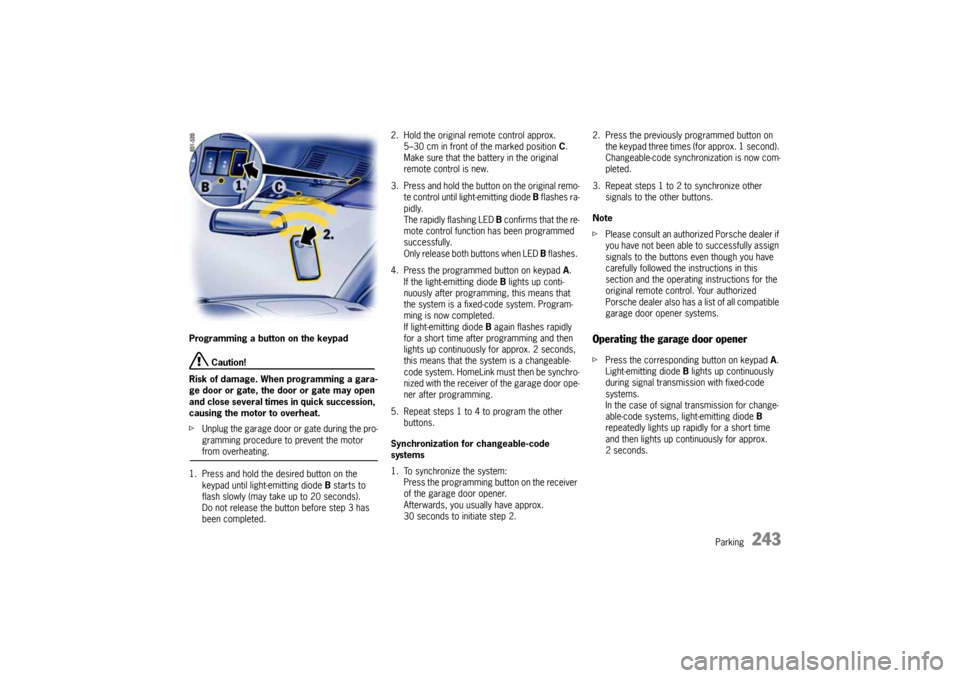
Programming a button on the keypad
Caution!
Risk of damage. When programming a gara-
ge door or gate, the door or gate may open
and close several times in quick succession,
causing the motor to overheat.
fUnplug the garage door or gate during the pro-
gramming procedure to prevent the motor from overheating.
1. Press and hold the desired button on the
keypad until light-emitting diode B starts to
flash slowly (may take up to 20 seconds).
Do not release the button before step 3 has
been completed.2. Hold the original remote control approx.
5–30 cm in front of the marked position C.
Make sure that the battery in the original
remote control is new.
3. Press and hold the button on the original remo-
te control until light-emitting diode B flashes ra-
pidly.
The rapidly flashing LED B confirms that the re-
mote control function has been programmed
successfully.
Only release both buttons when LED B flashes.
4. Press the programmed button on keypad A.
If the light-emitting diode B lights up conti-
nuously after programming, this means that
the system is a fixed-code system. Program-
ming is now completed.
If light-emitting diode B again flashes rapidly
for a short time after programming and then
lights up continuously for approx. 2 seconds,
this means that the system is a changeable-
code system. HomeLink must then be synchro-
nized with the receiver of the garage door ope-
ner after programming.
5. Repeat steps 1 to 4 to program the other
buttons.
Synchronization for changeable-code
systems
1. To synchronize the system:
Press the programming button on the receiver
of the garage door opener.
Afterwards, you usually have approx.
30 seconds to initiate step 2.2. Press the previously programmed button on
the keypad three times (for approx. 1 second).
Changeable-code synchronization is now com-
pleted.
3. Repeat steps 1 to 2 to synchronize other
signals to the other buttons.
Note
fPlease consult an authorized Porsche dealer if
you have not been able to successfully assign
signals to the buttons even though you have
carefully followed the instructions in this
section and the operating instructions for the
original remote control. Your authorized
Porsche dealer also has a list of all compatible
garage door opener systems.
Operating the garage door openerfPress the corresponding button on keypad A.
Light-emitting diode B lights up continuously
during signal transmission with fixed-code
systems.
In the case of signal transmission for change-
able-code systems, light-emitting diode B
repeatedly lights up rapidly for a short time
and then lights up continuously for approx.
2seconds.
10_Cayenne_21_KW17.book Seite 243 Donnerstag, 9. April 2009 3:33 15
Page 250 of 379

250
Maintenance and Car Care
Exercise Extreme Caution when
Working on your Vehicle
Danger!
Ignoring the following instructions may cau-
se serious personal injury or death.
fThe engine compartment of any motor vehicle
is a potentially hazardous area. If you are not
fully familiar with proper repair procedures, do
not attempt the adjustments described on the
following pages.
This caution applies to the entire vehicle.
fO n l y w o r k o n y o u r v e h i c l e o u t d o o r s o r i n a w e l l
ventilated area.
fEnsure that there are no open flames in the
area of your vehicle at any time when fuel
fumes might be present. Be especially
cautious of such devices such as hot water
heaters which ignite a flame intermittently.
fBefore working on any part in the engine
compartment, turn the engine off and let it cool
down sufficiently. Hot engine compartment
components can burn skin on contact.
fBe alert and cautious around engine at all
times while the engine is running.
If you have to work on the engine while it is
running, always put the parking brake on and
put the gearshift lever in neutral or the
Tiptronic selector lever in position P or N.fIn particular, be very careful to ensure that
items of clothing (ties, shirt, sleeves etc.),
jewelry, long hair, hand or fingers cannot get
caught in the fan, belts or other moving parts.
The radiator and radiator fans are in the front
of the car.
The fans can start or continue running as a
function of temperature, even with the engine
switched off.
Carry out work in these areas only with the
engine off and exercise extreme caution.
fYour Porsche is equipped with an electronic
ignition system. When the ignition is on, high
voltage is present in all wires connected with
the ignition system; therefore, exercise
extreme caution when working on any part of
the engine while the ignition is on or the engine
is running.
fAlways support your car with safety stands if it
is necessary to work under the car. The jack
supplied with the car is not adequate for this
purpose.
For vehicles with air suspension with level
control and height adjustment switch off level
control.
Please see the chapter “RAISING VEHICLE
WITH THE JACK” on Page 192.fWhen working under the car without safety
stands but with the wheels on the ground,
make sure the car is on level ground, the
wheels are blocked, and that the engine can-
not be started.
Withdraw ignition keys (switch ignition off in
vehicles that have Porsche Entry & Drive).
fDo not smoke or allow an open flame around
the battery or fuel.
Keep a fire extinguisher close at hand.
fIncomplete or improper servicing may cause
problems in the operation of the car. If in doubt
about any servicing, have it done by your
authorized Porsche dealer.
Improper maintenance during the warranty
period may affect your Porsche warranty
coverage.
fSupplies of fluids, e.g. engine oil, washer fluid,
brake fluid or coolant, are hazardous to your
health.
Keep these fluids out of children's reach and
dispose of them in accordance with the appro-
priate regulations.
fSome countries require additional tools and
special spare parts to be carried in your
vehicle. Please make enquiries before driving
abroad.
10_Cayenne_21_KW17.book Seite 250 Donnerstag, 9. April 2009 3:33 15
Page 265 of 379

Maintenance and Car Care
265
The catalytic converters will be damaged by:
– push or tow starting the vehicle
– misfiring of the engine
– turning off the ignition while the vehicle is
moving or
– driving until the fuel tank is completely empty
– by other unusual operating conditions.
fDo not continue to operate your vehicle under
these conditions, since raw fuel might reach
the catalytic converters. This could result in
overheating of the converters. Federal law
prohibits use of leaded fuel in this car.
Fuel EconomyFuel economy will vary depending on where,
when and how you drive, optional equipment
installed, and the general condition of your
car.
A car tuned to specifications and correctly
maintained, will help you to achieve optimal
fuel economy.
fHave your vehicle tuned to specifications. Air
cleaner should be dirt free to allow proper
engine “breathing”.
Battery should be fully charged.
Wheels should be properly aligned.
Tires should be inflated to the correct
pressure.
fAlways monitor your fuel consumption.
fDrive smoothly, avoid abrupt changes in speed
as much as possible.
fAvoid jack rabbit starts and sudden stops.
fDo not drive longer than necessary in the lower
gears. Shifting into a higher gear early without
lugging the engine will help save fuel.
fProlonged “warm up” idling wastes gas. Start
the vehicle just before you are ready to drive.
Accelerate slowly and smoothly.fSwitch off the engine if stationary for longer
periods.
fAny additional weight carried in the vehicle
re d u c e s f u e l e c o n o m y. A l w a ys k e e p c a rg o t o a
minimum and remove all unnecessary items.
fOrganize your trips to take in several errands
in one trip.
fAll electrical accessories contribute to
increased fuel consumption.
fOnly switch on the air conditioning when neces-
sary.
fDo not drive with the Roof Transport System
mounted unless you need it.
The EPA estimated miles per gallon (mpg) is
to be used for comparison purposes, actual
mileage may be different from the estimated
mpg, depending on your driving speed,
weather conditions and trip length. Your
actual highway mileage will probably be less
than the estimated mpg.
fPlease see all local and national speed limits.
10_Cayenne_21_KW17.book Seite 265 Donnerstag, 9. April 2009 3:33 15
Page 278 of 379

278
Maintenance and Car Care
Cleaning AlcantarafDo not use a leather care product to clean
Alcantara.
For regular care it is sufficient to clean the cover
with a soft brush. Heavy abrasion or rubbing when
cleaning causes a permanent change in the
surface.
Cleaning when lightly soiled
fWet a soft cloth with water or a neutral soap
solution and wipe off the dirt.
Cleaning when heavily soiled
fWet a soft cloth with lukewarm water or
thinned white spirit and dab the dirt from the
outside in.Cleaning safety beltsfUse mild detergent to clean soiled belts.
fWhen drying, avoid direct sunlight.
fOnly use suitable cleaning agents.
fDo not tint or bleach the belts.
The belt fabric could be weakened, thus affec-
ting safety.
Storing your PorscheIf you intend to store your Porsche for a prolonged
period, please consult your authorized Porsche
dealer. The staff will be glad to advise you on the
most suitable and necessary methods.
fClean your vehicle thoroughly inside and out-
side. Clean the engine compartment. The
under carriage and chassis components
should be free of dirt and salt deposits.
fFill up the fuel tank.
fChange the oil and oil filter, and run the engine
for several minutes.
fIncrease the tire pressure to 58 psi (4 bar). It
is not recommended to lift the vehicle, due to
the possibility of corrosion on shock absorber
piston shafts.The vehicle should be moved
slightly, approximately every four weeks, to
prevent flat spot on the tires.
Climate control
The air conditioning system should be in good
working condition and fully charged.
Windshield/Headlight washer
fCheck and correct antifreeze/cleaning solution
level as necessary.Electrical system
fRemove the battery from the vehicle and store
it in a cool dry place, not on a cement floor.
When the battery is disconnected, the alarm
system is deactivated.
fRecharge the battery every 3 months. If the
battery remains in the vehicle with the cables
connected, it is necessary to check, remove
and recharge the battery every 2-3 weeks.
Do not fast charge the battery.
fPlease see the chapter “CHARGE STATE” on
Page 320.
Vehicle interior
The interior must be dry, especially in the area of
the floor carpets. The use of drying agents (Silica-
Gel) is recommended in vehicles with leather inte-
rior and in areas with high humidity. The recom-
mended amount is 3 fabric bags of 1.1 lbs.
(500 grams) each placed on the floor carpets.
fWindows, doors, lids and roof must be closed.
The air vents should be opened.
10_Cayenne_21_KW17.book Seite 278 Donnerstag, 9. April 2009 3:33 15
Page 279 of 379
Minor Repairs
279 Minor Repairs
Exercise Extreme Caution
when Working on your Vehicle ..................... 280
Tires/Wheels ............................................. 281
Jack .......................................................... 291
Tool Kit ..................................................... 292
Compressor .............................................. 292
Spacers .................................................... 293
Wheel Bolts ............................................... 293
Changing Wheels........................................ 294
Flat Tire ..................................................... 295
Lifting the Vehicle
with a Lifting Platform or Garage lift ............. 298
Electrical System ....................................... 312
Battery ...................................................... 320
Replacing the remote control battery ........... 322
Emergency Starting with Jumper Cables ...... 323
Replacing Bulbs ......................................... 326
Headlights ................................................. 327
Tail light .................................................... 336
License Plate Lights................................... 338
Headlight Adjustment.................................. 339
Changing headlights
from left to right-hand traffic ....................... 340
Bulb Chart ................................................. 342
Towing ...................................................... 342
10_Cayenne_21_KW17.book Seite 279 Donnerstag, 9. April 2009 3:33 15
Page 280 of 379

280
Minor Repairs
Exercise Extreme Caution when
Working on your Vehicle
Danger!
Ignoring the following instructions may cau-
se serious personal injury or death.
fThe engine compartment of any motor vehicle
is a potentially hazardous area. If you are not
fully familiar with proper repair procedures, do
not attempt the adjustments described on the
following pages.
This caution applies to the entire vehicle.
fO n l y w o r k o n y o u r v e h i c l e o u t d o o r s o r i n a w e l l
ventilated area.
fEnsure that there are no open flames in the
area of your vehicle at any time when fuel
fumes might be present. Be especially
cautious of such devices such as hot water
heaters which ignite a flame intermittently.
fBefore working on any part in the engine com-
partment, turn the engine off and let it cool
down sufficiently. Hot engine compartment
components can burn skin on contact.
fBe alert and cautious around engine at all
times while the engine is running.
If you have to work on the engine while it is run-
ning, always put the parking brake on and put
the gearshift lever in neutral or the Tiptronic
selector lever in position P or N.fIn particular, be very careful to ensure that
items of clothing (ties, shirt, sleeves etc.),
jewelry, long hair, hand or fingers cannot get
caught in the engine-compartment blower, fan,
belts or other moving parts.
The radiator and radiator fans are in the front
of the car.
The fans can start or continue running as a
function of temperature, even with the engine
switched off.
Carry out work in these areas only with the
engine off and exercise extreme caution.
fYour Porsche is equipped with an electronic
ignition system. When the ignition is on, high
voltage is present in all wires connected with
the ignition system; therefore, exercise
extreme caution when working on any part of
the engine while the ignition is on or the engine
is running.
fAlways support your car with safety stands if it
is necessary to work under the car. The jack
supplied with the car is not adequate for this
purpose.
For vehicles with air suspension with level
control and height adjustment:
Please see the chapter “RAISING VEHICLE
WITH THE JACK” on Page 192.fWhen working under the car without safety
stands but with the wheels on the ground,
make sure the car is on level ground, the
wheels are blocked, and that the engine can-
not be started.
Remove the ignition key.
fDo not smoke or allow an open flame around
the battery or fuel.
Keep a fire extinguisher close at hand.
fIncomplete or improper servicing may cause
problems in the operation of the car. If in doubt
about any servicing, have it done by your
authorized Porsche dealer.
Improper maintenance during the warranty
period may affect your Porsche warranty
coverage.
fSupplies of fluids, e.g. engine oil, brake fluid or
coolant, are hazardous to your health. Keep
these fluids out of children's reach and dispose
of them in accordance with the appropriate
regulations.
fSome countries require additional tools and
special spare parts to be carried in your vehi-
cle.
Please make enquiries before driving abroad.
10_Cayenne_21_KW17.book Seite 280 Donnerstag, 9. April 2009 3:33 15
Page 311 of 379
Minor Repairs
311
Closing spare wheel bracket
Warning!
Danger of injury and risk of accident if the
spare wheel bracket is operated improperly.
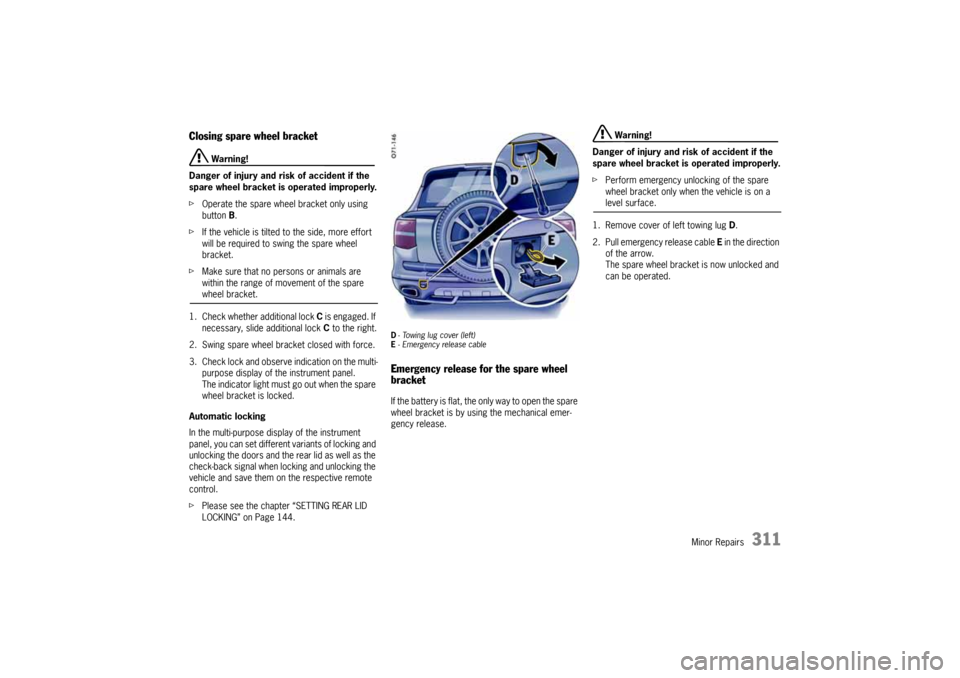
fOperate the spare wheel bracket only using
button B.
fIf the vehicle is tilted to the side, more effort
will be required to swing the spare wheel
bracket.
fMake sure that no persons or animals are
within the range of movement of the spare wheel bracket.
1. Check whether additional lock C is engaged. If
necessary, slide additional lock C to the right.
2. Swing spare wheel bracket closed with force.
3. Check lock and observe indication on the multi-
purpose display of the instrument panel.
The indicator light must go out when the spare
wheel bracket is locked.
Automatic locking
In the multi-purpose display of the instrument
panel, you can set different variants of locking and
unlocking the doors and the rear lid as well as the
check-back signal when locking and unlocking the
vehicle and save them on the respective remote
control.
fPlease see the chapter “SETTING REAR LID
LOCKING” on Page 144.
D- Towing lug cover (left)
E- Emergency release cableEmergency release for the spare wheel
bracketIf the battery is flat, the only way to open the spare
wheel bracket is by using the mechanical emer-
gency release.
Warning!
Danger of injury and risk of accident if the
spare wheel bracket is operated improperly.
fPerform emergency unlocking of the spare
wheel bracket only when the vehicle is on a level surface.
1. Remove cover of left towing lug D.
2. Pull emergency release cable E in the direction
of the arrow.
The spare wheel bracket is now unlocked and
can be operated.
10_Cayenne_21_KW17.book Seite 311 Donnerstag, 9. April 2009 3:33 15
Page 312 of 379
312
Minor Repairs
Electrical SystemIn order to avoid damage and faults in electrical or
electronic systems, electrical accessories should
be installed at your authorized Porsche dealer.
fUse only accessories authorized by Porsche.
Warning!
Risk of short circuit and fire, resulting in
serious personal injury or death.
Replacing fuses or relays with engine running
or the ignition on could cause electrical
shock.
fDisconnect the negative terminal on the
battery during all work on the electrical sys-tem.
RelaysRelays should be checked or changed only by an
authorized workshop.
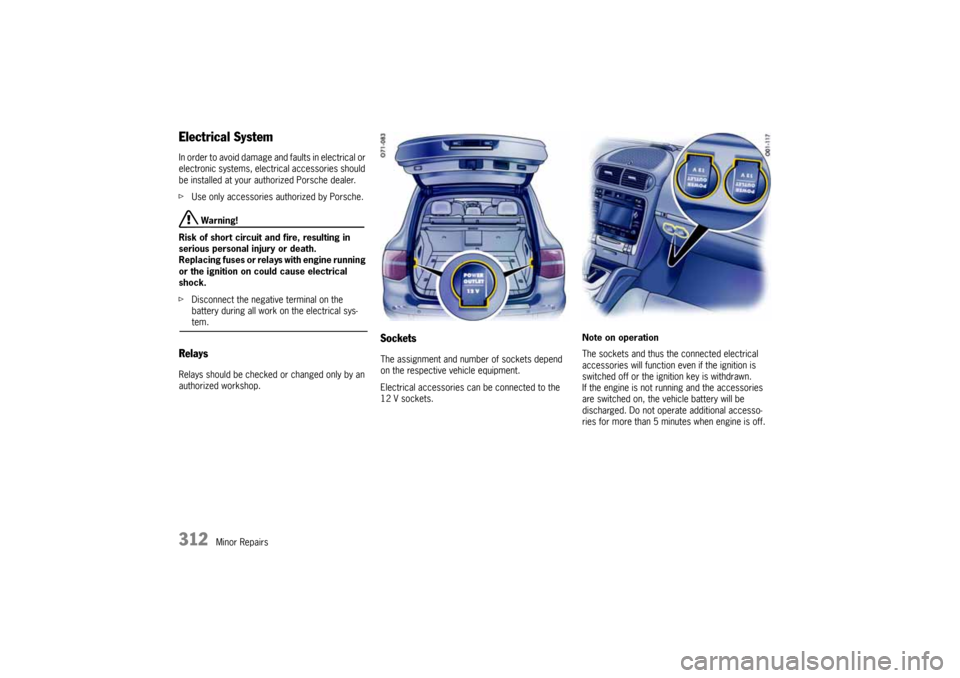
SocketsThe assignment and number of sockets depend
on the respective vehicle equipment.
Electrical accessories can be connected to the
12 V sockets.Note on operation
The sockets and thus the connected electrical
accessories will function even if the ignition is
switched off or the ignition key is withdrawn.
If the engine is not running and the accessories
are switched on, the vehicle battery will be
discharged. Do not operate additional accesso-
ries for more than 5 minutes when engine is off.
10_Cayenne_21_KW17.book Seite 312 Donnerstag, 9. April 2009 3:33 15
Page 320 of 379

320
Minor Repairs
Battery
Danger!
Risk of short circuit and fire, resulting in
serious personal injury or death.
fObserve all warning notes on the battery.
fDisconnect the negative terminal on the
battery during all work on the electrical sys-
tem.
fDo not lay tools or other metal objects on the
battery as they could cause a short circuit
across the battery terminal.
Hydrogen gas generated by the battery
could cause an explosion, resulting in
serious personal injury or death.
fCharge battery in a well vetilated area.
fNever charge a frozen battery. It may explode
because of gas trapped in the ice. Allow a fro-
zen battery to thaw out first.
fDo not expose the battery to an open flame,
electrical spark or a lit cigarette.
Risk of explosion as a result of static charge,
resulting in serious personal injury or death.
fDo not wipe the battery with a dry cloth.
fBefore touching the battery, discharge any
static electricity by touching the vehicle.Risk of serious personal injury or death and
damage to the fabric, metal or paint.
fWear eye protection.
fDo not allow battery acid to come in contact
with your skin, eyes, fabric or painted sur-
faces.
fIf you get electrolyte, which is an acid, in your
eyes or on your skin, immediately rinse with
cold water for several minutes and call a
doctor.
fSpilled electrolyte must be rinsed off at once
with a solution of baking soda and water to
neutralize the acid.
Battery posts, terminals and related acces-
sories contain lead and lead compounds,
chemicals known to the State of California to
cause cancer and reproductive harm.
fAlways protect your skin by washing
thoroughly with soap and water.
The battery is located in the battery box under the
left front seat.
Charge stateA well charged battery will not only prevent
starting problems but will also last longer.
In order to avoid unintended battery
discharge
fSwitch off unnecessary electrical loads in city
traffic, on short trips or in a line of traffic.
fAlways remove the ignition key from the igni-
tion switch when leaving the vehicle or
switch ignition off in vehicles with Porsche
Entry & Drive.
fAvoid using the Porsche Communication
Management system and the audio system
when the engine is not running.
Maintenance Note
In the cold season, in particular, or if you mainly
drive only short distances, it may become neces-
sary to recharge the battery from time to time.
10_Cayenne_21_KW17.book Seite 320 Donnerstag, 9. April 2009 3:33 15