ECO mode PORSCHE CAYNNE 2013 2.G Information Manual
[x] Cancel search | Manufacturer: PORSCHE, Model Year: 2013, Model line: CAYENNE, Model: PORSCHE CAYENNE 2013 2.GPages: 79, PDF Size: 14.97 MB
Page 19 of 79
Drive systems and chassis | Drive systems · 38
37 · Drive systems and chassis | Drive systems
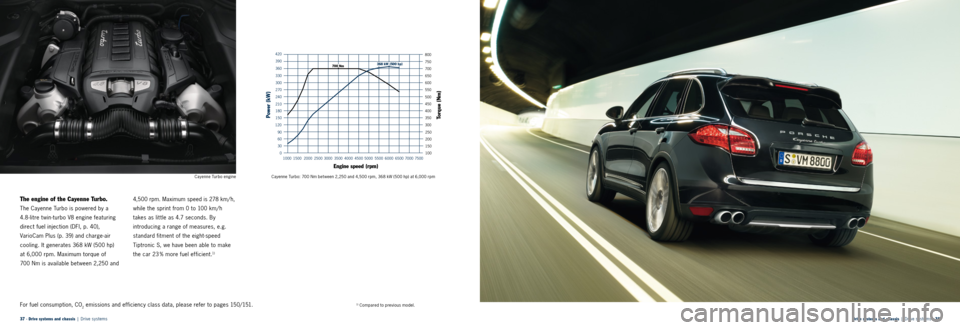
The engine of the Cayenne Turbo.
The Cayenne Turbo is powered by a
4.8-litre t win-turbo V8 engine featuring
direct fuel injection (DFI, p. 40),
VarioCam Plus (p. 39) and charge-air
cooling. It generates 368 kW (500 hp)
at 6,000 rpm. Maximum torque of
700 Nm is available bet ween 2,250 and
Cayenne Turbo engine
4,500 rpm. Maximum speed is 278 km/ h,
while the sprint from 0 to 100 km/ h
takes as lit tle as 4.7 seconds. By
introducing a range of measures, e.g.
standard fitment of the eight-speed
Tiptronic S, we have been able to make
the car 23 % more fuel efficient.
1)
Cayenne Turbo: 700 Nm bet ween 2,250 and 4,500 rpm, 368 kW (500 hp) at 6,000 rpm
For fuel consumption, CO2 emissions and efficiency class data, please refer to pages 150/151.1) Compared to previous model.
100
300 350 400
450
500 550 600 6500
30 60 90
120
150 180 210 240 270 300
3301500
7500
2000 25003000 3500400045005000 5500600065007000 150 200
2501000
Power (kW)
T orque (Nm)
Engine speed (rpm)
360
700
390
750800
420
700 Nm368 kW (500 hp)
Page 20 of 79
Drive systems and chassis | Drive systems · 40
39 · Drive systems and chassis | Drive systems
The heart of every Porsche.
Applying power with intelligence.
Engine technology.
Auto start/stop function.
The Cayenne models that are equipped
with eight-speed Tiptronic S also feature
an auto start /stop function. If, for ex -
ample, you stop at traffic lights and keep
your foot on the brake pedal, the auto
start/stop function will automatically
cut the engine. Although the engine is
not running, all audio and communication
systems remain switched on and the
standard climate control continues to
maintain the selected temperature. The
only changes you’ll perceive: peace
and quiet and – thanks to greater fuel
economy – also peace of mind.
The system is deactivated in certain
situations, e.g. if the outside temperature
is very high or the bat tery charge is low.
The starter motor has been revised to cope with the additional demands of the
system, and the bat tery charge and life
are continuously monitored. The battery
and starter motor are replacement parts
that are subject to greater wear and tear
with frequent use of the auto start /stop
function.
Standard on the Cayenne Diesel,
Cayenne S, Cayenne S Hybrid,
Cayenne GTS and Cayenne Turbo.
Available as an option for the Cayenne in
conjunction with the optional Tiptronic S.
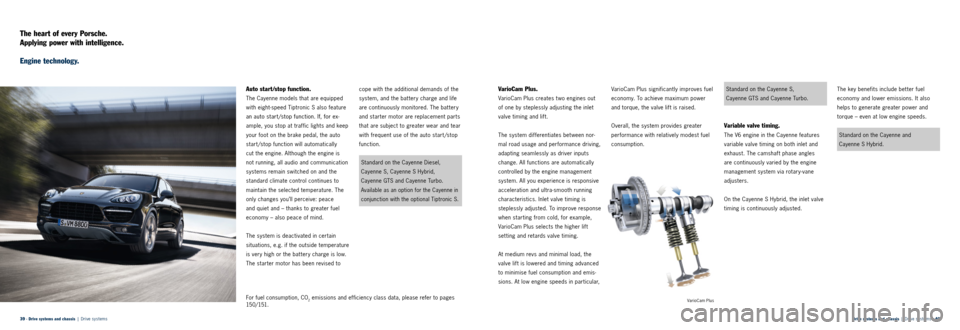
VarioCam Plus.
VarioCam Plus creates t wo engines out
of one by steplessly adjusting the inlet
valve timing and lift.
The system differentiates bet ween nor
-
mal road usage and performance driving,
adapting seamlessly as driver inputs
change. All functions are automatically
controlled by the engine management
system. All you experience is responsive
acceleration and ultra-smooth running
characteristics. Inlet valve timing is
steplessly adjusted. To improve response
when starting from cold, for example,
VarioCam Plus selects the higher lift
setting and retards valve timing.
At medium revs and minimal load, the
valve lift is lowered and timing advanced
to minimise fuel consumption and emis -
sions. At low engine speeds in particular, VarioCam Plus significantly improves fuel
economy. To achieve maximum power
and torque, the valve lift is raised.
Overall, the system provides greater
performance with relatively modest fuel
consumption.
Standard on the Cayenne S,
Cayenne GTS and Cayenne Turbo.
Variable valve timing.
The V6 engine in the Cayenne features
variable valve timing on both inlet and
exhaust. The camshaft phase angles
are continuously varied by the engine
management system via rotary-vane
adjusters.
On the Cayenne S Hybrid, the inlet valve
timing is continuously adjusted.
VarioCam Plus
The key benefits include better fuel
economy and lower emissions. It also
helps to generate greater power and
torque – even at low engine speeds.
Standard on the Cayenne and
Cayenne S Hybrid.
For fuel consumption, CO2 emissions and efficiency class data, please refer to pages
15 0/ 151.
Page 21 of 79

Drive systems and chassis | Engine technology · 42
41 · Drive systems and chassis | Engine technology
Compression with precision.
Essential for getting right to the point.
Direct fuel injection (DFI).
DFI injects fuel directly into the combus -
tion chamber at up to 120 bar with milli -
second precision using electromagnetic
injectors. The injector position and spray
geometry have been carefully designed
to improve output, torque, fuel economy
and emissions. The swirling of the fuel as
it enters each chamber increases the
mixing of air and fuel, thereby enhancing
combustion. By forming the air/fuel mix -
ture directly in the combustion chamber,
DFI contributes to engine cooling. As a
result, it was possible to increase the
compression ratio and therefore power
and efficiency.
Direct fuel injection on the diesel
engine (common-rail injection system).
On the Cayenne Diesel, direct fuel injec -
tion comes courtesy of a common-rail
injection system. The injection pressure
is now up to 2,000 bar, ensuring optimum
distribution of the air/fuel mixture – for
greater performance. The piezoelectric
injectors provide flexible injection rate
adjustment, using exactly metered
quantities of fuel, with multiple injections
for each power stroke to deliver smooth
combustion.
Cooling systems.
A high-performance engine can only
maintain its maximum capability over
a long service life if all components are
operating consistently within a specific
temperature range. The engines in the
Cayenne models are therefore designed
for efficient cooling.
In order to reduce the frictional losses
that occur during warm-up, all Cayenne
models feature comprehensive thermal
management. Using intelligent control,
it activates the different cooling circuits
individually and on demand, thereby
ensuring that the optimum operating
temperature for the engine and trans -
mission is reached more quickly. This
minimises friction – and keeps fuel
consumption and CO
2 emissions low.
The V8 engines have an enhanced coolant
management system offering effective
temperature control throughout the engine.
While 20 % of coolant flows longitudinally
through the crankcase, the remaining 80 %
serves the cylinder heads using the proven
cross-flow principle (from hot to cold).
On all Cayenne models, the piston heads
are cooled using oil-spray jets integrated
within the main lubrication system.
The entire cooling system is designed for
prolonged heav y-dut y use, e.g. off-road
driving or heav y towing and carrying
applications.
Lubrication.
The V8 engines use dry-sump lubrication
to ensure a consistent supply of oil in
all load conditions, especially in off-road
terrain. The oil reservoir is located inside
the engine. This saves on space and
reduces weight.
Oil is circulated around the V8 engines
using a demand-driven pump. This has
been designed for the toughest driving
scenarios on and off road, including per -
formance driving and extreme gradients.
The V6 engines have a wet-sump lubrica -
tion system. Ensuring a reliable supply of
oil, whatever the driving conditions.
For fuel consumption, CO
2 emissions and efficiency class data, please refer to pages 150/151.
Page 22 of 79
Drive systems and chassis | Engine technology · 44
43 · Drive systems and chassis | Engine technology
Air intake system.
The Cayenne models are all equipped
with a resonance air intake system.
This technology uses the pressure waves
generated by the inlet valves to ‘ force’ air
into the engine.
The effect is further enhanced on the V6
engine in the Cayenne and the V8 engine
in the Cayenne S and the Cayenne GTS
by a t wo -stage intake manifold. This vari -
able geometry combines all the benefits
of a long intake tube (higher torque at
low rpm) with those of a shorter length
(more power at higher rpm).
The result: highly impressive torque
ratings across the entire engine speed
range.
Turbocharging system in the
Cayenne Turbo.
In the Cayenne Turbo, the engine is
assisted by t win turbocharger units
arranged in parallel – one for each bank
of cylinders. Incoming air is passed
through a filter and compressed by the
turbine units. Its temperature is then
reduced in the twin intercooler system,
which improves cylinder charging and
limits thermal loads on the engine.
Supercharging system in the
Cayenne S Hybrid.
The engine in the Cayenne S Hybrid is
equipped with a supercharger. For a
more direct response, even at low revs
and road speeds. The supercharger has
a low-temperature water cooling system
for cooling the charge air.
Variable Turbine Geometry (VTG) in
the Cayenne Diesel.
The turbocharger in the Cayenne Diesel
features Variable Turbine Geometry
(V TG). The gas-flow from the engine
is channelled onto the turbines via elec -
tronically adjustable guide vanes. By
changing the vane angle, the system can
replicate the geometry in all t ypes of
turbo, large or small, and thus achieve
the optimum gas-flow characteristics.
As a result, even at low engine rpm,
the turbine speed is maximised. For a
significant increase in boost pressure,
excellent cylinder charging plus greater
power and torque.
Electronic engine management.
Cultured performance in all driving
scenarios requires comprehensive
engine control. The electronic engine
management system does this by
continually monitoring the relevant input
data from a variet y of sophisticated
sensors. This data is then compared with
a corresponding set of reference values.
Based on this information, a range of
key engine functions, e.g. ignition and
injection timings as well as injection
quantities, are seamlessly and auto -
matically adjusted. Other major functions
include on-board recuperation. It ensures
that the on-board power supply is only
replenished while the vehicle is on the
overrun. This boosts fuel economy as
well as performance, and ensures max -
imum engine output during acceleration.
All this goes unnoticed by the driver,
apart from the obvious benefits: lower
fuel consumption and CO
2 emissions plus
greater power and torque at all times.
Exhaust system.
The light weight exhaust systems in the
Cayenne models are made from special,
long-life stainless steel. The key features
of the catalysts are high efficiency,
faster warm-up and a long service life.
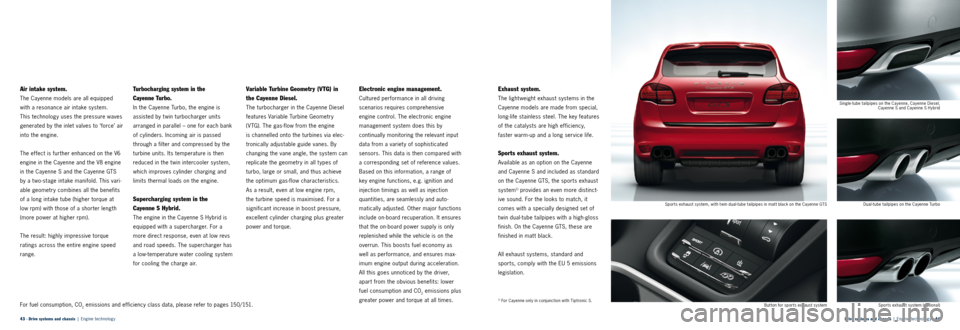
Sports exhaust system.
Available as an option on the Cayenne
and Cayenne S and included as standard
on the Cayenne GTS, the sports exhaust
system
1) provides an even more distinct -
ive sound. For the looks to match, it
comes with a specially designed set of
t win dual-tube tailpipes with a high-gloss
finish. On the Cayenne GTS, these are
finished in mat t black.
All exhaust systems, standard and
sports, comply with the EU 5 emissions
legislation.
1) For Cayenne only in conjunction with Tiptronic S. Single-tube tailpipes on the Cayenne, Cayenne Diesel,
Cayenne S and Cayenne S Hybrid
Dual-tube tailpipes on the Cayenne Turbo
Sports exhaust system (optional)
But ton for spor ts exhaust system
Spor ts exhaust system, with t win dual -tube tailpipes in mat t black on the Cayenne GTS For fuel consumption, CO2 emissions and efficiency class data, please refer to pages 150/151.
Page 23 of 79
Drive systems and chassis | Transmission · 46
45 · Drive systems and chassis | Transmission
Precision control.
Whatever your choice of terrain.
Transmission.
Six-speed manual gearbox.
The six-speed manual gearbox on the
Cayenne has been specifically adapted
for the demands of high-performance
use. The gear lever throw is short and
precise, and each of the six ratios has
been selected for optimum progression
through the gears. As the centre console
rises to meet the dashboard, the gear
lever is close to hand – for an even more
engaging drive.
The standard upshift display in the
instrument cluster helps to reduce fuel
consumption further still. Eight-speed Tiptronic S is also available
as an option on the Cayenne in conjunc
-
tion with the auto start/stop function.
Standard on the Cayenne.
Eight-speed Tiptronic S.
The outstanding feature of the eight-
speed Tiptronic S is a particularly wide
ratio spread. 1st gear is designed for
optimum acceleration when pulling away
and greater performance when tackling
ascents and towing loads in off-road
terrain. Top speed is reached in 6th gear
(in 7th gear on the Cayenne Diesel). The
remaining upper gears are used to lower
the revs at high speed, thereby enhanc -
ing fuel economy and occupant comfort. On the motorway in particular, driving
at low revs will significantly reduce the
noise level inside the vehicle.
In automatic mode, the driver can influ -
ence gearshifts on the Tiptronic S using
the throt tle and brakes alone. Tiptronic S
automatically adapts the gearshift points
for performance driving – equally, if a
more defensive driving st yle is detected,
the system selects a gearshift point that
offers maximum fuel economy. Under
heav y braking, Tiptronic S shifts down to
maximise engine braking.
An electric pump is used to maintain the
required pressure of the transmission fluid,
e.g. to transmit high levels of torque
at
lower engine speeds. The standard sports steering wheel in
conjunction with Tiptronic S has two
ergonomic switches for manual gear
changes. One press forward with the
thumb and Tiptronic S shifts up. One
pull backwards with the index finger and
Tiptronic S shifts down. Either the right
or left-hand switch can be used. The
result: an even more dynamic response
when changing gear.
Standard on the Cayenne Diesel,
Cayenne S, Cayenne S Hybrid,
Cayenne GTS and Cayenne Turbo.
Optional for the Cayenne.
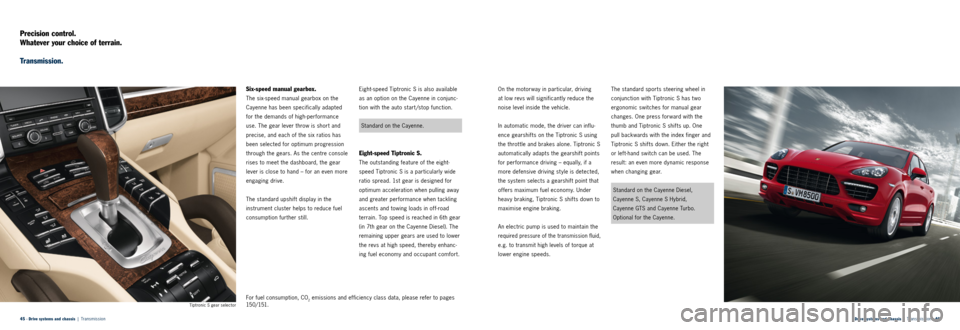
Tiptronic S gear selector
For fuel consumption, CO2 emissions and efficiency class data, please refer to pages
15 0/ 151.
Page 26 of 79
Drive systems and chassis | Off-road capability · 52
51 · Drive systems and chassis | Off-road capability
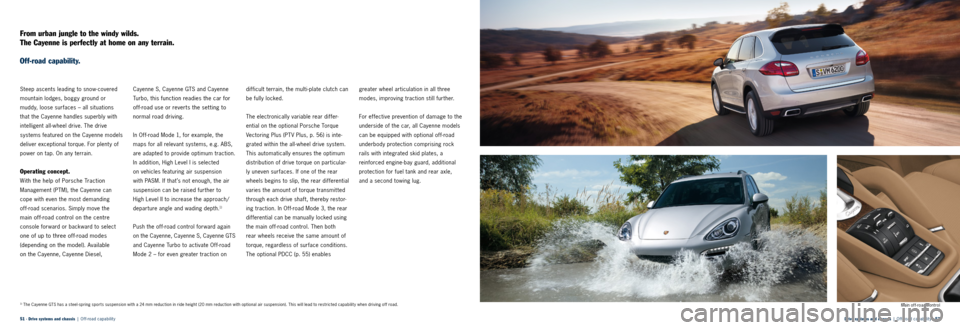
From urban jungle to the windy wilds.
The Cayenne is perfectly at home on any terrain.
Off-road capability.
Steep ascents leading to snow- covered
mountain lodges, boggy ground or
muddy, loose surfaces – all situations
that the Cayenne handles superbly with
intelligent all-wheel drive. The drive
systems featured on the Cayenne models
deliver exceptional torque. For plent y of
power on tap. On any terrain.
Operating concept.
With the help of Porsche Traction
Management (PTM), the Cayenne can
cope with even the most demanding
off-road scenarios. Simply move the
main off-road control on the centre
console forward or backward to select
one of up to three off-road modes
(depending on the model). Available
on the Cayenne, Cayenne Diesel,
Cayenne S, Cayenne GTS and Cayenne
Turbo, this
function readies the car for
off-road use or reverts the set ting to
normal road driving.
In Off-road Mode 1, for example, the
maps for all relevant systems, e.g. ABS,
are adapted to provide optimum traction.
In addition, High Level I is selected
on vehicles featuring air suspension
with PASM. If that ’s not enough, the air
suspension can be raised further to
High Level II to increase the approach/
departure angle and wading depth.
1)
Push the off-road control forward again
on the Cayenne, Cayenne S, Cayenne GTS
and Cayenne Turbo to activate Off-road
Mode 2 – for even greater traction on difficult terrain, the multi-plate clutch can
be fully locked.
The electronically variable rear diffe
r-
ential on the optional Porsche Torque
Vectoring Plus (PT V Plus, p. 56) is inte -
grated within the all-wheel drive system.
This automatically ensures the optimum
distribution of drive torque on particular -
ly uneven surfaces. If one of the rear
wheels begins to slip, the rear differential
varies the amount of torque transmit ted
through each drive shaft, thereby restor -
ing traction. In Off-road Mode 3, the rear
differential can be manually locked using
the main off-road control. Then both
rear wheels receive the same amount of
torque, regardless of surface conditions.
The optional PDCC (p. 55) enables greater wheel articulation in all three
modes, improving traction still further.
For effective prevention of damage to the
underside of the car, all Cayenne models
can be equipped with optional off-road
underbody protection comprising rock
rails with integrated skid plates, a
reinforced engine-bay guard, additional
protection for fuel tank and rear axle,
and a second towing lug.
1) The Cayenne GTS has a steel -spring spor ts suspension with a 24 mm reduction in ride height (20 mm reduction with optional air suspension). This will lead to restricted capabilit y when driving of f road.
Main off-road control
Page 27 of 79
Drive systems and chassis | Chassis · 54
53 · Drive systems and chassis | Chassis
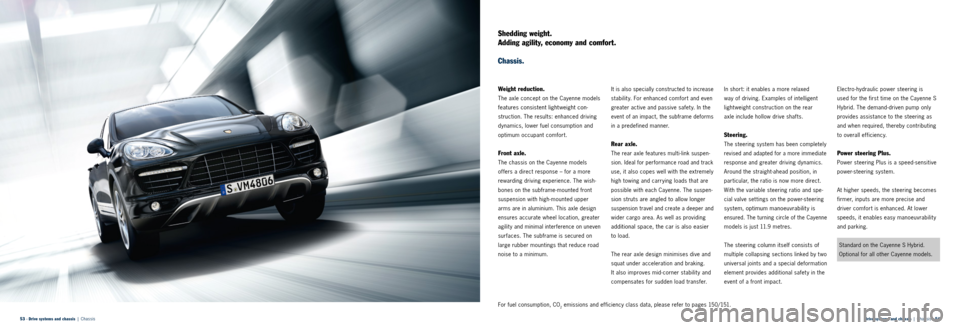
Shedding weight.
Adding agility, economy and comfort.
Chassis.
Weight reduction.
The axle concept on the Cayenne models
features consistent lightweight con -
struc
tion. The results: enhanced driving
dynamics, lower fuel consumption and
optimum occupant comfort.
Front axle.
The chassis on the Cayenne models
offers a direct response – for a more
rewarding driving experience. The wish -
bones on the subframe-mounted front
suspension with high-mounted upper
arms are in aluminium. This axle design
ensures accurate wheel location, greater
agility and minimal interference on uneven
surfaces. The subframe is secured on
large rubber mountings that reduce road
noise to a minimum.
It is also specially constructed to increase
stability. For enhanced comfort and even
greater active and passive safet y. In the
event of an impact, the subframe deforms
in a predefined manner.
Rear axle.
The rear axle features multi-link suspen -
sion. Ideal for performance road and track
use, it also copes well with the extremely
high towing and carrying loads that are
possible with each Cayenne. The suspen -
sion struts are angled to allow longer
suspension travel and create a deeper and
wider cargo area. As well as providing
additional space, the car is also easier
to
load.
The rear axle design minimises dive and
squat under acceleration and braking.
It also improves mid-corner stability and
compensates for sudden load transfer. In short: it enables a more relaxed
way of driving. Examples of intelligent
lightweight construction on the rear
axle include hollow drive shafts.
Steering.
The steering system has been com pletely
revised and adapted for a more immediate
response and greater driving dynamics.
Around the straight-ahead pos ition, in
particular, the ratio is now more direct.
With the variable steering ratio and spe -
cial valve settings on the power-steering
system, optimum manoeuvrability is
ensured. The turning circle of the Cayenne
models is just 11.9 metres.
The steering column itself consists of
multiple collapsing sections linked by two
universal joints and a special deformation
element provides additional safet y in the
event of a front impact. Electro -hydraulic power steering is
used for the first time on the Cayenne S
Hybrid. The demand-driven pump only
provides assistance to the steering as
and when required, thereby contributing
to overall efficiency.
Power steering Plus.
Power steering Plus is a speed-sensitive
power-steering system.
At higher speeds, the steering becomes
firmer, inputs are more precise and
driver comfort is enhanced. At lower
speeds, it enables easy manoeuvrability
and parking.
Standard on the Cayenne S Hybrid.
Optional for all other Cayenne models.
For fuel consumption, CO2 emissions and efficiency class data, please refer to pages 150/151.
Page 28 of 79
1
2
3
4
5
6
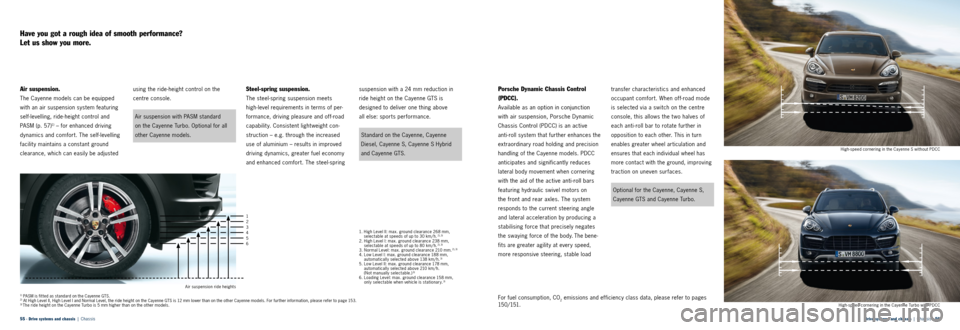
Air suspension ride heightsDrive systems and chassis | Chassis ·
56
55 · Drive systems and chassis | Chassis High-speed cornering in the Cayenne Turbo with PDCCHigh-speed cornering in the Cayenne S without PDCC
1) PASM is fit ted as standard on the Cayenne GTS.2)
At High Level II, High Level I and Normal Level, the ride height on the Cayenne GTS is 12 mm lower than on the other Cayenne models. For fur ther information, please refer to page 153.3) The ride height on the Cayenne Turbo is 5 mm higher than on the other models.For fuel consumption, CO2 emissions and efficiency class data, please refer to pages
15 0/ 151.
Have you got a rough idea of smooth performance?
Let us show you more.
Air suspension.
The Cayenne models can be equipped
with an air suspension system featuring
self-levelling, ride-height control and
PASM (p. 57)
1) – for enhanced driving
dynamics and comfort. The self-levelling
facility maintains a constant ground
clearance, which can easily be adjusted using the ride-height control on the
centre console.
Air suspension with PASM standard
on the Cayenne Turbo. Optional for all
other Cayenne models.
Steel-spring suspension.
The steel-spring suspension meets
high-level requirements in terms of per
-
formance, driving pleasure and off-road
capability. Consistent lightweight con -
struction – e.g. through the increased
use of aluminium – results in improved
driving dynamics, greater fuel economy
and enhanced comfort. The steel-spring suspension with a 24 mm reduction in
ride height on the Cayenne GTS is
designed to
deliver one thing above
all else: sports performance.
Standard on the Cayenne, Cayenne
Diesel, Cayenne S, Cayenne S Hybrid
and Cayenne GTS.
Porsche Dynamic Chassis Control
(PDCC).
Available as an option in conjunction
with air suspension, Porsche Dynamic
Chassis Control (PDCC) is an active
anti-roll system that further enhances the
extraordinary road holding and precision
handling of the Cayenne models. PDCC
anticipates and significantly reduces
lateral body movement when cornering
with the aid of the active anti-roll bars
featuring hydraulic swivel motors on
the front and rear axles. The system
responds to the current steering angle
and lateral acceleration by producing a
stabilising force that precisely negates
the swaying
force of the body. The bene-
fits are greater agilit y at every speed,
more responsive steering, stable load transfer characteris
tics and enhanced
occupant comfort. When off-road mode
is selected via a switch on the centre
console, this allows the t wo halves of
each anti-roll bar to rotate further in
opposition to each other. This in turn
enables greater wheel articu lation and
ensures that each individual wheel has
more contact with the ground, improving
traction on uneven surfaces.
Optional for the Cayenne, Cayenne S,
Cayenne GTS and Cayenne Turbo.
1. High Level II: max. ground clearance 268 mm,
selectable at speeds of up to 30 km/ h. 2), 3)2. High Level I: max. ground clearance 238 mm,
selectable at speeds of up to 80 km/ h. 2), 3)3. Normal Level: max. ground clearance 210 mm. 2), 3)4. Low Level I: max. ground clearance 188 mm,
automatically selected above 138 km/ h. 3)5. Low Level II: max. ground clearance 178 mm,
automatically selected above 210 km/ h.
(Not manually selectable.)
3)6. Loading Level: max. ground clearance 158 mm,
only selectable when vehicle is stationary. 3)
Page 32 of 79
Safety and environment | Safet y · 64
63 · Safety and environment | Safet y
Driving with foresight.
Quite literally.
Active safety.
It’s always a pleasure taking corners
in a Porsche. Especially when they’re
now so visible at night. The striking
lighting arrangement is also instantly
recognisable.
Automatic headlight activation.
The headlights are automatically
switched on when darkness sets in
or when driving through a tunnel in the
daytime. Other features include an auto -
matic switch-off and ‘Welcome Home’
function – when you arrive at a destin -
ation after dark, the headlights remain
illuminated for a user-defined period,
lighting your path from the car.
Standard on all Cayenne models.
Halogen main headlights.
The projector-beam halogen main head -
lights feature automatic static range
control and reflection high-beam lights –
for optimum illumination of the road.
Standard on the Cayenne, Cayenne
Diesel, Cayenne S and Cayenne S
Hybrid.
Bi-Xenon main headlights with
Porsche Dynamic Light System (PDLS).
The Bi-Xenon main headlights – which
also have a black surround on the
Cayenne GTS – feature halogen auxiliary
headlights, integrated headlight cleaning
and automatic dynamic range control.
This provides more uniform illumination
of the road in both dipped and high-beam
mode. The dynamic cornering light function
swivels the main headlights towards the
inside of a bend based on the current
steering angle and road speed. The static
cornering lights activate the auxiliary
headlights in order to illuminate more of
the road in tight bends and turns.
PDLS also features speed-sensitive
headlight control and an adverse
weather function, which is activated
in conjunction with the rear foglight –
for even greater safet y, not just at night
and during cornering.
Standard on the Cayenne GTS and
Cayenne Turbo. Optional for all other
Cayenne models.
Porsche Dynamic Light System Plus
(PDLS Plus).
PDLS Plus offers t wo additional func -
tions: high Beam Assistant recognises
oncoming vehicles and automatically
switches the headlights from high beam
to dipped beam.
As you approach a crossing, Intersection
Assistant activates the left and right
indicators, making the beam of light
broader and shorter. This improves illu -
mination of the area directly surrounding
the vehicle, making the driver more
aware of what ’s going on around him.
Optional for all Cayenne models.
Daytime running lights.
Fit ted as standard on all Cayenne
models: LED day time running lights. On the Cayenne, Cayenne Diesel,
Cayenne S and Cayenne S Hybrid, these
are arranged horizontally in the front light
units, whereas on the Cayenne GTS and
the Cayenne Turbo each main
headlight
unit has four LED spotlights. Day time
running lights improve safet y in the
day time as they make you more visible
to other road users.
Taillights.
LED technology is used for all functions
on the rear light modules. For an ultra-
fast response and greater luminance.
In
short: for greater safet y. In an emer -
gency stop, the adaptive LED brake
lights on the Cayenne models pulsate
to alert the traffic behind more quickly
to a critical situation. The high-level third
brake light is integrated into the roof
s p o i l e r.
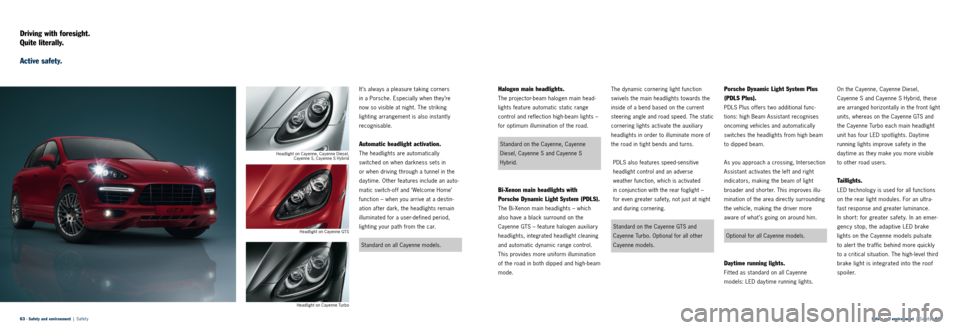
Headlight on Cayenne Turbo
Headlight on Cayenne, Cayenne Diesel,
Cayenne S, Cayenne S Hybrid
Headlight on Cayenne GTS
Page 34 of 79

Safety and environment | Safet y · 68
67 · Safety and environment | Safet y
Recuperation.
The electronic engine management sys -
tem on the Cayenne S Hybrid controls
the braking process so that, when
the brake pedal is actuated, as much
expended energy as possible can be
harnessed by the electric machine in gen-
erator mode and stored in the 288-volt
nickel metal hydride (NiMH) bat tery. This
is referred to as recuperation. To do this,
the engine management system adjusts
the generator current depending on the
brake pedal position, recovers part of
the kinetic energy and stores it in the
bat tery. When the pressure on the brake
pedal exceeds a certain threshold, the
brakes are applied.
Porsche Ceramic Composite Brake
(PCCB).
Available as an option on all Cayenne
models, the Porsche Ceramic Composite
Brake (PCCB) has already proven its
abilit y to cope with the harshest require -
ments of the racetrack. It is available in
conjunction with 20-inch wheels or larger
for the Cayenne Turbo and with 19-inch
wheels or larger for all other Cayenne
models.
The discs are made from a specially
treated carbon-fibre compound that is
silicated in a high-vacuum process at
approximately 1,700 °C. The resulting
material is not only much harder than
cast iron, it is also more resistant to
heat.
Even at high temperatures, the thermal
resistance of the PCCB disc ensures
outstanding dimensional stability. The
ceramic material is totally resistant to
corrosion and offers excellent acoustic
damping properties.
PCCB enables shorter braking distances
– no mat ter how tough the driving
conditions. The pedal response is fast
and precise with only moderate input
required. Excellent fade resistance
ensures greater balance when slowing
from high speed.
The key advantage of PCCB is a total
weight saving of approximately 50
%
compared with equivalent cast-iron discs.
As well as enhancing performance and fuel economy, the unsprung and rotating
masses are lightened. The results:
greater comfort and road-holding on
uneven road surfaces plus better
handling and agility.
Optional for all Cayenne models.
Porsche Ceramic Composite Brake (PCCB)For fuel consumption, CO2 emissions and efficiency class data, please refer to pages 150/151.