fuel PORSCHE CAYNNE 2013 2.G Information Manual
[x] Cancel search | Manufacturer: PORSCHE, Model Year: 2013, Model line: CAYENNE, Model: PORSCHE CAYENNE 2013 2.GPages: 79, PDF Size: 14.97 MB
Page 30 of 79
Drive systems and chassis | Chassis · 60
59 · Drive systems and chassis | Chassis
More than just a small cog in the system.
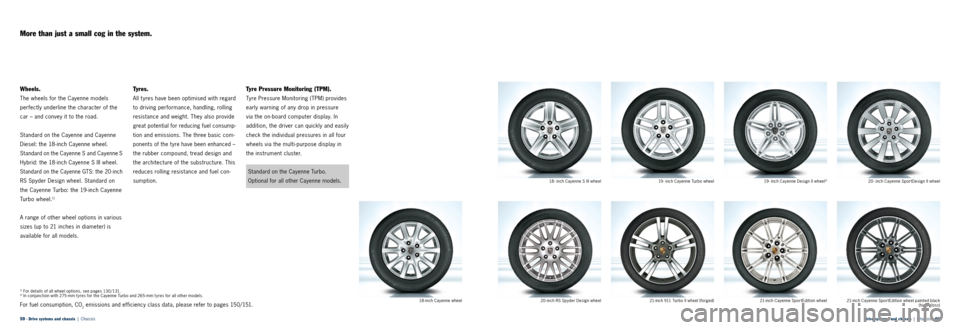
Wheels.
The wheels for the Cayenne models
perfectly underline the character of the
car – and convey it to the road.
Standard on the Cayenne and Cayenne
Diesel: the 18-inch Cayenne wheel.
Standard on the Cayenne S and Cayenne S
Hybrid: the 18-inch Cayenne S III wheel.
Standard on the Cayenne GTS: the 20 -inch
RS Spyder Design wheel. Standard on
the Cayen
ne Turbo: the 19-inch Cayenne
Tu r b o w h e e l .
1)
A range of other wheel options in various
sizes (up to 21 inches in diameter) is
available for all models.
Ty r e s .
All t yres have been optimised with regard
to driving performance, handling, rolling
resistance and weight. They also provide
great potential for reducing fuel consump-
tion and emissions. The three basic com -
ponents of the t yre have been enhanced –
the rubber compound, tread design and
the architecture of the substructure. This
reduces rolling resistance and fuel con -
sumption.
Tyre Pressure Monitoring (TPM).
Tyre Pressure Monitoring (TPM) provides
early warning of any drop in pressure
via the on-board computer display. In
addition, the driver can quickly and easily
check the individual pressures in all four
wheels via the multi-purpose display in
the instrument cluster.
Standard on the Cayenne Turbo.
Optional for all other Cayenne models.
1) For details of all wheel options, see pages 130/131.2) In conjunction with 275 - mm t yres for the Cayenne Turbo and 265 - mm t yres for all other models. 19- inch Cayenne Turbo wheel
20 - inch RS Spyder Design wheel 20 - inch Cayenne Spor tDesign II wheel
19 - inch Cayenne Design II wheel
2)
21-inch Cayenne SportEdition wheel 21-inch Cayenne SportEdition wheel painted black
(high-gloss)
21- inch 911 Turbo II wheel (forged)
18 - inch Cayenne S III wheel
18-inch Cayenne wheelFor fuel consumption, CO2 emissions and efficiency class data, please refer to pages 150/151.
Page 34 of 79
Safety and environment | Safet y · 68
67 · Safety and environment | Safet y
Recuperation.
The electronic engine management sys -
tem on the Cayenne S Hybrid controls
the braking process so that, when
the brake pedal is actuated, as much
expended energy as possible can be
harnessed by the electric machine in gen-
erator mode and stored in the 288-volt
nickel metal hydride (NiMH) bat tery. This
is referred to as recuperation. To do this,
the engine management system adjusts
the generator current depending on the
brake pedal position, recovers part of
the kinetic energy and stores it in the
bat tery. When the pressure on the brake
pedal exceeds a certain threshold, the
brakes are applied.
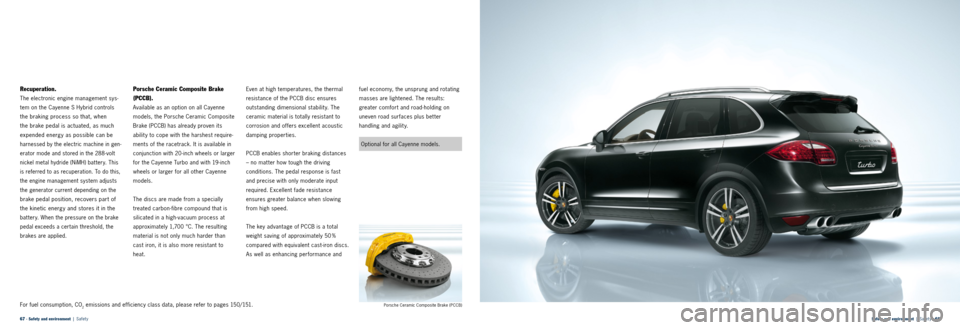
Porsche Ceramic Composite Brake
(PCCB).
Available as an option on all Cayenne
models, the Porsche Ceramic Composite
Brake (PCCB) has already proven its
abilit y to cope with the harshest require -
ments of the racetrack. It is available in
conjunction with 20-inch wheels or larger
for the Cayenne Turbo and with 19-inch
wheels or larger for all other Cayenne
models.
The discs are made from a specially
treated carbon-fibre compound that is
silicated in a high-vacuum process at
approximately 1,700 °C. The resulting
material is not only much harder than
cast iron, it is also more resistant to
heat.
Even at high temperatures, the thermal
resistance of the PCCB disc ensures
outstanding dimensional stability. The
ceramic material is totally resistant to
corrosion and offers excellent acoustic
damping properties.
PCCB enables shorter braking distances
– no mat ter how tough the driving
conditions. The pedal response is fast
and precise with only moderate input
required. Excellent fade resistance
ensures greater balance when slowing
from high speed.
The key advantage of PCCB is a total
weight saving of approximately 50
%
compared with equivalent cast-iron discs.
As well as enhancing performance and fuel economy, the unsprung and rotating
masses are lightened. The results:
greater comfort and road-holding on
uneven road surfaces plus better
handling and agility.
Optional for all Cayenne models.
Porsche Ceramic Composite Brake (PCCB)For fuel consumption, CO2 emissions and efficiency class data, please refer to pages 150/151.
Page 37 of 79
Safety and environment | Environment · 74
73 · Safety and environment | Environment
The concept behind every car we build
is based around the pursuit of perform -
ance. This has been the case since
1948. Another of our traditional core
values is efficiency. At Porsche, we are
continually striving to find a successful
balance between the two.
This is achieved using advanced engine
concepts featuring technologies such
as DFI (p. 40), VarioCam Plus (p. 39),
the auto start /stop function (p. 38),
the parallel full hybrid drive (p. 28) and
consistent lightweight construction. Weight reduction is a key aspect of our
design philosophy derived from our rich
racing heritage. Part of our R&D Centre,
the Motorsport Department is located in
Weissach where it shares premises with
the Automotive Industry Exhaust Emission
Centre (ADA). Just a
coincidence? We call
it symbiosis.
In practice: the Cayenne is up to 185 kg
lighter, depending on the model.
1) We
have achieved this through the use of
new, innovative weight-saving materials,
the development of new production technologies and functionalities, and a
series of concept modifications. This
has enabled us to halve the weight of
the tailgate, for example. Innovative
materials are also a feature of the axle
construction, with steel being replaced
where possible by lightweight alterna -
tives such as aluminium and plastic.
The benefits for the driver: greater agilit y
and driving dynamics – with lower fuel
consumption. Efficiency at its best.
Great achievements are something to be proud of.
Even more so if they benefit the world around you.
Environment.
1) Compared to previous model.For fuel consumption, CO2 emissions and efficiency class data, please refer to pages 150/151.
Page 38 of 79
Safety and environment | Environment · 76
75 · Safety and environment | Environment
Exhaust emissions.
The Cayenne models are all equipped
with the latest emissions technology. As
a result, they comply with the European
exhaust emissions standard, EU 5.
Whatever the class, every Porsche
combines high performance with com -
paratively moderate emissions. On the
Cayenne models, this is achieved using
advanced drive concepts – from petrol
and diesel engines to our parallel full
hybrid drive. This is further aided by the
rapid warm-up cycle of the catalytic
converters. The optimum operating tem -
perature is reached earlier so emissions
are reduced sooner when starting from
cold. On the petrol- engined and hybrid models,
another important feature is the use of
t win oxygen-sensor circuits. Each bank of
cylinders has a separate control system
which the engine management system
uses to establish the optimum amount of
fuel – for effective emissions control.
The exhaust-gas recirculation on the
Cayenne Diesel routes part of the exhaust
gas back into the combustion process,
resulting in lower peak com bustion tem-
perature and therefore lower nitrogen
oxide emissions. An oxidation catalyst
also forms an integral part of the process
along with a diesel particulate filter.
Porsche engines.
Performing for today – and the future.
Fuel and fuel economy.
Increasing performance while enhancing
fuel economy. The Cayenne comes in a
choice of three different drive systems,
each featuring state-of-the-art technol -
ogy for high efficiency and relatively low
fuel consumption. The petrol-engined
models already operate on fuels with
an ethanol content of up to 10 %. This
further improves the carbon dioxide
balance since the plants grown for the
production of biofuels absorb carbon
dioxide from the atmosphere. As you
can see, for the benefit of the environ
-
ment, we are continually working on
making our cars more efficient – as
well as compatible with alternative
fuels. While ensuring that they remain
one thing: a thoroughbred Porsche.
Fuel system.
We have also applied the highest stand -
ards to our petrol- engined models in
order to protect the environment from
fuel evaporation. The non-return fuel
supply system provides a considerable
reduction in vapour emissions. The lines
carrying vapour are made from multi-
layer plastics. A large active-carbon
filter and multi-layer plastic fuel tank help
reduce evaporation still further.
For fuel consumption, CO
2 emissions and efficiency class data, please refer to pages
15 0/ 151.
Page 39 of 79
Safety and environment | Environment · 78
77 · Safety and environment | Environment
Noise.
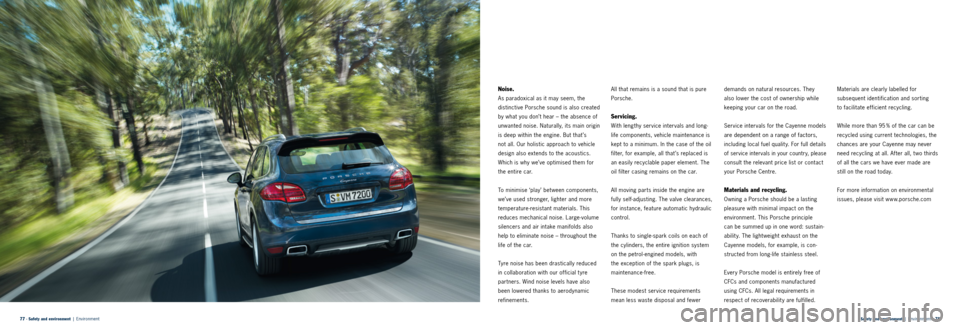
As paradoxical as it may seem, the
distinctive Porsche sound is also created
by what you don’t hear – the absence of
unwanted noise. Naturally, its main origin
is deep within the engine. But that ’s
not all. Our holistic approach to vehicle
design also extends to the acoustics.
Which is why we’ve optimised them for
the entire car.
To minimise ‘play’ between components,
we’ve used stronger, lighter and more
temperature-resistant materials. This
reduces mechanical noise. Large-volume
silencers and air intake manifolds also
help to eliminate noise – throughout the
life of the car.
Tyre noise has been drastically reduced
in collaboration with our official t yre
partners. Wind noise levels have also
been lowered thanks to aerodynamic
refinements. All that remains is a sound that is pure
Porsche.
Servicing.
With lengthy service intervals and long-
life components, vehicle maintenance is
kept to a minimum. In the case of the oil
filter, for example, all that ’s replaced is
an easily recyclable paper element. The
oil filter casing remains on the car.
All moving parts inside the engine are
fully self-adjusting. The valve clearances,
for instance, feature automatic hydraulic
control.
Thanks to single-spark coils on each of
the cylinders, the entire ignition system
on the petrol-engined models, with
the exception of the spark plugs, is
maintenance-free.
These modest service requirements
mean less waste disposal and fewer demands on natural resources. They
also lower the cost of ownership while
keeping your car on the road.
Service intervals for the Cayenne models
are dependent on a range of factors,
including local fuel quality. For full details
of service intervals in your country, please
consult the relevant price list or contact
your Porsche Centre.
Materials and recycling.
Owning a Porsche should be a lasting
pleasure with minimal impact on the
environment. This Porsche principle
can be summed up in one word: sustain -
abilit y. The light weight exhaust on the
Cayenne models, for example, is con -
structed from long-life stainless steel.
Every Porsche model is entirely free of
CFCs and components manufactured
using CFCs. All legal requirements in
respect of recoverability are fulfilled.
Materials are clearly labelled for
subsequent identification and sorting
to facilitate efficient recycling.
While more than 95 % of the car can be
recycled using current technologies, the
chances are your Cayenne may never
need
recycling at all. After all, t wo thirds
of all the cars we have ever made are
still on the road today.
For more information on environmental
issues, please visit www.porsche.com
Page 41 of 79
Comfort and transport | Comfor t · 82
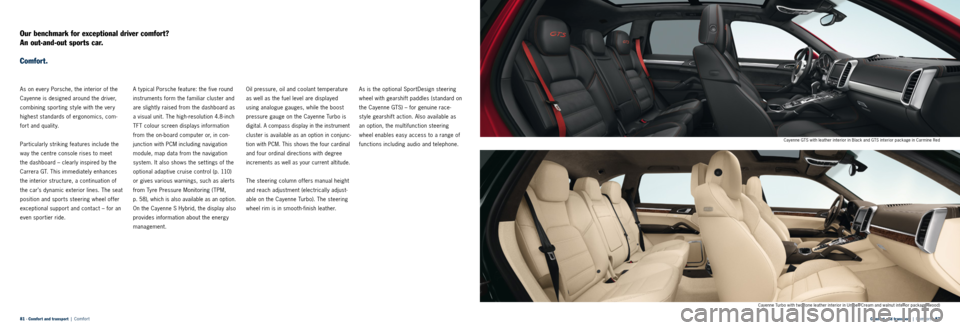
81 · Comfort and transport | Comfor t Cayenne Turbo with t wo -tone leather interior in Umber/Cream and walnut interior package (wood)Cayenne GTS with leather interior in Black and GTS interior package in Carmine Red
As on every Porsche, the interior of the
Cayenne is designed around the driver,
combining sporting st yle with the very
highest standards of ergonomics, com
-
fort and quality.
Particularly striking features include the
way the centre console rises to meet
the dashboard – clearly inspired by the
Carrera GT. This immediately enhances
the interior structure, a continuation of
the car’s dynamic exterior lines. The seat
position and sports steering wheel offer
exceptional support and contact – for an
even sportier ride.
Our benchmark for exceptional driver comfort?
An out-and-out sports car.
Comfort.
A t ypical Porsche feature: the five round
instruments form the familiar cluster and
are slightly raised from the dashboard as
a visual unit. The high-resolution 4.8-inch
TFT colour screen displays information
from the on-board computer or, in con -
junction with PCM including navigation
module, map data from the navigation
system. It also shows the set tings of the
optional adaptive cruise control (p. 110)
or gives various warnings, such as alerts
from Tyre Pressure Monitoring (TPM,
p. 58), which is also available as an option.
On the Cayenne S Hybrid, the display also
provides information about the energy
management. Oil pressure, oil and coolant temperature
as well as the fuel level are displayed
using analogue gauges, while the boost
pressure gauge on the Cayenne Turbo is
digital. A compass display in the instrument
cluster is available as an
option in conjunc-
tion with PCM. This shows the four cardinal
and four ordinal directions with degree
increments as well as your current altitude.
The steering column offers manual height
and reach adjustment (electrically adjust -
able on the Cayenne Turbo). The steering
wheel rim is in smooth-finish leather. As is the optional SportDesign steering
wheel with gearshift paddles (standard on
the Cayenne GTS) – for genuine race-
st yle gearshift action. Also available as
an option, the multifunction steering
wheel enables easy access to a range of
functions including audio and telephone.
Page 66 of 79
Personalisation · 134
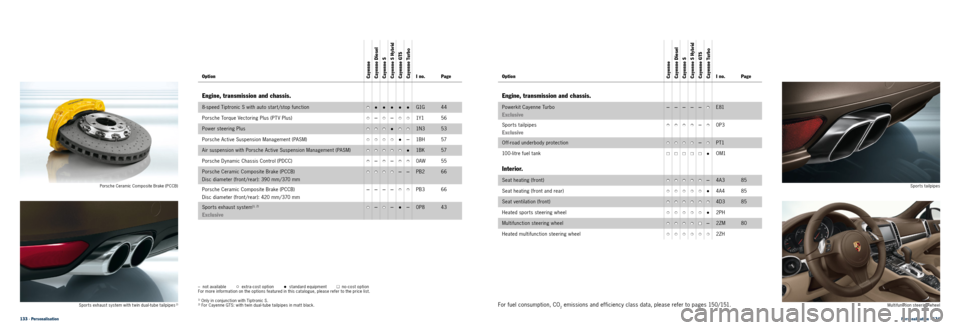
133 · Personalisation Porsche Ceramic Composite Brake (PCCB)
Sports tailpipes
Spor ts exhaust system with t win dual -tube tailpipes
2)Multifunction steering wheel1) Only in conjunction with Tiptronic S. 2) For Cayenne GTS: with t win dual -tube tailpipes in mat t black.
– not available
extra-cost option• standard equipment■ no-cost option
For more information on the options featured in this catalogue, please refer to the price list.
OptionCayenne
Cayenne Diesel
Cayenne S
Cayenne S Hybrid
Cayenne GTS
Cayenne TurboI no. Page
Engine, transmission and chassis.
Powerkit Cayenne Turbo
Exclusive
–––––•E81
Sports tailpipes
Exclusive••••–•0P3
Off-road underbody protection
•••• –•PT1
100 -litre fuel tank
■■■■■•OM1
Interior.
Seat heating (front)••••• –4A3
85
Seat heating (front and rear)
••••• •4A4 85
Seat ventilation (front)
••••••4D3 85
Heated sports steering wheel
••••• •2PH
Multifunction steering wheel
••••■–2ZM 80
Heated multifunction steering wheel
••••••2ZH
OptionCayenne
Cayenne Diesel
Cayenne S
Cayenne S Hybrid
Cayenne GTS
Cayenne TurboI no. Page
Engine, transmission and chassis.
8-speed Tiptronic S with auto start /stop function••••••G1G 44
Porsche Torque Vectoring Plus (PTV Plus)
• –•–••1Y 1
56
Power steering Plus
••• •••1N3 53
Porsche Active Suspension Management (PASM)
•••• •–1B H
57
Air suspension with Porsche Active Suspension Management (PASM)
••••• •1B K 57
Porsche Dynamic Chassis Control (PDCC)
• –•–••0AW
55
Porsche Ceramic Composite Brake (PCCB)
Disc diameter (front /rear): 390 mm/370 mm
•••• –
–PB2 66
Porsche Ceramic Composite Brake (PCCB)
Disc diameter (front /rear): 420 mm/370 mm
– –––••PB3 66
Sports exhaust system
1), 2)
Exclusive• –•–
•–0P8
43
For fuel consumption, CO2 emissions and efficiency class data, please refer to pages 150/151.
Page 73 of 79
147 · Technical dataTechnical data · 148
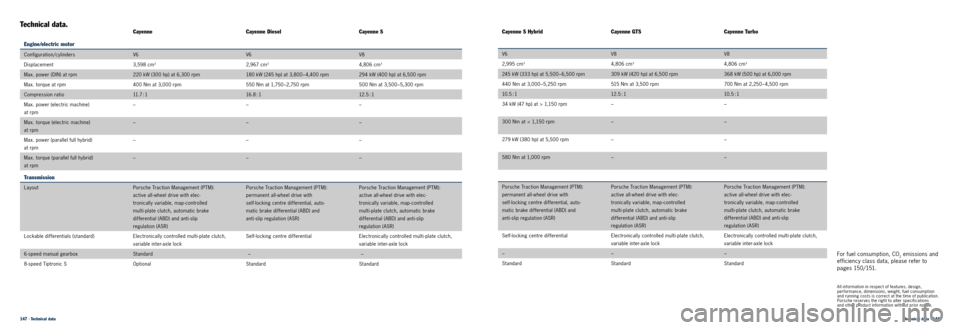
Technical data.CayenneCayenne DieselCayenne S
Engine/electric motor
Configuration/cylinders V6 V6V8
Displacement 3,598 cm
32,967 cm34,806 cm3
Max. power (DIN) at rpm220 kW ( 300 hp) at 6,300 rpm 18 0 kW ( 245 hp) at 3,800–4,400 rpm 294 kW (400 hp) at 6,500 rpm
Max. torque at rpm 400 Nm at 3,000 rpm 550 Nm at 1,75 0 –2,75 0 r p m 500 Nm at 3,500–5,300 rpm
Compression ratio 11. 7 : 1 16 . 8 : 1 12.5 : 1
Max. power (electric machine)
at rpm –
––
Max. torque (electric machine)
at rpm –
––
Max. power (parallel full hybrid)
at rpm –
––
Max. torque (parallel full hybrid)
at rpm –
––
Transmission
LayoutPorsche Traction Management (PTM):
active all-wheel drive with elec-
tronically variable, map-controlled
multi-plate clutch, automatic brake
differential (ABD) and anti-slip
regulation (ASR) Porsche Traction Management (PTM):
permanent all-wheel drive with
self-locking centre dif ferential, auto
-
matic brake dif ferential (ABD) and
anti-slip regulation (ASR) Porsche Traction Management (PTM):
active all-wheel drive with elec
-
tronically variable, map-controlled
multi-plate clutch, automatic brake
differential (ABD) and anti-slip
regulation (ASR)
Lockable differentials (standard) Electronically controlled multi-plate clutch,
variable inter-axle lock Self-locking centre differential
Electronically controlled multi-plate clutch,
variable inter-axle lock
6-speed manual gearbox Standard ––
8-speed Tiptronic S Optional StandardStandard
Cayenne S HybridCayenne GTS Cayenne Turbo
V6 V8 V8
2,995 cm
34,806 cm34,806 cm3
245 kW ( 333 hp) at 5,500 – 6,500 rpm 309 kW ( 420 hp) at 6,500 rpm 368 kW ( 500 hp) at 6,000 rpm
440 Nm at 3,000–5,250 rpm 515 Nm at 3,500 rpm 700 Nm at 2,250–4,500 rpm
10. 5 : 1 12.5 : 1 10.5 : 1
34 kW (47 hp) at > 1,150 rpm – –
300 Nm at < 1,150 rpm – –
279 kW (380 hp) at 5,500 rpm – –
580 Nm at 1,000 rpm – –
Porsche Traction Management (PTM):
permanent all-wheel drive with
self-locking centre dif ferential, auto -
matic brake dif ferential (ABD) and
anti-slip regulation (ASR) Porsche Traction Management (PTM):
active all-wheel drive with elec
-
tronically variable, map-controlled
multi-plate clutch, automatic brake
differential (ABD) and anti-slip
regulation (ASR) Porsche Traction Management (PTM):
active all-wheel drive with elec
-
tronically variable, map-controlled
multi-plate clutch, automatic brake
differential (ABD) and anti-slip
regulation (ASR)
Self-locking centre differential Electronically controlled multi-plate clutch,
variable inter-axle lock Electronically controlled multi-plate clutch,
variable inter-axle lock
– – –
Standard Standard Standard
All information in respect of features, design,
performance, dimensions, weight, fuel consumption
and running costs is correct at the time of publication.
Porsche reser ves the right to alter specifications
and other product information without prior notice.
For fuel consumption, CO2 emissions and
efficiency class data, please refer to
p a ge s 15 0/ 151.
Page 74 of 79
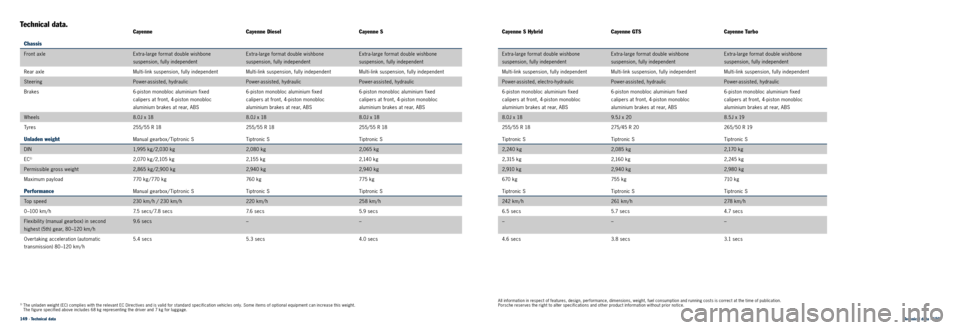
149 · Technical dataTechnical data · 150
CayenneCayenne DieselCayenne S
Chassis
Front a xle Extra-large format double wishbone
suspension, fully independent Extra-large format double wishbone
suspension, fully independentExtra-large format double wishbone
suspension, fully independent
Rear axle Multi-link suspension, fully independent Multi-link suspension, fully independentMulti-link suspension, fully independent
Steering Power-assisted, hydraulic Power-assisted, hydraulicPower-assisted, hydraulic
Brakes 6-piston monobloc aluminium fixed
calipers at front, 4-piston monobloc
aluminium brakes at rear, ABS 6-piston monobloc aluminium fixed
calipers at front, 4-piston monobloc
aluminium brakes at rear, ABS6-piston monobloc aluminium fixed
calipers at front, 4-piston monobloc
aluminium brakes at rear, ABS
Wheels 8.0J x 18 8.0J x 188.0J x 18
Ty r e s 255/55 R 18 255/55 R 18255/55 R 18
Unladen weightManual gearbox/ Tiptronic STiptronic STiptronic S
DIN 1,995 kg /2,030 kg 2,080 kg 2,065 kg
EC
1)2,070 kg /2,105 kg 2,155 k g 2 ,14 0 k g
Permissible gross weight 2,865 kg /2,900 kg 2,940 k g 2,940 k g
Maximum payload 770 kg / 770 kg 760 k g 775 kg
PerformanceManual gearbox/ Tiptronic S Tiptronic STiptronic S
Top speed 230 km/ h / 230 km/ h 220 km/ h258 km/ h
0–100 km/h 7.5 secs/7.8 secs 7.6 secs5.9 secs
Flexibility (manual gearbox) in second
highest (5th) gear, 80 –120 km/ h 9.6 secs
––
Overtaking acceleration (automatic
transmission) 80 –120 km/ h 5.4 secs
5.3 secs4.0 secs
Cayenne S HybridCayenne GTS Cayenne Turbo
Extra-large format double wishbone
suspension, fully independent Extra-large format double wishbone
suspension, fully independent Extra-large format double wishbone
suspension, fully independent
Multi-link suspension, fully independent Multi-link suspension, fully independent Multi-link suspension, fully independent
Power-assisted, electro-hydraulic Power-assisted, hydraulic Power-assisted, hydraulic
6-piston monobloc aluminium fixed
calipers at front, 4-piston monobloc
aluminium brakes at rear, ABS 6-piston monobloc aluminium fixed
calipers at front, 4-piston monobloc
aluminium brakes at rear, ABS 6-piston monobloc aluminium fixed
calipers at front, 4-piston monobloc
aluminium brakes at rear, ABS
8.0J x 18 9.5J x 20 8.5J x 19
255/55 R 18 275/45 R 20 265/50 R 19
Tiptronic S Tiptronic S Tiptronic S
2,240 k g 2,085 kg 2,170 k g
2,315 k g 2,16 0 k g 2,245 k g
2,910 k g 2,940 k g 2,980 k g
670 kg 755 kg 710 k g
Tiptronic S Tiptronic S Tiptronic S
242 k m / h 261 k m / h 278 km/ h
6.5 secs 5.7 secs 4.7 secs
– – –
4.6 secs 3.8 secs 3.1 secs
1) The unladen weight (EC) complies with the relevant EC Directives and is valid for standard specification vehicles only. Some items of optional equipment can increase this weight.
The figure specified above includes 68 kg representing the driver and 7 kg for luggage. All information in respect of features, design, per formance, dimensions, weight, fuel consumption and running costs is correct at the time of publication.
Porsche reser ves the right to alter specifications and other product information without prior notice.
Technical data.
Page 75 of 79
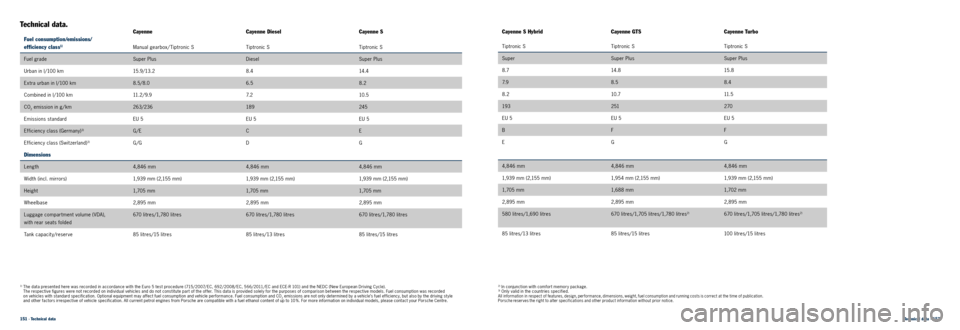
Technical data · 152
151 · Technical data
1) The data presented here was recorded in accordance with the Euro 5 test procedure (715/2007/ EC, 692/2008/ EC, 566/2011/ EC and ECE- R 101) and the NEDC (New European Driving Cycle). The respective figures were not recorded on individual vehicles and do not constitute par t of the of fer. This data is provided solely for the purposes of comparison bet ween the respective models. Fuel consumption was recorded on vehicles with standard specification. Optional equipment may af fect fuel consumption and vehicle per formance. Fuel consumption and CO2 emissions are not only determined by a vehicle’s fuel ef ficiency, but also by the driving st yle and other factors irrespective of vehicle specification. All current petrol engines from Porsche are compatible with a fuel ethanol content of up to 10 %. For more information on individual models, please contact your Porsche Centre.
CayenneCayenne DieselCayenne S
Fuel consumption/emissions/
efficiency class
1)Manual gearbox/ Tiptronic S Tiptronic STiptronic S
Fuel grade Super Plus DieselSuper Plus
Urban in l/100 km 15.9/ 13. 2 8.414 . 4
Extra urban in l/100 km 8.5/8.0 6.58.2
Combined in l/100 km 11. 2 / 9 . 9 7. 210. 5
CO
2 emission in g / km 263/236 189245
Emissions standard EU 5 EU 5EU 5
Efficiency class (Germany)
3)G/E CE
Efficiency class (Switzerland)
3)G/G DG
Dimensions
Length4,846 mm 4,846 mm 4,846 mm
Width (incl. mirrors) 1,939 mm (2,155 mm) 1,939 mm (2,155 mm)1,939 mm (2,155 mm)
Height 1,705 m m 1,705 m m 1,705 m m
Wheelbase 2,895 mm 2,895 mm 2,895 mm
Luggage compartment volume (VDA),
with rear seats folded 670 litres/1,780 litres
670 litres/1,780 litres670 litres/1,780 litres
Tank capacity/reserve 85 litres/15 litres 85 litres/13 litres85 litres/15 litres
Cayenne S HybridCayenne GTS Cayenne Turbo
Tiptronic S Tiptronic S Tiptronic S
Super Super Plus Super Plus
8.7 14 . 8 15.8
7. 9 8.5 8.4
8.2 10.7 11. 5
193 251 270
EU 5 EU 5 EU 5
B F F
E G G
4,846 mm 4,846 mm 4,846 mm
1,939 mm (2,155 mm) 1,954 mm (2,155 mm) 1,939 mm (2,155 mm)
1,705 m m 1,6 8 8 m m 1,702 m m
2,895 mm 2,895 mm 2,895 mm
580 litres/1,690 litres 670 litres/1,705 litres/1,780 litres
2)670 litres/1,705 litres/1,780 litres2)
85 litres/13 litres 85 litres/15 litres 100 litres/15 litres
2) In conjunction with comfort memory package.3) Only valid in the countries specified.All information in respect of features, design, per formance, dimensions, weight, fuel consumption and running costs is correct at the time of publication. Porsche reser ves the right to alter specifications and other product information without prior notice.
Technical data.