snow PORSCHE CAYNNE 2013 2.G Information Manual
[x] Cancel search | Manufacturer: PORSCHE, Model Year: 2013, Model line: CAYENNE, Model: PORSCHE CAYENNE 2013 2.GPages: 79, PDF Size: 14.97 MB
Page 26 of 79
Drive systems and chassis | Off-road capability · 52
51 · Drive systems and chassis | Off-road capability
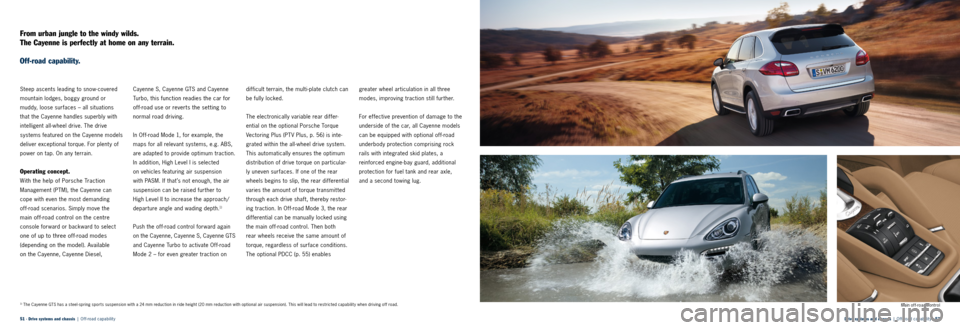
From urban jungle to the windy wilds.
The Cayenne is perfectly at home on any terrain.
Off-road capability.
Steep ascents leading to snow- covered
mountain lodges, boggy ground or
muddy, loose surfaces – all situations
that the Cayenne handles superbly with
intelligent all-wheel drive. The drive
systems featured on the Cayenne models
deliver exceptional torque. For plent y of
power on tap. On any terrain.
Operating concept.
With the help of Porsche Traction
Management (PTM), the Cayenne can
cope with even the most demanding
off-road scenarios. Simply move the
main off-road control on the centre
console forward or backward to select
one of up to three off-road modes
(depending on the model). Available
on the Cayenne, Cayenne Diesel,
Cayenne S, Cayenne GTS and Cayenne
Turbo, this
function readies the car for
off-road use or reverts the set ting to
normal road driving.
In Off-road Mode 1, for example, the
maps for all relevant systems, e.g. ABS,
are adapted to provide optimum traction.
In addition, High Level I is selected
on vehicles featuring air suspension
with PASM. If that ’s not enough, the air
suspension can be raised further to
High Level II to increase the approach/
departure angle and wading depth.
1)
Push the off-road control forward again
on the Cayenne, Cayenne S, Cayenne GTS
and Cayenne Turbo to activate Off-road
Mode 2 – for even greater traction on difficult terrain, the multi-plate clutch can
be fully locked.
The electronically variable rear diffe
r-
ential on the optional Porsche Torque
Vectoring Plus (PT V Plus, p. 56) is inte -
grated within the all-wheel drive system.
This automatically ensures the optimum
distribution of drive torque on particular -
ly uneven surfaces. If one of the rear
wheels begins to slip, the rear differential
varies the amount of torque transmit ted
through each drive shaft, thereby restor -
ing traction. In Off-road Mode 3, the rear
differential can be manually locked using
the main off-road control. Then both
rear wheels receive the same amount of
torque, regardless of surface conditions.
The optional PDCC (p. 55) enables greater wheel articulation in all three
modes, improving traction still further.
For effective prevention of damage to the
underside of the car, all Cayenne models
can be equipped with optional off-road
underbody protection comprising rock
rails with integrated skid plates, a
reinforced engine-bay guard, additional
protection for fuel tank and rear axle,
and a second towing lug.
1) The Cayenne GTS has a steel -spring spor ts suspension with a 24 mm reduction in ride height (20 mm reduction with optional air suspension). This will lead to restricted capabilit y when driving of f road.
Main off-road control
Page 29 of 79
Drive systems and chassis | Chassis · 58
57 · Drive systems and chassis | Chassis
Making headway without getting in a spin.
An approach we thoroughly support.
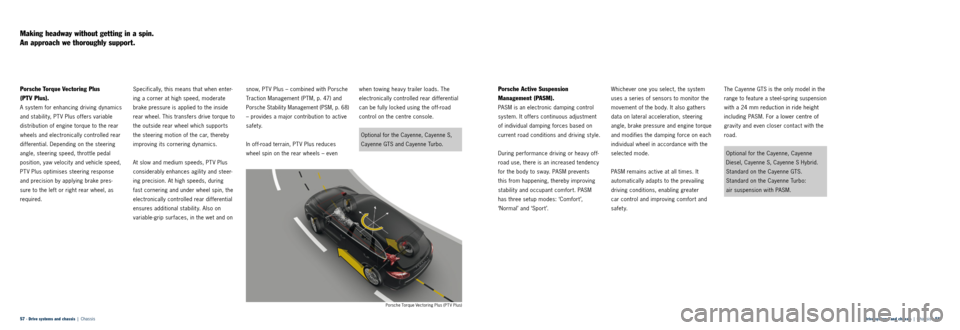
Porsche Torque Vectoring Plus
(PTV Plus).
A system for enhancing driving dynamics
and stability, PTV Plus offers variable
distribution of engine torque to the rear
wheels and electronically controlled rear
differential. Depending on the steering
angle, steering speed, throttle pedal
position, yaw velocit y and vehicle speed,
PT V Plus optimises steering response
and precision by applying brake pres -
sure to the left or right rear wheel, as
r equired. Specifically, this means that when enter
-
ing a corner at high speed, moderate
brake pressure is applied to the inside
rear wheel. This transfers drive torque to
the outside rear wheel which supports
the steering motion of the car, thereby
improving its cornering dynamics.
At slow and medium speeds, PT V Plus
considerably enhances agility and steer -
ing precision. At high speeds, during
fast cornering and under wheel spin, the
electronically controlled rear differential
ensures additional stabilit y. Also on
variable-grip surfaces, in the wet and on snow, PT V Plus – combined with Porsche
Traction Management (PTM, p. 47) and Porsche Stabilit y Management (PSM, p. 68)
– provides a major contribution to active
safety.
In off-road terrain, PT V Plus reduces
wheel spin on the rear wheels – even when towing heav y trailer loads. The
electronically controlled rear differential
can be fully locked using the off-road
control on the centre console.
Optional for the Cayenne, Cayenne S,
Cayenne GTS and Cayenne Turbo.
Porsche Active Suspension
Management (PASM).
PASM is an electronic damping control
system. It offers continuous adjustment
of individual damping forces based on
current road conditions and driving st yle.
During performance driving or heav y off-
road use, there is an increased tendency
for the body to sway. PASM prevents
this from happening, thereby improving
stability and occupant comfort. PASM
has three setup modes: ‘Comfort ’,
‘Normal’ and ‘Sport’.
Porsche Torque Vectoring Plus (PTV Plus)
Whichever one you select, the system
uses a series of sensors to monitor the
movement of the body. It also gathers
data on lateral acceleration, steering
angle, brake pressure and engine torque
and modifies the damping force on each
individual wheel in accordance with the
selected mode.
PASM remains active at all times. It
automatically adapts to the prevailing
driving conditions, enabling greater
car control and improving comfort and
safety.The Cayenne GTS is the only model in the
range to feature a steel-spring suspension
with a 24 mm reduction in ride height
including PASM. For a lower centre of
gravit y and even closer contact with the
road.
Optional for the Cayenne, Cayenne
Diesel, Cayenne S, Cayenne S Hybrid.
Standard on the Cayenne GTS.
Standard on the Cayenne Turbo:
air suspension with PASM.
Page 35 of 79
Safety and environment | Safet y · 70
69 · Safety and environment | Safet y
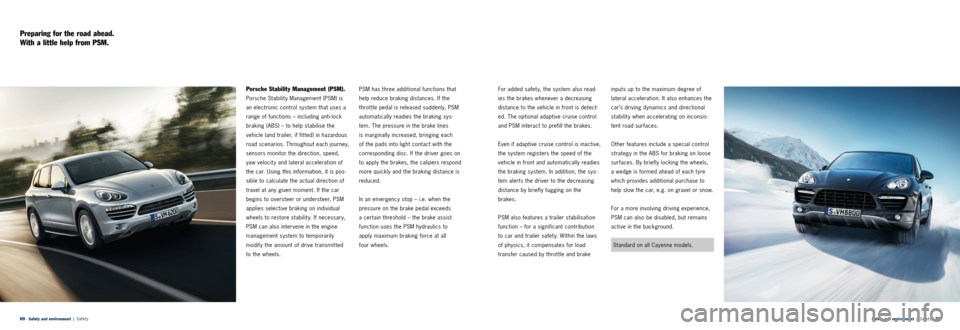
Porsche Stability Management (PSM).
Porsche Stabilit y Management (PSM) is
an electronic control system that uses a
range of functions – including anti-lock
braking (ABS) – to help stabilise the
vehicle (and trailer, if fit ted) in hazardous
road scenarios. Throughout each journey,
sensors monitor the direction, speed,
yaw velocit y and lateral acceleration of
the car. Using this information, it is pos-
sible to calculate the actual direction of
travel at any given moment. If the car
begins to oversteer or understeer, PSM
applies selective braking on individual
wheels to restore stabilit y. If necessary,
PSM can also intervene in the engine
management system to temporarily
modify the amount of drive transmitted
to the wheels. PSM has three additional functions that
help reduce braking distances. If the
throt tle pedal is released suddenly, PSM
automatically readies the braking sys
-
tem. The pressure in the brake lines
is marginally increased, bringing each
of the pads into light contact with the
corresponding disc. If the driver goes on
to apply the brakes, the calipers respond
more quickly and the braking distance is
reduced.
In an emergency stop – i.e. when the
pressure on the brake pedal exceeds
a certain threshold – the brake assist
function uses the PSM hydraulics to
apply maximum braking force at all
four wheels.
Preparing for the road ahead.
With a little help from PSM.
For added safet y, the system also read -
ies the brakes whenever a decreasing
distance to the vehicle in front is detect -
ed. The optional adaptive cruise control
and PSM interact to prefill the brakes.
Even if adaptive cruise control is inactive,
the system registers the speed of the
vehicle in front and automatically readies
the braking system. In addition, the sys -
tem alerts the driver to the decreasing
distance by briefly tugging on the
brakes.
PSM also features a trailer stabilisation
function – for a significant contribution
to car and trailer safet y. Within the laws
of physics, it compensates for load
transfer caused by throt tle and brake inputs up to the maximum degree of
lateral acceleration. It also enhances the
car’s driving dynamics and directional
stability when accelerating on inconsis
-
tent road surfaces.
Other features include a special control
strategy in the ABS for braking on loose
surfaces. By briefly locking the wheels,
a wedge is formed ahead of each t yre
which provides additional purchase to
help slow the car, e.g. on gravel or snow.
For a more involving driving experience,
PSM can also be disabled, but remains
active in the background.
Standard on all Cayenne models.