brakes PORSCHE CAYNNE S 2005 1.G User Guide
[x] Cancel search | Manufacturer: PORSCHE, Model Year: 2005, Model line: CAYENNE S, Model: PORSCHE CAYENNE S 2005 1.GPages: 380, PDF Size: 3.17 MB
Page 221 of 380
Shifting Gear, Traction Systems
221
The events below inform the driver of PSM control
operations and warn him to adapt his driving style
to the road conditions:
– The information light in the instrument panel
lights up.
– Hydraulic noises can be heard.
– The vehicle decelerates and steering-wheel
forces are altered as the PSM controls the
brakes.
– Reduced engine power.
– The brake pedal pulsates and its position is
changed during braking.
However, it is possible at any time to achieve
full vehicle deceleration by increasing the foot
pressure slightly.
Examples of PSM control operations
–Vehicle understeers:
If the front wheels of the vehicle drift on a
bend, engine power is reduced and the rear
wheel on the inside of the bend is braked if
necessary.
–Vehicle oversteers:
If the rear of the vehicle swings out on a bend,
the front wheel on the outside of the bend is
braked.Combined use of PSM and PTM/PTM Plus
In order to ensure optimal stabilisation of the
vehicle, the center differential lock (PTM) and
possibly the rear differential lock (PTM Plus) are
also opened when PSM interventions occur.
Tip on driving
When PSM is switched off, wheel-specific brake
interventions and the traction control system
(TCS) are also inactive.
The automatic brake differential (ABD) remains on.Off-road PSM
(PSM in Low Range program)
When Low Range is active, an off-road PSM
specially matched to off-road driving is activated
to enhance traction.
At a speed below 22 mph (35 km/h), the terrain
PSM intervenes later if the vehicle should under-
steer and thereby improves steerability in Low
Range.
If the brakes are highly stressed, the automatic
brake differential (ABD) switches itself off to
protect the brakes. It remains deactivated until the
brake system has cooled sufficiently.
Engine drag torque control
In conditions of excessive slip, the engine drag
torque control system prevents all driven wheels
from locking up when the car is overrunning. This
is also the case for downshifts on a slippery road.
Page 226 of 380
226
Shifting Gear, Traction Systems
Engine Braking Support
(Assistance when heading downhill)The Porsche Down-Hill Assistant is an assistance
system which helps the driver at slower downhill
driving up to approx. 12 mph (20 km/h), e.g., on
steep slopes or on wintry mountain roads.
As long as the gas pedal is not used when trav-
eling downhill, the Porsche Down-Hill Assistant is
active and brakes the vehicle.
The braking ability of the Engine Braking Support
is affected by slippery surfaces (e.g., on icy or
loose surfaces), like all brakes.
If road grip is lost on one or more wheels, the
system brakes the wheels which have good road
contact.
Conditions:
– The gas pedal must not be used when
travelling downhill.
– The speed must not exceed 12 mph
(20 km/h).
– The selector lever position D or Mmust be
engaged.
Warning!
Risk of accident. Reduced braking ability on
a slippery surface.
fAlways adjust your driving style to the driving situation.
Tip on driving
The Porsche Down-Hill Assistant is active when
driving downhill either forwards or backwards.
Checks on test standsPower measurement
Power measurements on roller test stands are not
approved by Porsche.
Brake tests
Brake tests must be carried out only in High Range
and on plate-type test stands or roller test stands.
The following limit values must not be exceeded
on roller test stands:
– Testing speed 4.7 mph (7.5 km/h)
– Test duration 20 seconds
Parking brake test
Parking brake tests on the brake tester must be
performed only with the ignition switched off and
the selector lever in position N.
Balancing wheels on the vehicle
During finish balancing of the wheels, the entire ve-
hicle must be lifted and the wheels must be free to
turn.
Page 227 of 380
Shifting Gear, Traction Systems
227
Off-Road DrivingPlease read this chapter carefully before driving
off road with your Porsche.
The information provided will familiarise you with
the special advantages of your vehicle, allowing
you to arrive at your destination safely every time.
We recommend practicing on less rugged terrain.
Vehicles with SportDesign package
Warning!
Risk of damage. On vehicles with Sport-
Design package, front, rear, and side
member trim are painted and pulled down
lower. Off-road driving can seriously damage
these trim parts.
fWhen driving off-road, make sure these parts
are not damaged.
fMake sure there is sufficient clearance
between obstacles and the underside of the
vehicle.
fAvoid driving through water.
fDo not use side member trim as a running board.Maintenance note
Please bear in mind that off-road driving subjects
all vehicle components to considerably more wear
than normal use, making professional inspection
and maintenance after each use a vital precondi-
tion for functioning and safety.
Grains of sand, dirt particles and other abrasive
materials entering the brakes can cause exces-
sive wear or unpredictable braking action.
Rules for off-road drivingfEnsure vehicle is equipped with approved all-
terrain tires.
fPlease observe the chapter “GROUND CLEA-
RANCE” on Page 366.
fActivate Low Range.
fStow or fasten luggage and loads securely.
Please observe the chapter “LOADING INFOR-
MATION” on Page 195.
fIf unknown terrain is obscured from view, ex-
amine it on foot first and traverse it with ex-
treme caution.
This way, obstacles are easier to recognise
and damage to the vehicle is avoided.
fAlways drive with the engine running.
Steering assistance is provided only with the
engine running.
fDrive slowly and uniformly.fAlways make sure that the wheels touch the
ground.
fBefore driving through water, check the water
depth, the condition of the surface beneath it
and the speed of the water.
fLook out for obstacles such as boulders,
holes, tree stumps or ruts.
fAlways keep the sliding/lifting roof or
Panorama roof system and the side windows
closed while driving.
fDo not depart from marked routes or paths.
fRespect Nature.
Always obey off-limits signs.
Page 232 of 380

232
Shifting Gear, Traction Systems
Water crossingfPlease observe the chapter “GROUND CLEA-
RANCE” on Page 366.
Danger!
Danger of drowning if water enters the vehi-
cle. Risk of damage to the engine and acces-
sories if water penetrates.
fBefore driving through water, check the water
depthA, water speed and the condition of the
surface beneath it.
The water must not be deeper than 20 in./
50 cm (22 in./55.5 cm for vehicles with level
control and height adjustment).
fCheck the door sills and rubber seals before
starting to drive.
fDo not drive through deep or rapidly flowing
water.
Deep or rapidly flowing water, e.g. mountain
streams, can cause the car to deviate from the
desired path.
fAvoid a "bow wave" by driving at an appropriate
speed.
fNever open the doors when driving through wa-
ter.Soiling can impair the braking action.
fCheck and clean the brakes if they have been
soiled.
Danger of steering assistance failing during
a long journey in the water if the drive belt
slips.
fIf the steering assistance fails, more effort will
be required to steer.
Danger of damaging electrical systems
fAvoid driving through salt water.
Notes on operation
fActivate Low Range.
fSwitch the air conditioner off.
fSwitch the headlights off.
Page 233 of 380
Shifting Gear, Traction Systems
233
Tips on driving
fAvoid high engine speeds (max. 2,500 rpm).
fDo not perform manual gear changes when
driving, and try to avoid stopping.
Moving off in the water can be difficult due to
the high resistance and the loose surface in-
volved.
fStart the water crossing at a shallow place at
walking speed.
fAfter checking the body of water, take the
shortest path through it.
fNever drive into the water at high speed. The
resulting “bow wave” could damage the engine
and its accessories.
fAdjust your driving style to the unfamiliar sur-
roundings.
fCross the body of water slowly and at a con-
stant speed.
fNever turn around when crossing a body of wa-
ter.
fIf it is not possible to cross the body of water,
the car must be backed out of it in reverse
gear.
The servo pump and alternator can fail if the car is
driven through water for an extended period.
fIf the servo pump fails, substantially more
force will have to be exerted in order to steer. Maintenance note
The car requires a special check after the water
crossing.
fRemove mud from the tire tread.
fBriefly brake the brakes dry after driving
through the water.
HumpsfPlease observe the chapter “GROUND CLEA-
RANCE” on Page 366.
Note on operation
fActivate Low Range and engage differential
locks if necessary.
Tips on driving
fJust before reaching the hump, ease off the ac-
celerator slightly and use the car's momentum
to cross the hump. This will prevent the car
from jumping over the hump and landing on the
following downward slope at an excessive
speed.
fAvoid high engine speeds (max. 2,500 rpm).
Page 251 of 380
Maintenance, Car Care
251
Brake-Fluid LevelfPlease observe the chapter “EXERCISE
EXTREME CAUTION WHEN WORKING ON YOUR
VEHICLE” on Page 242.
fUse only new (unused) Original Porsche brake
fluid.
Warning!
Brake fluid is hazardous to your health, and
may be fatal if swallowed.
Brake fluid also attacks paintwork.
fKeep brake fluid out of children's reach.
fImmediately rinse off spilled brake fluid with
clean water.
fIf brake fluid gets into your eye, immediately
rinse with clean water for a few minutes. Then
see a doctor immediately.
fPlease note all the information on the refill container of the brake fluid.
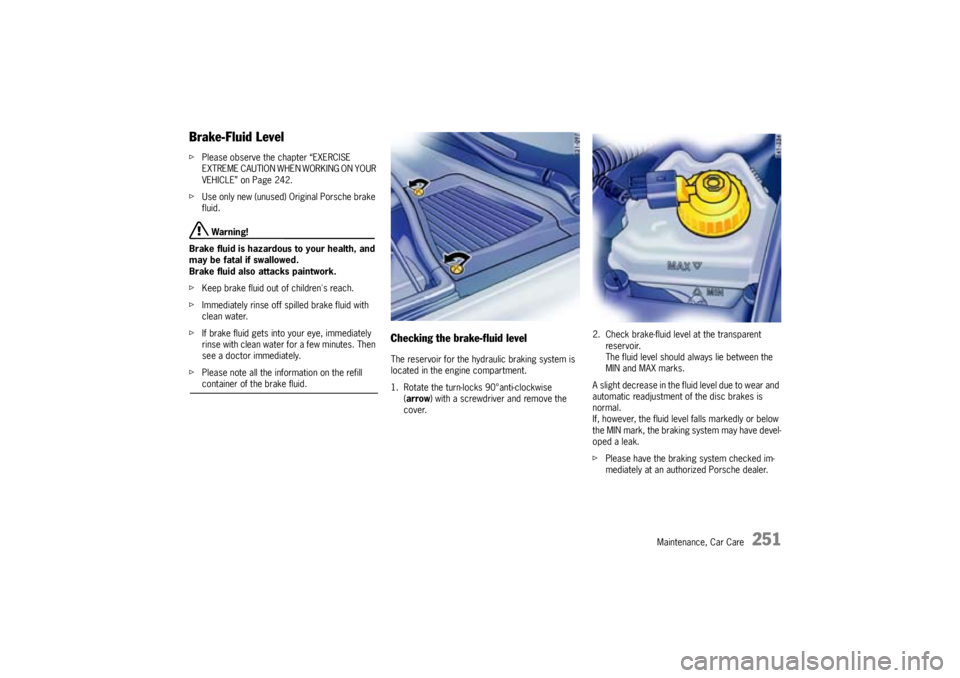
Checking the brake-fluid levelThe reservoir for the hydraulic braking system is
located in the engine compartment.
1. Rotate the turn-locks 90°anti-clockwise
(arrow) with a screwdriver and remove the
cover.2. Check brake-fluid level at the transparent
reservoir.
The fluid level should always lie between the
MIN and MAX marks.
A slight decrease in the fluid level due to wear and
automatic readjustment of the disc brakes is
normal.
If, however, the fluid level falls markedly or below
the MIN mark, the braking system may have devel-
oped a leak.
fPlease have the braking system checked im-
mediately at an authorized Porsche dealer.
Page 265 of 380

Maintenance, Car Care
265
Car Care InstructionsfPlease observe the chapter “EXERCISE
EXTREME CAUTION WHEN WORKING ON YOUR
VEHICLE” on Page 242.
Regular and correct care helps to maintain
the value of your car and is also a
precondition for the New Vehicle Warranty
and the Anti Corrosion Warranty.
Your authorized Porsche dealer has specially
developed car-care products from the
Porsche program available either singly or
as complete car-care sets. They will be
pleased to help you select suitable products.
Whether you use Porsche products or other
commercially available cleaning agents first
make sure of their correct application.
A Porsche that is well-cared for can look like new
for years. It all depends on the amount of care the
owner is willing to give the car.
Warning!
Risk of serious personal injury or damage to
the vehicle or property.
Cleaning agents may be hazardous to your
health.
Most chemical cleaners are concentrates
which require dilution. High concentrations
might cause problems ranging from irritation
to serious injury as well as damage to your
vehicle.
fKeep cleaning agents out of reach from chil-
dren.
fObserve all caution labels.
fAlways read directions on the container before
using any product. These directions may con-
tain information necessary to avoid personal
injury.
fDo not use fuel, kerosene, naphtha, nail polish
remover or other volatile cleaning fluids. They
may be toxic, flammable or hazardous in other
ways. Only use spot removing fluids in a well
vented area.
fDo not clean the underside of chassis, fend-
ers, wheel covers, etc., without protecting
your hands and arms as you may cut yourself on sharp-edged metal parts.Moisture and road salt on brakes may affect bra-
king efficiency.
fTest the brakes after each vehicle washing.
f f f
Page 266 of 380

266
Maintenance, Car Care
High-pressure cleaning units
Warning!
High-pressure cleaning units can damage
the following components:
–Tires
– Logos, emblems
– Painted surfaces
– Widened fenders
– Lock and latch of the removable towing attach-
ment
– Alternator, valve covers
– ParkAssist sensors
fPlease observe the operating instructions from
the unit manufacturer.
fAlways cover the lid over the brake fluid reser-
voir prior to cleaning. Never point the cleaning
jet directly at the lid.
fWhen cleaning with a flat-jet nozzle or the like,
maintain a minimum distance of 21 in.
(50 cm).fNever use high-pressure cleaning units with a
round-jet nozzle.
A high-pressure cleaning unit with round nozzle
will damage your vehicle. The tires are particu-
larly susceptible to damage.
fDo not point the cleaning jet directly at any of
the aforementioned components.
WashingThe best protection for the car from the damaging
effects of the environment is frequent washing and
preservation. The underside of the car should also
be thoroughly washed for cinders, salt or sanding
at winter‘s end.
The longer salt, road dust, industrial dust, insect
remains, bird excrement, and tree exudations (res-
in, pollen), etc. are allowed to remain on the body-
work, the more serious is their harmful effect.
New cars should be washed carefully with plenty
of clear water to protect the new paint work.
Dark paint finishes show up the smallest of sur-
face damage (e.g. scratches) more readily than
lighter colors.
Dark colors are also more susceptible to scratch-
ing because of the composition of their pigments
and require particularly careful paint care.fDo not wash your car in bright sunlight or while
the bodywork is still hot.
fWhen washing by hand, use abundant water, a
soft sponge or wash brush and Porsche car
shampoo.
fBegin by spraying the body thoroughly with wa-
ter to rinse away loose dirt.
fAfter washing, rinse the car with plenty of wa-
ter and then dry with a chamois leather.
Do not use the same chamois leather for
drying as you use for cleaning the windshield
and windows.
Warning!
Moisture which gets on to the brakes during
a car wash can reduce braking efficiency or
make the brake pull unevenly which could in-
crease the danger of an accident, causing
serious personal injuries or death.
fAlways apply the brakes a few times after
washing the car to test braking efficiency and
dry the brake discs.
When doing this, take care not to hamper other
road users behind you (traffic conditions per-mitting).
Page 277 of 380

Practical Tips, Minor Repairs
277
Tires/WheelsThe original equipment tires and wheel rims on
your Porsche comply with all applicable Federal
Motor Vehicle Safety Standards.
For your safety remember the following:
– Wheel rims and wheel bolts are matched to fit
your Porsche.
– If you intend to use other than original equip-
ment wheels, be sure that they conform to
Porsche specifications for your model. Only
tires with the same make and with the same
specification code (e.g. “N0“, “N1“...) can be
mounted.
– The use of wheel rims and wheel bolts that do
not meet specifications of the original factory
installed equipment will affect the safe opera-
tion of your vehicle and affect warranty cover-
age.
– Before you plan on exchanging wheels, or
snow tires already mounted on the wheel rims,
consult your authorized Porsche dealer.
Your dealer has the technical information nec-
essary to advise you which wheel rims and
wheel bolts are compatible with the original
factory installations.
Danger!
Risk of loss of control and serious personal
injury or death.
fIf while driving, your vehicle experiences a sud-
den vibration or ride disturbance, and/or you
suspect that possible damage to your tires or
vehicle has occurred, you should immediately
reduce your speed without excessive use of
the brakes.
fStop the vehicle as soon as possible, and
inspect the tires.
If you cannot determine the cause for the dis-
turbance, have your vehicle towed to the near-
est Porsche or tire dealer to have your vehicle
or tire(s) inspected.
fContinuing to operate the vehicle without cor-
rection could result in a loss of control and seri-ous personal injury.
Page 369 of 380
Index
369
Warning light ........................................ 68
Brake-fluid level
Checking ............................................ 251
Brakes ................................................ 64
,226
Fluid.......................................... 251,362
Fluid warning light ...................... 112,252
Pads ............................................. 14,69
Test stand .......................................... 226
Warning light ........................................ 65
Wear .................................................. 112
Bulbs
Changing............................................ 346
Chart ................................................. 335
CCapacities .................................................. 362
Car care..................................................... 265
Car key
Battery ............................................... 334
Car Telephone ............................................ 173
Care ................................................. 269
,271
cargo area ................................................. 186
Carpet ....................................................... 272
Catalytic converter...................................... 264
Center differential lock ................................ 213
Central locking system ......................... 21,310
Button .................................................. 22
Button (rear) .................................. 22,31
Unlocking vehicle doors ......................... 21
Central vents ..................................... 134
,140
Changing wheels................................ 294,301
Check engine ............................................... 79
Checking hydraulic fluid (power steering) ...... 253
Child restraint anchorages ............................. 46Child restraint systems ..................................47
Child seat bracket .........................................48
Child seats ...................................................48
Installing ...............................................48
Childproof locks
Rear doors ...........................................26
Cigarette lighter ..........................................171
Circulating-air mode ...........................134
,139
Circulating-air mode, automatic ...........134,139
Cleaner
Air......................................................254
Particle...............................................254
Clock ..................................................77,101
Closing mechanism, power ..........................183
Clutch ........................................................202
Collapsible spare wheel ............. 92
,110
,222
,
......................................302
,327
,358
,359
Comfort function
Sliding/lifting roof.......................153,158
Comfort lighting ..........................................151
Coming Home function .......................106,151
Compass....................................................102
Compressor ......................................293,304
Coolant
Checking ............................................249
Cooling system .............................................75
Engine coolant level warning ..................75
Temperature gauge...............................75
Warning ................................................75
Cornering light ...................................117,342
Crankcase ventilation ..................................264
Crossing obstacles .....................................234
Cruise control
Accelerating .......................................125
Decelerating .......................................125Interrupting ........................................ 125
Speed limit ........................................ 124
Storing speed .................................... 124
Switching off ...................................... 126
Switching on ...................................... 124
Cupholder.................................................. 180
Closing rear ....................................... 181
Opening front ..................................... 180
opening rear ...................................... 181
Removing insert front ......................... 180
DData bank .................................................. 354
Diagnostic Socket ........................................ 15
Dimensions ................................................ 365
Dimming .................................................... 151
Button ............................................... 149
Door lock
Deicing .............................................. 267
Door locking, automatic ....................... 23
,104
Door mirrors .............................. 56
,151
,198
Automatic anti-dazzle operation ............. 58
Driving with a trailer ............................ 198
Extending ............................................ 57
Folding in ............................................. 57
Heating................................................ 57
Setting ................................................ 57
Swivelling, automatic ............................ 57
Door opening .......... 19
,20,21,23,26,104
Emergency operation ........................... 18
Door trim panel
Lighting ............................................. 151
Doors.......................................................... 26
Door-surrounding lighting ............................ 151