heating PORSCHE CAYNNE S 2006 1.G User Guide
[x] Cancel search | Manufacturer: PORSCHE, Model Year: 2006, Model line: CAYENNE S, Model: PORSCHE CAYENNE S 2006 1.GPages: 420, PDF Size: 3.81 MB
Page 154 of 420

154
Controls, Safety, Instruments You can switch to automatic mode for the front
and rear air-conditioned areas, independently of
one another.
fPress AUTO button C on the front or rear
control panel.
The indicator light in button C of the front con-
trol panel and the Auto indication in the rear
control panel are lit.
Air quantity and distribution are automatically
controlled and variations are compensated.
Note on operation
If necessary, the automatic system can be
manually influenced.
This setting is retained until the appropriate
function button is pressed again or the AUTO
button C is pressed.Switching MONO function on
The temperature and air quantity settings for the
driver’s side can be accepted for the entire
vehicle.
fPress AUTO button C in the front control panel
for 2 seconds.
The MONO logo appears on the air-condi-
tioning display panel.
Ending MONO function
fPress AUTO button C in the front control panel
for 2 seconds or
fChange the settings in the air-conditioned
areas.Automatic mode
Setting temperatureTo suit personal comfort, the interior temperature
for each of the four air-conditioned areas can be
adjusted between 61°F and 85°F (16°C and
29.5°C).
Recommendation: 72°F (22°C)
fPush temperature button up or down.
Button H:
Left air-conditioned area at the front or rear.
Button R:
Right air-conditioned area at the front or rear.
The selected temperature is shown on the
display above the button.
If “LO” or “HI” appears on the display, the system
is operating at maximum cooling or heating pow-
er.
If the preselected temperature is changed, the air
quantity blowing out can adjust automatically in au-
tomatic mode.
The desired temperature is reached more quickly
this way.
Page 158 of 420

158
Controls, Safety, Instruments
A-“
–” button
B-TIMER button
C-ON/OFF button
D-“+” button
Parking HeaterThe parking heater features two functions: parking
heating and parking ventilation.
The parking heater is ready for use regardless of
the ignition key position.
The parking heater is also used as an auxiliary
heater. Operation of the parking heater is clearly
audible when outside temperatures are low, even
if the parking heater has been manually switched
off.
Danger!
Risk of poisoning due to carbon monoxide
(CO). The parking heater consumes fuel and
emits exhaust fumes. Exposure to such
fumes can cause unconsciousness, serious
personal injury or death.
fSwitch off the parking heater before refuelling.
fDo not operate the parking heater in enclosed spaces (e.g. a garage).
The parking heater is operated using the following
buttons on the front air-conditioning control panel:
Switch parking heater on and off
Activate program
Start programming
Call memories
Set ON times
Activate heating function
Set ON times
Activate ventilating function
Page 159 of 420

Controls, Safety, Instruments
159
Notes on operation
The parking heater runs on fuel, and it therefore
cannot be switched on after the reserve warning
lights up.
fPlease observe the chapter “FUEL RESERVE
WARNING” on Page 88.
The parking heater must be operated at least
once per month, with the engine cold and the
blower at its lowest setting.
Ignition off: When the parking heater is running,
the remaining running time is shown on the display
panel.
Operation of the parking heater is clearly audible
when outside temperatures are low and the engine
is cold.Switching on
fPress ON/OFF button C.
The programed parking heating or parking ven-
tilation function is switched on.
Switching off
fPress ON/OFF button C again.
Note on operation
fAfter switching off the parking heater using
ON/OFF button C wait for at least 2 minutes
before you press the button again.
The combusion chamber is cleaned.
Switching parking heater on and
off
Page 160 of 420
160
Controls, Safety, Instruments
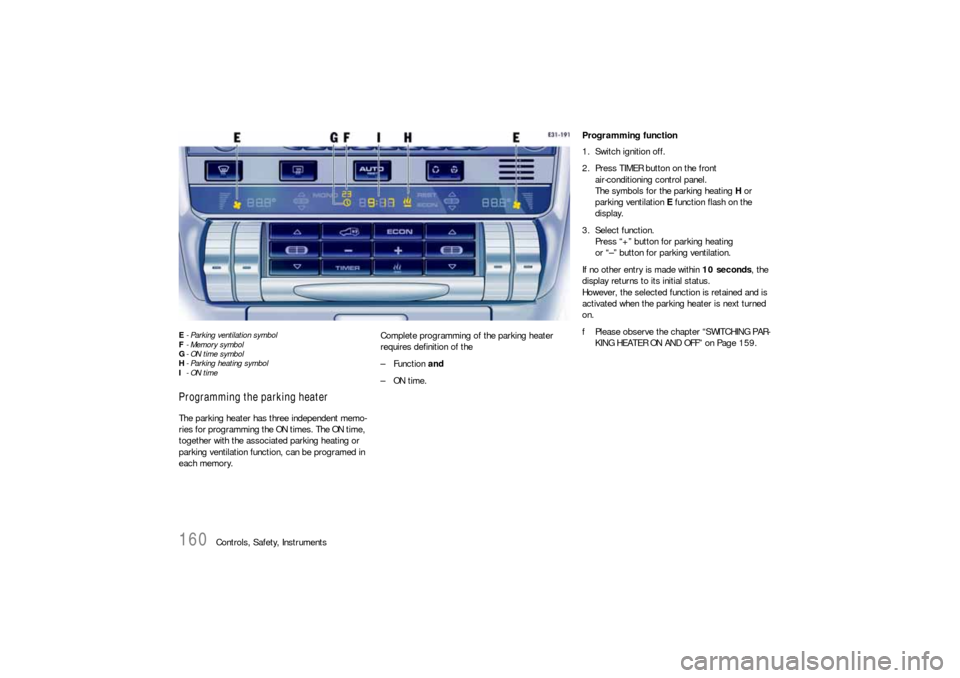
E- Parking ventilation symbol
F-Memory symbol
G-ON time symbol
H- Parking heating symbol
I-ON timeProgramming the parking heaterThe parking heater has three independent memo-
ries for programming the ON times. The ON time,
together with the associated parking heating or
parking ventilation function, can be programed in
each memory.Complete programming of the parking heater
requires definition of the
–Function and
–ON time.
Programming function
1. Switch ignition off.
2. Press TIMER button on the front
air-conditioning control panel.
The symbols for the parking heating H or
parking ventilation E function flash on the
display.
3. Select function.
Press “+” button for parking heating
or “–” button for parking ventilation.
If no other entry is made within 10 seconds, the
display returns to its initial status.
However, the selected function is retained and is
activated when the parking heater is next turned
on.
fPlease observe the chapter “SWITCHING PAR-
KING HEATER ON AND OFF” on Page 159.
Page 161 of 420

Controls, Safety, Instruments
161
Programming ON times
1. Switch ignition off.
2. Press TIMER button.
3. Select function (parking heating or parking
ventilation).
4. Select the memory using TIMER button B.
The desired memory can be selected by
pressing button B several times.
5. Set ON time using the “+” and “–” buttons A
und D.
Pressing the buttons adjusts the time on a
minute-by-minute basis. If the button is kept
depressed, the time is adjusted faster.
ON times are only valid for 24 hours.
6. Press ON/OFF button C.
Displays F and G flash for approx. 10 seconds.
The button C can be pressed again to switch
off the displays before this time has elapsed.
ON time I, clock symbol F and memory G are
displayed for 2 minutes after ON/OFF button C
has been pressed.
The display then goes out.
The parking heater has now been programed
and the selected memory is active (symbol G
is lit).
Note on operation
Only one memory can be active at any one time.Activating the memory
The parking heater runs for 30 minutes. It then
switches itself off automatically.
The program must be reactivated for every subse-
quent run.
To do this:
1. Switch ignition off.
2. Press TIMER button B.
3. Select function (parking heating or parking
ventilation).
4. Select the memory using TIMER button B. The
ON time that was last saved is displayed.
5. Press ON/OFF button C.
The program is reactivated.
Displays F and G flash for approx. 10 seconds.
The ON/OFF button can be pressed again to
switch off the displays before this time has
elapsed.
After the ON/OFF button has been pressed,
the ON time I, clock symbol F and memory G
are displayed for 2 minutes.
The display then goes out.
The parking heater has now been programed
and the selected memory is active (symbol G
is lit).
Note on operation
Only one memory can be active at any one time.Example:
The parking heater is to activate the parking
heating function at 9:48 a.m.
To do this:
1. Switch ignition off.
2. Press TIMER button B on the front air-condi-
tioning control panel.
The symbols for the parking heating or parking
ventilation function flash on the display.
3. Press “+” button D.
This selects the parking heating function.
4. Select the memory using TIMER button B
.
5. Set ON time to 9:48 a.m. using the “+” and
“–” buttons (A and D).
6. Press ON/OFF button C.
The parking heater has now been programed
and the selected memory is active.
Note on operation
If the parking heater is switched on manually prior
to program start of an active memory, this will
delete the programming.
The memory must be reactivated if it is needed.
If the memory is not reactivated, the parking
heater will not switch on.
Page 162 of 420

162
Controls, Safety, Instruments
Parking heater faultsIn the event of faults in the parking heater, no
function symbol appears on the display – only the
remaining running time is shown. The display
flashes on briefly and then goes completely dark.
fHave the parking heater checked at an
authorized Porsche dealer.
In the event of a serious accident, the parking
heater switches off automatically for safety
reasons.
The parking heater is not ready for operation.
fPlease consult an authorized Porsche dealer.
If the temperature rises, the overheating protec-
tion switches the parking heater off automatically.
The parking heater is not ready for operation.
fPlease consult an authorized Porsche dealer.
The parking heater is switched off automatically if
the voltage is too low. The parking heater is
temporarily unavailable.
Page 188 of 420
188
Controls, Safety, Instruments
Cigarette Lighter
Warning!
Danger of fire and burning. The cigarette
lighter is ready for use, regardless of the ig-
nition lock position.
fDo not leave children in the car unattended.
fNever touch the heating element or sides of
the lighter.
fHold the lighter by the knob only.
The cigarette lighter is ready for use regardless of
the ignition lock position.
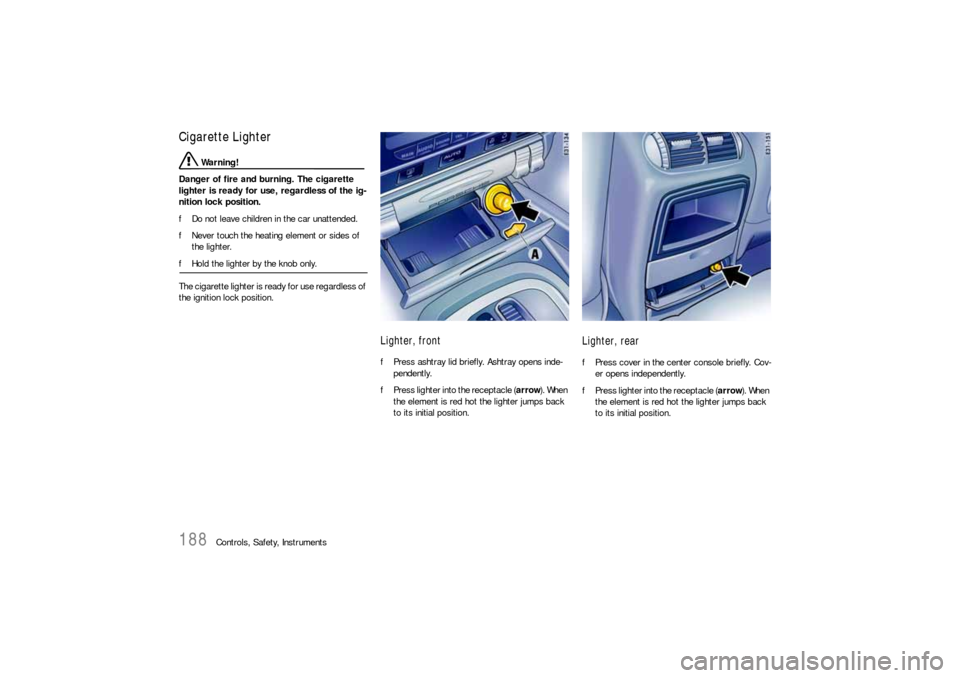
Lighter, frontfPress ashtray lid briefly. Ashtray opens inde-
pendently.
fPress lighter into the receptacle (arrow). When
the element is red hot the lighter jumps back
to its initial position.
Lighter, rearfPress cover in the center console briefly. Cov-
er opens independently.
fPress lighter into the receptacle (arrow). When
the element is red hot the lighter jumps back
to its initial position.
Page 215 of 420

Controls, Safety, Instruments
215
Stowing load in the vehicle
Warning!
Danger of injury.
An unsecured or incorrectly positioned cargo
can slip out of place or endanger the vehicle
occupants during braking, direction changes
or in accidents.
Never transport objects which are not se-
cured.
fAlways transport cargo in the cargo area, nev-
er in the passenger compartment (e.g. on or in
front of the seats).
fSupport the cargo on the seat backrests when-
ever possible. Always lock the backrests into
place.
fPlace the cargo behind unoccupied seats
whenever possible.
fStow heavy objects as close to the front of the
cargo area as possible, with lightweight ob-
jects behind them.
fThe cargo must never project over the top
edge of the seat backrest.
fAlways protect the passenger compartment
with a luggage safety net and a luggage
compartment cover.
Do not drive with objects on top of the luggage
compartment cover.fIf the rear seats are not occupied, the back-
rests can be additionally secured with the safe-
ty belts. Simply cross the outer safety belts
and insert each into the opposite buckle.
fMake sure that the cargo cannot damage the
heating filaments of the rear window and the
TV antenna of the side window.
Luggage net
fLuggage must be stowed completely covered
by the luggage net.
The luggage net can prevent only lightweight
objects from slipping.
Tie-down belts
fDo not use elastic belts or straps to tie down
cargo.
fDo not place belts and straps over sharp edg-
es.
fObserve the directions for use and information
for the tie-down equipment.
fUse only belts with a tear strength of at least
1543 lbs. (700 kg) and a maximum width of
1in. (25mm).
fCross the belts over the load.Driving
fThe car's handling changes depending on the
vehicle loading. Adapt your driving style to the
changed driving behavior.
fDo not exceed the maximum gross weight and
the axle load.
fPlease observe the chapter “WEIGHTS” on
Page 387.
fNever drive with the rear window or rear lid
open.
Exhaust gases can enter the passenger
compartment.
fAdapt the tire pressure to the load.
fPlease observe the chapter “LOAD” on
Page 108.
fPlease observe the chapter “TIRE PRESSU-
RES, COLD” on Page 385.
Page 283 of 420

Maintenance, Car Care
283
How Emission Control WorksWhen an automobile engine is running, it uses en-
ergy generated through the combustion of a mix-
ture of air and fuel. Depending on whether a car is
driven fast or slowly or whether the engine is cold
or hot, some of the fuel (hydrocarbons) may not
be burned completely, but may be discharged into
the engine crankcase or exhaust system. Additon-
al hydrocarbons may enter the atmosphere
through evaporation of fuel from the fuel tank.
These hydrocarbons (HC), when released into the
air, contribute to undesirable pollution.
In addition, carbon monoxide (CO) and oxides of
nitrogen (NOx) contribute to engine emissions.
They, too, are formed during the combustion proc-
ess and discharged into the exhaust system.
To reduce these pollutants, your Porsche is
equipped with a precisely calibrated fuel injection
system to assure a finely balanced air/fuel mixture
under all operating conditions.
Oxygen sensorThe oxygen sensor, installed in the exhaust pipe
continuously senses the oxygen content of the ex-
haust and signals the information to an electronic
control unit. The control unit corrects the air/fuel
ratio, so the engine always receives an accurately
metered air/fuel mixture.Crankcase ventilationThrough crankcase ventilation, undesirable emis-
sions from the engine crankcase are not permit-
ted to reach the outside atmosphere. These emis-
sions are recirculated from the crankcase to the
air intake system. From here the emissions mix
with the intake air and are later burned in the en-
gine.Catalytic convertersThe catalytic converters are efficient “clean-up“
devices built into the exhaust system of the vehi-
cle. The catalytic converters burn the undesirable
pollutants in the exhaust gas before it is released
into the atmosphere.
The exclusive use of unleaded fuel is critical-
ly important for the life of the catalytic con-
verters. Therefore, only unleaded fuel must
be used.The catalytic converters will be damaged by:
– push or tow starting the vehicle
– misfiring of the engine
– turning off the ignition while the vehicle is mov-
ing or
– driving until the fuel tank is completely empty
– by other unusual operating conditions.
fDo not continue to operate your vehicle under
these conditions, since raw fuel might reach
the catalytic converters. This could result in
overheating of the converters. Federal law pro-
hibits use of leaded fuel in this car.
Page 330 of 420
330
Practical Tips, Minor Repairs
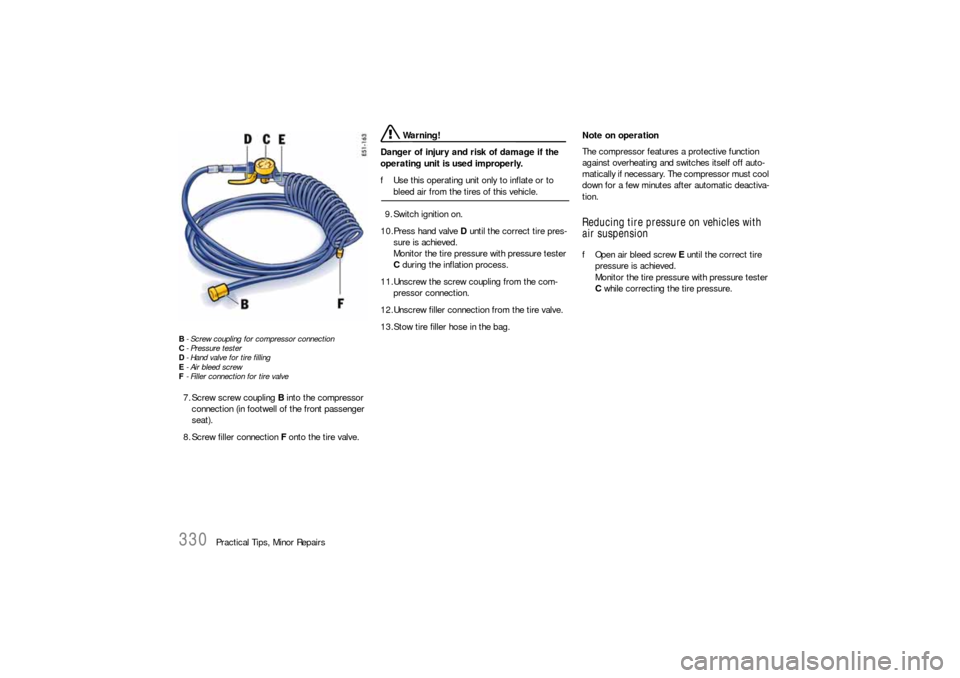
B- Screw coupling for compressor connection
C- Pressure tester
D- Hand valve for tire filling
E- Air bleed screw
F- Filler connection for tire valve7. Screw screw coupling B into the compressor
connection (in footwell of the front passenger
seat).
8. Screw filler connection F onto the tire valve.
Warning!
Danger of injury and risk of damage if the
operating unit is used improperly.
fUse this operating unit only to inflate or to bleed air from the tires of this vehicle.
9. Switch ignition on.
10.Press hand valve D until the correct tire pres-
sure is achieved.
Monitor the tire pressure with pressure tester
C during the inflation process.
11.Unscrew the screw coupling from the com-
pressor connection.
12.Unscrew filler connection from the tire valve.
13.Stow tire filler hose in the bag.Note on operation
The compressor features a protective function
against overheating and switches itself off auto-
matically if necessary. The compressor must cool
down for a few minutes after automatic deactiva-
tion.
Reducing tire pressure on vehicles with
air suspensionfOpen air bleed screw E until the correct tire
pressure is achieved.
Monitor the tire pressure with pressure tester
C while correcting the tire pressure.