engine PORSCHE CAYNNE S 2006 1.G Manual PDF
[x] Cancel search | Manufacturer: PORSCHE, Model Year: 2006, Model line: CAYENNE S, Model: PORSCHE CAYENNE S 2006 1.GPages: 420, PDF Size: 3.81 MB
Page 245 of 420

Shifting Gear, Traction Systems
245
Off-Road DrivingPlease read this chapter carefully before driving
off road with your Porsche.
The information provided will familiarise you with
the special advantages of your vehicle, allowing
you to arrive at your destination safely every time.
We recommend practicing on less rugged terrain.
Vehicles with SportDesign package
Caution!
Risk of damage. On vehicles with Sport-
Design package, front, rear, and side
member trim are painted and pulled down
lower. Off-road driving can seriously damage
these trim parts.
fWhen driving off-road, make sure these parts
are not damaged.
fMake sure there is sufficient clearance
between obstacles and the underside of the
vehicle.
fAvoid driving through water.
fDo not use side member trim as a running board.Maintenance note
Please bear in mind that off-road driving subjects
all vehicle components to considerably more wear
than normal use, making professional inspection
and maintenance after each use a vital precondi-
tion for functioning and safety.
Grains of sand, dirt particles and other abrasive
materials entering the brakes can cause exces-
sive wear or unpredictable braking action.
Rules for off-road drivingfEnsure vehicle is equipped with approved all-
terrain tires.
fPlease observe the chapter “GROUND CLEA-
RANCE” on Page 390.
fActivate Low Range.
fStow or fasten luggage and loads securely.
Please observe the chapter “LOADING INFOR-
MATION” on Page 213.
fIf unknown terrain is obscured from view, ex-
amine it on foot first and traverse it with ex-
treme caution.
This way, obstacles are easier to recognise
and damage to the vehicle is avoided.
fAlways drive with the engine running.
Steering assistance is provided only with the
engine running.
fDrive slowly and uniformly.fAlways make sure that the wheels touch the
ground.
fBefore driving through water, check the water
depth, the condition of the surface beneath it
and the speed of the water.
fLook out for obstacles such as boulders,
holes, tree stumps or ruts.
fAlways keep the sliding/lifting roof or
Panorama roof system and the side windows
closed while driving.
fDo not depart from marked routes or paths.
fRespect Nature.
Always obey off-limits signs.
Page 248 of 420

248
Shifting Gear, Traction Systems
Uphill driving
Danger!
Danger of serious personal injury or death
and risk of damage if the vehicle should
overturn.
fDo not turn around when driving uphill.
fIf it is not possible to climb a gradient, the car
must be backed down in reverse gear.
fDo not drive over embankments or slopes at
steep diagonal angles.
fIf the vehicle starts to tilt, immediately steer in
the direction of the tilt (line of slope).
fWhen driving uphill, never let the vehicle roll
backward when in idle or not in gear.
Exclusive use of the footbrake is too risky in such situations.Note on operation
fActivate Low Range before taking extreme up-
ward or downward gradients.
Tips on driving
fDo not perform manual gear changes when
driving, and try to avoid stopping.
fAvoid high engine speeds (max. 2,500 rpm).
Traction on uphill slopesNote on operation
fActivate Low Range and engage differential
locks if necessary.
Tips on driving
fWhen driving uphill, go easy on the accelerator
and make sure that wheels have sufficient trac-
tion (don't spin).
fAvoid high engine speeds (max. 2,500 rpm).
fDrive slowly.
Page 249 of 420

Shifting Gear, Traction Systems
249
Driving downhill
Danger!
There is a danger of serious personal injury
or death and risk of damage if the vehicle
should overturn.
fDo not drive over embankments or slopes at
steep diagonal angles.
fDrive downhill slowly, with the wheels pointing
straight ahead.
fIf the vehicle starts to tilt, immediately steer in
the direction of the tilt (line of slope).
fWhen driving downhill, never let the vehicle roll
when in idle.
fUse engine braking effect.
If the engine braking effect is not adequate, gently apply the foot brake.Note on operation
fActivate Low Range. The off-road ABS is
switched on automatically.
Tips on driving
The same general principle as for uphill driving ap-
plies to downhill driving.
fDo not perform manual gear changes when
driving, and try to avoid stopping.
fAvoid high engine speeds (max. 2,500 rpm).
A special circuit in the off-road ABS permits con-
trolled brief lock-up of the front wheels so that they
can dig into the loose surface more effectively.
Locked wheels slip and can no longer be steered.
fWhen driving down steep hills on unpaved sur-
faces, brake carefully so that vehicle does not
start to slide.
Page 250 of 420
250
Shifting Gear, Traction Systems
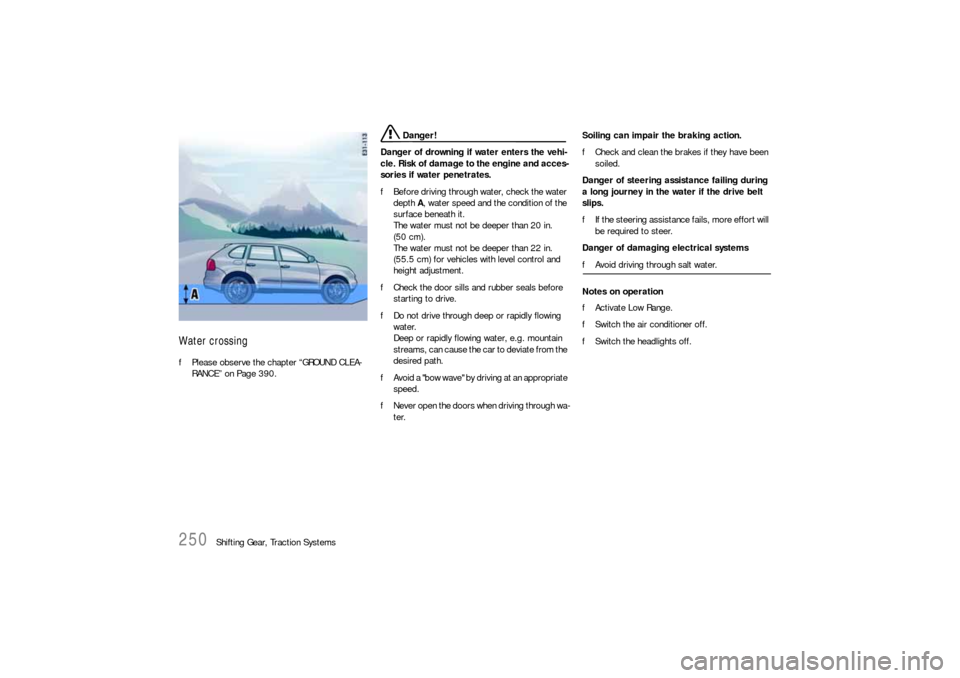
Water crossingfPlease observe the chapter “GROUND CLEA-
RANCE” on Page 390.
Danger!
Danger of drowning if water enters the vehi-
cle. Risk of damage to the engine and acces-
sories if water penetrates.
fBefore driving through water, check the water
depth A, water speed and the condition of the
surface beneath it.
The water must not be deeper than 20 in.
(50 cm).
The water must not be deeper than 22 in.
(55.5 cm) for vehicles with level control and
height adjustment.
fCheck the door sills and rubber seals before
starting to drive.
fDo not drive through deep or rapidly flowing
water.
Deep or rapidly flowing water, e.g. mountain
streams, can cause the car to deviate from the
desired path.
fAvoid a "bow wave" by driving at an appropriate
speed.
fNever open the doors when driving through wa-
ter.Soiling can impair the braking action.
fCheck and clean the brakes if they have been
soiled.
Danger of steering assistance failing during
a long journey in the water if the drive belt
slips.
fIf the steering assistance fails, more effort will
be required to steer.
Danger of damaging electrical systems
fAvoid driving through salt water.
Notes on operation
fActivate Low Range.
fSwitch the air conditioner off.
fSwitch the headlights off.
Page 251 of 420

Shifting Gear, Traction Systems
251
Tips on driving
fAvoid high engine speeds (max. 2,500 rpm).
fDo not perform manual gear changes when
driving, and try to avoid stopping.
Moving off in the water can be difficult due to
the high resistance and the loose surface in-
volved.
fStart the water crossing at a shallow place at
walking speed.
fAfter checking the body of water, take the
shortest path through it.
fNever drive into the water at high speed. The
resulting “bow wave” could damage the engine
and its accessories.
fAdjust your driving style to the unfamiliar sur-
roundings.
fCross the body of water slowly and at a con-
stant speed.
fNever turn around when crossing a body of wa-
ter.
fIf it is not possible to cross the body of water,
the car must be backed out of it in reverse
gear.
The servo pump and alternator can fail if the car is
driven through water for an extended period.
fIf the servo pump fails, substantially more
force will have to be exerted in order to steer. Maintenance note
The car requires a special check after the water
crossing.
fRemove mud from the tire tread.
fBriefly apply the brakes in order to dry them af-
ter driving through the water.
ObstaclesfPlease observe the chapter “GROUND CLEA-
RANCE” on Page 390.
Note on operation
fActivate Low Range and engage differential
locks if necessary.
Tips on driving
fJust before reaching the obstacle, ease off the
accelerator slightly and use the car's momen-
tum to cross the obstacle. This will prevent the
car from jumping over the obstacle and landing
on the following downward slope at an exces-
sive speed.
fAvoid high engine speeds (max. 2,500 rpm).
Page 252 of 420
252
Shifting Gear, Traction Systems
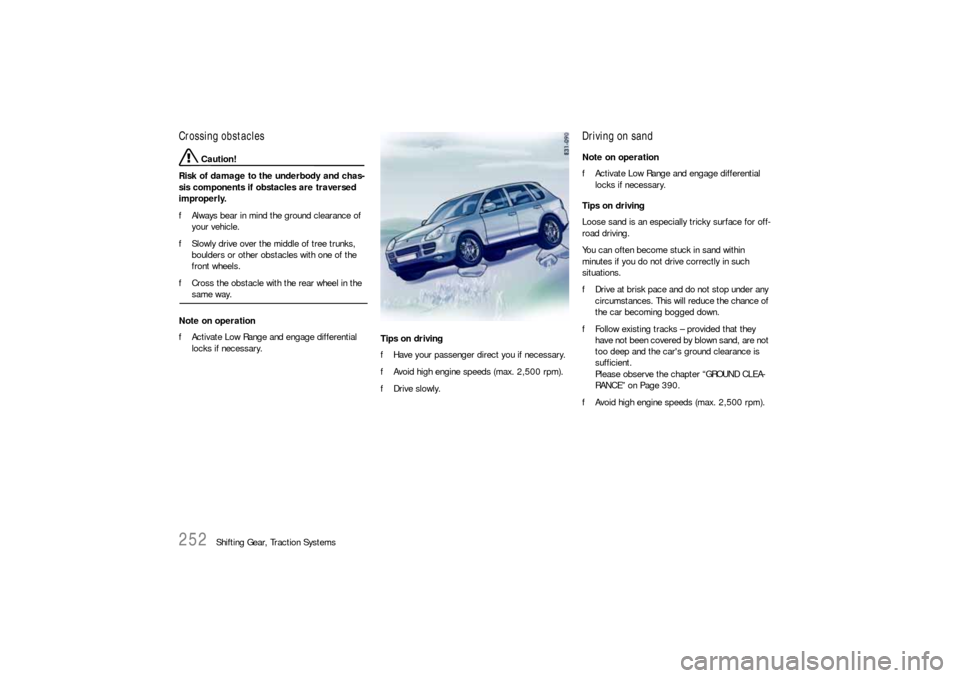
Crossing obstacles
Caution!
Risk of damage to the underbody and chas-
sis components if obstacles are traversed
improperly.
fAlways bear in mind the ground clearance of
your vehicle.
fSlowly drive over the middle of tree trunks,
boulders or other obstacles with one of the
front wheels.
fCross the obstacle with the rear wheel in the same way.
Note on operation
fActivate Low Range and engage differential
locks if necessary.Tips on driving
fHave your passenger direct you if necessary.
fAvoid high engine speeds (max. 2,500 rpm).
fDrive slowly.
Driving on sandNote on operation
fActivate Low Range and engage differential
locks if necessary.
Tips on driving
Loose sand is an especially tricky surface for off-
road driving.
You can often become stuck in sand within
minutes if you do not drive correctly in such
situations.
fDrive at brisk pace and do not stop under any
circumstances. This will reduce the chance of
the car becoming bogged down.
fFollow existing tracks – provided that they
have not been covered by blown sand, are not
too deep and the car's ground clearance is
sufficient.
Please observe the chapter “GROUND CLEA-
RANCE” on Page 390.
fAvoid high engine speeds (max. 2,500 rpm).
Page 253 of 420

Shifting Gear, Traction Systems
253
When driving on slopes with soft sand on vehicles
with Tiptronic S:
fUse the manual select mode M in addition to
the Low Range program.
If your vehicle becomes stuck nevertheless:
Do not spin the wheels. Instead, use branches,
mats or similar items to provide adequate traction
so that you can drive out of the critical area.
Track rutsOther vehicles leave ruts in many off-road courses
or gravel roads.
fPlease observe the chapter “GROUND CLEA-
RANCE” on Page 390.
Caution!
Risk of damage to the vehicle floor when
driving through ruts that are too deep.
fAlways bear in mind the car's ground clear-
ance.
fDo not drive over ruts that are too deep.
Note on operation
fActivate Low Range and engage differential
locks if necessary.
Tips on driving
fIn cases of doubt, drive with one wheel on the
strip of grass between the ruts.
fAvoid high engine speeds (max. 2,500 rpm).
fDrive slowly.
Page 259 of 420

Maintenance, Car Care
259 Maintenance, Car Care
Exercise Extreme Caution
when Working on your Vehicle ..................... 260
Engine Oil Level ......................................... 262
Engine Oil Recommendation ........................ 265
Coolant Level ............................................. 267
Brake-Fluid Level ........................................ 269
Washer Fluid .............................................. 270
Power Steering .......................................... 271
Air Cleaner ................................................ 272
Particle Filter ............................................. 272
Automatic Transmission Fluid ...................... 272
Manual Transmission Oil ............................. 272
Wiper Blades ............................................. 273
Fuel Economy ............................................ 276
Operating Your Porsche in other Countries ... 276
Fuel........................................................... 277
Fuel Recommendations............................... 280
Portable Fuel Containers ............................. 281
Fuel Evaporation Control ............................. 281
Emission Control System ............................ 282
Car Care Instructions.................................. 284
Page 260 of 420

260
Maintenance, Car Care
Exercise Extreme Caution when
Working on your Vehicle
Danger!
Ignoring the following instructions may
cause serious personal injury or death.
fThe engine compartment of any motor vehicle
is a potentially hazardous area. If you are not
fully familiar with proper repair procedures, do
not attempt the adjustments described on the
following pages.
This caution applies to the entire vehicle.
fO n l y w o r k o n y o u r v e h i c l e o u t d o o r s o r i n a w e l l
ventilated area.
fEnsure that there are no open flames in the
area of your vehicle at any time when fuel
fumes might be present. Be especially cau-
tious of such devices such as hot water heat-
ers which ignite a flame intermittently.
fBefore working on any part in the engine com-
partment, turn the engine off and let it cool
down sufficiently. Hot engine compartment
components can burn skin on contact.
fBe alert and cautious around engine at all
times while the engine is running.
If you have to work on the engine while it is run-
ning, always put the handbrake on and put the
gearshift lever in neutral or the selector lever
in position P.fIn particular, be very careful to ensure that
items of clothing (ties, shirt, sleeves etc.), jew-
elry, long hair, hand or fingers cannot get
caught in the fan, belts or other moving parts.
The radiator and radiator fans are in the front
of the car.
The fans can start or continue running as a
function of temperature, even with the engine
switched off.
Carry out work in these areas only with the en-
gine off and exercise extreme caution.
fYour Porsche is equipped with an electronic ig-
nition system. When the ignition is on, high volt-
age is present in all wires connected with the
ignition system; therefore, exercise extreme
caution when working on any part of the engine
while the ignition is on or the engine is running.
fAlways support your car with safety stands if it
is necessary to work under the car. The jack
supplied with the car is not adequate for this
purpose.
For vehicles with air suspension with level con-
trol and height adjustment switch off level con-
trol. Therefore:
Please observe the chapter “RAISING VEHICLE
WITH THE JACK” on Page 256.
fWhen working under the car without safety
stands but with the wheels on the ground,
make sure the car is on level ground, the
wheels are blocked, and that the engine can-
not be started.
Withdraw ignition keys (switch ignition off in ve-
hicles that have Porsche Entry & Drive).fDo not smoke or allow an open flame around
the battery or fuel.
Keep a fire extinguisher in close reach.
fIncomplete or improper servicing may cause
problems in the operation of the car. If in doubt
about any servicing, have it done by your au-
thorized Porsche dealer.
Improper maintenance during the warranty pe-
riod may affect your Porsche warranty cover-
age.
fSupplies of fluids, e.g. engine oil, washer fluid,
brake fluid or coolant, are hazardous to your
health.
Keep these fluids out of children's reach and
dispose of them in accordance with the appro-
priate regulations.
fSome countries require additional tools and
special spare parts to be carried.
Please make enquiries before driving abroad.
Power measurementsPower measurements on dynamometers are not
approved by Porsche.
Page 261 of 420

Maintenance, Car Care
261
Radiator fansThe radiator and radiator fans are in the front of
the car.
Warning!
Danger of injury. The fans can start running
as a function of temperature, even with the
engine switched off.
fExercise extreme caution when working in the area of the radiator fans.
Engine OilEngine oil consumption
It is normal for your engine to consume oil.
The rate of oil consumption depends on the quality
and viscosity of oil, the speed at which the engine
is operated, the climate, road conditions as well
as the amount of dilution and oxidation of the lubri-
cant.
If the vehicle is used for repeated short trips, and
consumes a normal amount of oil, the engine oil
measurement may not show any drop in the oil lev-
el at all, even after 600 miles (1000 km) or more.
This is because the oil is gradually becoming dilut-
ed with fuel or moisture, making it appear that the
oil level has not changed.
The diluting ingredients evaporate out when the
vehicle is driven at high speeds, as on an express-
way, making it then appear that oil is excessively
consumed after driving at high speeds.
If the conditions you drive your vehicle in are
dusty, humid, or hot, the frequency of the oil
change intervals should be greater.If the vehicle is driven at a high rate of speed, cli-
matic conditions are warm, and the load is high,
the oil should be checked more frequently, as driv-
ing conditions will determine the rate of oil con-
sumption.
– The engine in your vehicle depends on oil to lu-
bricate and cool all of its moving parts. There-
fore, the engine oil should be checked regular-
ly and kept at the required level.
– Make it a habit to have the engine oil level
checked with every fuel filling.
– The oil pressure warning light is not an oil level
indicator.
The oil pressure warning light indicates serious
engine damage may be occuring when lit, if en-
gine rpm is above idle speed.