light controls PORSCHE CAYNNE S 2006 1.G Manual PDF
[x] Cancel search | Manufacturer: PORSCHE, Model Year: 2006, Model line: CAYENNE S, Model: PORSCHE CAYENNE S 2006 1.GPages: 420, PDF Size: 3.81 MB
Page 184 of 420

184
Controls, Safety, Instruments
A- Programable keypad
B- Light-emitting diode for status identificationGarage Door OpenerThe programable garage door opener in your
Porsche replaces up to three original hand-held
transmitters used to operate a variety of devices
(e.g. garage door, gate to the property, alarm
system).
You have the option of programming each individ-
ual key in key pad A with an original hand-held
transmitter frequency.
Warning!
Risk of accident when using the garage door
opener if persons, animals or objects are
within the range of movement of the equip-
ment that is being operated.
fWhen using the garage door opener, ensure
that no persons, animals or objects are within
the range of movement of the equipment that
is being operated.
fObserve the safety notes for the original hand-held transmitter.
To operate the device in question
(e.g. garage door, gate to the property,
alarm system):
fPress the relevant button in keypad A.
Light-emitting diode B lights up during the
signal transfer.Notes on operation
fAlways use the garage door opener in the di-
rection of travel.
Otherwise, range restrictions cannot be ruled
out.
fBefore selling the vehicle, delete the pro-
gramed signals in keypad A of the garage door
opener.
fPlease read the instructions for the original
hand-held transmitter to find out whether the
original transmitter is equipped with fixed or
changeable code.
Page 185 of 420

Controls, Safety, Instruments
185
Allocating garage door opener signals to
the keysfPlease follow the operating instructions for the
original hand-held transmitter.
Before programming the keypad the first
time with garage door opener signals
This process deletes the standard codes set at
the factory. Do not repeat the process if you
program further buttons.
fKeep the two outer buttons of keypad A
depressed for approx. 20 seconds until light-
emitting diode B begins to flash.Garage door opener with fixed code system
1. Point the original transmitter at the position
marked.
2. Press the button of the original hand-held
transmitter and at the same time the button to
be allocated on keypad A.
3. Keep both buttons depressed until light-emit-
ting diode B starts to flash (first slowly and
then quickly).
Only release both keys when light-emitting
diode B flashes quickly.
The rapidly flashing light-emitting diode B
confirms that the new frequency signal was
programed successfully.
4. Repeat steps 1 to 3 to allocate signals for the
garage door opener to other keys. Garage door opener with changeable code
system
1. Allocate the required keys as for the systems
with fixed code (points 1 to 4).
2. To synchronise the system:
Press the programming button on the receiver
for the garage door actuator.
Afterwards, you usually have approx.
30 seconds to initiate step 3.
3. Press allocated button in keypad A twice
(in some devices you must press the allocated
button a third time to complete the setting).
4. Repeat the programming steps to allocate sig-
nals for the garage door opener to other but-
tons.
Note
fPlease consult your authorized Porsche dealer
if you have not been able to successfully allo-
c a t e s i g n a l s f o r t h e g a r a g e d o o r o p e n e r t o t h e
keys even though you have carefully followed
the instructions in this chapter and the operat-
ing instructions for the original hand-held trans-
mitter.
Page 186 of 420

186
Controls, Safety, Instruments Reprogramming an individual button of
keypad A
1. Press the button of keypad A to be repro-
gramed. Do not release the buttons before
step 4 is executed.
2. When the light-emitting diode B flashes slowly
(after approximately 20 seconds), point the
original transmitter at the position marked.
3. Press the button of the original hand-held
transmitter and keep it depressed.
4. The light-emitting diode B first flashes slowly
and then more quickly.
Only release both buttons when light-emitting
diode B flashes quickly.
Deleting programed signals
(e.g., when selling the vehicle)
fKeep the two outer buttons of key pad A
pressed for approx. 20 seconds until light-
emitting diode B begins to flash.
All programed signals are deleted.
Page 187 of 420
Controls, Safety, Instruments
187
Ashtray
Warning!
Danger of fire.
fNever use ashtray for waste paper disposal, as it could pose a fire hazard.
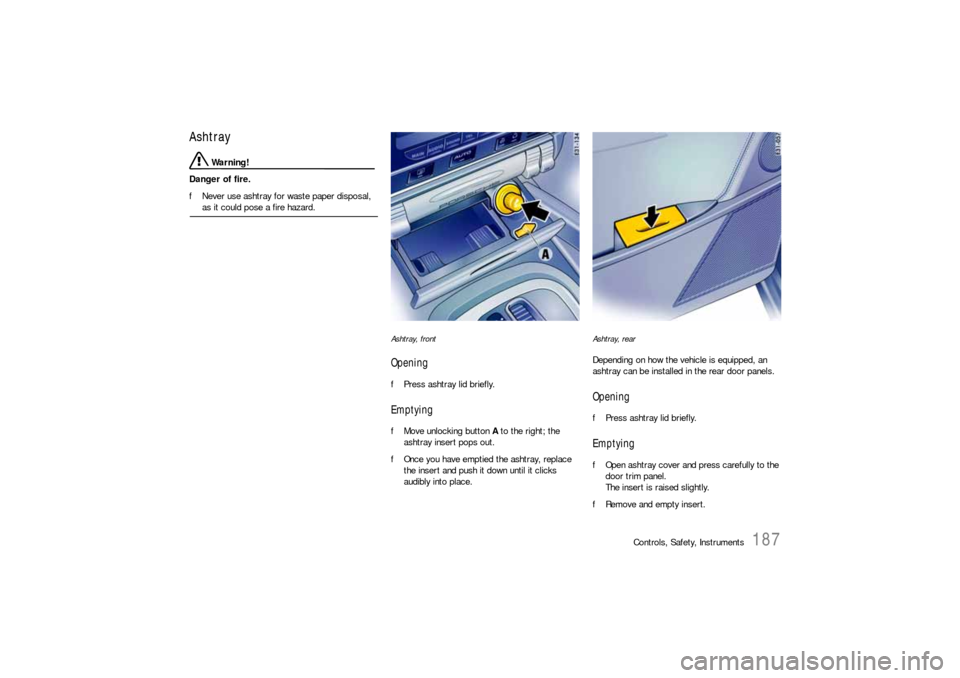
Ashtray, frontOpeningfPress ashtray lid briefly.EmptyingfMove unlocking button A to the right; the
ashtray insert pops out.
fOnce you have emptied the ashtray, replace
the insert and push it down until it clicks
audibly into place.
Ashtray, rearDepending on how the vehicle is equipped, an
ashtray can be installed in the rear door panels.OpeningfPress ashtray lid briefly.EmptyingfOpen ashtray cover and press carefully to the
door trim panel.
The insert is raised slightly.
fRemove and empty insert.
Page 188 of 420
188
Controls, Safety, Instruments
Cigarette Lighter
Warning!
Danger of fire and burning. The cigarette
lighter is ready for use, regardless of the ig-
nition lock position.
fDo not leave children in the car unattended.
fNever touch the heating element or sides of
the lighter.
fHold the lighter by the knob only.
The cigarette lighter is ready for use regardless of
the ignition lock position.
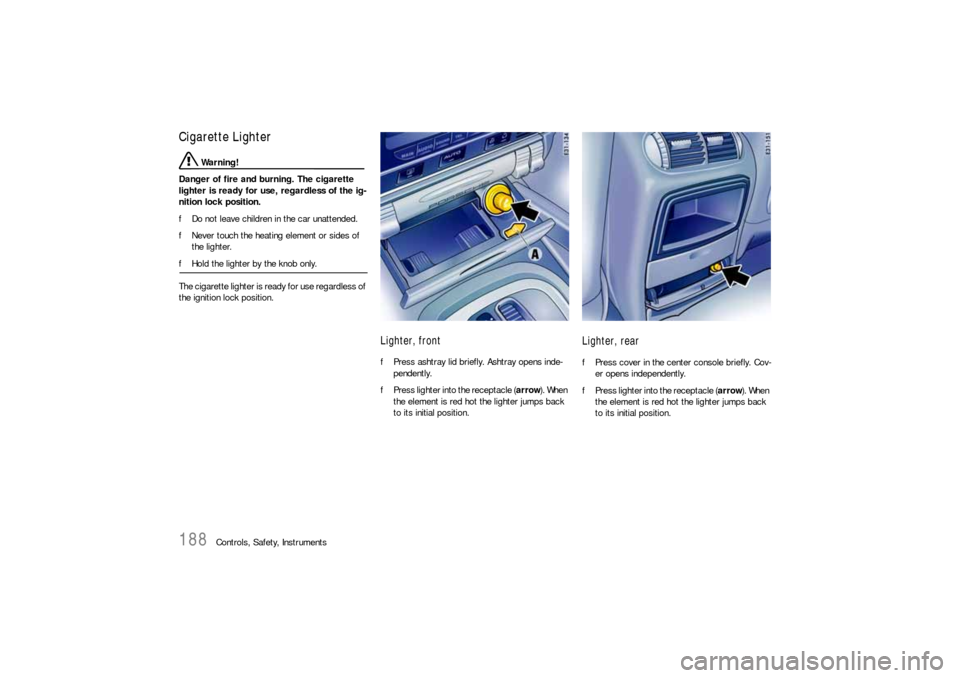
Lighter, frontfPress ashtray lid briefly. Ashtray opens inde-
pendently.
fPress lighter into the receptacle (arrow). When
the element is red hot the lighter jumps back
to its initial position.
Lighter, rearfPress cover in the center console briefly. Cov-
er opens independently.
fPress lighter into the receptacle (arrow). When
the element is red hot the lighter jumps back
to its initial position.
Page 190 of 420

190
Controls, Safety, Instruments
Compact disc player
Caution!
To avoid damage to compact disc player and
discs.
fUse only compact discs labeled as shown, hav-
ing no dirt, damage or warpage.
fNever attempt to disassemble or oil any part
of the player unit. Do not insert any object oth-
er than a disc into the slot.Remember there are
no user-serviceable parts inside the compact
disc player.
fDo not allow the disc to sustain any finger-
prints, scrapes or stickers on the surfaces.
This may cause poor sound quality.
Hold the disc only on the edge or center hole.
fWhen not in use, take the disc out of the player,
put the disc back into its case and store it
away from dust, heat, damp and direct sun-
light.
Leaving the disc on the dashboard in the sun
can damage the disc.fIf the disc gets dirty, clean the disc by wiping
the surfaces from the center to the outside in
a radial direction with a soft cloth.
Do not use a conventional record cleaner or
anti-static record preservative.
Disc cleaners are available in audio stores.
Car Telephone and Aftermarket Alarms Important legal and safety information re-
garding the use of cellular telephones
Some states may prohibit the use of cellular tele-
phones while driving a vehicle. Check the laws and
regulations on the use of cellular telephones in the
areas where you drive.
Danger!
Risk of an accident.
Severe personal injury or death can result in
the event of an accident.
Looking away from the road or turning your
attention away from your driving can cause
an accident and serious personal injury or
death.
When using your cellular telephone, you should al-
ways:
fGive full attention to your driving - pull off the
road and park before making or answering a
call if traffic conditions so require; andfKeep both hands on the steering wheel - use
hands-free operation (if available) - pull off the
road and park before using a hand-held tele-
phone.
It is essential to observe the instructions of
the telephone manufacturer before putting
the telephone into operation.
Any portable telephone or radio transmitter which
is used in a Porsche must be properly installed in
accordance with the technical requirements of
Porsche.
The transmission power must not exceed
10 W.
The devices must possess a type approval for
your vehicle and have an “e“ symbol.
If you should require equipment with transmission
power values greater than 10 W, please consult
your authorized Porsche dealer for this purpose.
He is familiar with the technical requirements for
installing devices of this kind.
The antennas for all radios and telephones with a
transmitting antenna must be externally mounted.
The improper installation of radios or telephones
or use of a radio or telephone with a transmitting
antenna inside the car may cause the warning
lights to come on.
Improper installation of such equipment can cre-
ate a discharged battery or excessive current
draw from added equipment.
Page 202 of 420
202
Controls, Safety, Instruments
LoadspaceThe maximum permissible load on the loadspace
floor is 400 kg or 880 lbs. The weight must be dis-
tributed evenly over the entire loadspace.
fPlease observe the chapter “LOADING INFOR-
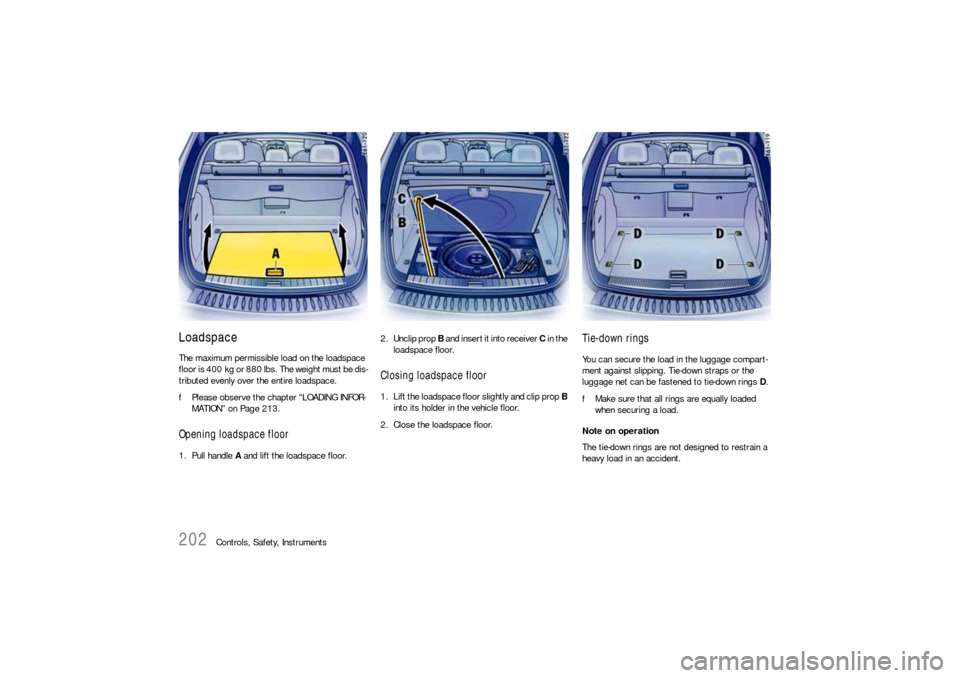
MATION” on Page 213.Opening loadspace floor1. Pull handle A and lift the loadspace floor.2. Unclip prop B and insert it into receiver C in the
loadspace floor.
Closing loadspace floor1. Lift the loadspace floor slightly and clip prop B
into its holder in the vehicle floor.
2. Close the loadspace floor.
Tie-down ringsYou can secure the load in the luggage compart-
ment against slipping. Tie-down straps or the
luggage net can be fastened to tie-down rings D.
fMake sure that all rings are equally loaded
when securing a load.
Note on operation
The tie-down rings are not designed to restrain a
heavy load in an accident.
Page 206 of 420
206
Controls, Safety, Instruments
Luggage Safety NetThe safety net can hold back only lightweight
items during braking, direction changes or in an
accident.
fPlease observe the chapter “LOADING INFOR-
MATION” on Page 213.
Warning!
Danger of injury. During braking, direction
changes or in an accident, an unsecured
load can slip and endanger the occupants.
fAlways secure the passenger compartment
with the luggage safety net.
fAlways fasten the load at the tie-down rings.
fThe load must never project over the top edge
of the seat backrest.
fIf the safety net was heavily stressed or dam-
aged during braking or an accident, etc., have
the luggage safety net and its bracket checked by an authorized Porsche dealer.
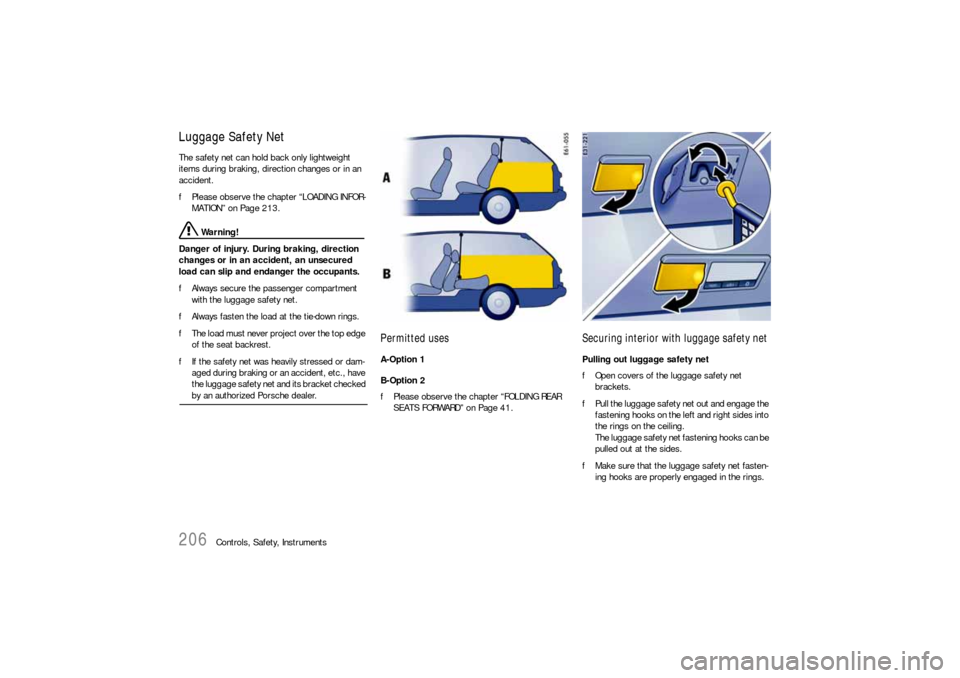
Permitted usesA-Option 1
B-Option 2
fPlease observe the chapter “FOLDING REAR
SEATS FORWARD” on Page 41.
Securing interior with luggage safety netPulling out luggage safety net
fOpen covers of the luggage safety net
brackets.
fPull the luggage safety net out and engage the
fastening hooks on the left and right sides into
the rings on the ceiling.
The luggage safety net fastening hooks can be
pulled out at the sides.
fMake sure that the luggage safety net fasten-
ing hooks are properly engaged in the rings.
Page 215 of 420

Controls, Safety, Instruments
215
Stowing load in the vehicle
Warning!
Danger of injury.
An unsecured or incorrectly positioned cargo
can slip out of place or endanger the vehicle
occupants during braking, direction changes
or in accidents.
Never transport objects which are not se-
cured.
fAlways transport cargo in the cargo area, nev-
er in the passenger compartment (e.g. on or in
front of the seats).
fSupport the cargo on the seat backrests when-
ever possible. Always lock the backrests into
place.
fPlace the cargo behind unoccupied seats
whenever possible.
fStow heavy objects as close to the front of the
cargo area as possible, with lightweight ob-
jects behind them.
fThe cargo must never project over the top
edge of the seat backrest.
fAlways protect the passenger compartment
with a luggage safety net and a luggage
compartment cover.
Do not drive with objects on top of the luggage
compartment cover.fIf the rear seats are not occupied, the back-
rests can be additionally secured with the safe-
ty belts. Simply cross the outer safety belts
and insert each into the opposite buckle.
fMake sure that the cargo cannot damage the
heating filaments of the rear window and the
TV antenna of the side window.
Luggage net
fLuggage must be stowed completely covered
by the luggage net.
The luggage net can prevent only lightweight
objects from slipping.
Tie-down belts
fDo not use elastic belts or straps to tie down
cargo.
fDo not place belts and straps over sharp edg-
es.
fObserve the directions for use and information
for the tie-down equipment.
fUse only belts with a tear strength of at least
1543 lbs. (700 kg) and a maximum width of
1in. (25mm).
fCross the belts over the load.Driving
fThe car's handling changes depending on the
vehicle loading. Adapt your driving style to the
changed driving behavior.
fDo not exceed the maximum gross weight and
the axle load.
fPlease observe the chapter “WEIGHTS” on
Page 387.
fNever drive with the rear window or rear lid
open.
Exhaust gases can enter the passenger
compartment.
fAdapt the tire pressure to the load.
fPlease observe the chapter “LOAD” on
Page 108.
fPlease observe the chapter “TIRE PRESSU-
RES, COLD” on Page 385.
Page 216 of 420

216
Controls, Safety, Instruments
Towing a trailer
Warning!
Driving with a trailer
fAlways observe the permissible towing capac-
ity, vertical coupling load and rear-axle load.
Please observe the chapter “WEIGHTS” on
Page 387.
fWhen connected, the trailer must always be
horizontal behind the towing vehicle. If neces-
sary, use a trailer with an adjustable drawbar.
fWhen the vehicle is driven in the mountains, the
engine output decreases as altitude increases.
The maximum weights stated are the values at
sea level. The total permissable weight of the
car-trailer combination must therefore be re-
duced by 10% for each increment of 3,280 ft.
(1,000 meters) altitude. A fractional increment
counts as the full 3,280 ft. (1,000 meters).
Please take this into consideration when plan-
ning your route.Distributing the load
fDistribute the load in the trailer so that heavy
objects are as close to the axle as possible.
Always safeguard all objects against slipping
and tie them down securely.
fYou should make the best possible use of the
trailer coupling's rated vertical coupling load
when loading the trailer, but never exceed it.
Tire pressure
fSelect the vehicle tire pressure for full load
when towing a trailer.
fPlease observe the chapter “TIRE PRESSU-
RES, COLD” on Page 385.
fCheck the tire pressure of the trailer's wheels
according to the manufacturer's instructions.Door mirrors
fIf the width of the trailer obstructs your view of
the traffic behind the trailer, you must have ad-
ditional door mirrors fitted.
Headlights, lights
fAlways check the headlight adjustment before
driving with a trailer.
If necessary, correct with the headlight beam
adjustment function.
fCheck whether the plug of the trailer is
plugged into the towing vehicle and whether all
lights function.