check engine PORSCHE CAYNNE TURBO 2005 1.G User Guide
[x] Cancel search | Manufacturer: PORSCHE, Model Year: 2005, Model line: CAYENNE TURBO, Model: PORSCHE CAYENNE TURBO 2005 1.GPages: 369, PDF Size: 3.17 MB
Page 76 of 369

76
Controls, Safety, Instruments
Emission ControlThe emission control system detects malfunctions
early that could, for example, cause increased pol-
lutant emissions or consequential damage.
Faults are indicated by the warning light in the in-
strument panel by being continuously lit or flash-
ing.
The faults are recorded in the control unit's fault
memory.
The warning light in the instrument panel lights up
when the ignition is switched on as a lamp check
and goes out approx. 4 seconds after the engine
starts.The warning light in the instrument panel flashes to
indicate operating states (e.g. engine misfiring)
which might cause damage to certain parts of the
emission control system.
fIn this case, immediately reduce the engine
load by easing off the accelerator.
The warning light in the instrument panel is lit
continuously after the critical range is left.
fIn order to avoid consequential damage to the
engine or emission control system (e.g. cata-
lytic converter) go immediately to the nearest
authorized Porsche dealer to have the fault
diagnosed and rectified.
Caution!
Risk of damage. If the warning light in the in-
strument panel continues flashing even when
you have eased off the accelerator pedal,
the emission control system may overheat.
fStop as soon as possible in a safe place.
Make sure that combustible materials, such as
dry grass or leaves, cannot come into contact
with the hot exhaust system.
fSwitch off the engine.
fContact your nearest authorized Porsche deal-er to have the fault rectified.
Check engine warning light
Page 107 of 369

Controls, Safety, Instruments
107
Check low beam Check bulb.
Check trailer lights Check bulb.
Check direction indicators Check turn signal bulb.
Check brake lights Check bulb.
Check high beam Check bulb.
Check number plate light Check bulb.
Check fog lights Check bulb.
Check reversing lights Check bulb.
Check tail lights Check bulb.
Check front side lights Check bulb.
Check headlight beam adjustment Have the fault remedied at an authorized Porsche dealer.
Daytime driving lights off Daytime driving lights switch off when the engine is shut off.
Switch on lights if necessary.
Airbag faulty Have the fault remedied at an authorized Porsche dealer.
Safety belt Fasten safety belt.
Warning – Flat tire – Check tires Stop in a suitable place and check the tires. Change wheel if
necessary.
Check spare wheel – Required pressure:
50 psi/3,4 barAppears about every 6 months.
Check if the pressure of the mounted spare wheel matches the
required pressure, as it is not monitored electronically.
Instrument
panelMulti-purpose
displayText display Meaning/measures
Page 109 of 369

Controls, Safety, Instruments
109
Engine temperature too high Switch engine off and let it cool.
Check coolant level. Add coolant if necessary.
Check coolant level Switch engine off and let it cool.
Check coolant level. Add coolant if necessary.
Battery/generator warning Stop in a suitable place and switch engine off. Do not continue
driving.
Have the fault remedied at an authorized Porsche dealer.
Starting engine The battery discharges if the engine is not running and loads are
switched on.
Start the vehicle or switch the loads off.
Electrics – Loads – Switch-off Vehicle electrical system is overloaded. Certain loads (e.g.
heated rear window, seat heating) will be switched off.
Please refuel
Topping up washer fluid
Oil level monitoring – Failure – Workshop Have the fault remedied at an authorized Porsche dealer.
Checking the oil level
Oil pressure too low Immediately stop in a suitable place and switch engine off.
Do not continue driving.
Check engine oil level. Add oil if necessary.
Do not continue driving if the warning light comes on even when
the oil level is correct. Have the fault remedied at an authorized
Porsche dealer.
Service in 1864 mls (3000 km)Service indicator
Bring the vehicle in for service no later than after the distance
shown has been covered.
Service nowService indicator
Have your vehicle serviced at an authorized Porsche dealer.
Instrument
panelMulti-purpose
displayText display Meaning/measures
Page 169 of 369

Controls, Safety, Instruments
169
Car Telephone and Aftermarket Alarms Important legal and safety information re-
garding the use of cellular telephones
Some states may prohibit the use of cellular tele-
phones while driving a vehicle. Check the laws and
regulations on the use of cellular telephones in the
areas where you drive.
Danger!
Risk of an accident.
Severe personal injury or death can result in
the event of an accident.
Looking away from the road or turning your
attention away from your driving can cause
an accident and serious personal injury or
death.
When using your cellular telephone, you should al-
ways:
fGive full attention to your driving - pull off the
road and park before making or answering a
call if traffic conditions so require; and
fKeep both hands on the steering wheel - use
hands-free operation (if available) - pull off the
road and park before using a hand-held tele-phone.It is essential to observe the instructions of
the telephone manufacturer before putting
the telephone into operation.
Any portable telephone or radio transmitter which
is used in a Porsche must be properly installed in
accordance with the technical requirements of
Porsche.
The transmission power must not exceed
10 W.
The devices must possess a type approval for
your vehicle and have an “e“ symbol.
If you should require equipment with transmission
power values greater than 10 W, please consult
your authorized Porsche dealer for this purpose.
He is familiar with the technical requirements for
installing devices of this kind.
The antennas for all radios and telephones with a
transmitting antenna must be externally mounted.
The improper installation of radios or telephones
or use of a radio or telephone with a transmitting
antenna inside the car may cause the warning
lights to come on.
Improper installation of such equipment can cre-
ate a discharged battery or excessive current
draw from added equipment.If aftermarket systems are installed by non-dealer-
ship technicians or outside the selling dealer,
problems may result. Installation of aftermarket
equipment is not covered under the New Car War-
ranty.
fConsult your authorized Porsche dealer about
the installation of non Porsche approved equip-
ment.
Reception quality
The reception quality of your car telephone will
change constantly when you are driving. Interfer-
ence caused by buildings, landscape and weather
is unavoidable. It may become particularly difficult
to hear when using the hands-free function due to
external noise such as engine and wind noise.
Automatic car-wash
fUnscrew external antennas before using an au-
tomatic car-wash.
Page 181 of 369
Controls, Safety, Instruments
181
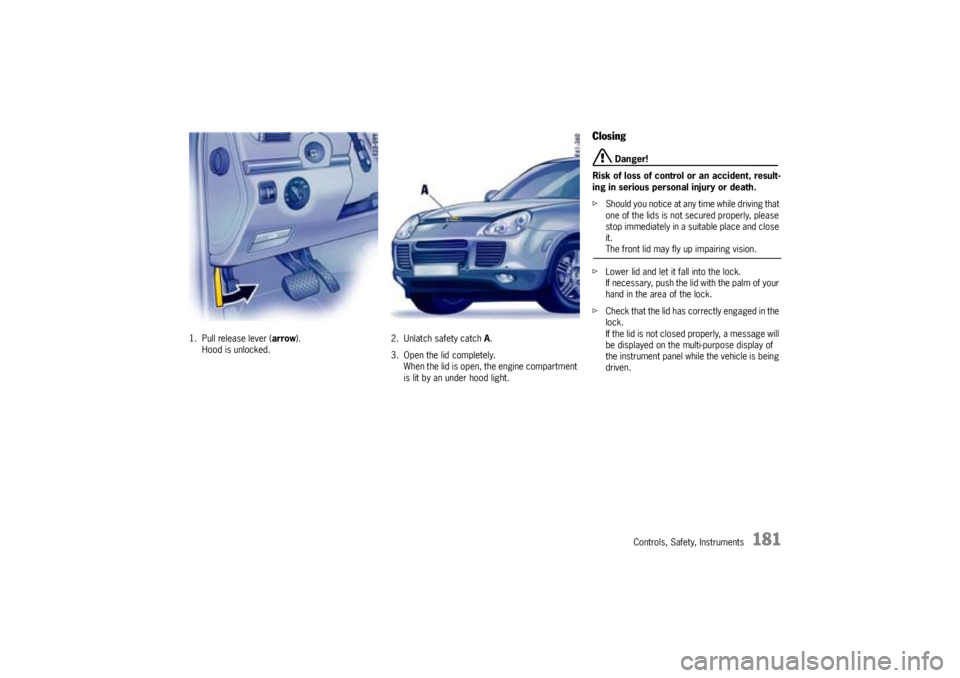
1. Pull release lever (arrow).
Hood is unlocked.2. Unlatch safety catch A.
3. Open the lid completely.
When the lid is open, the engine compartment
is lit by an under hood light.
Closing
Danger!
Risk of loss of control or an accident, result-
ing in serious personal injury or death.
fShould you notice at any time while driving that
one of the lids is not secured properly, please
stop immediately in a suitable place and close
it.The front lid may fly up impairing vision.
fLower lid and let it fall into the lock.
If necessary, push the lid with the palm of your
hand in the area of the lock.
fCheck that the lid has correctly engaged in the
lock.
If the lid is not closed properly, a message will
be displayed on the multi-purpose display of
the instrument panel while the vehicle is being
driven.
Page 194 of 369

194
Controls, Safety, Instruments
Towing a trailer
Warning!
Driving with a trailer
fAlways observe the permissible towing capac-
ity, vertical coupling load and rear-axle load.
Please observe the chapter “WEIGHTS” on
Page 352.
fWhen connected, the trailer must always be
horizontal behind the towing vehicle. If neces-
sary, use a trailer with an adjustable drawbar.
fWhen the vehicle is driven in the mountains, the
engine output decreases as altitude increases.
The maximum weights stated are the values at
sea level. The total weight of the car-trailer
combination must therefore be reduced by
10% for each increment of 3,280 ft. or
1,000 metres altitude. A fractional increment
counts as the full 1,000 metres. Please take
this into consideration when planning your
route.Distributing the load
fDistribute the load in the trailer so that heavy
objects are as close to the axle as possible.
Always safeguard all objects against slipping
and tie them down securely.
fYou should make the best possible use of the
trailer coupling's rated vertical coupling load
when loading the trailer, but never exceed it.
Tire pressure
fSelect the vehicle tire pressure for full load
when towing a trailer.
fPlease observe the chapter “Tire pressure ta-
bles”.
fCheck the tire pressure of the trailer's wheels
according to the manufacturer's instructions.Door mirrors
fIf the width of the trailer obstructs your view of
the traffic behind the trailer, you must have ad-
ditional door mirrors fitted.
Headlights, lights
fCheck whether the plug of the trailer is
plugged into the towing vehicle and whether all
lights function.
Page 217 of 369

Shifting Gear, Traction Systems
217
ABS
(Anti-lock Brake System)
Caution!
In spite of the advantages of ABS, it is still the driv-
er’s responsibility to adapt his driving style and
maneuvres in line with road and weather condi-
tions, as well as the traffic situation.
The increased safety that is provided should not in-
duce you to take greater risks with your safety.
The limits set by the physics of driving cannot be
overcome, even with ABS.
Risks of accident due to inappropriate speed can-
not be reduced by ABS.
ABS ensures
–Full steering control
The vehicle remains steerable
–Good driving stability
No skidding due to locked wheels
–Optimum braking distance
Shorter stopping distances in most cases
–Lock prevention
No flat spots on the tiresFunction
The decisive advantage of ABS is in the driving
stability and maneuvrability of the vehicle in
hazardous situations, even during heavy braking
while cornering.
ABS prevents locking of the wheels during full
braking, on almost all road surfaces, until shortly
before the vehicle stops.
The ABS begins to control the braking process as
soon as a wheel shows a tendency to lock.
This controlled braking process is comparable to
extremely rapid cadence braking.
The pulsating brake pedal and a “rattling noise”
warn the driver to adapt his driving speed to the
road conditions.Warning light
If the ABS warning lights light up in the instrument
panel and on the multi-purpose display of the in-
strument panel while the engine is running, the
ABS has switched off because of a fault.
In this event, the braking system will operate with-
out lock prevention,as in cars without ABS.
fAdapt your driving style to the changed brak-
ing behavior.
The ABS must be checked immediately at an
authorized Porsche dealer in order to prevent
the occurrence of further faults the effects of
which cannot be defined.
The ABS control unit is adjusted for the approved
tire dimensions.
The use of tires with non-approved dimensions can
lead to different wheel speeds, causing the ABS to
switch off.
f f f
Page 219 of 369

Shifting Gear, Traction Systems
219
Engine Braking Support
(Assistance when heading downhill)The Porsche Down-Hill Assistant is an assistance
system which helps the driver at slower downhill
driving up to approx. 12 mph (20 km/h), e.g., on
steep slopes or on wintry mountain roads.
As long as the accelerator pedal is not used when
traveling downhill, the Porsche Down-Hill Assistant
is active and brakes the vehicle.
The braking ability of the Engine Braking Support
is affected by slippery surfaces (e.g., on icy or
loose surfaces), like all brakes.
If road grip is lost on one or more wheels, the
system brakes the wheels which have good road
contact.
Warning!
Risk of accident. Reduced braking ability on
a slippery surface.
fAlways adjust your driving style to the driving situationConditions:
– The accelerator pedal must not be used when
travelling downhill.
– The speed must not
exceed 12 mph (20 km/h).
– The selector lever position D or Mmust be
engaged.
Tip on driving
The Porsche Down-Hill Assistant is active when dri-
ving downhill either forwards or backwards.
Checks on test standsPower measurement
Power measurements on roller test stands are not
approved by Porsche.
Brake tests
Brake tests must be carried out only in High Range
and on plate-type test stands or roller test stands.
The following limit values must not be exceeded
on roller test stands:
– Testing speed 4.7 mph (7.5 km/h)
– Test duration 20 seconds
Parking brake test
Parking brake tests on the brake tester must be
performed only with the ignition switched off and
the selector lever in position N.
Balancing wheels on the vehicle
During finish balancing of the wheels, the entire ve-
hicle must be lifted and the wheels must be free to
turn.
Page 220 of 369

220
Shifting Gear, Traction Systems
Off-Road DrivingfPlease read this chapter carefully before dri-
ving off road with your Porsche.
The information provided will familiarise you with
the special advantages of your vehicle, allowing
you to arrive at your destination safely every time.
We recommend practicing on less rugged terrain.
Vehicles with SportDesign package
Warning!
Risk of damage. On vehicles with
SportDesign package, front, rear, and side
member trim are painted and pulled down
lower. Off-road driving can seriously damage
these trim parts.
fWhen driving off-road, make sure these parts
are not damaged.
fMake sure there is sufficient clearance
between obstacles and the underside of the
vehicle.
fAvoid driving through water.
fDo not use side member trim as a running board.Maintenance note
Please bear in mind that off-road driving subjects
all vehicle components to considerably more wear
than normal use, making professional inspection
and maintenance after each use a vital precondi-
tion for functioning and safety.
Grains of sand, dirt particles and other abrasive
materials entering the brakes can cause exces-
sive wear or unpredictable braking action.
Rules for off-road drivingfEnsure vehicle is equipped with approved all-
terrain tires.
fPlease observe the chapter “GROUND CLEA-
RANCE” on Page 355.
fActivate Low Range.
fStow or fasten luggage and loads securely.
Please observe the chapter “LOADING INFOR-
MATION” on Page 191.
fIf unknown terrain is obscured from view, ex-
amine it on foot first and traverse it with ex-
treme caution.
This way, obstacles are easier to recognise
and damage to the vehicle is avoided.fAlways drive with the engine running.
Steering assistance is provided only with the
engine running.
fDrive slowly and uniformly.
fAlways make sure that the wheels touch the
ground.
fBefore driving through water, check the water
depth, the condition of the surface beneath it
and the speed of the water.
fLook out for obstacles such as boulders,
holes, tree stumps or ruts.
fAlways keep the sliding/lifting roof or
Panorama roof system and the side windows
closed while driving.
fDo not depart from marked routes or paths.
fRespect nature.
Always obey off-limits signs.
Page 224 of 369

224
Shifting Gear, Traction Systems
Water crossingfPlease observe the chapter “GROUND CLEA-
RANCE” on Page 355.
Danger!
Danger of drowning if water enters the vehi-
cle. Risk of damage to the engine and acces-
sories if water penetrates.
fBefore driving through water, check the water
depthA, water speed and the condition of the
surface beneath it.
The water must not be deeper than 22 in. or
55.5 cm.
fCheck the door sills and rubber seals before
starting to drive.
fDo not drive through deep or rapidly flowing
water.
Deep or rapidly flowing water, e.g. mountain
streams, can cause the car to deviate from the
intended path.
fAvoid a "bow wave" by driving at an appropriate
speed.
fNever open the doors when driving through wa-
ter.Soiling can impair the braking action.
fCheck and clean the brakes if they have been
soiled.
Danger of steering assistance failing during
a long journey in the water if the drive belt
slips.
fIf the steering assistance fails, more effort will
be required to steer.
Danger of damaging electrical systems
fAvoid driving through salt water.
Notes on operation
fActivate Low Range.
fSwitch the air conditioner off.
fSwitch the headlights off.