brake PORSCHE CAYNNE TURBO 2005 1.G Owner's Manual
[x] Cancel search | Manufacturer: PORSCHE, Model Year: 2005, Model line: CAYENNE TURBO, Model: PORSCHE CAYENNE TURBO 2005 1.GPages: 369, PDF Size: 3.17 MB
Page 107 of 369
Controls, Safety, Instruments
107
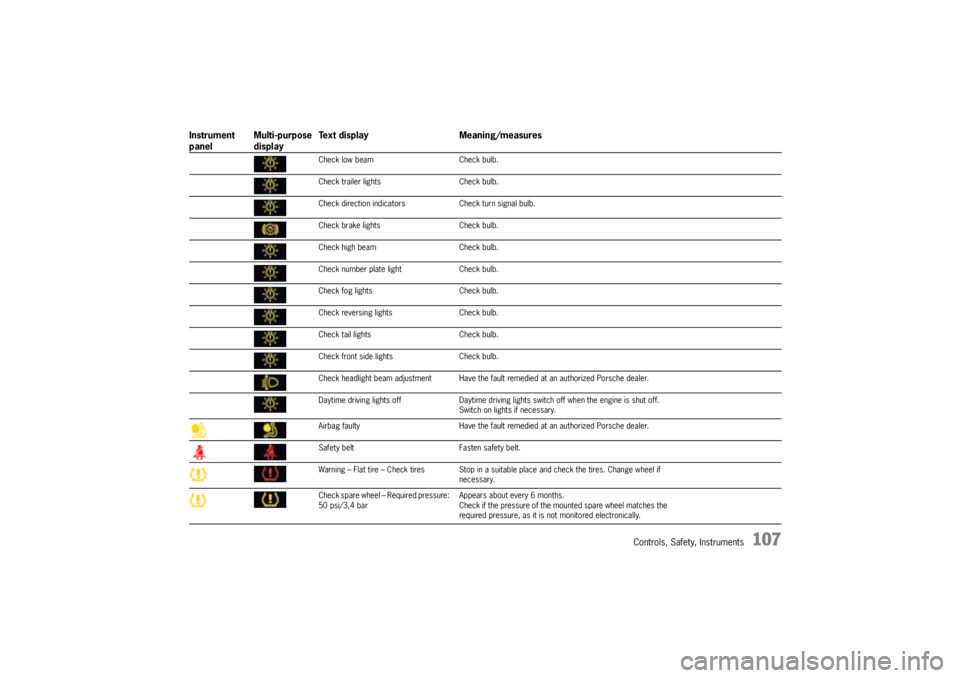
Check low beam Check bulb.
Check trailer lights Check bulb.
Check direction indicators Check turn signal bulb.
Check brake lights Check bulb.
Check high beam Check bulb.
Check number plate light Check bulb.
Check fog lights Check bulb.
Check reversing lights Check bulb.
Check tail lights Check bulb.
Check front side lights Check bulb.
Check headlight beam adjustment Have the fault remedied at an authorized Porsche dealer.
Daytime driving lights off Daytime driving lights switch off when the engine is shut off.
Switch on lights if necessary.
Airbag faulty Have the fault remedied at an authorized Porsche dealer.
Safety belt Fasten safety belt.
Warning – Flat tire – Check tires Stop in a suitable place and check the tires. Change wheel if
necessary.
Check spare wheel – Required pressure:
50 psi/3,4 barAppears about every 6 months.
Check if the pressure of the mounted spare wheel matches the
required pressure, as it is not monitored electronically.
Instrument
panelMulti-purpose
displayText display Meaning/measures
Page 110 of 369

110
Controls, Safety, Instruments
Brake pads – Workshop Have the brake pads replaced at an authorized Porsche dealer
without delay.
Warning – Brake circuit division Stop immediately in a suitable place. Do not continue driving.
Have the fault remedied at an authorized Porsche dealer.
ABS failure – WorkshopDrive carefully. Have the fault remedied at an authorized
Porsche dealer.
PSM failure – WorkshopDrive carefully. Have the fault remedied at an authorized
Porsche dealer.
Warning – Brake fluid level Stop immediately in a suitable place. Do not continue driving.
Have the fault remedied at an authorized Porsche dealer.
Parking brake Parking brake not released.
PSM onPorsche Stability Management was switched on.
PSM offPorsche Stability Management was switched off.
PHC failure The Hillholder and the Porsche Down-Hill Assistant are not avail-
able.
Brake booster faulty Greater braking pedal force necessary. Drive carefully to the
nearest authorized Porsche dealer.
Sport shock absorber Current setting of Porsche Active Suspension Management.
Normal shock absorber Current setting of Porsche Active Suspension Management.
Comfort shock absorber Current setting of Porsche Active Suspension Management.
Warning – Air suspension Stop in a suitable place. Do not continue driving.
Have the fault remedied at an authorized Porsche dealer.
Air suspension faulty – Workshop Drive carefully to the nearest authorized Porsche dealer.
Instrument
panelMulti-purpose
displayText display Meaning/measures
Page 111 of 369

Controls, Safety, Instruments
111
Spare wheel fillingCollapsible spare wheel being filled with level-control
compressor.
Do not drive off!
Control off Level control has been switched off (to jack up the vehicle).
Not permissible The prerequisites for setting the desired level have not been
met.
Pressure accumulator charging Level control temporarily unavailable.
Warning - off-road anti-roll bar The anti-roll bar cannot be engaged; the system is faulty. Drive
carefully to the nearest workshop. Have the fault remediesd at
an authorized Porsche dealer as soon as possible.
Off-road anti-roll bar faulty The anti-roll bar cannot be disengaged. Have the fault reme-
diesd at an authorized Porsche dealer.
Off-road anti-roll bar disengaged,
max. 30 mph (50 km/h)The anti-roll bars cannot be disengaged. Have the fault reme-
diesd at an authorized Porsche dealer.
Not permissible The prerequisites for disengaging the anti-roll bars have not
been met.
Only possible with reduction Disengagement of the anti-roll bars is only possible with
Low Range engaged.
All-wheel drive system faulty Have the fault remedied at an authorized Porsche dealer.
Shifting not possible,
Speed too highWhen changing between Low Range and High Range, the limit
speed (off-road shifting) must not be exceeded.
Possible only in neutral with brake
appliedThe vehicle must be stationary, the footbrake must be applied
and the selector lever must be in position Nwhen changing
between Low Range and High Range.
Warning – Parking lock!
Operate footbrake.Do not continue driving. Apply the parking brake.
Have the fault remedied at an authorized Porsche dealer.
Instrument
panelMulti-purpose
displayText display Meaning/measures
Page 123 of 369

Controls, Safety, Instruments
123
Accelerating (e.g. to overtake)Option 1
fIncrease the speed as usual with the accelera-
tor.
When you ease off the accelerator, the previ-
ously stored value is set again.
Option 2
fPush operating lever upwards into position 3
until the desired speed is reached.
The speed reached is maintained and stored
when the operating lever is released.
Option 3
fPush operating lever slightly upwards into po-
sition3(a maximum of 10 times).
The speed is increased by 1 mph (2 km/h).
Note on operation
Cruise control operation is automatically interrupt-
ed if the speed is increased by more than approx.
16 mph (25 km/h) for longer than 20 seconds.
DeceleratingOption 1
fPush operating lever down into position 4 until
the desired speed is reached.
The speed reached is maintained and stored
when the operating lever is released.
Option 2
fPush operating lever slightly downwards into
position4 (a maximum of 10 times).
The speed is reduced by 1 mph (2 km/h).
Interrupting cruise control operationThe speed driven before the interruption remains
stored in the memory.
fPush forward the operating lever to position 2
(it doesn’t engage) or
fPress brake pedal or
fSwitch selector lever to position N.
fPlease observe the chapter “TIPTRONIC S” on
Page 198.
Cruise control operation is interrupted
automatically:
– If the set vehicle speed is exceeded by more
than approx. 16 mph (25 km/h) for longer than
20 seconds.
– If the actual vehicle speed falls by approx.
6 mph (10 km/h) below the set vehicle speed
for longer than 5 seconds (e.g. upward
slopes).
– If Porsche Stability Management (PSM) inter-
venes for longer than 0.2 seconds.
– If Low Range is switched on.
Page 160 of 369

160
Controls, Safety, Instruments Limits of ultrasonic measurement
– ParkAssist cannot detect sound-absorbing ob-
stacles (e.g. powder snow),
– Sound-reflecting obstacles (e.g. glass surfac-
es, flat painted surfaces),
– And very thin obstacles.
Other ultrasound sources (e.g. pneumatic brakes
of other vehicles, jackhammers) can interfere with
detection of obstacles.
Fault indication without warning tone
All red light segments of the active warning indica-
tors light up when there is a temporary fault in
ParkAssist.
Note
Correct operation is no longer ensured if there is
a temporary fault (e.g. caused by ice formation or
heavy soiling on the sensors).
The system detects the temporary fault.
All light segments light up until a speed of
9 mph (14 km/h) is reached.
ParkAssist is ready for operation again when the
interference has been eliminated.Fault indication with warning tone
In the event of a long-lasting fault in ParkAssist,
the red light segments of the active warning indi-
cators light up and a continuous tone sounds for
three seconds after a transmission range has
been selected.
Possible causes
– Defect or system fault.
fSwitch ParkAssist off.
When ParkAssist is switched off, the indicator
light in the button lights up.
fPlease have the fault remedied at an autho-
rized Porsche dealer.Driving with a trailer
The ParkAssist rear monitoring area is switched
off when the trailer’s power supply is plugged in.
Page 190 of 369

190
Controls, Safety, Instruments
Trailer Coupling
Warning!
Risk of accident.
fFollow the operating instructions for the trailer
recommended by the trailer manufacturer.
fDo not modify or repair the trailer coupling.
fBefore having new ADAPTER fitted, find out
from your authorized Porsche dealer about the
current authorization status.fUse only ADAPTER makes tested and appro-
ved by Porsche.
fEnsure that all trailer equipment conforms to
the appropriate classification for total gross
trailer weight and tongue weight.
fPlease observe the chapter “WEIGHTS” on
Page 352.
fPlease observe the chapter “LOADING INFOR-
MATION” on Page 191.
RetrofittingHave a trailer coupling retrofitted only by an autho-
rized Porsche dealer. The dealer is familiar with
the manufacturer's specifications and any neces-
sary conversion measures.Electrical connectionYour Porsche is equipped with a 7-pin connector A
for the electrical connection to the trailer.
Warning!
Risk of accident. Failure to keep an electrical
adapter clean may result in corrosion and af-
fect operation of electrical lines, resulting in
possible trailer brake system failure.
fPeriodically inspect and clean adapter as needed.
Hitching trailerfAlways turn off the alarm system before you at-
tach a trailer. The inclination sensor could trig-
ger the alarm unintentionally.
fFollow the operating instructions for the trailer
recommended by the trailer manufacturer.
fPlease observe the chapter “WEIGHTS” on
Page 352.Unhitching trailerfIf the trailer is equipped with an overrun brake,
do not unhitch the trailer when its brake is still
applied.
Page 195 of 369

Controls, Safety, Instruments
195
Driving with a trailer
When towing a trailer you must under all
circumstances adapt your speed to prevailing
road and driving conditions.
In no event should you exeed a speed of 50 mph
(80 km/h). Towing in excessive speed can result
in loss of control.
fCarefully and gradually familiarize yourself with
the handling and braking behavior of the car-
trailer combination.
fDo not drive with the towing vehicle empty and
the trailer loaded.
If this unfavorable combination is unavoidable,
please drive especially slowly.
fBear in mind the different vehicle handling and
size in situations such as braking, parking,
cornering and overtaking, etc.
fThe driving stability of the car-trailer combina-
tion worsens as the speed increases. There-
fore, drive especially slowly on downhill
stretches and in the case of unfavorable road
and weather conditions (such as wind).
fDrive in an appropriately low gear on downhill
stretches in order to make use of the engine
braking effect.fSlow down immediately if the trailer starts to
sway. Do not countersteer; brake if necessary.
Never attempt to straighten out the car-trailer
combination by accelerating.
fActivate Low Range when moving off on steep
slopes.
fUnder no circumstances may people, animals
or objects be in the space between the trailer
and the towing vehicle when the vehicle is
moving.
fWhen reversing, bear in mind that ParkAssist is
not active.
Maintenance note
fPlease take into consideration that driving with
a trailer places markedly greater stress on all
vehicle components. Expert inspection and
maintenance after every use are indispensable
prerequisites for proper functioning and safety.
Page 198 of 369
198
Shifting Gear, Traction Systems
Tiptronic SThe Porsche Tiptronic is a six-speed transmission
and features an “automatic” and a “manual” gear-
shift mode.
Inautomatic selection mode (selector lever po-
sitionD), gear changing is automatic.
Depending on the driving program, you can
change temporarily from automatic to manual
mode using the rocker switches on the steering
wheel.
Inmanual selection mode (selector lever
positionM), you change gear using the rocker
switches on the steering wheel or by pushing the
selector lever forward or back.
You can change between selector lever positions
Dand M as you wish while driving.
Note on operation
Take care not to operate the rocker switches on
the steering wheel inadvertently, thereby trigger-
ing undesired gear changes.
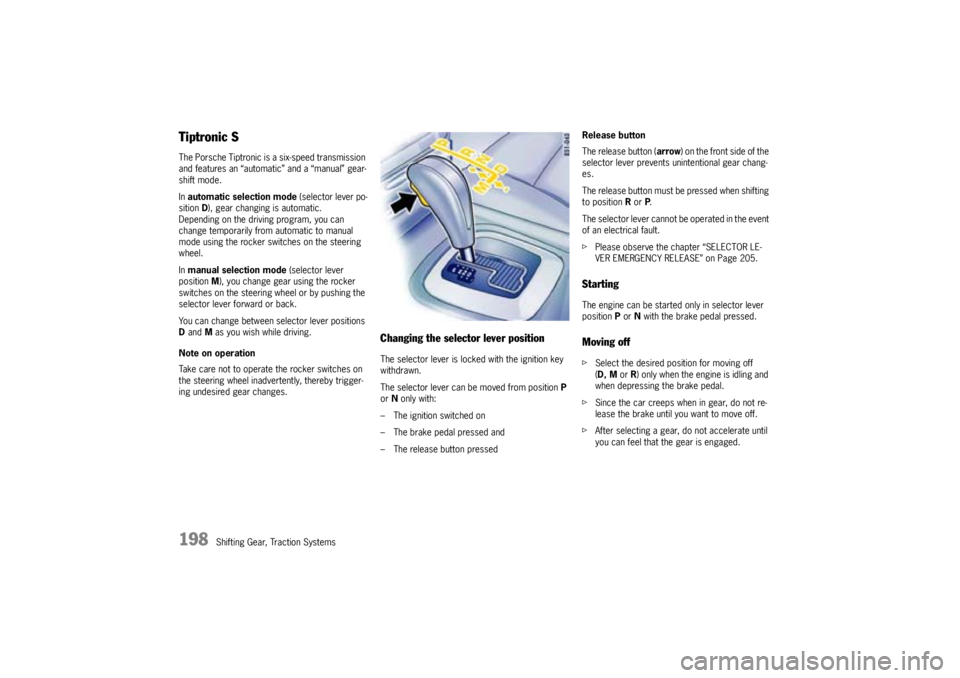
Changing the selector lever positionThe selector lever is locked with the ignition key
withdrawn.
The selector lever can be moved from position P
or N only with:
– The ignition switched on
– The brake pedal pressed and
– The release button pressedRelease button
The release button (arrow) on the front side of the
selector lever prevents unintentional gear chang-
es.
The release button must be pressed when shifting
to position Ror P.
The selector lever cannot be operated in the event
of an electrical fault.
fPlease observe the chapter “SELECTOR LE-
VER EMERGENCY RELEASE” on Page 205.
StartingThe engine can be started only in selector lever
positionPor N with the brake pedal pressed.Moving offfSelect the desired position for moving off
(D, M or R) only when the engine is idling and
when depressing the brake pedal.
fSince the car creeps when in gear, do not re-
lease the brake until you want to move off.
fAfter selecting a gear, do not accelerate until
you can feel that the gear is engaged.
Page 199 of 369
Shifting Gear, Traction Systems
199
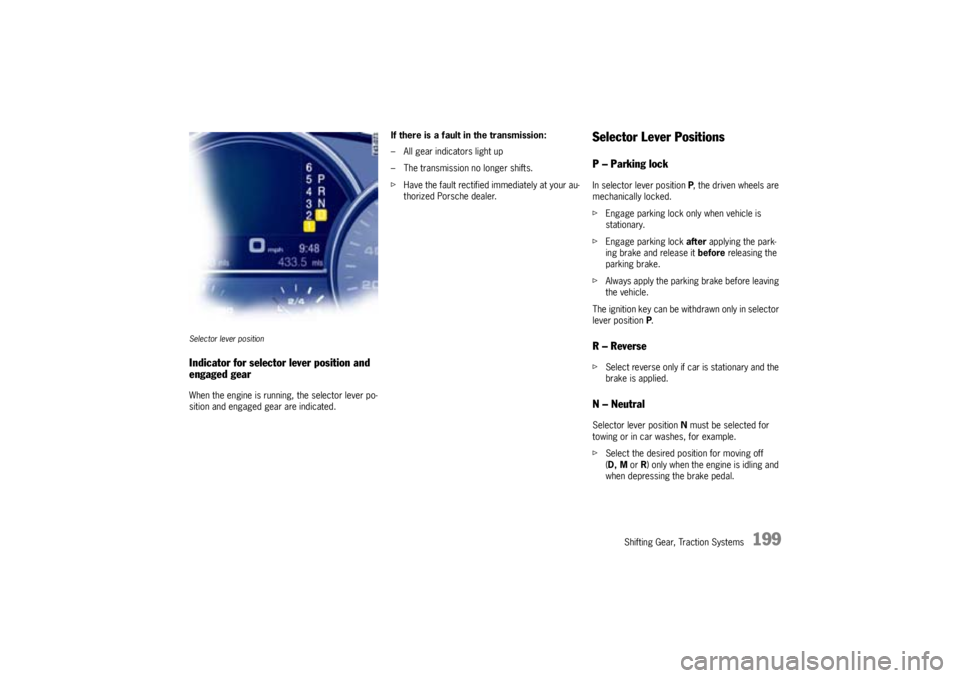
Selector lever positionIndicator for selector lever position and
engaged gearWhen the engine is running, the selector lever po-
sition and engaged gear are indicated.If there is a fault in the transmission:
– All gear indicators light up
– The transmission no longer shifts.
fHave the fault rectified immediately at your au-
thorized Porsche dealer.
Selector Lever PositionsP – Parking lockIn selector lever position P, the driven wheels are
mechanically locked.
fEngage parking lock only when vehicle is
stationary.
fEngage parking lock after applying the park-
ing brake and release it before releasing the
parking brake.
fAlways apply the parking brake before leaving
the vehicle.
The ignition key can be withdrawn only in selector
lever position P.R – ReversefSelect reverse only if car is stationary and the
brake is applied.N – NeutralSelector lever position N must be selected for
towing or in car washes, for example.
fSelect the desired position for moving off
(D, M or R) only when the engine is idling and
when depressing the brake pedal.
Page 200 of 369

200
Shifting Gear, Traction Systems
D - Automatic selection mode (in the road
driving program)The functions of selector lever positions Dand M
differ in the on-road program, High Range, and in
the off-road program, Low Range.
fUse selector lever position D for “normal” driv-
ing.
The gears are shifted automatically according
to the accelerator position and speed.
Depending on the way the vehicle is driven and on
the resistance (e.g. uphill), the gear-changing
points are shifted towards higher or lower engine-
speed ranges. Movement of the accelerator,
driving speed, longitudinal and lateral acceleration
and the road profile all have an influence on the
gear-changing characteristic.
When PSM is switched off, transmission gear
changes are done at higher engine speeds.
Unwanted upward shifts, e.g. before bends, are
prevented by swiftly releasing the accelerator ped-
al.
Depending on lateral acceleration, upward chang-
es on bends are not made until the engine-speed
limit is reached.
During braking, and depending on the amount of
deceleration, the Tiptronic changes down earlier.
For subsequent cornering, the right gear is en-
gaged when pressure is applied to the brakes be-
fore the bend.The bend is taken in the right gear, and when you
accelerate out of the bend you do not have to
change down.
Moving off
In 2nd gear, the vehicle moves off with the throttle
only slightly open. Move off in 1st gear with the
throttle open wider or when the engine is cold.
When PSM is switched off, the car generally
moves off in 1st gear.
Shifting gear on the steering wheel
By shifting gear with the rocker switches on the
steering wheel, you can temporarily change from
automatic selection mode D to manual selection
mode M.
Advantages
– Shifting down before bends and on entering
built-up areas.
– Shifting down on downward slopes (engine
braking).
– Shifting down for brief spurts of acceleration.
– Selecting 1st or 2nd gear for moving off.
The manual selection mode remains engaged:
– For cornering (depending on the lateral accel-
eration) and overrunning,
– When the vehicle is stationary (e.g. at a junc-
tion).The system leaves manual selection mode:
– automatically after around 8 seconds
(unless car is cornering, overrunning or
stationary),
– if you depress the accelerator to kickdown.
Temporary change-down
Precondition
– Speed is higher than approx. 33 mph
(54 km/h).
fDepress accelerator quickly.
The Tiptronic changes temporarily to the sport-
iest gear-changing map, i.e. to the highest pos-
sible gear-changing points. Correspondingly,
the transmission shifts down immediately by
one, two or three gears.
Ending the function
fRelease the accelerator markedly (by approx.
25%).