fuel PORSCHE CAYNNE TURBO 2005 1.G Owner's Manual
[x] Cancel search | Manufacturer: PORSCHE, Model Year: 2005, Model line: CAYENNE TURBO, Model: PORSCHE CAYENNE TURBO 2005 1.GPages: 369, PDF Size: 3.17 MB
Page 137 of 369
Controls, Safety, Instruments
137
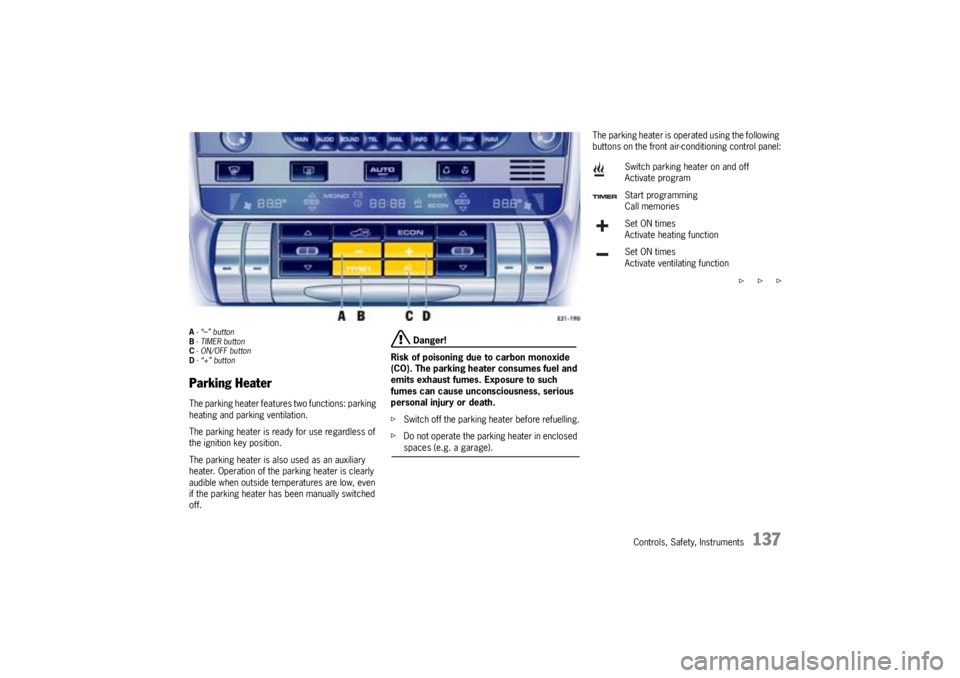
A-“
–” button
B- TIMER button
C- ON/OFF button
D-“+” button
Parking HeaterThe parking heater features two functions: parking
heating and parking ventilation.
The parking heater is ready for use regardless of
the ignition key position.
The parking heater is also used as an auxiliary
heater. Operation of the parking heater is clearly
audible when outside temperatures are low, even
if the parking heater has been manually switched
off.
Danger!
Risk of poisoning due to carbon monoxide
(CO). The parking heater consumes fuel and
emits exhaust fumes. Exposure to such
fumes can cause unconsciousness, serious
personal injury or death.
fSwitch off the parking heater before refuelling.
fDo not operate the parking heater in enclosed spaces (e.g. a garage).
The parking heater is operated using the following
buttons on the front air-conditioning control panel:
f f f Switch parking heater on and off
Activate program
Start programming
Call memories
Set ON times
Activate heating function
Set ON times
Activate ventilating function
Page 138 of 369
138
Controls, Safety, Instruments Notes on operation
The parking heater runs on fuel, and it therefore
cannot be switched on after the reserve warning
lights up.
fPlease observe the chapter “FUEL RESERVE
WARNING” on Page 74.
The parking heater must be operated at least
once per month, with the engine cold and the
blower at its lowest setting.
Ignition off: When the parking heater is running,
the remaining running time is shown on the display
panel.
Operation of the parking heater is clearly audible
when outside temperatures are low and the engine
is cold.Switching on
fPress ON/OFF button C.
The programed parking heating or parking ven-
tilation function is switched on.
Switching off
fPress ON/OFF button C again.
Note on operation
fAfter switching off the parking heater using
ON/OFF button C wait for at least 2 minutes
before you press the button again.
The combusion chamber is cleaned.
Switching parking heater on and
off
Page 189 of 369

Controls, Safety, Instruments
189
Roof Transport SystemfPlease follow the separate instructions for
fitting the Roof Transport System.
fPlease observe the chapter “LOADING INFOR-
MATION” on Page 191.
Fitting normal commercially available luggage
racks is not possible.
ThePorsche Roof Transport System allows the
transport of various sports and hobby equipment.
Your authorized Porsche dealer will be pleased to
tell you about the manifold uses of the Roof Trans-
port System.
Warning!
Risk of an accident, loss of control and dam-
age to the vehicle.
fCompletely remove the Roof Transport System
before using an automatic car wash – risk of
damage to the vehicle.
fDo not exceed the permissible roof load, the
permissible gross weight and the permissible
axle loads.
Please observe the chapter “WEIGHTS” on
Page 352.
fDistribute load evenly, with heavy items as low
as possible. Items of luggage must not project
beyond the side of the load area.
fFix and secure every item to the basic carrier
with a rope or lashing strap (do not use elastic
rubber tensioners).
fBefore every journey, and at regular intervals
during long trips, check that Roof Transport
System and load are secure. Re-tighten if
necessary and secure additionally by locking.When the Roof Transport System is loaded, the
maximum speed depends on the nature, size and
weight of the load being carried.
fBut never drive faster than 90 mph
(140 km/h).
fWith the basic carrier fitted and no load, do not
exceed a maximum speed of 110 mph
(180 km/h).
Adapt your driving style and speed to the changed
conditions.
Nevertheless, Porsche recommends that you do
not exceed the posted speed limit.
Driving, braking and steering behavior change due
to the higher center of gravity and the greater
wind-resistant area. You should adapt your driving
style appropriately.
fSince fuel consumption and noise are in-
creased with the Roof Transport System fitted,
it should not remain on the car if not in use.
Page 221 of 369

Shifting Gear, Traction Systems
221
Driving systems for off-road drivingSpecially adapted driving programs or power-
transmission and running-gear control systems
are available for off-road driving:
– Off-road program Low Range
–Off-road PSM
–Off-road ABS
– Center differential lock
– Rear differential lock
fPlease observe the chapter “POWER-TRANS-
MISSION AND RUNNING-GEAR CONTROL SYS-
TEMS” on Page 211.Before driving offTires
fCheck tread depth and tire pressure.
fCheck for damage and remove any foreign ob-
jects (e.g. stones) from the tread.
fReplace missing valve caps.
Rims
fReplace dented or damaged rims before
driving off road.
After driving off roadOff-road driving places a greater burden on the ve-
hicle than does normal driving on roads.
We recommend inspecting the vehicle after off-
road driving. Potential damage poses an accident
risk and impairs driving comfort. Damage on the
car is recognised in good time if the car is
checked.
Warning!
Car damage poses an accident risk for the
vehicle occupants and other road users.
fIn cases of doubt, have your vehicle checked
by your authorized Porsche dealer.
fExamine tires for signs of damage such as
cuts, tears, bulges or foreign objects stuck in
the tread. Replace a damaged tire if necessa-
ry.
fHave any damage to your vehicle repaired by an authorized Porsche dealer without delay.
Recommended procedure
fDeactivate Low Range.
fClean headlights and tail lights and check them
for signs of damage.
fClean the front and rear licence plates.fClean the tire tread with a jet of water and re-
move any foreign objects.
fClean wheels, wheel housings and the under-
body with a jet of water.
fCheck whether the car has picked up plant
parts or branches.
These materials increase the risk of fire and
can damage fuel lines, brake hoses, boots of
the axle joints and drive shafts.
fAfter off-road driving, always check the entire
floor assembly, tires, body structure, steering
system, running gear and exhaust system for
signs of damage.
fAfter driving for an extended period through
mud, sand, water or substances with a similar
soiling effect, check the brake discs, brake
pads, wheels and axle joints and have them
cleaned.
fIf you experience severe vibrations after
driving off road, check the wheels for foreign
substances.
These substances can produce an imbalance
which might be responsible for the vibrations.
Removing these deposits may remedy the
problem.
Page 233 of 369

Maintenance, Car Care
233 Maintenance, Car Care
Exercise Extreme Caution when Working
on your Vehicle .......................................... 234
Engine Oil Level ......................................... 236
Engine Oil Recommendation ........................ 238
Coolant Level ............................................. 240
Brake-Fluid Level ........................................ 242
Washer Fluid .............................................. 243
Power Steering .......................................... 244
Air Cleaner ................................................ 245
Particle Filter ............................................. 245
Automatic Transmission Fluid ...................... 245
Wiper Blades ............................................. 246
Fuel Economy ............................................ 249
Operating Your Porsche in other Countries ... 249
Fuel........................................................... 250
Fuel Recommendations............................... 252
Portable Fuel Containers ............................. 253
Fuel Evaporation Control ............................. 253
Emission Control System ............................ 254
Car Care Instructions.................................. 256
Page 234 of 369

234
Maintenance, Car Care
Exercise Extreme Caution when
Working on your Vehicle
Danger!
Ignoring the following instructions may
cause serious personal injury or death.
fThe engine compartment of any motor vehicle
is a potentially hazardous area. If you are not
fully familiar with proper repair procedures, do
not attempt the adjustments described on the
following pages.
This caution applies to the entire vehicle.
fO n l y w o r k o n y o u r v e h i c l e o u t d o o r s o r i n a w e l l
ventilated area.
fEnsure that there are no open flames in the
area of your vehicle at any time when fuel
fumes might be present. Be especially cau-
tious of such devices such as hot water heat-
ers which ignite a flame intermittently.
fBefore working on any part in the engine com-
partment, turn the engine off and let it cool
down sufficiently. Hot engine compartment
components can burn skin on contact.
fBe alert and cautious around engine at all
times while the engine is running.
If work has to be performed with the engine
running, always set the parking brake, and
make sure the selector lever is in position “P“
or “N“.fIn particular, be very careful to ensure that
items of clothing (ties, shirt, sleeves etc.), jew-
elry, long hair, hand or fingers cannot get
caught in the fan, belts or other moving parts.
The radiator and radiator fans are in the front
of the car.
The fans can start or continue running as a
function of temperature, even with the engine
switched off.
Carry out work in these areas only with the en-
gine off and exercise extreme caution.
fYour Porsche is equipped with an electronic ig-
nition system. When the ignition is on, high volt-
age is present in all wires connected with the
ignition system; therefore, exercise extreme
caution when working on any part of the engine
while the ignition is on or the engine is running.
fAlways support your car with safety stands if it
is necessary to work under the car. The jack
supplied with the car is not adequate for this
purpose.
fWhen working under the car without safety
stands but with the wheels on the ground,
make sure the car is on level ground, the
wheels are blocked, and that the engine can-
not be started.
Withdraw ignition keys (switch ignition off in ve-
hicles that have Porsche Entry & Drive).
fDo not smoke or allow an open flame around
the battery or fuel.
Keep a fire extinguisher in close reach.fIncomplete or improper servicing may cause
problems in the operation of the car. If in doubt
about any servicing, have it done by your au-
thorized Porsche dealer.
Improper maintenance during the warranty pe-
riod may affect your Porsche warranty cove-
rage.
fSupplies of fluids, e.g. engine oil, washer fluid,
brake fluid or coolant, are hazardous to your
health.
Keep these fluids out of children's reach and
dispose of them in accordance with the appro-
priate regulations.
fSome countries require additional tools and
special spare parts to be carried.
Please make enquiries before driving abroad.
Power measurementsPower measurements on dynamometers are not
approved by Porsche.
Page 235 of 369

Maintenance, Car Care
235
Radiator fansThe radiator and radiator fans are in the front of
the car.
Warning!
Danger of injury. The fans can start running
as a function of temperature, even with the
engine switched off.
fExercise extreme caution when working in the area of the radiator fans.
Engine OilEngine oil consumption
It is normal for your engine to consume oil.
The rate of oil consumption depends on the quality
and viscosity of oil, the speed at which the engine
is operated, the climate, road conditions as well
as the amount of dilution and oxidation of the lubri-
cant.
If the vehicle is used for repeated short trips, and
consumes a normal amount of oil, the engine oil
measurement may not show any drop in the oil lev-
el at all, even after 600 miles (1000 km) or more.
This is because the oil is gradually becoming dilut-
ed with fuel or moisture, making it appear that the
oil level has not changed.
The diluting ingredients evaporate out when the
vehicle is driven at high speeds, as on an express-
way, making it then appear that oil is excessively
consumed after driving at high speeds.
If the conditions you drive your vehicle in are
dusty, humid, or hot, the frequency of the oil
change intervals should be greater.If the vehicle is driven at a high rate of speed, cli-
matic conditions are warm, and the load is high,
the oil should be checked more frequently, as driv-
ing conditions will determine the rate of oil con-
sumption.
– The engine in your vehicle depends on oil to lu-
bricate and cool all of its moving parts. There-
fore, the engine oil should be checked regular-
ly and kept at the required level.
– Make it a habit to have the engine oil level
checked with every fuel filling.
– The oil pressure warning light is not an oil level
indicator.
The oil pressure warning light indicates serious
engine damage may be occuring when lit, if en-
gine rpm is above idle speed.
Page 236 of 369

236
Maintenance, Car Care
Engine Oil LevelfPlease observe the chapter “EXERCISE
EXTREME CAUTION WHEN WORKING ON YOUR
VEHICLE” on Page 234.
fPlease observe the chapter “WARNING LIGHTS
AND WARNING MESSAGES” on Page 106.
fCheck the oil level regularly. It is best to do this
when refuelling and before extended journeys.
Warning!
Engine oil is hazardous to your health and
may be fatal if swallowed.
fKeep engine oil out of children's reach.
Used engine oil contains chemicals that have
caused cancer in laboratory animals.
fAlways protect your skin by washing thorough-ly with soap and water.If the oil level is too low, this is indicated by the oil-
level warning light lighting up on the multi-purpose
display.
fCheck the oil level using the oil dipstick as
soon as possible and add engine oil if neces-
sary.
Note on operation
fIf the engine compartment lid is opened and oil
is not added, the warning message appears
again after approximately 62 miles (100 km).
Checking the oil level
Warning!
Danger of injury. The radiator fans can start
running as a function of temperature, even
with the engine switched off.
Risk of burning from hot parts in engine com-
partment.
fExercise extreme caution when working on the engine compartment.
Conditions for measuring the oil level
correctly
– Vehicle must be level.
– Engine must be switched off and at operating
temperature.
– Before the oil-level measurement, allow the en-
gine oil to flow back into the oil pan for around
3 minutes.
Oil-level warning
Page 249 of 369

Maintenance, Car Care
249
Fuel EconomyFuel economy will vary depending on where,
when and how you drive, optional equipment
installed, and the general condition of your
car.
A car tuned to specifications and correctly
maintained, will help you to achieve optimal
fuel economy.
fHave your vehicle tuned to specifications. Air
cleaner should be dirt free to allow proper en-
gine “breathing“.
Battery should be fully charged.
Wheels should be properly aligned.
Tires should be inflated at correct pressure.
fAlways monitor your fuel consumption.
fDrive smoothly, avoid abrupt changes in speed
as much as possible.
fAvoid jack rabbit starts and sudden stops.
fDo not drive longer than necessary in the lower
gears. Shifting into a higher gear early without
lugging the engine will help save fuel.
fProlonged “warm up“ idling wastes gas. Start
the vehicle just before you are ready to drive.
Accelerate slowly and smoothly.fSwitch off the engine if stationary for longer
periods.
fAny additional weight carried in the vehicle re-
duces fuel economy. Always keep cargo to a
minimum and remove all unnecessary items.
fOrganize your trips to take in several errands
in one trip.
fAll electrical accessories contribute to in-
creased fuel consumption.
fOnly switch on the air conditioning when neces-
sary.
fDo not drive with the Roof Transport System
mounted unless you need it.
The EPA estimated m.p.g. is to be used for
comparison purposes, actual mileage may
be different from the estimated m.p.g., de-
pending on your driving speed, weather con-
ditions and trip length. Your actual highway
mileage will probably be less than the esti-
mated m.p.g.
fPlease observe all local and national speed lim-
its.
Operating Your Porsche in other
CountriesGovernment regulations in the United States and
Canada require that automobiles meet specific
emission regulations and safety standards. There-
fore, cars built for the U.S. and Canada differ from
vehicles sold in other countries.
If you plan to take your Porsche outside the conti-
nental limits of the United States or Canada, there
is the possibility that
– unleaded fuel may not be available;
– unleaded fuel may have a considerably lower
octane rating. Excessive engine knock and se-
rious damage to both engine and catalytic con-
verters could result;
– service may be inadequate due to lack of prop-
er service facilities, tools or diagnostic equip-
ment;
– replacement parts may not be available or very
difficult to get.
Porsche cannot be responsible for the me-
chanical damage that could result because
of inadequate fuel, service or parts availabil-
ity.
If you purchased your Porsche abroad and want to
bring it back home, be sure to find out about ship-
ping and forwarding requirements, as well as cur-
rent import and customs regulations.
Page 250 of 369

250
Maintenance, Car Care
Fuel
Warning!
Fuel is highly flammable and harmful to
health.
fFire, open flame and smoking are prohibited
when handling fuel.
fAvoid contact with skin or clothing.
fDo not inhale fuel vapours.
To prevent damage to the emission control
system and engine:
fNever drive the tank completely out of fuel.
fAvoid high cornering speeds after the warning lights have come on.
fPlease observe the chapter “HOW EMISSION
CONTROL WORKS” on Page 255.
fPlease observe the chapter “LEVEL GAUGE”
on Page 74.
To avoid permanent damage to the functionality of
the catalytic converters and oxygen sensors, use
only unleaded fuel.
The engine is designed to provide optimum
performance and fuel consumption if unleaded
premium fuel with 98 RON/88 MON is used.
If unleaded premium fuels with octane numbers of
at least 95 RON/85 MON are used, the en-
gine's knock control automatically adapts the igni-
tion timing.
Filler flapThe filler flap is located in the rear right wing and
is electrically opened with pull-button A in the driv-
er's door.
The pull-button is also ready for operation when
the ignition is switched off.
Fuel quality labelOpening
fOperate pull-button A in the driver's door.
The filler flap pops open.
Closing
fClose the filler flap until it clicks shut.