wheel PORSCHE CAYNNE TURBO 2005 1.G Owner's Manual
[x] Cancel search | Manufacturer: PORSCHE, Model Year: 2005, Model line: CAYENNE TURBO, Model: PORSCHE CAYENNE TURBO 2005 1.GPages: 369, PDF Size: 3.17 MB
Page 64 of 369

64
Controls, Safety, Instruments
Brake system functionYour Porsche is equipped with a power assisted
hydraulic dual circuit brake system with disc
brakes at the front and rear.
Both circuits function independently. One brake
circuit operates the front left and rear right wheel
and the other operates the front right and rear left
wheel.
If one brake circuit has failed, the other will still op-
erate. However, you will notice an increased pedal
travel when you apply the brakes.Failure of one
brake circuit will cause the stopping distance to in-
crease.
Warning!
Risk of an accident. In the unlikely event of
hydraulic failure of one brake circuit:
fPush the brake pedal down firmly and hold it in
that position. A mechanical linkage activates
the second circuit, and you will be able to bring
the vehicle to a stop.
fAfter bringing your vehicle to a complete stop,
avoid driving the vehicle and instead have it
towed to the nearest authorized Porsche deal-er for repair.The warning light in the instrument panel lights up.
A message will be displayed on the multi-purpose
display of the instrument panel if the brake fluid
level is too low, or (if the brake pedal travel has in-
creased) one of the two brake circuits has failed.
A greater braking pressure will be required, stop-
ping distances will be longer and the braking be-
havior will change, particularly in curves.
With correctly adjusted brakes and a correctly
working brake system, the pedal travel to the
point of brake application should be 1-3/16 in. to
1-9/16 in. or 30 to 40 mm. Whenever the brake
pedal travel exceeds this value, have the brake
system checked.
Brake pedal
Warning!
Risk of an accident.
Any obstruction of the brake pedal could in-
crease the stopping distance.
fAlways check the movement of the brake pedal
before driving and make sure that it is not ob-
structed by a floor mat or any other object.
fSecure the floor mat to prevent it from sliding
into positions that could interfere with the safe
operation of your vehicle.
Your Porsche dealer will be glad to offer you
floor mats of the correct size including a secur-ing possibility.
Note
In case one of the two brake circuits fails, in-
creased pedal travel is required to bring your vehi-
cle to a full stop.
Brake warning light USA
Brake warning light
Canada
Page 85 of 369

Controls, Safety, Instruments
85
Tire PressureThe tire pressure monitoring system continuously
monitors tire pressure and tire temperature on all
four wheels and warns the driver when the tire
pressure is too low.
The display as well as the settings for tire
pressure monitoring are done on the multi-
purpose display in the TYRE PRESSURE menu.
However the tire pressure must be set manually
on the wheel.
The tire pressures to be monitored for tire type
are permanently set in the tire pressure
monitoring system and cannot be changed.
The driver is solely responsible for filling the tires
correctly and for selecting in the multi-purpose dis-
play.
Danger!
Risk of serious personal injury or death.
Driving the vehicle with low tire pressure in-
creases increases risk of a tire failure and re-
sulting loss of control. Furthermore, low tire
pressure increases rate of wear of the affect-
ed tires.
fWhen a flat tire has been displayed, immediate-
ly stop in a suitable place and check the tires
for damage. If necessary remedy the damages
with a tire sealant.
fDo not by any means continue to drive with
leaking tires.
fDefective tires must be immediately replaced
by a specialist workshop.
Tyre repairs are not permissible under
any circumstances.
fSealing the tyre with the tyre sealant is only an
emergency repair, so you can drive to the next
workshop. The maximum permitted speed is
50 mph (80 km/h).
fDo not drive with tires whose tyre pressure
drops again in a short period of time. In cases
of doubt, have tires checked by a specialist
workshop.
fIf the tire pressure monitoring system is defec-
tive (e.g., defective wheel transmitter), contact
a specialist workshop immediately and have
the damages repaired.
The tire pressure will not be monitored by a
defective tire pressure monitoring system.fUse only the pressure differences shown in the
TYRE PRESSURE menu or from tyre pressure
messages or warnings when correcting the
tyre pressure.
fTires lose air over time without a tire defect be-
ing present. A tire pressure warning will then
appear in the multi-purpose display
Correct the tire pressure.
fThe tire pressure monitoring system gives a
warning about tyre damages due to insufficient
tyre pressure as well as about a gradual loss
of pressure due to foreign objects.
The tyre pressure monitoring system cannot
warn you about tyre damages occurring sud-
denly (e.g., flat tyre due to sudden external ef-
fects).
fIf a message is displayed, check the tire
pressure at the next opportunity.
fBefore fitting tires approved by Porsche which
are not stored in the on-board computer, the
missing information should be supplemented
in the on-board computer.
Page 87 of 369
Controls, Safety, Instruments
87
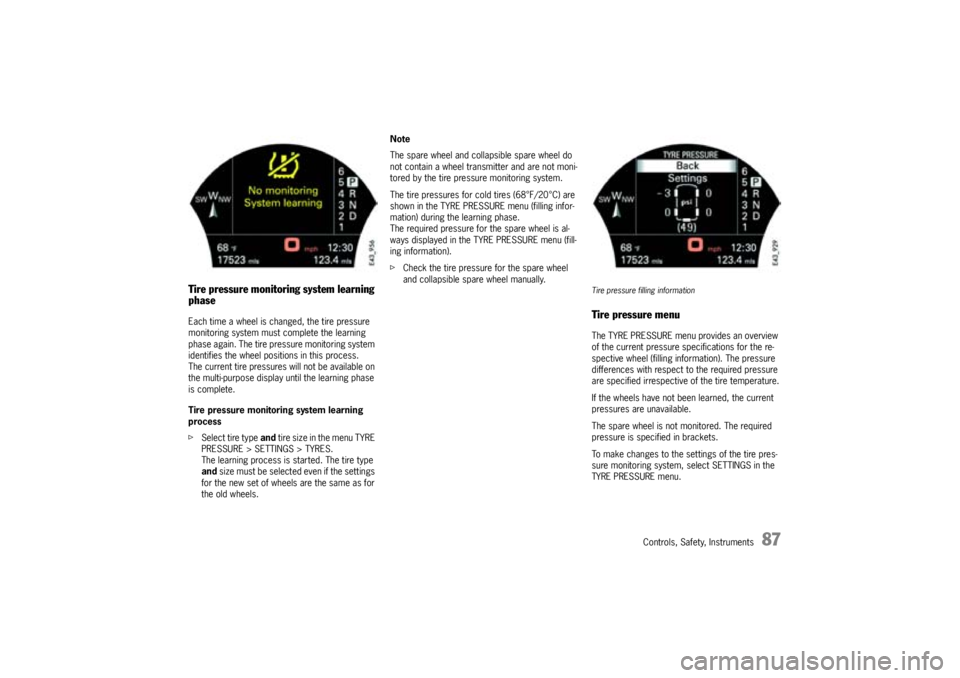
Tire pressure monitoring system learning
phaseEach time a wheel is changed, the tire pressure
monitoring system must complete the learning
phase again. The tire pressure monitoring system
identifies the wheel positions in this process.
The current tire pressures will not be available on
the multi-purpose display until the learning phase
is complete.
Tire pressure monitoring system learning
process
fSelect tire type and tire size in the menu TYRE
PRESSURE > SETTINGS > TYRES.
The learning process is started. The tire type
and size must be selected even if the settings
for the new set of wheels are the same as for
the old wheels.Note
The spare wheel and collapsible spare wheel do
not contain a wheel transmitter and are not moni-
tored by the tire pressure monitoring system.
The tire pressures for cold tires (68°F/20°C) are
shown in the TYRE PRESSURE menu (filling infor-
mation) during the learning phase.
The required pressure for the spare wheel is al-
ways displayed in the TYRE PRESSURE menu (fill-
ing information).
fCheck the tire pressure for the spare wheel
and collapsible spare wheel manually.
Tire pressure filling informationTire pressure menuThe TYRE PRESSURE menu provides an overview
of the current pressure specifications for the re-
spective wheel (filling information). The pressure
differences with respect to the required pressure
are specified irrespective of the tire temperature.
If the wheels have not been learned, the current
pressures are unavailable.
The spare wheel is not monitored. The required
pressure is specified in brackets.
To make changes to the settings of the tire pres-
sure monitoring system, select SETTINGS in the
TYRE PRESSURE menu.
Page 88 of 369
88
Controls, Safety, Instruments
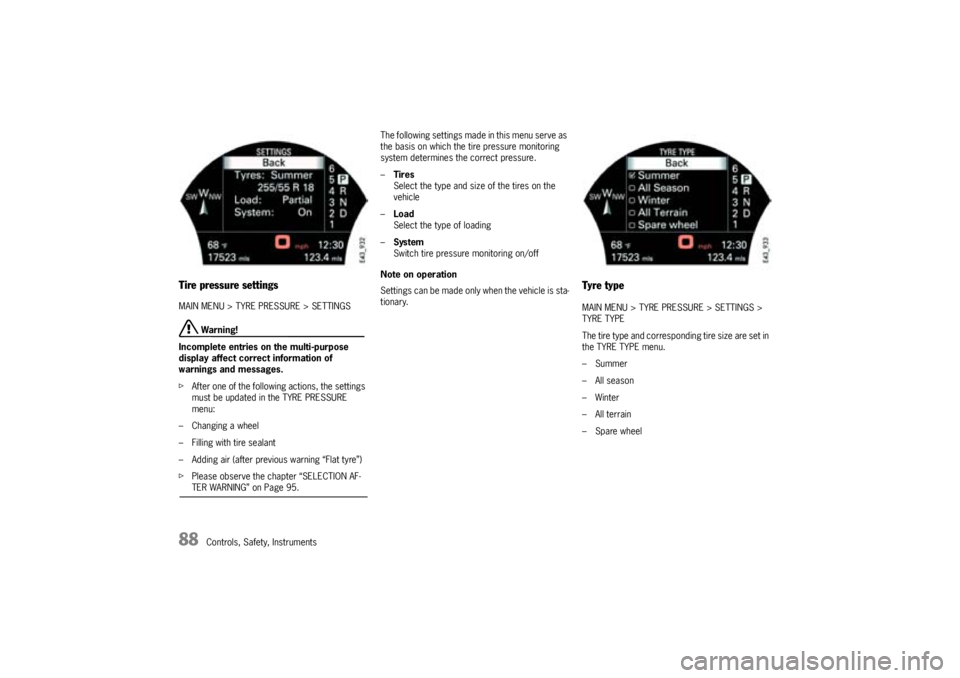
Tire pressure settingsMAIN MENU > TYRE PRESSURE > SETTINGS
Warning!
Incomplete entries on the multi-purpose
display affect correct information of
warnings and messages.
fAfter one of the following actions, the settings
must be updated in the TYRE PRESSURE
menu:
– Changing a wheel
– Filling with tire sealant
– Adding air (after previous warning “Flat tyre”)
fPlease observe the chapter “SELECTION AF-TER WARNING” on Page 95.The following settings made in this menu serve as
the basis on which the tire pressure monitoring
system determines the correct pressure.
–Tires
Select the type and size of the tires on the
vehicle
–Load
Select the type of loading
–System
Switch tire pressure monitoring on/off
Note on operation
Settings can be made only when the vehicle is sta-
tionary.
Tyre typeMAIN MENU > TYRE PRESSURE > SETTINGS >
TYRE TYPE
The tire type and corresponding tire size are set in
the TYRE TYPE menu.
–Summer
– All season
– Winter
– All terrain
–Spare wheel
Page 89 of 369
Controls, Safety, Instruments
89
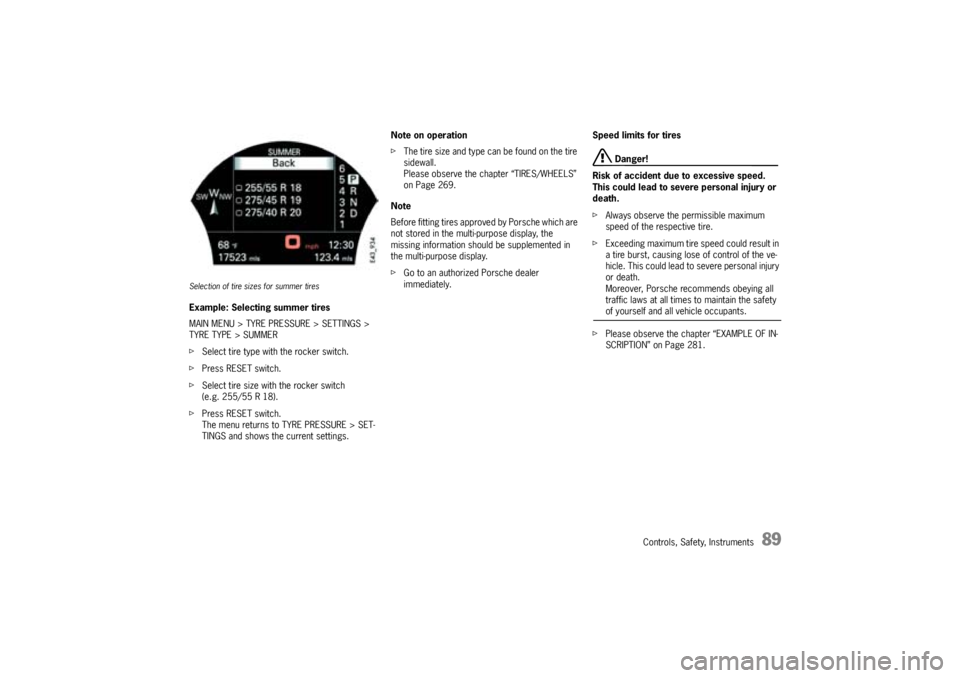
Selection of tire sizes for summer tiresExample: Selecting summer tires
MAIN MENU > TYRE PRESSURE > SETTINGS >
TYRE TYPE > SUMMER
fSelect tire type with the rocker switch.
fPress RESET switch.
fSelect tire size with the rocker switch
(e.g. 255/55 R 18).
fPress RESET switch.
The menu returns to TYRE PRESSURE > SET-
TINGS and shows the current settings.Note on operation
fThe tire size and type can be found on the tire
sidewall.
Please observe the chapter “TIRES/WHEELS”
on Page 269.
Note
Before fitting tires approved by Porsche which are
not stored in the multi-purpose display, the
missing information should be supplemented in
the multi-purpose display.
fGo to an authorized Porsche dealer
immediately.Speed limits for tires
Danger!
Risk of accident due to excessive speed.
This could lead to severe personal injury or
death.
fAlways observe the permissible maximum
speed of the respective tire.
fExceeding maximum tire speed could result in
a tire burst, causing lose of control of the ve-
hicle. This could lead to severe personal injury
or death.
Moreover, Porsche recommends obeying all
traffic laws at all times to maintain the safety of yourself and all vehicle occupants.
fPlease observe the chapter “EXAMPLE OF IN-
SCRIPTION” on Page 281.
Page 90 of 369
90
Controls, Safety, Instruments
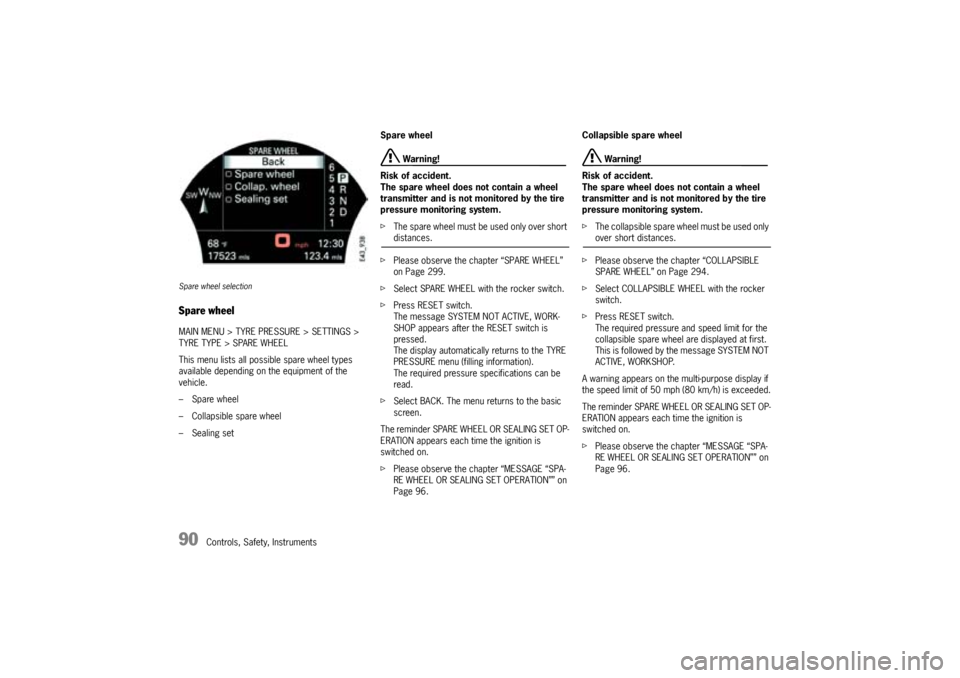
Spare wheel selectionSpare wheelMAIN MENU > TYRE PRESSURE > SETTINGS >
TYRE TYPE > SPARE WHEEL
This menu lists all possible spare wheel types
available depending on the equipment of the
vehicle.
–Spare wheel
– Collapsible spare wheel
– Sealing setSpare wheel
Warning!
Risk of accident.
The spare wheel does not contain a wheel
transmitter and is not monitored by the tire
pressure monitoring system.
fThe spare wheel must be used only over short distances.
fPlease observe the chapter “SPARE WHEEL”
on Page 299.
fSelect SPARE WHEEL with the rocker switch.
fPress RESET switch.
The message SYSTEM NOT ACTIVE, WORK-
SHOP appears after the RESET switch is
pressed.
The display automatically returns to the TYRE
PRESSURE menu (filling information).
The required pressure specifications can be
read.
fSelect BACK. The menu returns to the basic
screen.
The reminder SPARE WHEEL OR SEALING SET OP-
ERATION appears each time the ignition is
switched on.
fPlease observe the chapter “MESSAGE “SPA-
RE WHEEL OR SEALING SET OPERATION”” on
Page 96.Collapsible spare wheel
Warning!
Risk of accident.
The spare wheel does not contain a wheel
transmitter and is not monitored by the tire
pressure monitoring system.
fThe collapsible spare wheel must be used only over short distances.
fPlease observe the chapter “COLLAPSIBLE
SPARE WHEEL” on Page 294.
fSelect COLLAPSIBLE WHEEL with the rocker
switch.
fPress RESET switch.
The required pressure and speed limit for the
collapsible spare wheel are displayed at first.
This is followed by the message SYSTEM NOT
ACTIVE, WORKSHOP.
A warning appears on the multi-purpose display if
the speed limit of 50 mph (80 km/h) is exceeded.
The reminder SPARE WHEEL OR SEALING SET OP-
ERATION appears each time the ignition is
switched on.
fPlease observe the chapter “MESSAGE “SPA-
RE WHEEL OR SEALING SET OPERATION”” on
Page 96.
Page 91 of 369
Controls, Safety, Instruments
91
Tire sealant/sealing set
Warning!
Risk of accident.
fHave the tire replaced by a specialist work-
shop as soon as possible.
fAvoid hard acceleration and high cornering
speeds.
fDo not exceed maximum speed of 50 mph
(80 km/h).
fPlease observe the safety and operating in-structions on compressor.
fPlease observe the chapter “TIRE SEALANT”
on Page 288.
fSelect SEALING SET with the rocker switch.
fPress RESET switch.
The display automatically returns to the
TYRE PRESSURE menu (filling information).
fInflate tires according to the displayed
pressure differences.
A warning appears on the multi-purpose display if
the speed limit of 50 mph (80 km/h) is exceeded.
SPARE WHEEL OR SEALING SET OPERATION ap-
pears each time the ignition is switched on.
fPlease observe the chapter “MESSAGE “SPA-
RE WHEEL OR SEALING SET OPERATION”” on
Page 96.
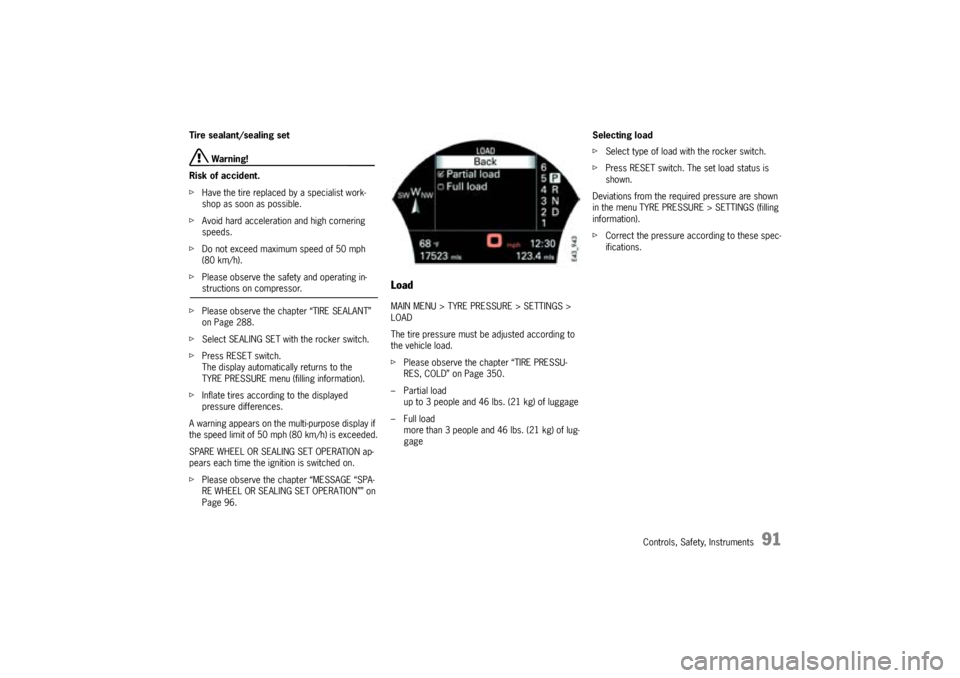
LoadMAIN MENU > TYRE PRESSURE > SETTINGS >
LOAD
The tire pressure must be adjusted according to
the vehicle load.
fPlease observe the chapter “TIRE PRESSU-
RES, COLD” on Page 350.
– Partial load
up to 3 people and 46 lbs. (21 kg) of luggage
–Full load
more than 3 people and 46 lbs. (21 kg) of lug-
gageSelecting load
fSelect type of load with the rocker switch.
fPress RESET switch. The set load status is
shown.
Deviations from the required pressure are shown
in the menu TYRE PRESSURE > SETTINGS (filling
information).
fCorrect the pressure according to these spec-
ifications.
Page 92 of 369
92
Controls, Safety, Instruments
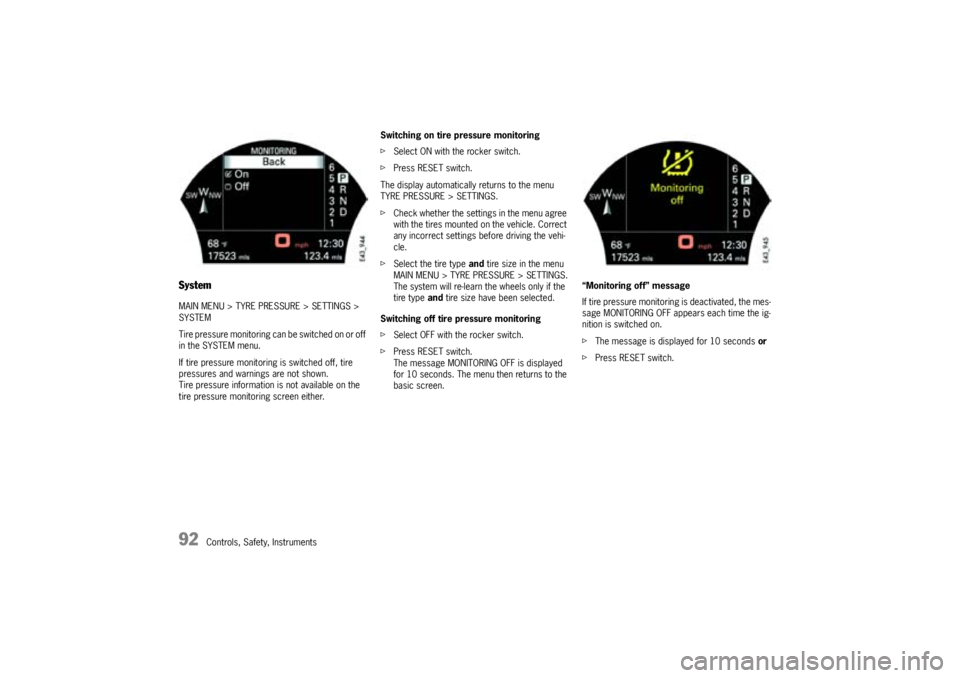
SystemMAIN MENU > TYRE PRESSURE > SETTINGS >
SYSTEM
Tire pressure monitoring can be switched on or off
in the SYSTEM menu.
If tire pressure monitoring is switched off, tire
pressures and warnings are not shown.
Tire pressure information is not available on the
tire pressure monitoring screen either.Switching on tire pressure monitoring
fSelect ON with the rocker switch.
fPress RESET switch.
The display automatically returns to the menu
TYRE PRESSURE > SETTINGS.
fCheck whether the settings in the menu agree
with the tires mounted on the vehicle. Correct
any incorrect settings before driving the vehi-
cle.
fSelect the tire type and tire size in the menu
MAIN MENU > TYRE PRESSURE > SETTINGS.
The system will re-learn the wheels only if the
tire type and tire size have been selected.
Switching off tire pressure monitoring
fSelect OFF with the rocker switch.
fPress RESET switch.
The message MONITORING OFF is displayed
for 10 seconds. The menu then returns to the
basic screen.“Monitoring off” message
If tire pressure monitoring is deactivated, the mes-
sage MONITORING OFF appears each time the ig-
nition is switched on.
fThe message is displayed for 10 seconds or
fPress RESET switch.
Page 93 of 369
Controls, Safety, Instruments
93
Tire pressure warnings and
messagesThe tire pressure monitoring system warns about
loss in pressure in two stages, depending on the
amount of pressure loss:
Stage 1 – Tyre pressure too low message
(3 to 6 psi (0.2 to 0.4 bar) loss in pressure)
Stage 2 – Flat tire warning
(loss in pressure as of 6 psi (0.4 bar))
Warning!
Risk of accident. Tire damage may impair
road safety.
fStop the vehicle at a suitable location if there
is a tire pressure warning or tire pressure mes-
sage. Check the tires for signs of damage and fill or change them if necessary.
Example: If the tire pressure display shows
“– 3 psi”, you must increase the tire pressure by
3psi.
Tires can lose air over time without a tire defect
being present. The tire pressure monitoring sys-
tem will then issue a corresponding message or
warning.
fCorrect the tire pressure.
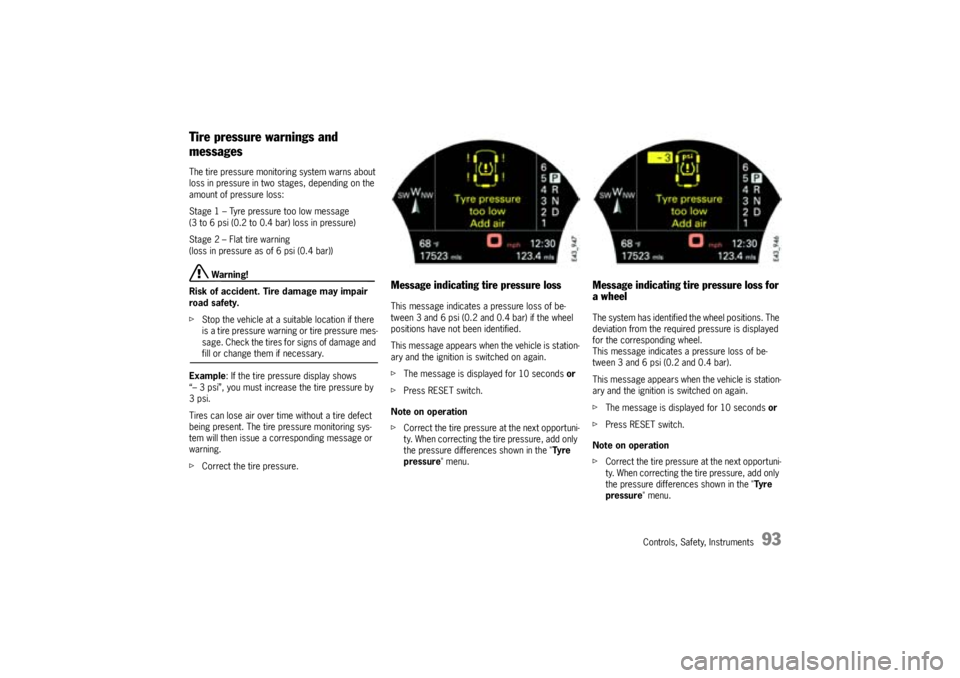
Message indicating tire pressure lossThis message indicates a pressure loss of be-
tween 3 and 6 psi (0.2 and 0.4 bar) if the wheel
positions have not been identified.
This message appears when the vehicle is station-
ary and the ignition is switched on again.
fThe message is displayed for 10 seconds or
fPress RESET switch.
Note on operation
fCorrect the tire pressure at the next opportuni-
ty. When correcting the tire pressure, add only
the pressure differences shown in the "Ty re
pressure" menu.
Message indicating tire pressure loss for
a wheelThe system has identified the wheel positions. The
deviation from the required pressure is displayed
for the corresponding wheel.
This message indicates a pressure loss of be-
tween 3 and 6 psi (0.2 and 0.4 bar).
This message appears when the vehicle is station-
ary and the ignition is switched on again.
fThe message is displayed for 10 seconds or
fPress RESET switch.
Note on operation
fCorrect the tire pressure at the next opportuni-
ty. When correcting the tire pressure, add only
the pressure differences shown in the "Ty re
pressure" menu.
Page 94 of 369
94
Controls, Safety, Instruments
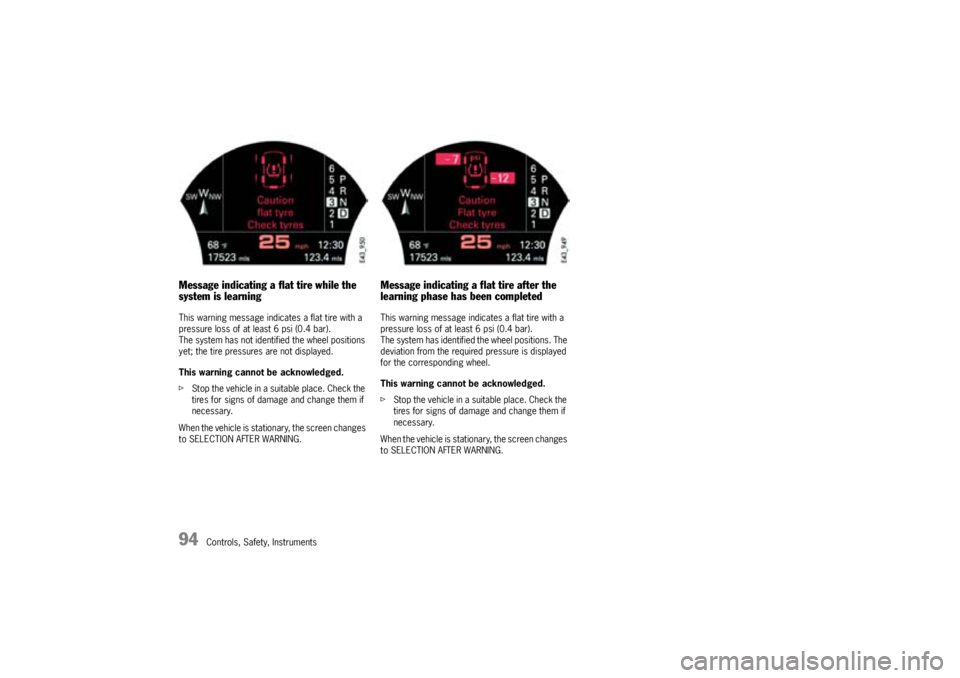
Message indicating a flat tire while the
system is learningThis warning message indicates a flat tire with a
pressure loss of at least 6 psi (0.4 bar).
The system has not identified the wheel positions
yet; the tire pressures are not displayed.
This warning cannot be acknowledged.
fStop the vehicle in a suitable place. Check the
tires for signs of damage and change them if
necessary.
When the vehicle is stationary, the screen changes
to SELECTION AFTER WARNING.
Message indicating a flat tire after the
learning phase has been completedThis warning message indicates a flat tire with a
pressure loss of at least 6 psi (0.4 bar).
The system has identified the wheel positions. The
deviation from the required pressure is displayed
for the corresponding wheel.
This warning cannot be acknowledged.
fStop the vehicle in a suitable place. Check the
tires for signs of damage and change them if
necessary.
When the vehicle is stationary, the screen changes
to SELECTION AFTER WARNING.