brake light PORSCHE CAYNNE TURBO 2005 1.G Owner's Guide
[x] Cancel search | Manufacturer: PORSCHE, Model Year: 2005, Model line: CAYENNE TURBO, Model: PORSCHE CAYENNE TURBO 2005 1.GPages: 369, PDF Size: 3.17 MB
Page 242 of 369

242
Maintenance, Car Care
Brake-Fluid LevelfPlease observe the chapter “EXERCISE
EXTREME CAUTION WHEN WORKING ON YOUR
VEHICLE” on Page 234.
fUse only new (unused) Original Porsche brake
fluid.
Warning!
Brake fluid is hazardous to your health, and
may be fatal if swallowed.
Brake fluid also attacks paintwork.
fKeep brake fluid out of children's reach.
fImmediately rinse off spilled brake fluid with
clean water.
fIf brake fluid gets into your eye, immediately
rinse with clean water for a few minutes. Then
see a doctor immediately.
fPlease note all the information on the refill container of the brake fluid.
Checking the brake-fluid levelThe reservoir for the hydraulic braking system is
located in the engine compartment.
1. Rotate the turn-locks 90° counterclockwise
(arrow) with a screwdriver and remove the
cover.
2. Check brake-fluid level at the transparent res-
ervoir.
The fluid level should always lie between the
MIN and MAX marks.A slight decrease in the fluid level due to wear and
automatic readjustment of the disc brakes is
normal.
If, however, the fluid level falls markedly or below
the MIN mark, the braking system may have devel-
oped a leak.
fPlease have the braking system checked im-
mediately at an authorized Porsche dealer.
Page 243 of 369

Maintenance, Car Care
243
Changing the brake fluidBrake fluid absorbs moisture from the air over
time. This accumulation of water lowers the boil-
ing point and, under certain operating conditions,
can affect the braking action.
fTherefore, have the brake fluid changed in ac-
cordance with the change intervals stated in
the booklet “Maintenance”.
The warning light in the instrument panel and the
warning message on the multi-purpose display of
the instrument panel
– indicate the brake level fluid is too low or,
– in conjunction with large pedal travel could
indicate a braking-circuit failure.
Note on operation
fStop immediately in a suitable place.
fDo not continue driving.
Please have the fault remedied at your nearest
authorized Porsche dealer.
Washer FluidThe washer-fluid reservoir for windshield, rear win-
dow and headlights is located in the engine com-
partment.Warning message on the multi-purpose
displayA message is shown on the multi-purpose display
of the instrument panel if the washer-fluid level is
too low.
In this case, the residual quantity is only around
0.85 quarts or 0.8 liters.
fAdd washer fluid at the next opportunity.
Topping off washer fluidThe capacity is approx. 7.9 quarts or 7.5 liters.
Clean water is generally not enough to clean the
windows and headlights.
It is advantageous to add a winter cleaner giving
antifreeze protection or a suitable summer clean-
er, depending on the season. Follow the instruc-
tions for the mixture ratio.
fUse only cleaner authorized by Porsche.
1. Please note all the information on the refill
container of the cleaning agent.
2. Open cap of the washer-fluid reservoir.
3. Top up washer fluid and close cap properly.
fDo not use engine coolant anti-freeze or any
other solution that can damage the car’s paint,
in the washer reservoir.
Brake fluid warning light
USA
Brake fluid warning light
Canada
Page 257 of 369

Maintenance, Car Care
257
High-pressure cleaning units
Warning!
High-pressure cleaning units can damage
the following components:
–Tires
– Logos, emblems
– Painted surfaces
– Widened fenders
– Lock and latch of the removable towing attach-
ment
– Seals of the electrically retractable ball hitch
– Alternator, valve covers
– ParkAssist sensors.
fPlease observe the operating instructions from
the unit manufacturer.
fAlways cover the lid over the brake fluid reser-
voir prior to cleaning. Never point the cleaning
jet directly at the lid.
fWhen cleaning with a flat-jet nozzle or the like,
maintain a minimum distance of 50 cm
(21 in.).fNever use high-pressure cleaning units with a
round-jet nozzle.
A high-pressure cleaning unit with round nozzle
will damage your vehicle. The tires are particu-
larly susceptible to damage.
fDo not point the cleaning jet directly at any of
the aforementioned components.
WashingThe best protection for the car from the damaging
effects of the environment is frequent washing and
preservation. The underside of the car should also
be thoroughly washed for cinders, salt or sanding
at winter‘s end.
The longer salt, road dust, industrial dust, insect
remains, bird excrement, and tree exudations (res-
in, pollen), etc. are allowed to remain on the body-
work, the more serious is their harmful effect.
New cars should be washed carefully with plenty
of clear water to protect the new paint work.
Dark paint finishes show up the smallest of sur-
face damage (e.g. scratches) more readily than
lighter colors.
Dark colors are also more susceptible to scratch-
ing because of the composition of their pigments
and require particularly careful paint care.fDo not wash your car in bright sunlight or while
the bodywork is still hot.
fWhen washing by hand, use abundant water, a
soft sponge or wash brush and Porsche car
shampoo.
fBegin by spraying the body thoroughly with wa-
ter to rinse away loose dirt.
fAfter washing, rinse the car with plenty of wa-
ter and then dry with a chamois leather.
Do not use the same chamois leather for
drying as you use for cleaning the windshield
and windows.
f f f
Page 260 of 369

260
Maintenance, Car Care
Cleaning the engine compartment
Caution!
Risk of damage, e.g. to the alternator, paint-
ed surfaces, and the valve covers.
fNever use high-pressure cleaning units with a
round-jet nozzle.
fAlways maintain a minimum distance of 50 cm
(21 in.).
fAlways cover the lid over the brake fluid reser-
voir prior to cleaning with a high-pressure
cleaner. Never point the cleaning jet directly at
the lid.
fDo not point the cleaning jet directly at any of the aforementioned components.
Note on operation
If the vehicle is driven off-road frequently and after
driving on salted or gritted roads:
fClean the engine compartment regularly.
WindowsThe road dust which settles on the windshield and
windows contains particles of tire rubber and oil
residue. The interior trim and upholstery release
particles, particularly in strong sunlight, which col-
lect on the insides of the windows. These deposits
are augmented by impurities in the air which en-
ters the car through the fresh air vents.
fClean all windows regularly, inside and outside,
with Porsche window cleaner.
fMake sure not to damage the TV antenna in the
side window when cleaning.
fIf you use a chamois leather for the windows,
do not use it for paintwork as it will otherwise
pick up a certain amount of preservative or pol-
ish and could smear the windows and thus im-
pair vision.
fRemove dead insects with insect remover.
Wiper bladesWiper blades that are in perfect condition are vital
for a clear view.
fReplace the wiper blades twice per year (be-
fore and after the cold season) or whenever
wiper performance deteriorates.
fPeriodically clean wiper blades with Porsche
window cleaner, especially after the vehicle
has been washed in a car wash.
If they are very dirty (e.g. with insect remains),
they can be cleaned with a sponge or cloth.
Page 262 of 369

262
Maintenance, Car Care
Headlights, lights, interior and exterior
plastic partsfUseonlyclean water and a little dishwashing
detergent to clean headlights, lights, plastic
parts and surfaces.
Do not clean when dry.
Use a soft sponge or a soft, lint-free cloth.
Gently wipe the surface without applying too
much pressure.
The Porsche inside window cleaner is also
suitable for cleaning plastic surfaces.
Follow the cleaning instructions on the
container.
Never use other chemical cleaners or
solvents.
fRinse cleaned surfaces with clear water.
Door, roof, lid and window sealsfWash dirt (e.g. abrasion, dust, road salt or grit)
from all seals regularly using warm soapy wa-
ter. Do not use any chemical cleaning agents
or solvents.
When there is a frost hazard, the outer door seals
and the lid seals can be protected against freezing
into place by a suitable care product.
In order to prevent damage to the anti-fric-
tion coating, the inner door seals must not be
treated with care products.
Light alloy wheelsfPlease observe the chapter “AUTOMATIC CAR
WASHES” on Page 258.
Pitting may occur if metallic particles which cause
contact corrosion (e.g. brass or copper in brake
dust) are allowed to remain on the aluminum too
long.
fIf possible, wash the wheels with a sponge or
wash brush about every two weeks. In areas
where road salt or grit is spread on winter
roads or there is a lot of airborne industrial
dust, it is best to clean the wheels weekly.
The Porsche Light Alloy Wheel Cleaner
(ph-value 9.5) can be used for this pur-
pose.
If the ph-value of the detergent is in-
corect, the protective coating on the
wheels will be destroyed.
Polishes which dissolve oxides, such as those
frequently used for other metals, or abrasive
tools or agents are unsuitable because they
break down the oxide film of the protective
coating and will cause discoloration of the
wheel.
fEvery three months, after cleaning, coat the
wheels with a car wax or non-corrosive grease
(e.g. vaseline).
Using a clean cloth thoroughly rub the grease
into the surface.
Page 306 of 369

306
Practical Tips, Minor Repairs 22 Rear differential lock30
23
Rear differential lock, disengageable anti-roll bars
10
24 Tire pressure monitoring system5
2526Porsche Stability Management, passenger airbag deactivation, brake pedal switch, instrument panel, engine control unit,
airbag control unit, steering column module1027282930313233
Steering wheel heating, steering column module
15
34 Passenger compartment monitoring, seat heating5
35
Low beam, high beam
15
36 Vehicle electrical system control unit10
3738 Brake lights1039
Relay activation, heated rear window, seat heating
5
40 Instrument panel5
41
Porsche Entry & Drive
15
42 Panorama roof30
43
Subwoofer
30 No. Designation Rating in A
Page 307 of 369
Practical Tips, Minor Repairs
307
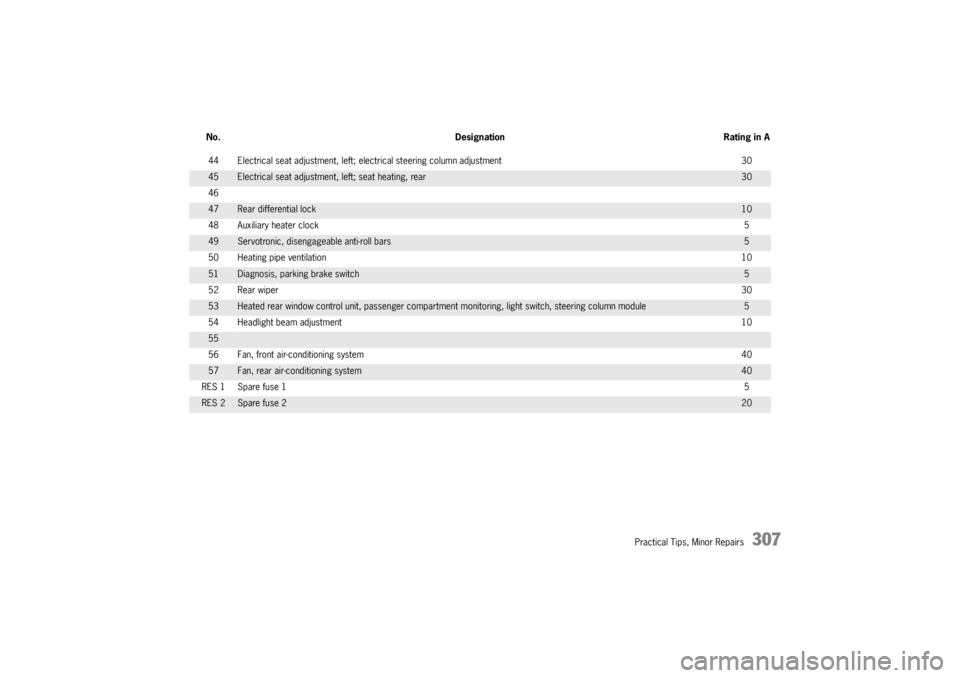
44 Electrical seat adjustment, left; electrical steering column adjustment 3045
Electrical seat adjustment, left; seat heating, rear
30
46
47
Rear differential lock
10
48 Auxiliary heater clock5
49
Servotronic, disengageable anti-roll bars
5
50 Heating pipe ventilation10
51
Diagnosis, parking brake switch
5
52 Rear wiper30
53
Heated rear window control unit, passenger compartment monitoring, light switch, steering column module
5
54 Headlight beam adjustment10
5556 Fan, front air-conditioning system4057
Fan, rear air-conditioning system
40
RES 1 Spare fuse 15
RES 2
Spare fuse 2
20 No. Designation Rating in A
Page 327 of 369

Practical Tips, Minor Repairs
327
Bulb Chart
Type, rating Type, rating
Exterior lights Interior lights
Xenon low beam and high beam D1S Interior light, front W5W
Side marker light, rear P21/5W Reading light W5W
Side marker light, front W5W Engine compartment light W5W
Turn signal light, rear P21W Footwell light W3W
Turn signal light, front PY21W Glove compartment light W3W
Brake light P21W Center console W3W
License plate light C5W Luggage compartment light K12V10W
Fog light H11 Curb lights (doors) W3W
Rear fog light P21/4W Warning lights (doors) W3W
Back up light P21W Kerb light (rear lid) W5W
Side indicator light W5W Curb lights (rear lid) W5W
Additional high beam H7
Cornering light H3
Page 336 of 369

336
Practical Tips, Minor Repairs 3. Screw in the fastening screws B.
4. Press in caps A.
Replacing bulbs1. Undo fastening screws C of the housing cover.
2. Remove housing cover D.
E- Rear fog light and tail light
F- Reversing light
G- Turn signal light
H- Brake light
I- Tail light3. Replace defective bulb.
4. Insert lamp bracket.
5. Install tail light.
Page 351 of 369

Vehicle Identification, Technical Data
351
CapacitiesUse only fluids and fuels authorized by Porsche. Your authorized Porsche dealer will be pleased to advise you.
Your Porsche has been designed so that it is not necessary to mix any additives with oils or fuels.1 Depending on equipment levelEngine oil change quantity without oil filter
approx. 8.5 quarts (8.0 liters)
Engine oil change quantity with oil filter approx. 9.0 quarts (8.5 litres)
Reference indication is the level on the oil dipstick.
Please observe the chapter “ENGINE OIL LEVEL” on Page 236.
Coolant
1)
approx. 4.8 – 5.5 U.S. gallons (18 - 21 liters)
Automatic transmission with torque converter approx. 10.6 quarts (10.1 liters)
Transfer box
approx. 0.9 quarts (0.85 liter)
Front-axle differential approx. 1.1 quarts (1.0 liter)
Rear-axle differential
approx. 1.5 quarts (1.4 liters)
Locking rear differential approx. 1.7 quarts (1.6 liters)
Fuel tank
approx. 26.4 U.S. gallons (100 liters),
including approx. 3.1 U.S. gallons (12 liters) reserve
Fuel quality The engine is designed to provide optimum performance and fuel consumption if unleaded premi-
um fuel with 98 RON/88 MON is used.
If unleaded premium fuels with octane numbers of at least 95 RON/85 MON are used, the engine's
“Electronic Oktane™ knock control“ automatically adapts the ignition timing.
Power steering
approx. 1.6 quarts (1.5 liters) Pentosin CHF 11 S
®
Brake fluid approx. 1.0 quart (0.95 liter)
Use only Original Porsche brake fluid.Window/headlight washer system
approx. 7.9 quarts (7.5 liters)