engine PORSCHE CAYNNE TURBO 2005 1.G Workshop Manual
[x] Cancel search | Manufacturer: PORSCHE, Model Year: 2005, Model line: CAYENNE TURBO, Model: PORSCHE CAYENNE TURBO 2005 1.GPages: 369, PDF Size: 3.17 MB
Page 201 of 369

Shifting Gear, Traction Systems
201
Kickdown
The kickdown function is active in selector lever
position D.
fFor optimum acceleration, e.g. when overtak-
ing, depress the accelerator pedal beyond the
full-throttle point (kickdown).
The transmission shifts down depending on the
speed of travel and engine speed.
Upward shifts occur at the highest possible engine
speeds.
These gear-changing speeds remain active until
the accelerator is released to approx. 80% of the
full-throttle position.D - Automatic selection mode (in the off-
road driving program)The functions of selector lever positions Dand M
differ in the on-road program, High Range, and in
the off-road program, Low Range.
fUse selector lever position D for “normal” driv-
ing.
The gears are shifted automatically according
to the accelerator position and speed.
The gears are shifted automatically according to
the accelerator position and speed. The gear-
changing points have been adjusted to achieve the
best possible vehicle control on difficult terrain.Depending on the route profile, the gear-changing
points are shifted towards higher or lower engine-
speed ranges. On steep downhill stretches, up-
ward shifts are prevented until medium engine
speeds are reached (at least 2,500 rpm).
When the car is overrunning, an automatic upshift
does not occur when the engine speed limit is
reached.
Moving off
The car moves off in 1st gear.
Shifting gear on the steering wheel
By shifting gear with the rocker switches on the
steering wheel, you can temporarily change from
automatic selection mode D to manual selection
mode M.
Advantages
– Shifting down on downward slopes (engine
braking).
– Shifting down for brief spurts of acceleration.
– Selecting 1st/2nd or 3rd gear for moving off.
The manual selection mode remains engaged:
– For overrunning
– Depending on lateral acceleration
– When the vehicle is stationary (e.g. at a junc-
tion).The system leaves manual selection mode:
– Automatically after around 8 seconds
(unless car is subject to high lateral accelera-
tion, is overrunning or stationary),
– if you depress the accelerator to kickdown.
Kickdown
The kickdown function is active in selector lever
position D.
fFor optimum acceleration, e.g. when overtak-
ing, depress the accelerator pedal beyond the
full-throttle point (kickdown).
The transmission shifts down depending on the
speed of travel and engine speed.
Upward shifts occur at the highest possible engine
speeds.
These gear-changing speeds remain active until
the accelerator is released to approx. 80% of the
full-throttle position.
Tip on driving
Unlike in the on-road driving program, an auto-
matic upshift is not performed in manual selection
modeM when the engine-speed limit is reached.
Page 202 of 369
202
Shifting Gear, Traction Systems
M - Manual selection mode (in the road
driving program)The functions of selector lever positions Dand M
differ in the on-road program, High Range, and in
the off-road program, Low Range.
The currently selected gear is retained if you
change from D to M.
If you change from M to D, the gear-changing map
suitable for your current driving style is selected
and the appropriate gear is selected.
Warning!
The kickdown function is not active in manual
selection mode “M“.
The kickdown function cannot be used to
downshift in manual selection mode “M“.
fTherefore shift down manually when accelerat-ing (e.g. to overtake).
Shifting up
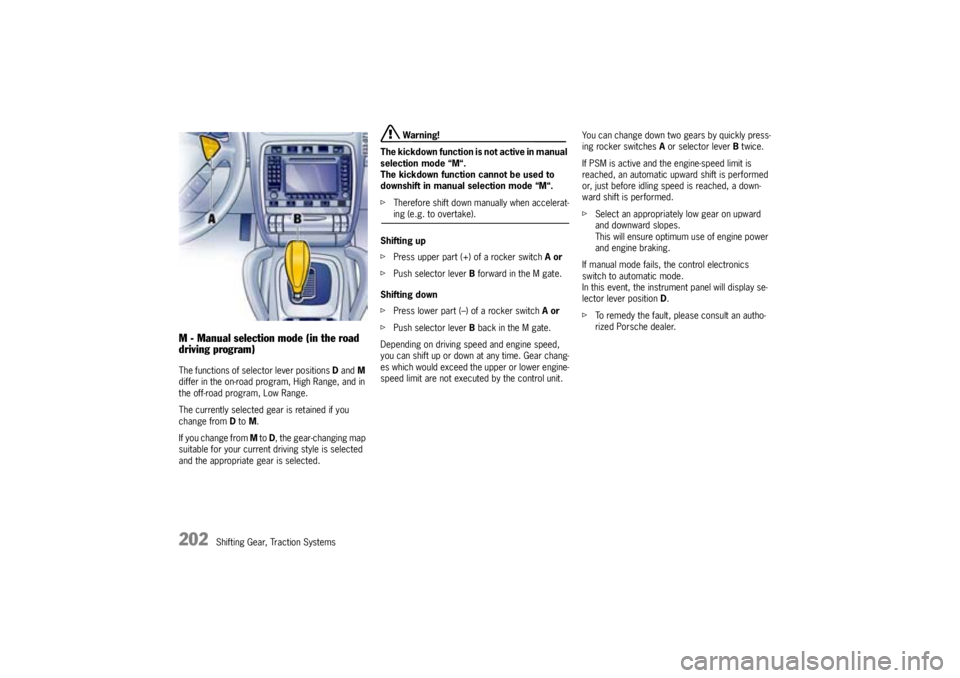
fPress upper part (+) of a rocker switch Aor
fPush selector lever B forward in the M gate.
Shifting down
fPress lower part (–) of a rocker switch Aor
fPush selector lever B back in the M gate.
Depending on driving speed and engine speed,
you can shift up or down at any time. Gear chang-
es which would exceed the upper or lower engine-
speed limit are not executed by the control unit.You can change down two gears by quickly press-
ing rocker switches A or selector lever B twice.
If PSM is active and the engine-speed limit is
reached, an automatic upward shift is performed
or, just before idling speed is reached, a down-
ward shift is performed.
fSelect an appropriately low gear on upward
and downward slopes.
This will ensure optimum use of engine power
and engine braking.
If manual mode fails, the control electronics
switch to automatic mode.
In this event, the instrument panel will display se-
lector lever position D.
fTo remedy the fault, please consult an autho-
rized Porsche dealer.
Page 203 of 369

Shifting Gear, Traction Systems
203
M - Manual selection mode (in the off-
road driving program)The functions of selector lever positions Dand M
differ in the on-road program, High Range, and in
the off-road program, Low Range.
The currently selected gear is retained if you
change from D to M.
If you change from M to D, the gear-changing map
suitable for your current driving style is selected
and the appropriate gear is selected.
Warning!
The kickdown function is not active in manual
selection mode “M“.
The kickdown function cannot be used to
downshift in manual selection mode “M“.
fTherefore shift down manually when accelerat-ing (e.g. to overtake).
Tip on driving
The kickdown function is not active in selector le-
ver position M.
Unlike in the road driving program, an automatic
upshift is not performed when the engine-speed
limit is reached.
Shifting up
fPress upper part (+) of a rocker switch Aor
fPush selector lever B forward in the M gate.Shifting down
fPress lower part (–) of a rocker switch Aor
fPush selector lever B back in the M gate.
Depending on driving speed and engine speed,
you can shift up or down at any time. Gear chang-
es which would exceed the upper or lower engine-
speed limit are not executed by the control unit.
You can change down two gears by quickly press-
ing rocker switches A or selector lever B twice.
The gear is changed down automatically just be-
fore idle speed is reached.
fSelect an appropriately low gear on upward
and downward slopes.
This will ensure optimum use of engine power
and engine braking.
If manual mode fails, the control electronics
switch to automatic mode. In this event, the instru-
ment panel will display selector lever position D.
fHave the fault eliminated at your authorized
Porsche dealer.
StoppingfFor a brief stop (e.g. at a traffic light), leave the
selector lever in drive position and hold the ve-
hicle with the brake pedal.
fDo not hold the car on a slope using the accel-
erator. Use the brake pedal or the parking
brake instead.
fBefore leaving the vehicle, always apply the
handbrake and move the selector lever to
positionP.
Tip on driving
In selector lever positions D and M, the Hillholder
prevents the car from rolling backward when it has
been stopped on an upward slope with the engine
running.
fPlease observe the chapter “HILLHOLDER” on
Page 218.
Page 209 of 369

Shifting Gear, Traction Systems
209
fPush rocker switch A forwards in stages until
engagement of the rear differential lock (trans-
verse lock) is indicated on the multi-purpose
display of the instrument panel and by the
illumination of the three light-emitting diodes B,
Cand D.
The center and rear differential locks are
changed over to fully engaged state by the
automatic control system.
Note on operation
The rear differential lock can only be engaged
while the engine is running.
Hydraulically disengageable anti-roll barsThe front and rear anti-roll bars can be disengaged
to improve traction and comfort when driving off
road. This feature increases the wheel articulation.
Condition for disengaging the anti-roll bars
– Low Range is engaged.
Note
The anti-roll bars cannot be engaged if the wheel
articulation or lateral acceleration is too great.Disengaging
fPress button E.
Disengagement of the anti-roll bars is indicated
on the multi-purpose display of the instrument
panel and by illumination of light-emitting diode
F.
The light-emitting diode on the button flashes
several times during the disengagement
process.
The anti-roll bars are disengaged.
Note on operation
The anti-roll bars cannot be disengaged manually
at speeds above 25 mph (40 km/h).
Engaging
fPress button E.
Light-emitting diode F on the button flashes
several times during the engagement
process and then goes out.
The anti-roll bars are engaged.
Note on operation
The anti-roll bars are engaged automatically when
a speed of 30 mph (50 km/h) is exceeded or
when the lateral acceleration value is high.
Notes
Engagement of the anti-roll bars is audible.
At temperatures below –4°F (–20 °C), the anti-roll
bars take somewhat longer to engage.
Page 211 of 369

Shifting Gear, Traction Systems
211
Power-Transmission and Running-Gear Control SystemsA complex interconnection of all control systems acting in power transmission and in the running gear has been realised in your Porsche.
All control systems have been linked with the aim of combining the best possible driving performance with maximum safety.
The following systems are involved:
System/designation Scope
PTM
Porsche Traction Management– Full-time all-wheel drive
– Electronically controlled center differential lock
– Automatic brake differential (ABD)
– Traction control system (TCS)
– Reduction gear/Low Range
PTM Plus
Porsche Traction ManagementIn addition to the PTM features, PTM Plus also includes:
– Electronically controlled rear differential lock
– Hydraulically disengageable anti-roll bars
PSM
Porsche Stability Management– Stability management system
– Anti-lock brake system (ABS)
– Traction control system (TCS)
– Automatic brake differential (ABD)
– Engine drag torque control (MSR)
Air suspension
with level control and height adjustment– Fully load bearing air spring struts with integral shock absorbers
– Air supply system with pressure accumulator
PAS M
Porsche Active Suspension Management– Shock absorber system with adaptive, continuous shock absorber control
Page 213 of 369

Shifting Gear, Traction Systems
213
Full-time all-wheel drive
With the four-wheel drive, the drive power is vari-
ably distributed to the front and rear wheels.
Power distribution and wheel speed compensation
between the front and rear axles is realised with a
transfer box.
Distribution of the drive power depends on the
wheel speed difference between the two axles.
The transfer box always controls power distribu-
tion in such a way that optimal propulsion is
achieved, even on an unfavorable road surface.
Full-time four-wheel drive ensures optimal handling
and great stability.
Caution!
In spite of the advantages of four-wheel drive, it is
still the driver’s responsibility to adapt his driving
style and maneuvers in line with road and weather
conditions, as well as the traffic situation.
The increased safety that is provided should not in-
duce you to take greater risks with your safety.
The limits set by the physics of driving cannot be
overcome, even with four-wheel drive.
Risks of accident due to inappropriate speed can-
not be reduced by four-wheel drive.Automatic brake differential (ABD)
The ABD system controls the front and rear axles
separately. If one wheel of an axle starts to spin,
it is braked so that the other wheel on the same
axle can be driven.
The ABD recognises different driving states, and it
features control strategies adapted to these
states. In situations in which little propulsive power
is required, such as when the car moves off on a
level gravel surface, traction control already be-
comes active at low engine speeds. If great
propulsive power is required, e.g. when moving off
on an uphill slope or for rapid acceleration, the
ABD is adapted accordingly.
A special off-road program is used in Low Range
mode.Traction control system (TCS)
The traction control system prevents the wheels
from spinning by adjusting the engine power,
thereby ensuring good lane-holding ability and a
stable driving behavior.
Page 214 of 369

214
Shifting Gear, Traction Systems
Porsche Stability Management (PSM)PSM is an active control system for stabilisation of
the vehicle during extreme driving maneuvres. It
operates together with the Porsche Traction
Management (PTM) system.
PSM makes use of both the ABD and TCS sys-
tems, as well as the known functions of the anti-
lock brake system (ABS) and engine drag torque
control system (MSR).
Caution!
In spite of the advantages of PSM, it is still the driv-
er’s responsibility to adapt his driving style and
maneuvres in line with road and weather condi-
tions, as well as the traffic situation.
The increased safety that is provided should not in-
duce you to take greater risks with your safety.
The limits set by the physics of driving cannot be
overcome, even with PSM.
Risks of accident due to inappropriate speed
cannot be reduced by PSM.Advantages of PSM
– Best possible traction and lane-holding ability
in all driving situations – even on road surfaces
with varying friction.
– The system compensates for undesired vehi-
cle reactions (Ferraria effect) when the driver
releases the accelerator pedal or brakes on
bends. This compensation functions up to the
maximum lateral acceleration.
– PSM actively stabilises the vehicle in the event
of under and oversteering during dynamic
driving maneuvres (e.g. rapid steering move-
ments, during lane changes or on alternating
bends).
– Improved braking stability on bends and on dif-
ferent or varying road surfaces.Readiness for operation
PSM is switched on automatically every time you
start the engine.
Function
Sensors at the wheels, brakes, steering system
and engine continuously measure:
–Driving speed
– Direction of travel
– Lateral acceleration
– Longitudinal acceleration
– Rate of turn about the vertical axis
PSM uses these values to determine the direction
of travel desired by the driver.
PSM intervenes and corrects the course if the ac-
tual direction of motion deviates from the desired
course (steering-wheel position):
It brakes individual wheels as needed. If neces-
sary, PSM additionally influences the engine power
or the gear-changing characteristic of the Tiptron-
ic in order to stabilise the vehicle.
Page 215 of 369

Shifting Gear, Traction Systems
215
The events below inform the driver of PSM control
operations and warn him to adapt his driving style
to the road conditions:
– The information light in the instrument panel
lights up.
– Hydraulic noises can be heard.
– The vehicle decelerates and steering-wheel
forces are altered as the PSM controls the
brakes.
– Reduced engine power.
– The brake pedal pulsates and its position is
changed during braking.
However, it is possible at any time to achieve
full vehicle deceleration by increasing the foot
pressure slightly.
Examples of PSM control operations
–Vehicle understeers:
If the front wheels of the vehicle drift on a
bend, engine power is reduced and the rear
wheel on the inside of the bend is braked if
necessary.
–Vehicle oversteers:
If the rear of the vehicle swings out on a bend,
the front wheel on the outside of the bend is
braked.Combined use of PSM and PTM/PTM Plus
In order to ensure optimal stabilisation of the
vehicle, the center differential lock (PTM) and
possibly the rear differential lock (PTM Plus) are
also opened when PSM interventions occur.
Tip on driving
When PSM is switched off, wheel-specific brake
interventions and the traction control system
(TCS) are also inactive.
The automatic brake differential (ABD) remains on.Off-road PSM
(PSM in Low Range program)
When Low Range is active, an off-road PSM
specially matched to off-road driving is activated
to enhance traction.
At a speed below 22 mph (35 km/h), the terrain
PSM intervenes later if the vehicle should under-
steer and thereby improves steerability in Low
Range.
If the brakes are highly stressed, the automatic
brake differential (ABD) switches itself off to
protect the brakes. It remains deactivated until the
brake system has cooled sufficiently.
Engine drag torque control
In conditions of excessive slip, the engine drag
torque control system prevents all driven wheels
from locking up when the car is overrunning. This
is also the case for downshifts on a slippery road.
Page 217 of 369
Shifting Gear, Traction Systems
217
ABS
(Anti-lock Brake System)
Caution!
In spite of the advantages of ABS, it is still the driv-
er’s responsibility to adapt his driving style and
maneuvres in line with road and weather condi-
tions, as well as the traffic situation.
The increased safety that is provided should not in-
duce you to take greater risks with your safety.
The limits set by the physics of driving cannot be
overcome, even with ABS.
Risks of accident due to inappropriate speed can-
not be reduced by ABS.
ABS ensures
–Full steering control
The vehicle remains steerable
–Good driving stability
No skidding due to locked wheels
–Optimum braking distance
Shorter stopping distances in most cases
–Lock prevention
No flat spots on the tiresFunction
The decisive advantage of ABS is in the driving
stability and maneuvrability of the vehicle in
hazardous situations, even during heavy braking
while cornering.
ABS prevents locking of the wheels during full
braking, on almost all road surfaces, until shortly
before the vehicle stops.
The ABS begins to control the braking process as
soon as a wheel shows a tendency to lock.
This controlled braking process is comparable to
extremely rapid cadence braking.
The pulsating brake pedal and a “rattling noise”
warn the driver to adapt his driving speed to the
road conditions.Warning light
If the ABS warning lights light up in the instrument
panel and on the multi-purpose display of the in-
strument panel while the engine is running, the
ABS has switched off because of a fault.
In this event, the braking system will operate with-
out lock prevention,as in cars without ABS.
fAdapt your driving style to the changed brak-
ing behavior.
The ABS must be checked immediately at an
authorized Porsche dealer in order to prevent
the occurrence of further faults the effects of
which cannot be defined.
The ABS control unit is adjusted for the approved
tire dimensions.
The use of tires with non-approved dimensions can
lead to different wheel speeds, causing the ABS to
switch off.
f f f
Page 218 of 369

218
Shifting Gear, Traction Systems Off-road ABS
(ABS in Low Range program)
When Low Range is active, an ABS specially
matched to off-road driving is activated automati-
cally.
At speeds below 30 mph (50 km/h), the front
wheels can lock up in cycles during braking to
shorten the braking distance when the vehicle is
driven off-road (the wheels dig in to the surface).
If the driver needs to steer, this off-road driving
program is automatically switched off briefly to
maintain steerability.
HillholderIn selector lever positions D and M, the Hillholder
function makes it easier to move off from a stand-
still on an upward slope when the engine is
running. The driver does not have to apply the
brake.
The hillholder thus makes moving off on slopes
easier.
Warning!
Risk of accident.
The vehicle can roll backwards if the Hillhold-
er is switched off.
fAlways apply the footbrake on slopes.
Hillholder is not active:
– In selector lever positions N and R
– In the reduced driving program and
– If not all of the wheels are touching the ground
(on difficult terrain, for example).
Safety notes!
In spite of the advantages of the hillholder func-
tion, it is still the driver’s responsibility to adapt his
driving style and maneuvers in line with situational
conditions.
The increased safety that is provided should not in-
duce you to take greater risks with your safety.
The limits set by the physics of driving cannot be
overcome, even with the hillholder function.
Driving at the limits should be avoided, e.g., on icy
slopes or on slippery surfaces. In this and similar
cases, the support of the hillholder function is not
ensured.