gas PORSCHE CAYNNE TURBO 2005 1.G Owners Manual
[x] Cancel search | Manufacturer: PORSCHE, Model Year: 2005, Model line: CAYENNE TURBO, Model: PORSCHE CAYENNE TURBO 2005 1.GPages: 369, PDF Size: 3.17 MB
Page 5 of 369

5
Environmentally friendly vehiclesModern environmental technology ensures compli-
ance with all emission laws applicable worldwide.
It has the following advantages:
– Rapid “operational readiness” of the catalytic
converters ensures low emissions, even in
short-trip operation.
– Reliable operation and good emission control
over a long useful life.
fPlease observe the chapter “FUEL ECONOMY”
on Page 249.
Recycling –
for a Porsche, this is virtually an
academic questionMore than two-thirds of all Porsches ever built are
still running.
But, just in case recycling is ever necessary,
we take the following precautionary
measures:
– Utilisation-friendly design.
– Identification of materials.
– Use of recyclable materials.
– Reusable components designed for simple
removal.
Emission control is built inInnovative engine technology combines high
engine performance and environmental compati-
bility.
The engine diagnosis system electronically
monitors the components and systems that affect
exhaust gases.
This continuous monitoring and fault storage
enables swift, reliable diagnosis and fault detec-
tion.
Faults are indicated to the driver by the “Emission
control” warning light and display.
fPlease observe the chapter “EMISSION CONT-
ROL” on Page 76.
Page 6 of 369
6Setting and operating vehicle
components when driving
Warning!
There is a danger of accident if you set or
operate the on-board computer, radio, navi-
gation system, telephone or other equipment
when driving.
This could distract you from the traffic and
cause you to lose control of the vehicle.
fOperate the components while driving only if
the traffic situation allows you to do so safely.
fCarry out any complicated operating or setting procedures only with the vehicle stationary.
Portable Fuel Containers
Danger!
Portable fuel containers, full or partially
empty, may leak, causing an explosion, or
result in fire in case of an accident.
fNever carry additional fuel in portable contain-ers in your vehicle.
Engine Exhaust
Danger!
Engine exhaust is dangerous if inhaled.
Engine exhaust fumes have many compo-
nents which you can smell. They also contain
carbon monoxide (CO), which is a colorless
and odorless gas.
Carbon monoxide can cause unconscious-
ness and even death if inhaled.
fNever start or let the engine run in an en-
closed, unventilated area.
It is not recommended to sit in your car for pro-
longed periods with the engine on and the car not moving.
Page 49 of 369
Controls, Safety, Instruments
49
Airbag SystemsThe Airbags in combination with the safety belts
makes up a safety system which offers the driver
and the passenger the best known protection
from injuries in case of accident.
Even if your vehicle is equipped with airbags, the
safety belts must be worn at all times,
because the front airbag system is only actuated
by frontal collisions with an impact of sufficient se-
verity.
Below the actuation threshold of the airbag sys-
tem, and during types of collisions which do not
cause the actuation of the system, the safety belts
provide the primary protection to the occupants
when correctly worn.
Therefore, all persons within the vehicle
must wear safety belts at all times (in many
states, state law requires the use of safety belts).
fPlease observe the chapter “SAFETY BELTS”
on Page 42.
Thefront airbags are located under the padded
steering wheel panel on the driver’s side and, on
the passenger's side, in the dashboard.
Theside airbags for the front seats are installed
on the side in the seat backrests.
Thehead airbags are installed above the doors
in the roof area.
FunctionThe front airbags are triggered during a frontal col-
lision of sufficient force.
In the event of a side impact of corresponding
force, the side airbag on the impact side is trig-
gered.
The inflation process generates the amount of gas
required to fill the airbags at the necessary pres-
sure in fractions of a second.
Airbags protect the face and upper body, while si-
multaneously damping the motion of the driver
and passenger in the impact direction in the event
of a frontal impact or side impact.
Your vehicle is equipped with a crash sensing and
diagnostic module. This module will record the
use of the seat belt restraint system by the driver
and front passenger when the side airbags and
head airbags are inflated.
Danger!
To provide optimal occupant protection, air-
bags must inflate at very high speed. If you
are not wearing your safety belt or are too
close to the airbag when its deployed, inflat-
ing airbags can result in serious personal in-
jury or death.
fMake sure there are no people, animals or ob-
jects between the driver or passenger and the
area into which the airbag inflates.
fSit back as far from the dashboard or steering
wheel as is practical, while still maintaining full
vehicle control.
fDo not lean against the inside of the doors.
fAlways hold the steering wheel by the outer
rim. Never rest your hands on the airbag panel.
fNever transport heavy or sharp objects on or
in front of the passenger seat.
fAlways keep the lid of the door storage com-
partment closed. Objects must not protrude
out of the door storage compartment.
fGive your passenger all of the information in
this chapter.
fNo changes must be made to the wiring or
components of the airbag system.
f f f
Page 50 of 369
50
Controls, Safety, Instruments fDo not add any additional coverings or stickers
to the steering wheel or in the area of the pas-
senger airbag and side airbags. Doing so may
adversely affect the functioning of the airbag
system or cause harm to the occupants if the
airbag system should deploy.
fDo not undertake any wiring for electrical ac-
cessory equipment in the vicinity of the airbag
wiring harnesses. Doing so may disable the air-
bag system or inadvertant inflation.
fIf the warning light comes on, the airbag sys-
tem should be repaired immediately by your
authorized Porsche dealer.
fAlways keep feet in the footwell while driving.
Do not put feet on the dashboard or the seat
area.
Note
Airbag components (e.g. steering wheel, door
trim) may be disassembled only by an authorized
Porsche dealer.
When disposing of a used airbag unit, our safety
instructions must be followed. These instructions
can be obtained at any authorized Porsche dealer.Faults are indicated by a warning light on the ta-
chometer and a message on the instrument
panel’s multi-purpose display.
fIn the following cases you should immedi-
ately consult an authorized Porsche
dealer in order to assure the airbag sys-
tem is functioning properly:
– If the warning light does not light up when the
ignition is switched on or
– If the warning light does not go out once the
engine is running or
– If the warning light appears while driving.
fPlease observe the chapter “WARNING LIGHTS
AND WARNING MESSAGES” on Page 106.
Airbag maintenanceIn order to ensure long-term functioning, the air-
bag system must be inspected by an authorized
Porsche dealer at the intervals recommended in
your Maintenance Booklet.
Important information
If you sell your Porsche, notify the purchaser that
the vehicle is equipped with airbags, and refer
them to the chapter, “Airbag Systems“, in the
owner's manual (safety and disposal rules).
Further information on the airbag system can be
found on stickers attached to the sun visors, as
well as on all airbag components.
For special recommendations on the use of child
restraints:
fPlease observe the chapter “CHILD RES-
TRAINT SYSTEMS” on Page 47.DisposalfNon-ignited gas alternators, or whole vehicles
or subassemblies with airbag units, must not
be disposed of as “normal” scrap or waste or
put into any other form of end storage.
Your authorized Porsche dealer will be able to
give you details about disposal.
Warning lights and warning
messages
Page 60 of 369
60
Controls, Safety, Instruments
Starting and Stopping the EnginefPlease observe the chapter “IMMOBILIZER” on
Page 19.
fPlease observe the chapter “EMISSION
CONTROL SYSTEM” on Page 254.
Danger!
Risk of poisoning. Exhaust gas contains
colorless and odorless carbon monoxide
(CO), which is toxic even in low concentra-
tion. Carbon monoxide can cause uncon-
sciousness and even death if inhaled.
fNever start or let the engine run in an en-
closed, unventilated area. It is not recommend-
ed to sit in your car for prolonged periods with
the engine on and the car not moving.
An unattended vehicle with a running engine
is potentially hazardous. If warning lights
should come on to indicate improper opera-
tion, they would go unnoticed.
fNever leave the engine idling unattended.
Danger of fire.
fDo not drive or park your car where combusti-
ble materials, such as dry grass or leaves,
can come into contact with the hot exhaust sy-
stem.
fIf your car catches on fire for any reason, call
the fire department. Do not endanger your life by attempting to put out the fire.
StartingfOperate footbrake.
fMove selector lever to position P or N.
fDo not press the accelerator pedal.
The engine control module will provide the
correct starting mixture.
fTurn ignition key to ignition lock position 2.
fDo not operate the starter longer than approx.
10 seconds.
If necessary, repeat the starting procedure af-
ter a pause of approx. 10 seconds. Turn the ig-
nition key back to ignition lock position 3first.
The first operation of the starter is ended
automatically when the engine starts.
If the engine does not start, subsequent starter
operations will not be ended automatically.
fDo not warm up the engine when stationary.
Drive off immediately.
Avoid high revolutions and full throttle until the
engine has reached operating temperature.
fIf battery output is insufficient, jump leads can
be used to start the engine.
Please observe the chapter “EMERGENCY
STARTING WITH JUMPER CABLES” on
Page 323.Note on operation
To ensure a good charge condition for the battery
and thus its ability to start the engine, all electrical
accessories which are not required should be
switched off when the ignition is switched on and
when engine revolutions are low (in stop and go
traffic).
Starting with auxiliary batteryIf your vehicle is fitted with an additional battery
in the luggage compartment, you have the possi-
bility of starting the engine with the ignition key,
even if the main battery fails.
In vehicles with Porsche Entry & Drive:
1. Remove the Porsche Entry & Drive control unit
from the ignition lock.
Please observe the chapter “REMOVING THE
CONTROL UNIT FROM THE IGNITION LOCK” on
Page 58.
2. Insert the ignition key into the ignition lock and
start the engine as described.
fPlease have the cause of the fault remedied at
an authorized Porsche dealer.
Page 178 of 369
178
Controls, Safety, Instruments
Rear LidThe equipment features “Porsche Entry & Drive”
and “spare wheel bracket” affect operation of the
rear lid.
fPlease observe the chapter “PORSCHE ENTRY
& DRIVE” on Page 24.
fPlease observe the chapter “SPARE WHEEL”
on Page 299.
Danger!
Risk of poisoning. Exhaust gases can enter
the passenger compartment when the rear
lid is open.
fAlways keep the rear lid closed when the
engine is running.
fAlways keep the rear lid closed while driving.
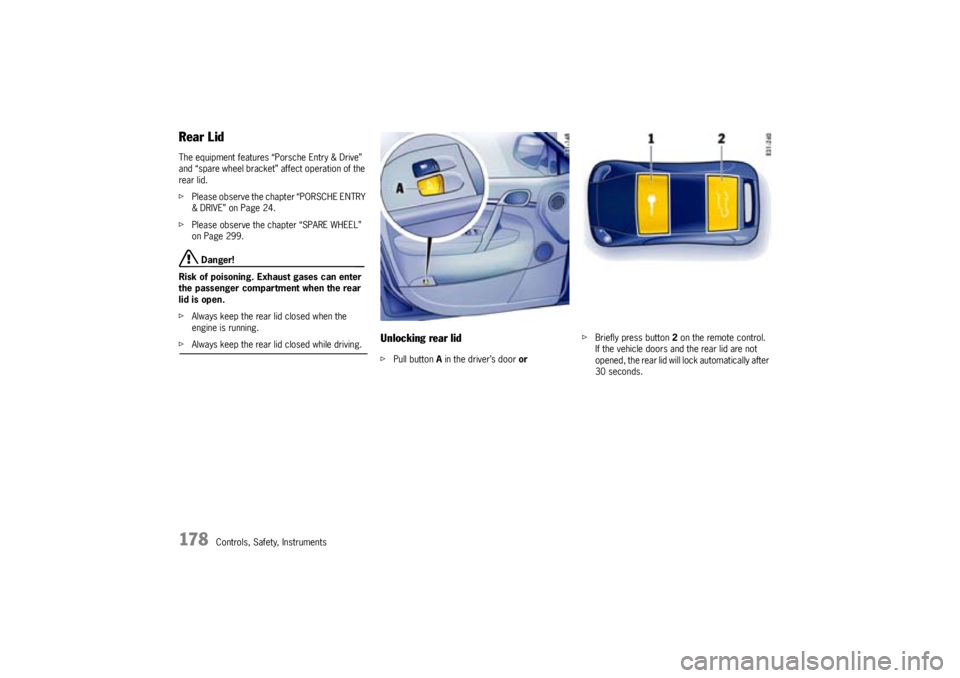
Unlocking rear lidfPull button A in the driver’s door orfBriefly press button 2 on the remote control.
If the vehicle doors and the rear lid are not
opened, the rear lid will lock automatically after
30 seconds.
Page 180 of 369
180
Controls, Safety, Instruments
Rear Window
Danger!
Risk of poisoning. Exhaust gases can enter
the passenger compartment when the rear
window is open.
fAlways keep the rear window closed when the
engine is running.
fAlways keep the rear window closed while driving.
fPlease observe the chapter “PORSCHE ENTRY
& DRIVE” on Page 24.
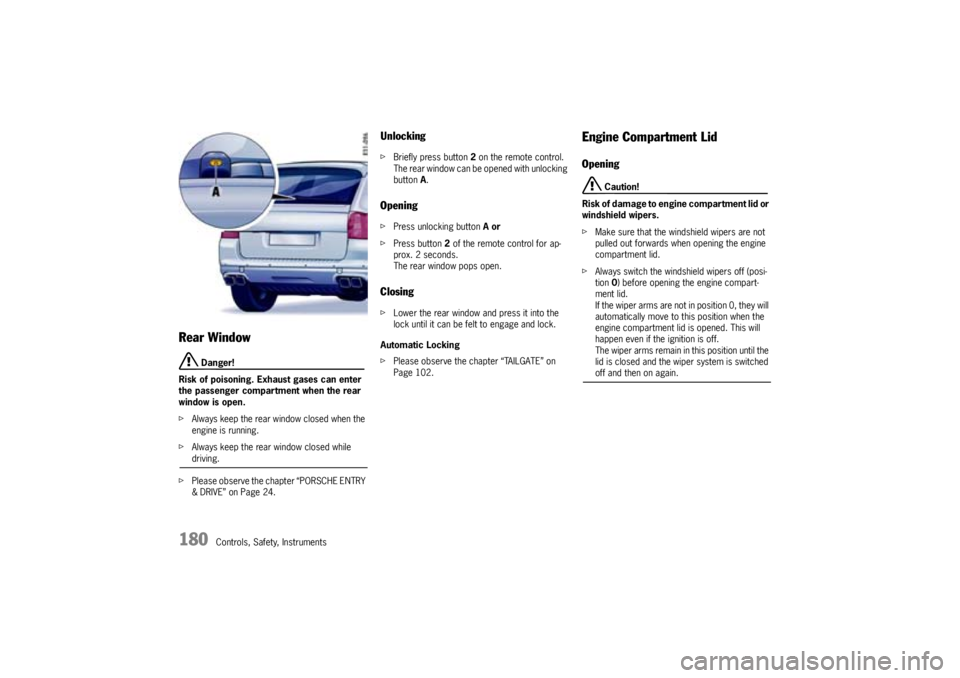
UnlockingfBriefly press button 2 on the remote control.
The rear window can be opened with unlocking
buttonA.OpeningfPress unlocking button Aor
fPress button 2of the remote control for ap-
prox. 2 seconds.
The rear window pops open.ClosingfLower the rear window and press it into the
lock until it can be felt to engage and lock.
Automatic Locking
fPlease observe the chapter “TAILGATE” on
Page 102.
Engine Compartment LidOpening
Caution!
Risk of damage to engine compartment lid or
windshield wipers.
fMake sure that the windshield wipers are not
pulled out forwards when opening the engine
compartment lid.
fAlways switch the windshield wipers off (posi-
tion0) before opening the engine compart-
ment lid.
If the wiper arms are not in position 0, they will
automatically move to this position when the
engine compartment lid is opened. This will
happen even if the ignition is off.
The wiper arms remain in this position until the
lid is closed and the wiper system is switched off and then on again.
Page 193 of 369
Controls, Safety, Instruments
193
Stowing load in the vehicle
Warning!
Danger of injury.
An unsecured or incorrectly positioned cargo
can slip out of place or endanger the vehicle
occupants during braking, direction changes
or in accidents.
Never transport objects which are not se-
cured.
fAlways transport cargo in the cargo area, nev-
er in the passenger compartment (e.g. on or in
front of the seats).
fSupport the cargo on the seat backrests when-
ever possible. Always lock the backrests into
place.
fPlace the cargo behind unoccupied seats
whenever possible.
fStow heavy objects as close to the front of the
cargo area as possible, with lightweight ob-
jects behind them.
fThe cargo must never project over the top
edge of the seat backrest.
fAlways protect the passenger compartment
with a luggage safety net and a luggage
compartment cover.
Do not drive with objects on top of the luggage
compartment cover.fIf the rear seats are not occupied, the back-
rests can be additionally secured with the safe-
ty belts. Simply cross the outer safety belts
and insert each into the opposite buckle.
fMake sure that the load cannot damage the
heating filaments of the rear window and the
TV antenna of the side window.
Luggage net
fLuggage must be stowed completely covered
by the luggage net.
The luggage net can prevent only lightweight
objects from slipping.
Tie-down belts
fDo not use elastic belts or straps to tie down
a load.
fDo not place belts and straps over sharp edg-
es.
fObserve the directions for use and information
for the tie-down equipment.
fUse only belts with a tear strength of at least
1543 lbs. or 700 kg and a maximum width of
1 in or 25 mm.
fCross the belts over the load.Driving
fThe car's handling changes depending on the
vehicle load. Adapt your driving style to the
changed driving behavior.
fDo not exceed the maximum gross weight and
the axle load.
fPlease observe the chapter “WEIGHTS” on
Page 352.
fNever drive with the rear window or rear lid
open.
Exhaust gases can enter the passenger
compartment.
fAdapt the tire pressure to the load.
fPlease observe the chapter “TIRE PRESSU-
RES, COLD” on Page 350.
Page 249 of 369
Maintenance, Car Care
249
Fuel EconomyFuel economy will vary depending on where,
when and how you drive, optional equipment
installed, and the general condition of your
car.
A car tuned to specifications and correctly
maintained, will help you to achieve optimal
fuel economy.
fHave your vehicle tuned to specifications. Air
cleaner should be dirt free to allow proper en-
gine “breathing“.
Battery should be fully charged.
Wheels should be properly aligned.
Tires should be inflated at correct pressure.
fAlways monitor your fuel consumption.
fDrive smoothly, avoid abrupt changes in speed
as much as possible.
fAvoid jack rabbit starts and sudden stops.
fDo not drive longer than necessary in the lower
gears. Shifting into a higher gear early without
lugging the engine will help save fuel.
fProlonged “warm up“ idling wastes gas. Start
the vehicle just before you are ready to drive.
Accelerate slowly and smoothly.fSwitch off the engine if stationary for longer
periods.
fAny additional weight carried in the vehicle re-
duces fuel economy. Always keep cargo to a
minimum and remove all unnecessary items.
fOrganize your trips to take in several errands
in one trip.
fAll electrical accessories contribute to in-
creased fuel consumption.
fOnly switch on the air conditioning when neces-
sary.
fDo not drive with the Roof Transport System
mounted unless you need it.
The EPA estimated m.p.g. is to be used for
comparison purposes, actual mileage may
be different from the estimated m.p.g., de-
pending on your driving speed, weather con-
ditions and trip length. Your actual highway
mileage will probably be less than the esti-
mated m.p.g.
fPlease observe all local and national speed lim-
its.
Operating Your Porsche in other
CountriesGovernment regulations in the United States and
Canada require that automobiles meet specific
emission regulations and safety standards. There-
fore, cars built for the U.S. and Canada differ from
vehicles sold in other countries.
If you plan to take your Porsche outside the conti-
nental limits of the United States or Canada, there
is the possibility that
– unleaded fuel may not be available;
– unleaded fuel may have a considerably lower
octane rating. Excessive engine knock and se-
rious damage to both engine and catalytic con-
verters could result;
– service may be inadequate due to lack of prop-
er service facilities, tools or diagnostic equip-
ment;
– replacement parts may not be available or very
difficult to get.
Porsche cannot be responsible for the me-
chanical damage that could result because
of inadequate fuel, service or parts availabil-
ity.
If you purchased your Porsche abroad and want to
bring it back home, be sure to find out about ship-
ping and forwarding requirements, as well as cur-
rent import and customs regulations.
Page 251 of 369
Maintenance, Car Care
251
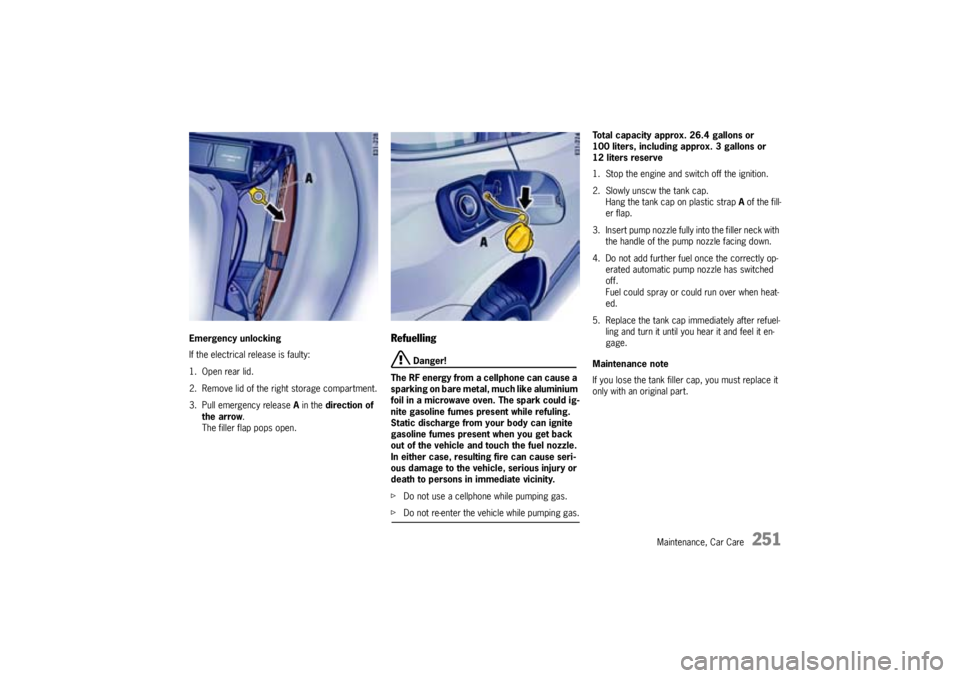
Emergency unlocking
If the electrical release is faulty:
1. Open rear lid.
2. Remove lid of the right storage compartment.
3. Pull emergency release Ain the direction of
the arrow.
The filler flap pops open.
Refuelling
Danger!
The RF energy from a cellphone can cause a
sparking on bare metal, much like aluminium
foil in a microwave oven. The spark could ig-
nite gasoline fumes present while refuling.
Static discharge from your body can ignite
gasoline fumes present when you get back
out of the vehicle and touch the fuel nozzle.
In either case, resulting fire can cause seri-
ous damage to the vehicle, serious injury or
death to persons in immediate vicinity.
fDo not use a cellphone while pumping gas.
fDo not re-enter the vehicle while pumping gas.Total capacity approx. 26.4 gallons or
100 liters, including approx. 3 gallons or
12 liters reserve
1. Stop the engine and switch off the ignition.
2. Slowly unscw the tank cap.
Hang the tank cap on plastic strap A of the fill-
er flap.
3. Insert pump nozzle fully into the filler neck with
the handle of the pump nozzle facing down.
4. Do not add further fuel once the correctly op-
erated automatic pump nozzle has switched
off.
Fuel could spray or could run over when heat-
ed.
5. Replace the tank cap immediately after refuel-
ling and turn it until you hear it and feel it en-
gage.
Maintenance note
If you lose the tank filler cap, you must replace it
only with an original part.