park PORSCHE CAYNNE TURBO 2005 1.G Owners Manual
[x] Cancel search | Manufacturer: PORSCHE, Model Year: 2005, Model line: CAYENNE TURBO, Model: PORSCHE CAYENNE TURBO 2005 1.GPages: 369, PDF Size: 3.17 MB
Page 11 of 369
Controls, Safety, Instruments
11 Controls, Safety, Instruments
Porsche and the Environment .......................... 4
Never invite car theft! .................................... 16
Keys ............................................................ 17
Central Locking System ................................ 21
Porsche Entry & Drive ................................... 24
Doors .......................................................... 26
Alarm System, Ultrasound Passenger Compart-
ment Monitoring System, Inclination Sensor .... 27
Power Windows ............................................ 29
Front seats................................................... 32
Front seat with memory................................. 33
Easy Entry Function ...................................... 35
Headrests .................................................... 36
Rear Seats ................................................... 37
Heated Seats – Front and Rear ...................... 40
Safety Belts.................................................. 42
Child Restraint Anchorages ............................ 46
Child Restraint Systems ................................ 47
Airbag Systems ............................................ 49
Steering Wheel ............................................. 51
Multi-Functional Steering Wheel ...................... 53
Interior Mirror ............................................... 55
Door Mirrors................................................. 55
Automatic Anti-Dazzle Mirror .......................... 57
Ignition Lock/Steering Lock ........................... 58
Starting and Stopping the Engine ................... 60
Parking Brake ............................................... 62
Brakes ......................................................... 63
Instrument Panel USA Models ........................ 68
Instrument Panel Canada Models.................... 70
Oil Temperature Gauge ................................. 72
Speedometer ............................................... 72Cooling System ............................................ 73
Fuel ............................................................. 74
Odometer..................................................... 75
Emission Control........................................... 76
Multi-Purpose Display .................................... 78
Warning Lights and Warning Messages ......... 106
Light Switch ............................................... 114
Instrument Illumination ................................. 116
Automatic Headlight Beam Adjustment ......... 116
Turn signal/High Beam/
Headlight Flasher Stalk ................................ 117
Emergency warning lights............................ 118
Windshield Wiper/Washer Stalk .................... 119
Cruise Control ............................................ 122
Vents ......................................................... 125
Fresh-air intake ........................................... 125
Heated Rear Window ................................... 126
Automatically Controlled
Two-Zone Air Conditioning ........................... 127
Automatically Controlled
Four-Zone Air Conditioning ........................... 131
Parking Heater............................................ 137
Sun Visors .................................................. 142
Sun Blinds, Rear Side Windows .................... 143
Interior Lighting .......................................... 144
Door-Surrounding Lighting ........................... 146
Coming Home Function (Off Delay) ............... 146
Sliding/Lifting Roof ..................................... 147
Parking Aids ............................................... 157
Garage Door Opener ................................... 162
Ashtray ...................................................... 165
Cigarette Lighter......................................... 166Car Audio Operation/Tips ............................ 167
Porsche Communication
Management (PCM) ..................................... 170
Fire Extinguisher ......................................... 171
Storage...................................................... 172
Cupholder .................................................. 176
Rear Lid ..................................................... 178
Rear Window .............................................. 180
Engine Compartment Lid ............................. 180
Loadspace ................................................. 182
Luggage Compartment Cover ...................... 183
Luggage Safety Net ....................................185
Ski Bag ...................................................... 187
Roof Transport System................................ 189
Trailer Coupling .......................................... 190
Loading Information ....................................191
Page 13 of 369

Controls, Safety, Instruments
13
In the driver's seat...fCheck operation of the horn.
fPosition seat for easy reach of foot pedals and
controls.To reduce the possibility of injury from
the airbag deployment, you should always sit
back as far from the steering wheel as is prac-
tical, while still maintaining full vehicle control.
fAdjust the inside and outside rear view mirrors.
fBuckle your safety belts.
fCheck operation of the foot and parking brake.
fCheck all warning and indicator lights with igni-
tion on and engine not running.
fStart engine and check all warning displays for
warning symbols.
fNever leave an idling car unattended.
fLock doors from inside, especially with chil-
dren in the car to prevent inadvertent opening
of doors from inside or outside. Drive with
doors locked.
On the road...fNever drive after you have consumed alcohol
or drugs.
fAlways have your safety belt fastened.
fAlways drive defensively.
Expect the unexpected.
fUse signals to indicate turns and lane changes.
fTurn on headlights at dusk or when the driving
conditions warrant it.
fAlways keep a safe distance from the vehicle in
front of you, depending on traffic, road and
weather conditions.
fReduce speed at night and during inclement
weather.
Driving in wet weather requires caution and re-
duced speeds, particularly on roads with
standing water, as the handling characteristics
of the vehicle may be impaired due to hydro-
planing of the tires.
fAlways observe speed limits and obey road
signs and traffic laws.
fWhen tired, get well off the road, stop and take
a rest. Turn the engine off. Do not sit in the ve-
hicle with engine idling.
Please observe the chapter “ENGINE EX-
HAUST” on Page 6.fWhen parked, always set the parking brake.
Move the Tiptronic selector lever to “P“.
On hills also turn the front wheels toward the
curb.
fWhen emergency repairs become necessary,
move the vehicle well off the road. Turn on the
emergency flasher and use other warning de-
vices to alert other motorists. Do not park or
operate the vehicle in areas where the hot ex-
haust system may come in contact with dry
grass, brush, fuel spill or other flammable ma-
terial.
fMake it a habit to have the engine oil checked
with every fuel filling.
Page 15 of 369

Controls, Safety, Instruments
15
1 Filler flap release
2 Rear lid release
3 Power windows
4 Inner door handle
5 Door mirror adjustment
6 Engine compartment lid release
7 Parking brake
8 Diagnostic socket
9 Parking brake release
10 Ignition lock/steering lock
11 Steering wheel adjustment
12 Seat adjustment
13 Instrument lighting knob
14 Light switch
15 Turn signal/high, low beam/headlight flasher
stalk
16 Operating lever for cruise control
17 Rocker switches for Tiptronic
18 Horn
19 Hazard warning light switch
20 Glove compartment
Page 16 of 369

16
Controls, Safety, Instruments
Never invite car theft!An unlocked car with the key in the ignition lock in-
vites car theft.
A steering wheel lock and a gong alarm are stan-
dard equipment in your Porsche. The gong alarm
will sound if you open the driver's door while the
key is still in the ignition lock. It is your reminder to
pull the key out of the ignition lock and to lock the
doors.
Warning!
Any uncontrolled movement of the vehicle
may result in serious personal injury and
property damage.
Never leave your vehicle unattended with the
key in the ignition lock, especially if children
and/or pets are left unattended in the vehi-
cle. They can operate power windows and
other controls. If the engine is left running,
they may accidentally engage the shift lever.
fAlways remove the ignition key.
fAlways set the parking brake.
fLock the doors with the key or with the remote control.
Warning!
Risk of a serious accident.
The steering column will lock when you re-
move the key while you are driving or as the
car is rolling to a stop. You will not be able to
steer the car.
fNever remove the key from the steering lock while you are driving.To protect your vehicle and your possessions
from theft, you should always proceed as fol-
lows when leaving your vehicle:
fClose windows.
fClose sliding/lifting roof or Panorama Roof
System.
fRemove ignition key (switch ignition off in vehi-
cles that have Porsche Entry & Drive).
fEngage steering lock.
fLock storage tray between the front seats and
glove compartment.
fRemove valuables (e.g. car documents, radio
control module, telephone, house keys) from
the car.
fLock doors.
fLock the glove compartment.
fClose oddment trays.
fCover luggage compartment with the luggage
compartment cover.
fClose rear lid and rear window.
Page 34 of 369

34
Controls, Safety, Instruments
Storing driver’s seat settingsStoring settings on a person button and a car
key
1. Apply the parking brake.
2. Switch ignition on.
3. Close doors.
4. Make the required adjustments to the seat,
mirror, steering wheel and safety belt.
5. Briefly press the SET memory button and,
within 10 seconds, hold down one of the per-
son buttons (1, 2 or 3) until an acknowledge
tone is obtained.
The settings are now stored on the desired
person button.
6. Withdraw car key or switch ignition off in vehi-
cles that have Porsche Entry & Drive.
7. Press the SET memory button within
10 seconds and keep the button depressed
until an acknowledge tone is obtained.
The settings are now assigned to the car key.
A- Mirror adjustmentStoring passenger mirror setting as a
parking aidIf the passenger’s mirror is supposed to swivel
downwards when reversing, this can also be
stored in the driver’s seat setting.
1. Apply the parking brake.
2. Switch ignition on.
3. Press the relevant person button.
4. Engage reverse gear.5. Set the control switch Afor the mirror setting
to the passenger’s side.
The passenger’s mirror swivels downwards.
6. Adjust the passenger’s mirror to the required
setting.
7. Briefly press the SET memory button and,
within 10 seconds, hold down the person but-
ton on which the setting is to be stored until an
acknowledge tone is obtained.
Storing passenger seat settings1. Apply the parking brake.
2. Switch ignition on.
3. Adjust seat position and belt height.
4. Briefly press the SET memory button and,
within 10 seconds, hold down one of the per-
son buttons (1, 2 or 3) until an acknowledge
tone is obtained.Automatic storage – driver’s seatIf settings were changed after the driver’s door
was opened, these new settings are automatically
stored when the vehicle is locked. This storage is
deleted if the vehicle is unlocked with a programed
key and the driver’s door is opened.
Page 55 of 369
Controls, Safety, Instruments
55
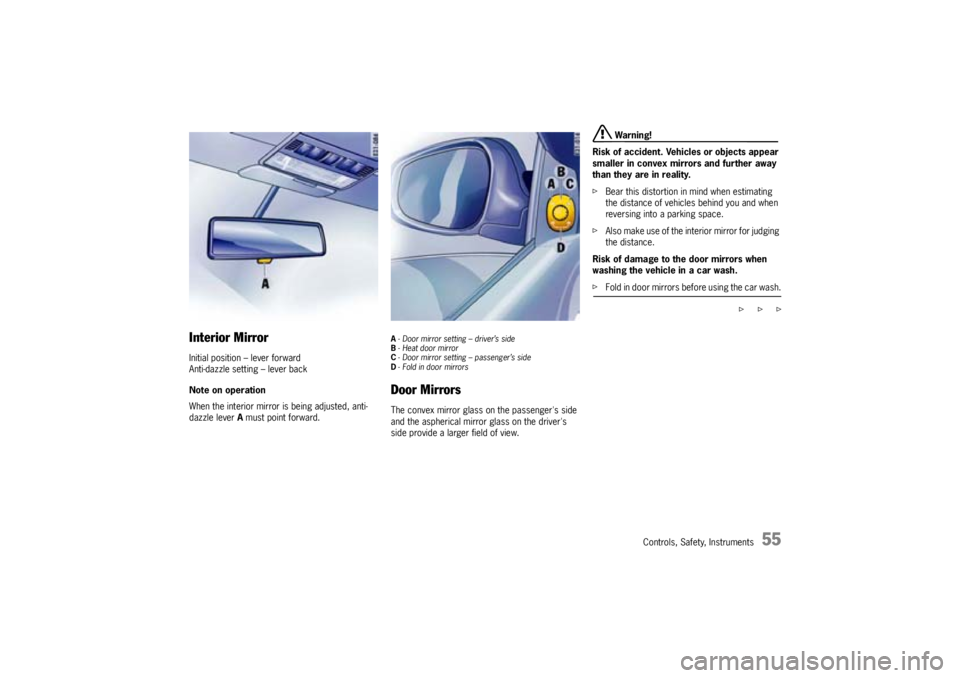
Interior MirrorInitial position – lever forward
Anti-dazzle setting – lever back
Note on operation
When the interior mirror is being adjusted, anti-
dazzle lever A must point forward.
A- Door mirror setting – driver’s side
B- Heat door mirror
C- Door mirror setting – passenger’s side
D- Fold in door mirrorsDoor MirrorsThe convex mirror glass on the passenger's side
and the aspherical mirror glass on the driver's
side provide a larger field of view.
Warning!
Risk of accident. Vehicles or objects appear
smaller in convex mirrors and further away
than they are in reality.
fBear this distortion in mind when estimating
the distance of vehicles behind you and when
reversing into a parking space.
fAlso make use of the interior mirror for judging
the distance.
Risk of damage to the door mirrors when
washing the vehicle in a car wash.
fFold in door mirrors before using the car wash.
f f f
Page 56 of 369
56
Controls, Safety, Instruments
Adjusting mirrorsfPlease observe the chapter “MIRRORS” on
Page 103.
1. Switch ignition on.
2. Select Afor the driver’s side or C for the
passenger’s side by turning the control switch.
3. Move the door mirrors in the appropriate
direction by tilting the control switch.
If the electrical adjustment facility fails
fAdjust the mirror by pressing on the mirror
face.Folding in door mirrorfSwitch ignition on.
fTurn control switch to D.
Both door mirrors fold in automatically.
If the electrical adjustment facility fails
fFold in mirror manually.
Unfolding door mirrorsfSwitch ignition on.
fTurn control switch to A or C.
Both door mirrors unfold automatically.
If the electrical adjustment facility fails
fUnfold mirrors manually.
Automatically swivelling down mirror
glass on the passenger's sidefPlease observe the chapter “FRONT SEAT
WITH MEMORY” on Page 33.
fPlease observe the chapter “PARKING AIDS”
on Page 157.Door mirror heatingThe door mirror heater is ready for operation
when the ignition is switched on.
Switching on
fTurn control switch to B.
Both door mirrors are heated.
Switching off
fChange the position of the control switch.
Page 60 of 369
60
Controls, Safety, Instruments
Starting and Stopping the EnginefPlease observe the chapter “IMMOBILIZER” on
Page 19.
fPlease observe the chapter “EMISSION
CONTROL SYSTEM” on Page 254.
Danger!
Risk of poisoning. Exhaust gas contains
colorless and odorless carbon monoxide
(CO), which is toxic even in low concentra-
tion. Carbon monoxide can cause uncon-
sciousness and even death if inhaled.
fNever start or let the engine run in an en-
closed, unventilated area. It is not recommend-
ed to sit in your car for prolonged periods with
the engine on and the car not moving.
An unattended vehicle with a running engine
is potentially hazardous. If warning lights
should come on to indicate improper opera-
tion, they would go unnoticed.
fNever leave the engine idling unattended.
Danger of fire.
fDo not drive or park your car where combusti-
ble materials, such as dry grass or leaves,
can come into contact with the hot exhaust sy-
stem.
fIf your car catches on fire for any reason, call
the fire department. Do not endanger your life by attempting to put out the fire.
StartingfOperate footbrake.
fMove selector lever to position P or N.
fDo not press the accelerator pedal.
The engine control module will provide the
correct starting mixture.
fTurn ignition key to ignition lock position 2.
fDo not operate the starter longer than approx.
10 seconds.
If necessary, repeat the starting procedure af-
ter a pause of approx. 10 seconds. Turn the ig-
nition key back to ignition lock position 3first.
The first operation of the starter is ended
automatically when the engine starts.
If the engine does not start, subsequent starter
operations will not be ended automatically.
fDo not warm up the engine when stationary.
Drive off immediately.
Avoid high revolutions and full throttle until the
engine has reached operating temperature.
fIf battery output is insufficient, jump leads can
be used to start the engine.
Please observe the chapter “EMERGENCY
STARTING WITH JUMPER CABLES” on
Page 323.Note on operation
To ensure a good charge condition for the battery
and thus its ability to start the engine, all electrical
accessories which are not required should be
switched off when the ignition is switched on and
when engine revolutions are low (in stop and go
traffic).
Starting with auxiliary batteryIf your vehicle is fitted with an additional battery
in the luggage compartment, you have the possi-
bility of starting the engine with the ignition key,
even if the main battery fails.
In vehicles with Porsche Entry & Drive:
1. Remove the Porsche Entry & Drive control unit
from the ignition lock.
Please observe the chapter “REMOVING THE
CONTROL UNIT FROM THE IGNITION LOCK” on
Page 58.
2. Insert the ignition key into the ignition lock and
start the engine as described.
fPlease have the cause of the fault remedied at
an authorized Porsche dealer.
Page 61 of 369
Controls, Safety, Instruments
61
StoppingfWithdraw the ignition key only when the vehicle
is stationary, otherwise the steering lock en-
gages and the vehicle cannot be steered.
fOnly switch the ignition off when the vehicle
comes to a stop as the steering assistance
and brake boost are deactivated when the
ignition is switched off.
fAlways withdraw the ignition key and engage
the parking brake when leaving the vehicle.
The control unit always remains in the ignition
lock in vehicles that have Porsche Entry &
Drive.
Note on operation
The vehicle battery discharges if the ignition key is
left inserted.
Warning!
Danger of injury. Hot engine compartment
components can burn skin on contact.
fBefore working on any part in the engine com-
partment, turn the engine off and let it cool down sufficiently.Radiator fans
The radiator and radiator fans are in the front of
the car.
Warning!
Danger of injury. After the ignition is
switched off, the engine compartment and
coolant temperatures are monitored for ap-
prox. 30 minutes. During this period, and de-
pending on temperature, the radiator fan
may continue to run or start to run.
fCarry out work in these areas only with the en-gine off and exercise extreme caution.
Page 62 of 369

62
Controls, Safety, Instruments
Parking BrakeThe parking brake acts on the rear wheels and
serves to secure the car while parked.
fUse the parking brake only after the vehicle
has come to a full stop.
Applying the parking brakefPress down firmly on the foot pedal.
The warning light in the instrument panel lights
up.
A message will be displayed on the multi-pur-
pose display of the instrument panel if the
parking brake is not released before moving
off.
If the brake is not fully set, the vehicle may roll
without control.
fMove the selector lever to “P“.
fBefore exiting the vehicle, make sure that the
parking brake is fully applied and the vehicle is
not moving at all.
Danger!
Risk of serious personal injury or death. A
partially engaged parking brake may allow
the vehicle to roll, causing serious personal
injury or death to any person in its path.
fEngage the parking brake fully.
fPlease observe the chapter “WARNING LIGHTS
AND WARNING MESSAGES” on Page 106.fPress on the footbrake and pull handle A of the
parking brake.
The warning light and the message disappear.
Releasing the parking brake