winter PORSCHE CAYNNE TURBO 2005 1.G Owners Manual
[x] Cancel search | Manufacturer: PORSCHE, Model Year: 2005, Model line: CAYENNE TURBO, Model: PORSCHE CAYENNE TURBO 2005 1.GPages: 369, PDF Size: 3.17 MB
Page 88 of 369
88
Controls, Safety, Instruments
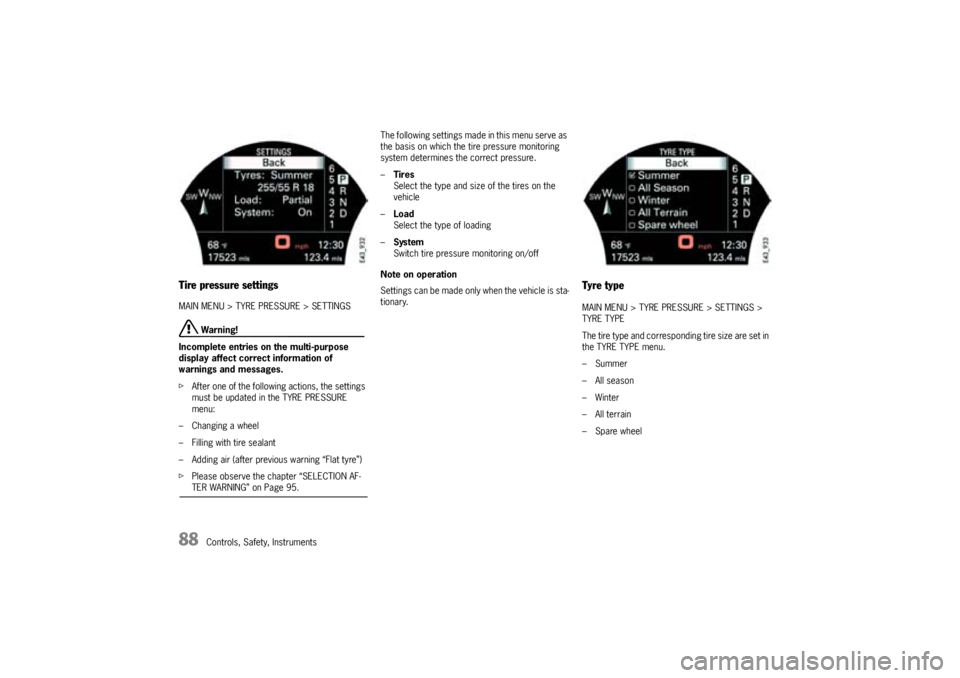
Tire pressure settingsMAIN MENU > TYRE PRESSURE > SETTINGS
Warning!
Incomplete entries on the multi-purpose
display affect correct information of
warnings and messages.
fAfter one of the following actions, the settings
must be updated in the TYRE PRESSURE
menu:
– Changing a wheel
– Filling with tire sealant
– Adding air (after previous warning “Flat tyre”)
fPlease observe the chapter “SELECTION AF-TER WARNING” on Page 95.The following settings made in this menu serve as
the basis on which the tire pressure monitoring
system determines the correct pressure.
–Tires
Select the type and size of the tires on the
vehicle
–Load
Select the type of loading
–System
Switch tire pressure monitoring on/off
Note on operation
Settings can be made only when the vehicle is sta-
tionary.
Tyre typeMAIN MENU > TYRE PRESSURE > SETTINGS >
TYRE TYPE
The tire type and corresponding tire size are set in
the TYRE TYPE menu.
–Summer
– All season
– Winter
– All terrain
–Spare wheel
Page 108 of 369

108
Controls, Safety, Instruments
Tire pressure too low – Add air System detects a pressure loss of at least 2,9 psi/0,2 bar.
Correct tire pressure at the next opportunity.
Collapsible spare wheel/sealing set
max. 50 mph (80 km/h)Observe maximum permitted speed.
Collapsible spare wheel/51 psi/3,5 bar
max. 50 mph (80 km/h)Information on driving with a collapsible spare wheel.
Observe maximum speed of max 50 mph or 80 km/h and
required pressure of 51 psi or 3,5 bar.
System not activeIndication when spare wheel or collapsible spare wheel is used
or tire pressure monitoring system is faulty.
Consult a qualified specialist workshop.
Select new set of wheels in the Tire pressure menu after chang-
ing the wheels.
System not active – Brief disturbance External interference of excessive temperature at the wheel
transmitters. System will reactivate itself.
System not active –
Too many wheel transmittersTire pressure monitoring system detects more than 4 wheel
transmitters.
(winter wheels in the luggage compartment, for example)
Tire pressure monitoring system will reactivate itself after the
additional wheel transmitters have been removed.
No monitoring – System learning After the tire type and size are selected in the tire pressure
menu, the system re-learns the tires.
Wheel change? Check settings Display after a wheel change without changed settings in the tire
pressure menu. Select tire type and size.
When vehicle stops: Hit selection Displayed after a flat tire if the system was not informed about
the work performed.
Make a selection on the multi-purpose display when the vehicle
is stationary.
Monitoring off Tire pressure monitoring was intentionally deactivated.
Tire pressure monitoring can be switched on or off on the
multi-purpose display.
Instrument
panelMulti-purpose
displayText display Meaning/measures
Page 170 of 369

170
Controls, Safety, Instruments
Porsche Communication
Management (PCM)
Warning!
There is a danger of accident if you set or
operate the on-board computer, radio, navi-
gation system, telephone or other equipment
when driving.
This could distract you from the traffic and
cause you to lose control of the vehicle re-
sulting in serious personal injury or death.
fOperate the components while driving only if
the traffic situation allows you to do so safely.
fCarry out any complicated operating or setting
procedures only with the vehicle stationary
fIf it is necessary to operate these components
while the vehicle is in motion, use the function keys on the multi-functional steering wheel.
fRefer to the separate operating instructions
before putting the PCM into operation.When put into operation for the first time, a dis-
tance of approx. 3 miles (5 km) must be driven in
order for the navigation system to complete the
process of fine calibration. The same applies
when the tires are changed (e.g. summer/winter
tires) or new tires fitted.
Full location accuracy is not yet achieved during
the fine-calibration process.
If the vehicle has been transported (e.g. ferry, car
train), the system may take a few minutes after
being switched on before it determines the current
location.
Serious tire slip (e.g. spinning wheels on snow)
may result in temporarily inaccurate navigation.
When the battery has been disconnected, it may
take up to 15 minutes before the navigation
system is operational once more.
Satellite radioYou must have the satellite radio activated before
you can put it into operation. You will need a con-
tract with a provider in order to use this radio.
fRefer to the separate radio operating instruc-
tions before putting into operation.
Page 204 of 369

204
Shifting Gear, Traction Systems
ParkingfGo easy on the accelerator.
fWhen parking or maneuvring in a small space,
control the speed by careful use of the foot-
brake.Driving in winterIn wintry road conditions it is advisable to take
steep inclines in manual mode M. This prevents
the occurrence of gear changes that could cause
wheelspin.
Reduced driving programIf there is a fault in the transmission:
– All gear indicators light up
– The transmission no longer shifts.
fTo remedy the fault, immediately consult an au-
thorized Porsche dealer.
Warning!
Reverse gear lock monitoring is disabled in
the emergency running program.
Damage to the vehicle may result as well as
loss of control, if the vehicle is moving for-
ward fast enough to cause rear wheel lockup.
fDo not shift into R while the vehicle is moving forward.Tip on driving
3rd or 5th gear in selector position D and reverse
gearR are now available and will allow you to
reach the nearest authorized Porsche dealer.
fPlease go to your authorized Porsche dealer
as soon as possible.
Page 239 of 369

Maintenance, Car Care
239
Oil changeThe engine oil has to be changed at the intervals
listed in your Maintenance Schedule.
fPlease observe the chapter “CAPACITIES” on
Page 351.
We recommend that you have the engine oil
changed at your Porsche dealer, who has the re-
quired oils and the necessary filling equipment.
If you suspect an oil leak in the engine have your
dealer check it out immediately.
All current engine oils are compatible with each
other, i.e. when making an oil change it is not nec-
essary to flush the engine if you wish to use a dif-
ferent brand or grade of oil.
Since, however, each brand of oil has a special
composition, you should, if possible, use the
same oil brand if it becomes necessary to top up
between oil changes.
Porsche engines have long intervals between oil
changes. Only by using oils approved by Porsche
the needed engine oil performance is guaranteed.If your vehicle is used frequently in stop-and-go
traffic in cold weather, the engine will not always
be properly warmed up.
Condensation from products of combustion may
accumulate in the oil. In this case, it is advisable
to change the oil more frequently so that your en-
gine once again has 100% efficient engine oil.
Engine oil performance classEngine oil is not only a lubricant, but also serves
to keep the engine clean, to neutralize the dirt
which penetrates into the engine through combus-
tion and to protect the engine against corrosion.
To perform these functions, the oil is provided with
additives which have been specially developed for
these functions.
The efficiency of an oil is expressed, for example,
by the API, ILSAC or ACEA classifications.
ViscosityLike all liquids, engine oil is viscous when cold,
and thin-bodied when warm. The viscosity of an oil
is expressed by its SAE class. For cold viscosity
the SAE class is given as a number and the letter
“W“ (as in winter), for hot viscosity the SAE class
is given only as a number.
The viscosity of an oil is, therefore, always the
same if it has the same number of an SAE class.
E.g.: A 5 W-40 oil and a 5 W-50 oil have the same
viscosity when cold; when hot the oil with the num-
ber 40 is thinner than the oil with the number 50.
Oils with two viscosities are called multigrade oils;
oils with only one viscosity are termed single-
grade oils.
The viscosity of the engine oil for your Porsche
has to be chosen according to the ambient tem-
perature given in the engine oil recommendation
table.
Page 243 of 369

Maintenance, Car Care
243
Changing the brake fluidBrake fluid absorbs moisture from the air over
time. This accumulation of water lowers the boil-
ing point and, under certain operating conditions,
can affect the braking action.
fTherefore, have the brake fluid changed in ac-
cordance with the change intervals stated in
the booklet “Maintenance”.
The warning light in the instrument panel and the
warning message on the multi-purpose display of
the instrument panel
– indicate the brake level fluid is too low or,
– in conjunction with large pedal travel could
indicate a braking-circuit failure.
Note on operation
fStop immediately in a suitable place.
fDo not continue driving.
Please have the fault remedied at your nearest
authorized Porsche dealer.
Washer FluidThe washer-fluid reservoir for windshield, rear win-
dow and headlights is located in the engine com-
partment.Warning message on the multi-purpose
displayA message is shown on the multi-purpose display
of the instrument panel if the washer-fluid level is
too low.
In this case, the residual quantity is only around
0.85 quarts or 0.8 liters.
fAdd washer fluid at the next opportunity.
Topping off washer fluidThe capacity is approx. 7.9 quarts or 7.5 liters.
Clean water is generally not enough to clean the
windows and headlights.
It is advantageous to add a winter cleaner giving
antifreeze protection or a suitable summer clean-
er, depending on the season. Follow the instruc-
tions for the mixture ratio.
fUse only cleaner authorized by Porsche.
1. Please note all the information on the refill
container of the cleaning agent.
2. Open cap of the washer-fluid reservoir.
3. Top up washer fluid and close cap properly.
fDo not use engine coolant anti-freeze or any
other solution that can damage the car’s paint,
in the washer reservoir.
Brake fluid warning light
USA
Brake fluid warning light
Canada
Page 257 of 369

Maintenance, Car Care
257
High-pressure cleaning units
Warning!
High-pressure cleaning units can damage
the following components:
–Tires
– Logos, emblems
– Painted surfaces
– Widened fenders
– Lock and latch of the removable towing attach-
ment
– Seals of the electrically retractable ball hitch
– Alternator, valve covers
– ParkAssist sensors.
fPlease observe the operating instructions from
the unit manufacturer.
fAlways cover the lid over the brake fluid reser-
voir prior to cleaning. Never point the cleaning
jet directly at the lid.
fWhen cleaning with a flat-jet nozzle or the like,
maintain a minimum distance of 50 cm
(21 in.).fNever use high-pressure cleaning units with a
round-jet nozzle.
A high-pressure cleaning unit with round nozzle
will damage your vehicle. The tires are particu-
larly susceptible to damage.
fDo not point the cleaning jet directly at any of
the aforementioned components.
WashingThe best protection for the car from the damaging
effects of the environment is frequent washing and
preservation. The underside of the car should also
be thoroughly washed for cinders, salt or sanding
at winter‘s end.
The longer salt, road dust, industrial dust, insect
remains, bird excrement, and tree exudations (res-
in, pollen), etc. are allowed to remain on the body-
work, the more serious is their harmful effect.
New cars should be washed carefully with plenty
of clear water to protect the new paint work.
Dark paint finishes show up the smallest of sur-
face damage (e.g. scratches) more readily than
lighter colors.
Dark colors are also more susceptible to scratch-
ing because of the composition of their pigments
and require particularly careful paint care.fDo not wash your car in bright sunlight or while
the bodywork is still hot.
fWhen washing by hand, use abundant water, a
soft sponge or wash brush and Porsche car
shampoo.
fBegin by spraying the body thoroughly with wa-
ter to rinse away loose dirt.
fAfter washing, rinse the car with plenty of wa-
ter and then dry with a chamois leather.
Do not use the same chamois leather for
drying as you use for cleaning the windshield
and windows.
f f f
Page 261 of 369

Maintenance, Car Care
261
UndercoatingThe underside of your car is durably protected
against chemical and mechanical influences.
As it is not possible to exclude the risk of damage
to this protective coating in day to day driving, it
is advisable to have the underside of the car in-
spected at certain intervals - preferably before the
start of winter and again in spring - and the under-
coating restored as necessary.
Your authorized Porsche dealer is familiar with the
bodyseal treatment procedures and has the nec-
essary equipment for applying factory approved
materials. We recommend that you entrust them
with such work and inspections.
Unlike conventional spray oils, undercoating and
rust-proofing compounds based on bitumen or
wax do not attack the sound-proofing materials ap-
plied at the factory.
Danger!
Danger of fire and serious personal injuries.
fDo not apply additional undercoating or rust-
proofing on or near the exhaust manifold, ex-
haust pipes, catalytic converters or heat
shields. During driving the substance used for undercoating could overheat and ignite.
fBefore applying fresh underseal, carefully re-
move deposits or dirt and grease. Once it has
dried, the new undercoating compound forms
a tough protective coating which provides effi-
cient rust-proofing of the floor panels and com-
ponents.
fAlways apply a fresh coating of suitable preser-
vative to unprotected areas after cleaning the
underside of the body, the transmission, the
engine or carrying out repairs to under-body,
engine or transmission components.
Effective rust-proofing is particularly important
during the cold weather season. If your car is driv-
en frequently in areas where salt has been spread
on the roads, the whole engine compartment
should be cleaned thoroughly after the winter to
prevent salt from causing any lasting damage. A
full under-body wash should also be performed at
the same time.
Page 262 of 369

262
Maintenance, Car Care
Headlights, lights, interior and exterior
plastic partsfUseonlyclean water and a little dishwashing
detergent to clean headlights, lights, plastic
parts and surfaces.
Do not clean when dry.
Use a soft sponge or a soft, lint-free cloth.
Gently wipe the surface without applying too
much pressure.
The Porsche inside window cleaner is also
suitable for cleaning plastic surfaces.
Follow the cleaning instructions on the
container.
Never use other chemical cleaners or
solvents.
fRinse cleaned surfaces with clear water.
Door, roof, lid and window sealsfWash dirt (e.g. abrasion, dust, road salt or grit)
from all seals regularly using warm soapy wa-
ter. Do not use any chemical cleaning agents
or solvents.
When there is a frost hazard, the outer door seals
and the lid seals can be protected against freezing
into place by a suitable care product.
In order to prevent damage to the anti-fric-
tion coating, the inner door seals must not be
treated with care products.
Light alloy wheelsfPlease observe the chapter “AUTOMATIC CAR
WASHES” on Page 258.
Pitting may occur if metallic particles which cause
contact corrosion (e.g. brass or copper in brake
dust) are allowed to remain on the aluminum too
long.
fIf possible, wash the wheels with a sponge or
wash brush about every two weeks. In areas
where road salt or grit is spread on winter
roads or there is a lot of airborne industrial
dust, it is best to clean the wheels weekly.
The Porsche Light Alloy Wheel Cleaner
(ph-value 9.5) can be used for this pur-
pose.
If the ph-value of the detergent is in-
corect, the protective coating on the
wheels will be destroyed.
Polishes which dissolve oxides, such as those
frequently used for other metals, or abrasive
tools or agents are unsuitable because they
break down the oxide film of the protective
coating and will cause discoloration of the
wheel.
fEvery three months, after cleaning, coat the
wheels with a car wax or non-corrosive grease
(e.g. vaseline).
Using a clean cloth thoroughly rub the grease
into the surface.
Page 263 of 369

Maintenance, Car Care
263
Leather careCharacteristics and special features
The natural surface markings of leather, e.g.
creases, healed scars, insect sting marks, struc-
tural differences and slight variations in shade and
grain add to the attractiveness of the natural leath-
er product.
A special mention must be made here of natural
leather. For natural leather, carefully selected
hides of the highest quality are used. It is not
covered completely with dye on production. “Na-
ture’s signature” is therefore easily recogniz-
able.This fine material is distinguished by an out-
standing seating comfort, special suppleness and
a typical patina.Leather care and treatment
fClean all types of leather regularly to remove
fine dust using a soft, damp, white woollen
cloth or a commercially available microfibre
cloth.
fRemove heavy contamination with Porsche
leather cleaner.
Please always follow the instructions for use
given on the containers.
Caustic cleaners and hard cleaning objects
must not be used.
Perforated leather must under no circum-
stances get wet on its reverse side.
Once cleaned, leather (particularly the heavily
stressed leather seats) must be treated only with
Porsche leather care liquid.
Carpets and matsfUse only a vacuum cleaner or a medium stiff
brush.
fRemove stains and spots with Porsche stain
remover.
The Porsche range of accessories includes floor-
mats to protect the carpets in summer and winter.
Warning!
Risk of an accident.
fAlways check the movement of the pedals be-
fore driving and make sure that they are not ob-
structed by a floor mat or any other object.
fSecure the floor mat to prevent it from sliding
into positions that could interfere with the safe
operation of your vehicle - do not lie them
loosely in the vehicle.
Your Porsche dealer will be glad to offer you
floor mats of correct size including a securing possibility.