height PORSCHE CAYNNE TURBO 2006 1.G User Guide
[x] Cancel search | Manufacturer: PORSCHE, Model Year: 2006, Model line: CAYENNE TURBO, Model: PORSCHE CAYENNE TURBO 2006 1.GPages: 387, PDF Size: 8.44 MB
Page 227 of 387

Shifting Gear, Traction Systems
227
Power-Transmission and Running-Gear Control SystemsA complex interconnection of all control systems acting in power transmission and in the running gear has been realised in your Porsche.
All control systems have been linked with the aim of combining the best possible driving performance with maximum safety.
The following systems are involved:
System/designation Scope
PTM
Porsche Traction Management– Full-time all-wheel drive
– Electronically controlled center differential lock
– Automatic brake differential (ABD)
– Traction control system (TCS)
– Reduction gear/Low Range
PTM Plus
Porsche Traction ManagementIn addition to the PTM features, PTM Plus also includes:
– Electronically controlled rear differential lock
– Hydraulically disengageable anti-roll bars
PSM
Porsche Stability Management– Stability management system
– Anti-lock brake system (ABS)
– Traction control system (TCS)
– Automatic brake differential (ABD)
– Engine drag torque control (MSR)
Air suspension
with level control and height adjustment– Fully load bearing air spring struts with integral shock absorbers
– Air supply system with pressure accumulator
PAS M
Porsche Active Suspension Management– Shock absorber system with adaptive, continuous shock absorber control
Page 240 of 387
240
Shifting Gear, Traction Systems
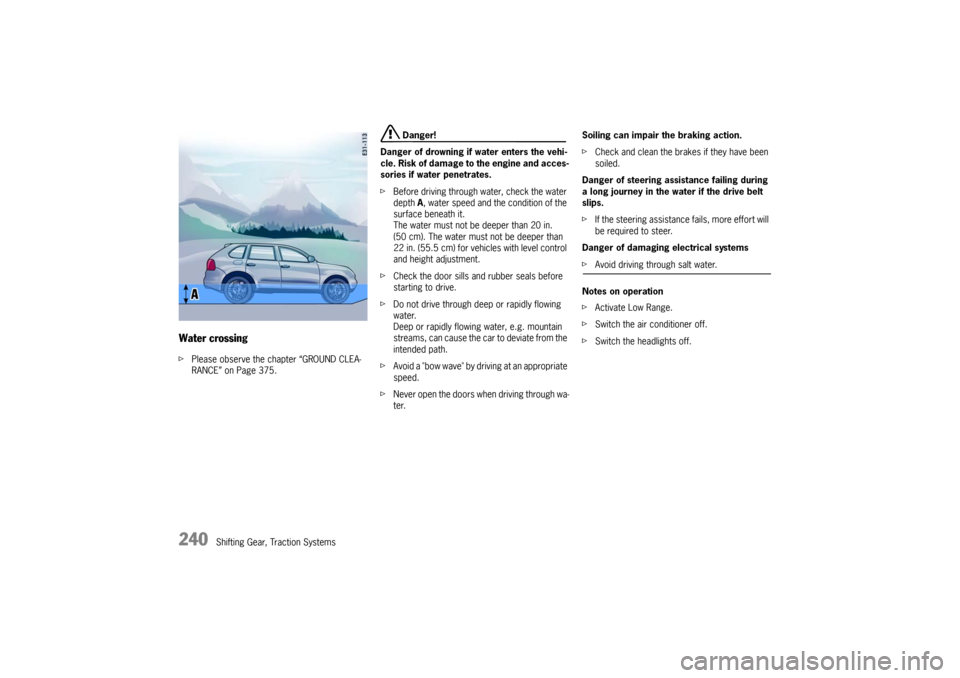
Water crossingfPlease observe the chapter “GROUND CLEA-
RANCE” on Page 375.
Danger!
Danger of drowning if water enters the vehi-
cle. Risk of damage to the engine and acces-
sories if water penetrates.
fBefore driving through water, check the water
depth A, water speed and the condition of the
surface beneath it.
The water must not be deeper than 20 in.
(50 cm). The water must not be deeper than
22 in. (55.5 cm) for vehicles with level control
and height adjustment.
fCheck the door sills and rubber seals before
starting to drive.
fDo not drive through deep or rapidly flowing
water.
Deep or rapidly flowing water, e.g. mountain
streams, can cause the car to deviate from the
intended path.
fAvoid a "bow wave" by driving at an appropriate
speed.
fNever open the doors when driving through wa-
ter.Soiling can impair the braking action.
fCheck and clean the brakes if they have been
soiled.
Danger of steering assistance failing during
a long journey in the water if the drive belt
slips.
fIf the steering assistance fails, more effort will
be required to steer.
Danger of damaging electrical systems
fAvoid driving through salt water.
Notes on operation
fActivate Low Range.
fSwitch the air conditioner off.
fSwitch the headlights off.
Page 244 of 387
244
Shifting Gear, Traction Systems
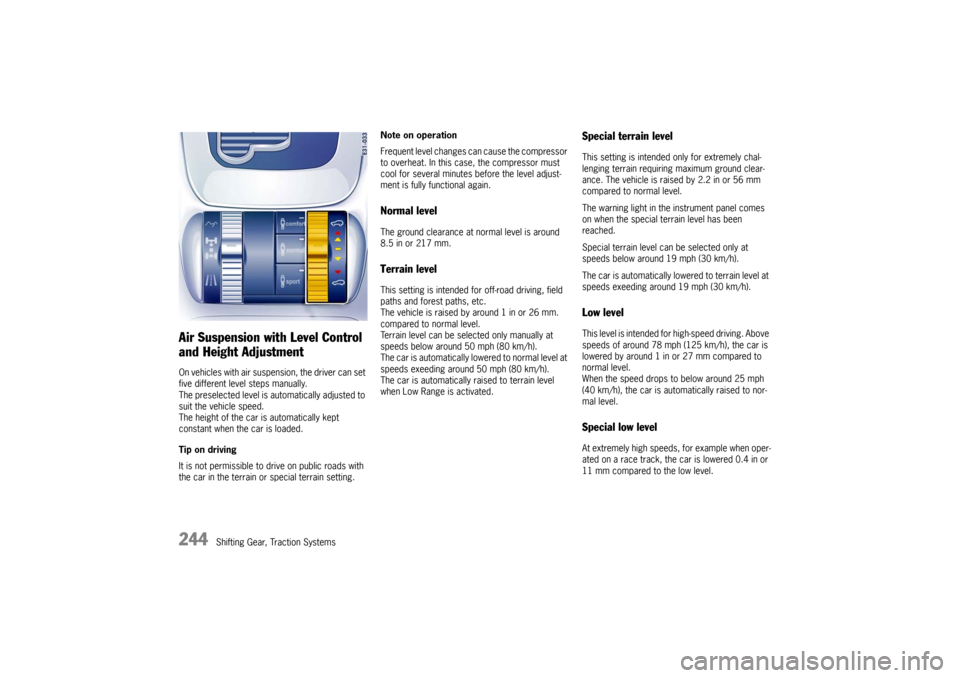
Air Suspension with Level Control
and Height AdjustmentOn vehicles with air suspension, the driver can set
five different level steps manually.
The preselected level is automatically adjusted to
suit the vehicle speed.
The height of the car is automatically kept
constant when the car is loaded.
Tip on driving
It is not permissible to drive on public roads with
the car in the terrain or special terrain setting.Note on operation
Frequent level changes can cause the compressor
to overheat. In this case, the compressor must
cool for several minutes before the level adjust-
ment is fully functional again.
Normal levelThe ground clearance at normal level is around
8.5 in or 217 mm.Terrain levelThis setting is intended for off-road driving, field
paths and forest paths, etc.
The vehicle is raised by around 1 in or 26 mm.
compared to normal level.
Terrain level can be selected only manually at
speeds below around 50 mph (80 km/h).
The car is automatically lowered to normal level at
speeds exeeding around 50 mph (80 km/h).
The car is automatically raised to terrain level
when Low Range is activated.
Special terrain levelThis setting is intended only for extremely chal-
lenging terrain requiring maximum ground clear-
ance. The vehicle is raised by 2.2 in or 56 mm
compared to normal level.
The warning light in the instrument panel comes
on when the special terrain level has been
reached.
Special terrain level can be selected only at
speeds below around 19 mph (30 km/h).
The car is automatically lowered to terrain level at
speeds exeeding around 19 mph (30 km/h).Low levelThis level is intended for high-speed driving. Above
speeds of around 78 mph (125 km/h), the car is
lowered by around 1 in or 27 mm compared to
normal level.
When the speed drops to below around 25 mph
(40 km/h), the car is automatically raised to nor-
mal level.Special low levelAt extremely high speeds, for example when oper-
ated on a race track, the car is lowered 0.4 in or
11 mm compared to the low level.
Page 245 of 387
Shifting Gear, Traction Systems
245
Loading level
Caution!
Risk of damage to running-gear parts, units
and the vehicle underbody.
If the car is driven off a curb when at loading level,
for example, insufficent ground clearance can
cause it to bottom out.
fAlways switch to normal level before moving off.
This setting makes it easier for you to load the lug-
gage compartment.
The vehicle is lowered by around 2.4 in. or 60 mm
compared to normal level.
The car is automatically raised to normal level at
speeds exceeding around 3 mph (5 km/h).
Setting level manuallyPreconditions
–Ignition on.
– Doors are closed.
Setting
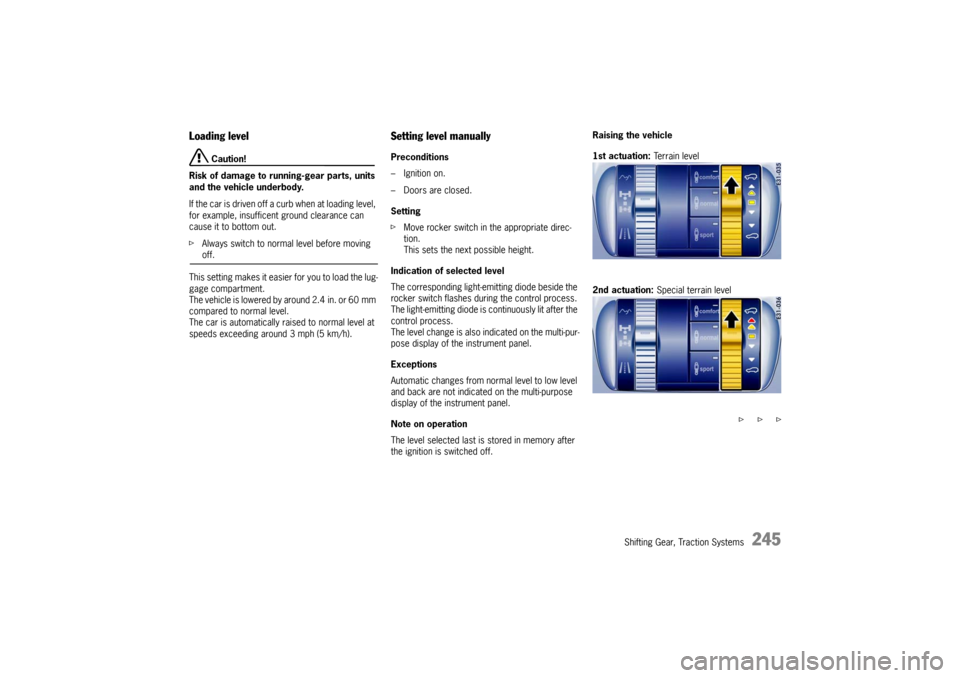
fMove rocker switch in the appropriate direc-
tion.
This sets the next possible height.
Indication of selected level
The corresponding light-emitting diode beside the
rocker switch flashes during the control process.
The light-emitting diode is continuously lit after the
control process.
The level change is also indicated on the multi-pur-
pose display of the instrument panel.
Exceptions
Automatic changes from normal level to low level
and back are not indicated on the multi-purpose
display of the instrument panel.
Note on operation
The level selected last is stored in memory after
the ignition is switched off.Raising the vehicle
1st actuation: Terrain level
2nd actuation: Special terrain level
f f f
Page 250 of 387

250
Maintenance, Car Care
Exercise Extreme Caution when
Working on your Vehicle
Danger!
Ignoring the following instructions may
cause serious personal injury or death.
fThe engine compartment of any motor vehicle
is a potentially hazardous area. If you are not
fully familiar with proper repair procedures, do
not attempt the adjustments described on the
following pages.
This caution applies to the entire vehicle.
fO n l y w o r k o n y o u r v e h i c l e o u t d o o r s o r i n a w e l l
ventilated area.
fEnsure that there are no open flames in the
area of your vehicle at any time when fuel
fumes might be present. Be especially cau-
tious of such devices such as hot water heat-
ers which ignite a flame intermittently.
fBefore working on any part in the engine com-
partment, turn the engine off and let it cool
down sufficiently. Hot engine compartment
components can burn skin on contact.
fBe alert and cautious around engine at all
times while the engine is running.
If work has to be performed with the engine
running, always set the parking brake, and
make sure the selector lever is in position “P“
or “N“.fIn particular, be very careful to ensure that
items of clothing (ties, shirt, sleeves etc.), jew-
elry, long hair, hand or fingers cannot get
caught in the fan, belts or other moving parts.
The radiator and radiator fans are in the front
of the car.
The fans can start or continue running as a
function of temperature, even with the engine
switched off.
Carry out work in these areas only with the en-
gine off and exercise extreme caution.
fYour Porsche is equipped with an electronic ig-
nition system. When the ignition is on, high volt-
age is present in all wires connected with the
ignition system; therefore, exercise extreme
caution when working on any part of the engine
while the ignition is on or the engine is running.
fAlways support your car with safety stands if it
is necessary to work under the car. The jack
supplied with the car is not adequate for this
purpose. For vehicles with air suspension with
level control and height adjustment switch off
level control. Therefore:
Please observe the chapter “LIFTING THE VE-
HICLE WITH A JACK” on Page 307.
fWhen working under the car without safety
stands but with the wheels on the ground,
make sure the car is on level ground, the
wheels are blocked, and that the engine can-
not be started.
Withdraw ignition keys (switch ignition off in ve-
hicles that have Porsche Entry & Drive).fDo not smoke or allow an open flame around
the battery or fuel.
Keep a fire extinguisher in close reach.
fIncomplete or improper servicing may cause
problems in the operation of the car. If in doubt
about any servicing, have it done by your au-
thorized Porsche dealer.
Improper maintenance during the warranty pe-
riod may affect your Porsche warranty cover-
age.
fSupplies of fluids, e.g. engine oil, washer fluid,
brake fluid or coolant, are hazardous to your
health.
Keep these fluids out of children's reach and
dispose of them in accordance with the appro-
priate regulations.
fSome countries require additional tools and
special spare parts to be carried.
Please make enquiries before driving abroad.
Power measurementsPower measurements on dynamometers are not
approved by Porsche.
Page 275 of 387

Maintenance, Car Care
275
Warning!
Moisture which gets on the brakes during a
car wash can reduce braking efficiency or
make the brake pull unevenly which could in-
crease the danger of an accident, causing
serious personal injuries or death.
fAlways apply the brakes a few times after
washing the car to test braking efficiency and
dry the brake discs.
When doing this, take care not to hamper other
road users behind you (traffic conditions per-mitting).
Automatic car washes
Optional add-on parts or parts which project be-
yond the contours of the vehicle may be damaged
by design features (e.g. brushes) of automatic car
washes.The following parts are particularly
susceptible to damage:
– Windshield wipers and rear wiper (always
switch them off – position 0 – to prevent them
wiping unintentionally in intermittent or sensor
operation).
– Door mirrors (always fold in).
– Roof Transport System (always remove com-
pletely).
– Spoiler.
– Wheels (the wider the rim and the lower the tire
height, the greater the risk of damage).
fPlease consult the operator before using
automatic car washes.
fWash and dry by hand all points not reached by
a car wash, such as door and lid seams or
door sills.
Note
Automatic car washes spray water at odd angles
and high pressures, which are not seen in normal
driving. Therefore, water can sometimes find its
way into the passengers compartment during or
shortly after the car wash.
Door lockfTo prevent the door lock from freezing during
the cold season, cover the lock barrel with a
suitable adhesive tape during washing.
fShould the locks freeze, use an ordinary de-ic-
er.
In many cases, a well warmed key can help.
Never use excessive force.
Page 284 of 387

284
Practical Tips, Minor Repairs
Exercise Extreme Caution when
Working on your Vehicle
Danger!
Ignoring the following instructions may
cause serious personal injury or death.
fThe engine compartment of any motor vehicle
is a potentially hazardous area. If you are not
fully familiar with proper repair procedures, do
not attempt the adjustments described on the
following pages.
This caution applies to the entire vehicle.
fO n l y w o r k o n y o u r v e h i c l e o u t d o o r s o r i n a w e l l
ventilated area.
fEnsure that there are no open flames in the
area of your vehicle at any time when fuel
fumes might be present. Be especially cau-
tious of such devices such as hot water heat-
ers which ignite a flame intermittently.
fBefore working on any part in the engine com-
partment, turn the engine off and let it cool
down sufficiently. Hot engine compartment
components can burn skin on contact.
fBe alert and cautious around engine at all
times while the engine is running.
If work has to be performed with the engine
running, always set the parking brake, and
make sure the selector lever is in position “P“
or “N“.fIn particular, be very careful to ensure that
items of clothing (ties, shirt, sleeves etc.), jew-
elry, long hair, hand or fingers cannot get
caught in the engine-compartment blower, fan,
belts or other moving parts.
The radiator and radiator fans are in the front
of the car.
The fans can start or continue running as a
function of temperature, even with the engine
switched off.
Carry out work in these areas only with the en-
gine off and exercise extreme caution.
fYour Porsche is equipped with an electronic ig-
nition system. When the ignition is on, high volt-
age is present in all wires connected with the
ignition system; therefore, exercise extreme
caution when working on any part of the engine
while the ignition is on or the engine is running.
fAlways support your car with safety stands if it
is necessary to work under the car. The jack
supplied with the car is not adequate for this
purpose.
For vehicles with air suspension with level con-
trol and height adjustment:
Please observe the chapter “AIR SUSPENSION
WITH LEVEL CONTROL AND HEIGHT ADJUST-
MENT” on Page 244.fWhen working under the car without safety
stands but with the wheels on the ground,
make sure the car is on level ground, the
wheels are blocked, and that the engine can-
not be started.
Remove the ignition key.
fDo not smoke or allow an open flame around
the battery or fuel.
Keep a fire extinguisher in close reach.
fIncomplete or improper servicing may cause
problems in the operation of the car. If in doubt
about any servicing, have it done by your au-
thorized Porsche dealer.
Improper maintenance during the warranty pe-
riod may affect your Porsche warranty cover-
age.
fSupplies of fluids, e.g. engine oil, brake fluid or
coolant, are hazardous to your health. Keep
these fluids out of children's reach and dispose
of them in accordance with the appropriate
regulations.
fSome countries require additional tools and
special spare parts to be carried.
Please make enquiries before driving abroad.
Page 297 of 387
Practical Tips, Minor Repairs
297
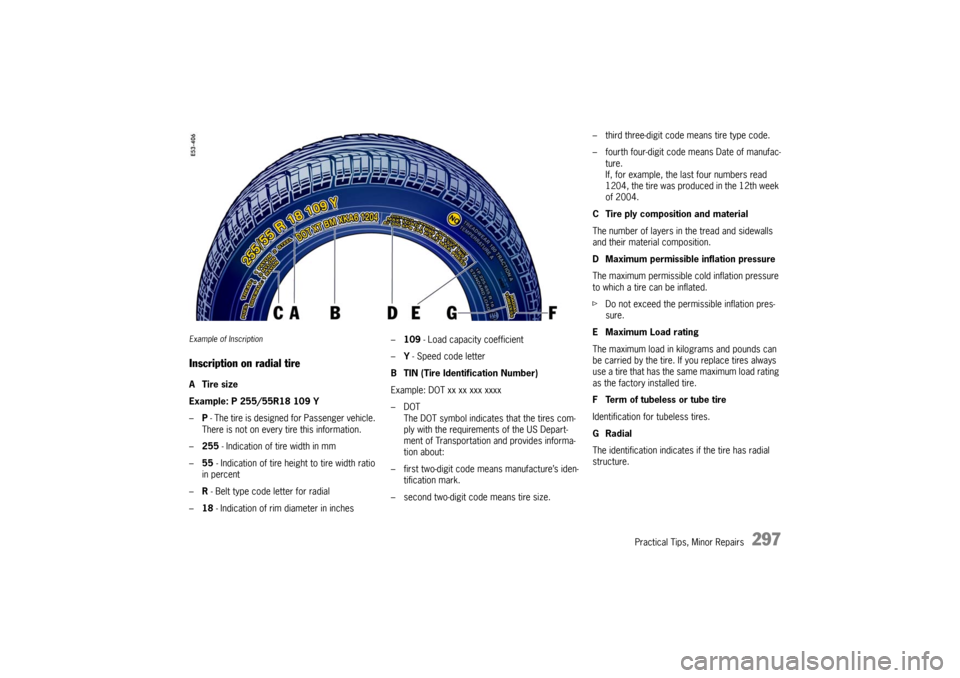
Example of InscriptionInscription on radial tireATire size
Example: P 255/55R18 109 Y
–P - The tire is designed for Passenger vehicle.
There is not on every tire this information.
–255 - Indication of tire width in mm
–55 - Indication of tire height to tire width ratio
in percent
–R - Belt type code letter for radial
–18 - Indication of rim diameter in inches–109 - Load capacity coefficient
–Y - Speed code letter
B TIN (Tire Identification Number)
Example: DOT xx xx xxx xxxx
–DOT
The DOT symbol indicates that the tires com-
ply with the requirements of the US Depart-
ment of Transportation and provides informa-
tion about:
– first two-digit code means manufacture’s iden-
tification mark.
– second two-digit code means tire size.
– third three-digit code means tire type code.
– fourth four-digit code means Date of manufac-
ture.
If, for example, the last four numbers read
1204, the tire was produced in the 12th week
of 2004.
C Tire ply composition and material
The number of layers in the tread and sidewalls
and their material composition.
D Maximum permissible inflation pressure
The maximum permissible cold inflation pressure
to which a tire can be inflated.
fDo not exceed the permissible inflation pres-
sure.
E Maximum Load rating
The maximum load in kilograms and pounds can
be carried by the tire. If you replace tires always
use a tire that has the same maximum load rating
as the factory installed tire.
F Term of tubeless or tube tire
Identification for tubeless tires.
GRadial
The identification indicates if the tire has radial
structure.
Page 359 of 387
Practical Tips, Minor Repairs
359
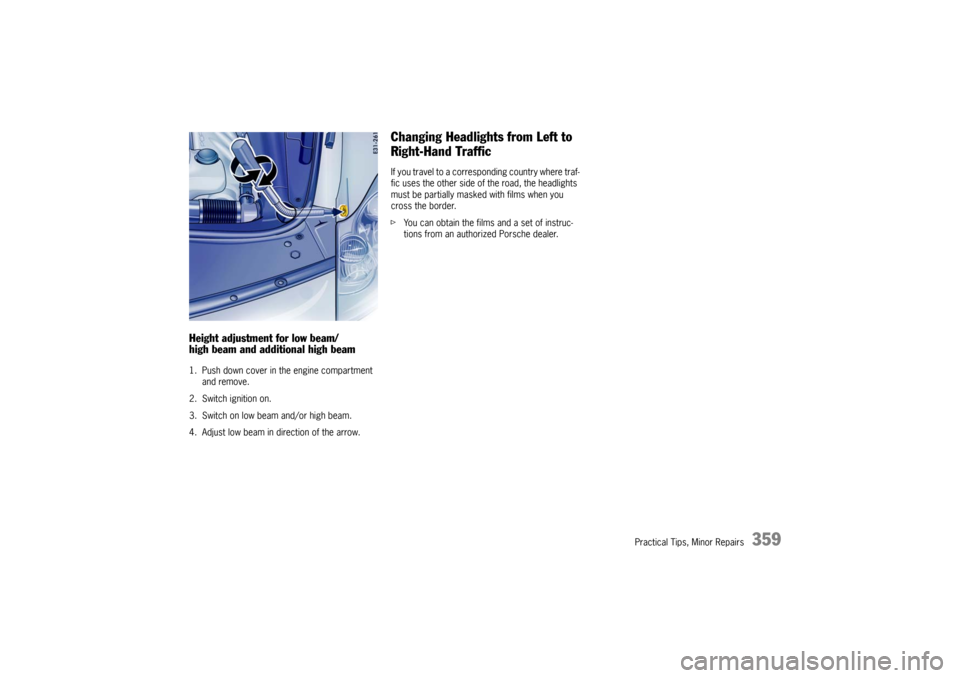
Height adjustment for low beam/
high beam and additional high beam1. Push down cover in the engine compartment
and remove.
2. Switch ignition on.
3. Switch on low beam and/or high beam.
4. Adjust low beam in direction of the arrow.
Changing Headlights from Left to
Right-Hand TrafficIf you travel to a corresponding country where traf-
fic uses the other side of the road, the headlights
must be partially masked with films when you
cross the border.
fYou can obtain the films and a set of instruc-
tions from an authorized Porsche dealer.
Page 374 of 387
374
Vehicle Identification, Technical Data
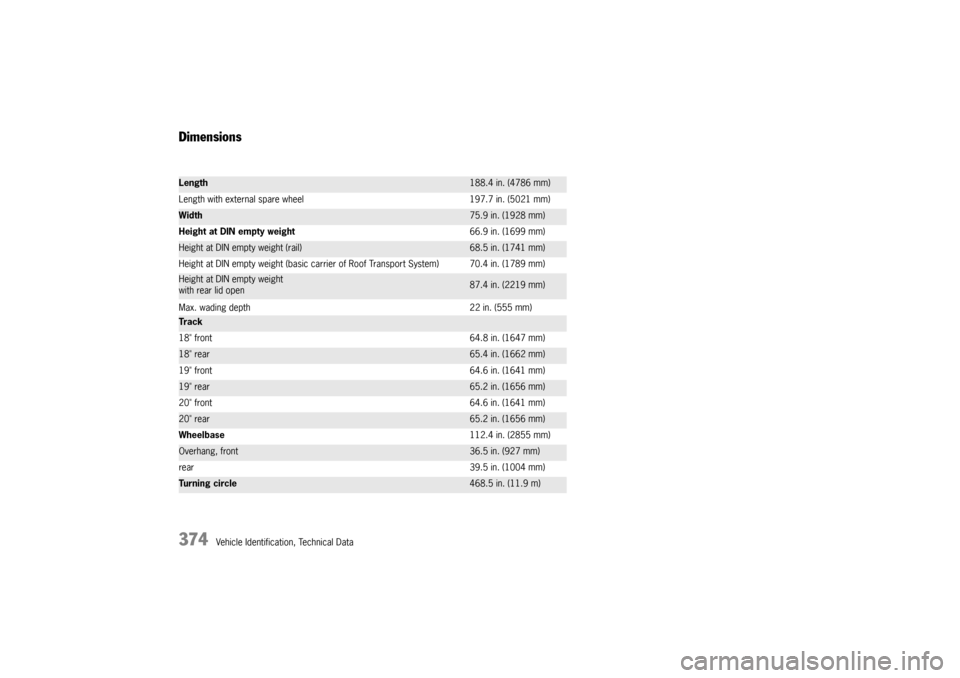
DimensionsLength
188.4 in. (4786 mm)
Length with external spare wheel 197.7 in. (5021 mm)
Width
75.9 in. (1928 mm)
Height at DIN empty weight66.9 in. (1699 mm)
Height at DIN empty weight (rail)
68.5 in. (1741 mm)
Height at DIN empty weight (basic carrier of Roof Transport System) 70.4 in. (1789 mm)
Height at DIN empty weight
with rear lid open
87.4 in. (2219 mm)
Max. wading depth 22 in. (555 mm)
Tr a c k18" front 64.8 in. (1647 mm)18" rear
65.4 in. (1662 mm)
19" front 64.6 in. (1641 mm)
19" rear
65.2 in. (1656 mm)
20" front 64.6 in. (1641 mm)
20" rear
65.2 in. (1656 mm)
Wheelbase112.4 in. (2855 mm)
Overhang, front
36.5 in. (927 mm)
rear 39.5 in. (1004 mm)
Turning circle
468.5 in. (11.9 m)