oil PORSCHE CAYNNE TURBO 2006 1.G User Guide
[x] Cancel search | Manufacturer: PORSCHE, Model Year: 2006, Model line: CAYENNE TURBO, Model: PORSCHE CAYENNE TURBO 2006 1.GPages: 387, PDF Size: 8.44 MB
Page 136 of 387
136
Controls, Safety, Instruments The rain sensor remains switched off if the wiper
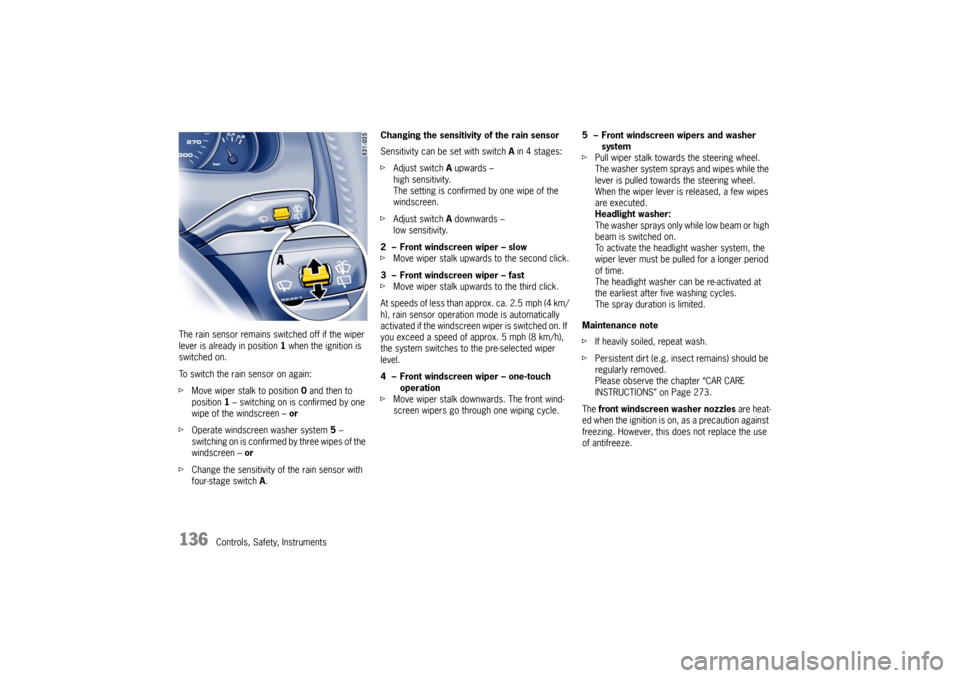
lever is already in position 1 when the ignition is
switched on.
To switch the rain sensor on again:
fMove wiper stalk to position 0 and then to
position 1 – switching on is confirmed by one
wipe of the windscreen – or
fOperate windscreen washer system 5 –
switching on is confirmed by three wipes of the
windscreen – or
fChange the sensitivity of the rain sensor with
four-stage switch A.Changing the sensitivity of the rain sensor
Sensitivity can be set with switch A in 4 stages:
fAdjust switch A upwards –
high sensitivity.
The setting is confirmed by one wipe of the
windscreen.
fAdjust switch A downwards –
low sensitivity.
2 – Front windscreen wiper – slow
fMove wiper stalk upwards to the second click.
3 – Front windscreen wiper – fast
fMove wiper stalk upwards to the third click.
At speeds of less than approx. ca. 2.5 mph (4 km/
h), rain sensor operation mode is automatically
activated if the windscreen wiper is switched on. If
you exceed a speed of approx. 5 mph (8 km/h),
the system switches to the pre-selected wiper
level.
4 – Front windscreen wiper – one-touch
operation
fMove wiper stalk downwards. The front wind-
screen wipers go through one wiping cycle.5 – Front windscreen wipers and washer
system
fPull wiper stalk towards the steering wheel.
The washer system sprays and wipes while the
lever is pulled towards the steering wheel.
When the wiper lever is released, a few wipes
are executed.
Headlight washer:
T h e w a s h e r s p r a ys o n l y w h i l e l o w b e a m o r h i g h
beam is switched on.
To activate the headlight washer system, the
wiper lever must be pulled for a longer period
of time.
The headlight washer can be re-activated at
the earliest after five washing cycles.
The spray duration is limited.
Maintenance note
fIf heavily soiled, repeat wash.
fPersistent dirt (e.g. insect remains) should be
regularly removed.
Please observe the chapter “CAR CARE
INSTRUCTIONS” on Page 273.
The front windscreen washer nozzles are heat-
ed when the ignition is on, as a precaution against
freezing. However, this does not replace the use
of antifreeze.
Page 176 of 387

176
Controls, Safety, Instruments Limits of ultrasonic measurement
– ParkAssist cannot detect sound-absorbing ob-
stacles (e.g. powder snow),
– Sound-reflecting obstacles (e.g. glass surfac-
es, flat painted surfaces),
– And very thin obstacles.
Other ultrasound sources (e.g. pneumatic brakes
of other vehicles, jackhammers) can interfere with
detection of obstacles.
Fault indication without warning tone
All red light segments of the active warning indica-
tors light up when there is a temporary fault in
ParkAssist.
Note
Correct operation is no longer ensured if there is
a temporary fault (e.g. caused by ice formation or
heavy soiling on the sensors).
The system detects the temporary fault.
All light segments light up until a speed of
9 mph (14 km/h) is reached.
ParkAssist is ready for operation again when the
interference has been eliminated.Fault indication with warning tone
In the event of a long-lasting fault in ParkAssist,
the red light segments of the active warning indi-
cators light up and a continuous tone sounds for
three seconds after a transmission range has
been selected.
Possible causes
– Defect or system fault.
fSwitch ParkAssist off.
When ParkAssist is switched off, the indicator
light in the button lights up.
fPlease have the fault remedied at an author-
ized Porsche dealer.Driving with a trailer
The ParkAssist rear monitoring area is switched
off when the trailer’s power supply is plugged in.
Page 184 of 387

184
Controls, Safety, Instruments
Compact disc player
Caution!
To avoid damage to compact disc player and
discs.
fUse only compact discs labeled as shown, hav-
ing no dirt, damage or warpage.
fNever attempt to disassemble or oil any part
of the player unit. Do not insert any object oth-
er than a disc into the slot.Remember there are
no user-serviceable parts inside the compact
disc player.
fDo not allow the disc to sustain any finger-
prints, scrapes or stickers on the surfaces.
This may cause poor sound quality.
Hold the disc only on the edge or center hole.
fWhen not in use, take the disc out of the player,
put the disc back into its case and store it
away from dust, heat, damp and direct sun-
light.
Leaving the disc on the dashboard in the sun
can damage the disc.fIf the disc gets dirty, clean the disc by wiping
the surfaces from the center to the outside in
a radial direction with a soft cloth.
Do not use a conventional record cleaner or
anti-static record preservative.
Disc cleaners are available in audio stores.
Page 237 of 387

Shifting Gear, Traction Systems
237
Driving systems for off-road drivingSpecially adapted driving programs or power-
transmission and running-gear control systems
are available for off-road driving:
– Off-road program Low Range
–Off-road PSM
–Off-road ABS
– Center differential lock
– Rear differential lock
fPlease observe the chapter “POWER-TRANS-
MISSION AND RUNNING-GEAR CONTROL SYS-
TEMS” on Page 227.Before driving offTires
fCheck tread depth and tire pressure.
fCheck for damage and remove any foreign ob-
jects (e.g. stones) from the tread.
fReplace missing valve caps.
Rims
fReplace dented or damaged rims before
driving off road.
After driving off roadOff-road driving places a greater burden on the ve-
hicle than does normal driving on roads.
We recommend inspecting the vehicle after off-
road driving. Potential damage poses an accident
risk and impairs driving comfort. Damage on the
car is recognised in good time if the car is
checked.
Warning!
Car damage poses an accident risk for the
vehicle occupants and other road users.
fIn cases of doubt, have your vehicle checked
by your authorized Porsche dealer.
fExamine tires for signs of damage such as
cuts, tears, bulges or foreign objects stuck in
the tread. Replace a damaged tire if neces-
sary.
fHave any damage to your vehicle repaired by an authorized Porsche dealer without delay.
Recommended procedure
fDeactivate Low Range.
fClean headlights and tail lights and check them
for signs of damage.
fClean the front and rear license plates.fClean the tire tread with a jet of water and re-
move any foreign objects.
fClean wheels, wheel housings and the under-
body with a jet of water.
fCheck whether the car has picked up plant
parts or branches.
These materials increase the risk of fire and
can damage fuel lines, brake hoses, boots of
the axle joints and drive shafts.
fAfter off-road driving, always check the entire
floor assembly, tires, body structure, steering
system, running gear and exhaust system for
signs of damage.
fAfter driving for an extended period through
mud, sand, water or substances with a similar
soiling effect, check the brake discs, brake
pads, wheels and axle joints and have them
cleaned.
fIf you experience severe vibrations after
driving off road, check the wheels for foreign
substances.
These substances can produce an imbalance
which might be responsible for the vibrations.
Removing these deposits may remedy the
problem.
Page 240 of 387
240
Shifting Gear, Traction Systems
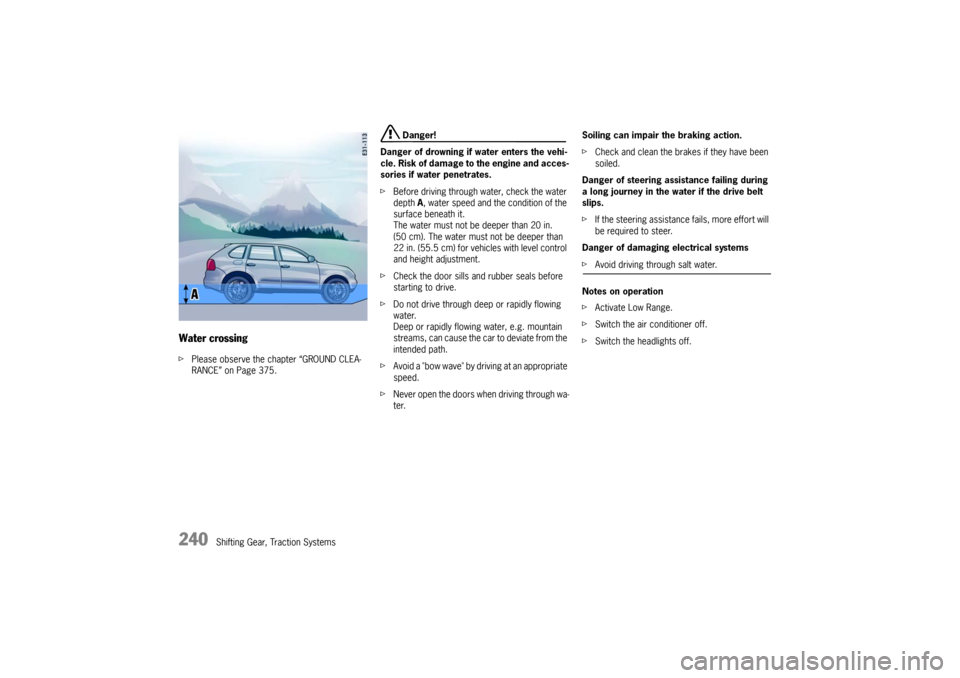
Water crossingfPlease observe the chapter “GROUND CLEA-
RANCE” on Page 375.
Danger!
Danger of drowning if water enters the vehi-
cle. Risk of damage to the engine and acces-
sories if water penetrates.
fBefore driving through water, check the water
depth A, water speed and the condition of the
surface beneath it.
The water must not be deeper than 20 in.
(50 cm). The water must not be deeper than
22 in. (55.5 cm) for vehicles with level control
and height adjustment.
fCheck the door sills and rubber seals before
starting to drive.
fDo not drive through deep or rapidly flowing
water.
Deep or rapidly flowing water, e.g. mountain
streams, can cause the car to deviate from the
intended path.
fAvoid a "bow wave" by driving at an appropriate
speed.
fNever open the doors when driving through wa-
ter.Soiling can impair the braking action.
fCheck and clean the brakes if they have been
soiled.
Danger of steering assistance failing during
a long journey in the water if the drive belt
slips.
fIf the steering assistance fails, more effort will
be required to steer.
Danger of damaging electrical systems
fAvoid driving through salt water.
Notes on operation
fActivate Low Range.
fSwitch the air conditioner off.
fSwitch the headlights off.
Page 249 of 387

Maintenance, Car Care
249 Maintenance, Car Care
Exercise Extreme Caution when Working on your
Vehicle ...................................................... 250
Engine Oil Level ......................................... 252
Engine Oil Recommendation ........................ 254
Coolant Level ............................................. 256
Brake-Fluid Level ........................................ 258
Washer Fluid .............................................. 259
Power Steering .......................................... 260
Air Cleaner ................................................ 261
Particle Filter ............................................. 261
Automatic Transmission Fluid ...................... 261
Wiper Blades ............................................. 262
Fuel Economy ............................................ 265
Operating Your Porsche in other Countries ... 265
Fuel........................................................... 266
Fuel Recommendations............................... 269
Portable Fuel Containers ............................. 270
Fuel Evaporation Control ............................. 270
Emission Control System ............................ 271
Car Care Instructions.................................. 273
Page 250 of 387

250
Maintenance, Car Care
Exercise Extreme Caution when
Working on your Vehicle
Danger!
Ignoring the following instructions may
cause serious personal injury or death.
fThe engine compartment of any motor vehicle
is a potentially hazardous area. If you are not
fully familiar with proper repair procedures, do
not attempt the adjustments described on the
following pages.
This caution applies to the entire vehicle.
fO n l y w o r k o n y o u r v e h i c l e o u t d o o r s o r i n a w e l l
ventilated area.
fEnsure that there are no open flames in the
area of your vehicle at any time when fuel
fumes might be present. Be especially cau-
tious of such devices such as hot water heat-
ers which ignite a flame intermittently.
fBefore working on any part in the engine com-
partment, turn the engine off and let it cool
down sufficiently. Hot engine compartment
components can burn skin on contact.
fBe alert and cautious around engine at all
times while the engine is running.
If work has to be performed with the engine
running, always set the parking brake, and
make sure the selector lever is in position “P“
or “N“.fIn particular, be very careful to ensure that
items of clothing (ties, shirt, sleeves etc.), jew-
elry, long hair, hand or fingers cannot get
caught in the fan, belts or other moving parts.
The radiator and radiator fans are in the front
of the car.
The fans can start or continue running as a
function of temperature, even with the engine
switched off.
Carry out work in these areas only with the en-
gine off and exercise extreme caution.
fYour Porsche is equipped with an electronic ig-
nition system. When the ignition is on, high volt-
age is present in all wires connected with the
ignition system; therefore, exercise extreme
caution when working on any part of the engine
while the ignition is on or the engine is running.
fAlways support your car with safety stands if it
is necessary to work under the car. The jack
supplied with the car is not adequate for this
purpose. For vehicles with air suspension with
level control and height adjustment switch off
level control. Therefore:
Please observe the chapter “LIFTING THE VE-
HICLE WITH A JACK” on Page 307.
fWhen working under the car without safety
stands but with the wheels on the ground,
make sure the car is on level ground, the
wheels are blocked, and that the engine can-
not be started.
Withdraw ignition keys (switch ignition off in ve-
hicles that have Porsche Entry & Drive).fDo not smoke or allow an open flame around
the battery or fuel.
Keep a fire extinguisher in close reach.
fIncomplete or improper servicing may cause
problems in the operation of the car. If in doubt
about any servicing, have it done by your au-
thorized Porsche dealer.
Improper maintenance during the warranty pe-
riod may affect your Porsche warranty cover-
age.
fSupplies of fluids, e.g. engine oil, washer fluid,
brake fluid or coolant, are hazardous to your
health.
Keep these fluids out of children's reach and
dispose of them in accordance with the appro-
priate regulations.
fSome countries require additional tools and
special spare parts to be carried.
Please make enquiries before driving abroad.
Power measurementsPower measurements on dynamometers are not
approved by Porsche.
Page 251 of 387

Maintenance, Car Care
251
Radiator fansThe radiator and radiator fans are in the front of
the car.
Warning!
Danger of injury. The fans can start running
as a function of temperature, even with the
engine switched off.
fExercise extreme caution when working in the area of the radiator fans.
Engine OilEngine oil consumption
It is normal for your engine to consume oil.
The rate of oil consumption depends on the quality
and viscosity of oil, the speed at which the engine
is operated, the climate, road conditions as well
as the amount of dilution and oxidation of the lubri-
cant.
If the vehicle is used for repeated short trips, and
consumes a normal amount of oil, the engine oil
measurement may not show any drop in the oil lev-
el at all, even after 600 miles (1000 km) or more.
This is because the oil is gradually becoming dilut-
ed with fuel or moisture, making it appear that the
oil level has not changed.
The diluting ingredients evaporate out when the
vehicle is driven at high speeds, as on an express-
way, making it then appear that oil is excessively
consumed after driving at high speeds.
If the conditions you drive your vehicle in are
dusty, humid, or hot, the frequency of the oil
change intervals should be greater.If the vehicle is driven at a high rate of speed, cli-
matic conditions are warm, and the load is high,
the oil should be checked more frequently, as driv-
ing conditions will determine the rate of oil con-
sumption.
– The engine in your vehicle depends on oil to lu-
bricate and cool all of its moving parts. There-
fore, the engine oil should be checked regular-
ly and kept at the required level.
– Make it a habit to have the engine oil level
checked with every fuel filling.
– The oil pressure warning light is not an oil level
indicator.
The oil pressure warning light indicates serious
engine damage may be occuring when lit, if en-
gine rpm is above idle speed.
Page 252 of 387

252
Maintenance, Car Care
Engine Oil LevelfCheck the oil level regularly. I t i s b e s t t o d o t h i s
when refuelling and before extended journeys.
Further important information concerning “mainte-
nance” can be found in a separate chapter.
fPlease observe the chapter “EXERCISE
EXTREME CAUTION WHEN WORKING ON YOUR
VEHICLE” on Page 250.
fPlease observe the chapter “WARNING LIGHTS
AND WARNING MESSAGES” on Page 122.
Warning!
Engine oil is hazardous to your health and
may be fatal if swallowed.
fKeep engine oil out of children's reach.
Used engine oil contains chemicals that have
caused cancer in laboratory animals.
fAlways protect your skin by washing thorough-ly with soap and water.If the oil level is too low, this is indicated by the oil-
level warning light lighting up on the multi-purpose
display.
fCheck the oil level using the oil dipstick as
soon as possible and add engine oil if neces-
sary.
Note on operation
fIf the engine compartment lid is opened and oil
is not added, the warning message appears
again after approximately 62 miles (100 km).
Checking the oil level
Warning!
Danger of injury. The radiator fans can start
running as a function of temperature, even
with the engine switched off.
Risk of burning from hot parts in engine com-
partment.
fExercise extreme caution when working on the engine compartment.
Conditions for measuring the oil level
correctly
– Vehicle must be level.
– Engine must be switched off and at operating
temperature.
– Before the oil-level measurement, allow the en-
gine oil to flow back into the oil pan for around
3 minutes.
Oil-level warning
Page 253 of 387
Maintenance, Car Care
253
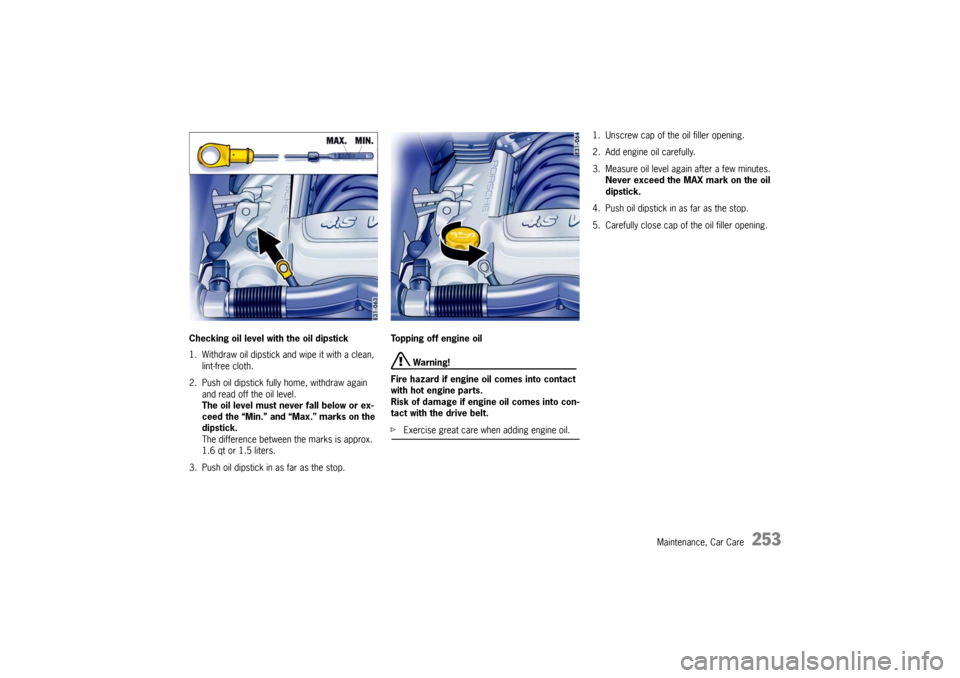
Checking oil level with the oil dipstick
1. Withdraw oil dipstick and wipe it with a clean,
lint-free cloth.
2. Push oil dipstick fully home, withdraw again
and read off the oil level.
The oil level must never fall below or ex-
ceed the “Min.” and “Max.” marks on the
dipstick.
The difference between the marks is approx.
1.6 qt or 1.5 liters.
3. Push oil dipstick in as far as the stop.Topping off engine oil
Warning!
Fire hazard if engine oil comes into contact
with hot engine parts.
Risk of damage if engine oil comes into con-
tact with the drive belt.
fExercise great care when adding engine oil.1. Unscrew cap of the oil filler opening.
2. Add engine oil carefully.
3. Measure oil level again after a few minutes.
Never exceed the MAX mark on the oil
dipstick.
4. Push oil dipstick in as far as the stop.
5. Carefully close cap of the oil filler opening.