tow PORSCHE CAYNNE TURBO 2006 1.G Owner's Manual
[x] Cancel search | Manufacturer: PORSCHE, Model Year: 2006, Model line: CAYENNE TURBO, Model: PORSCHE CAYENNE TURBO 2006 1.GPages: 387, PDF Size: 8.44 MB
Page 232 of 387
232
Shifting Gear, Traction Systems
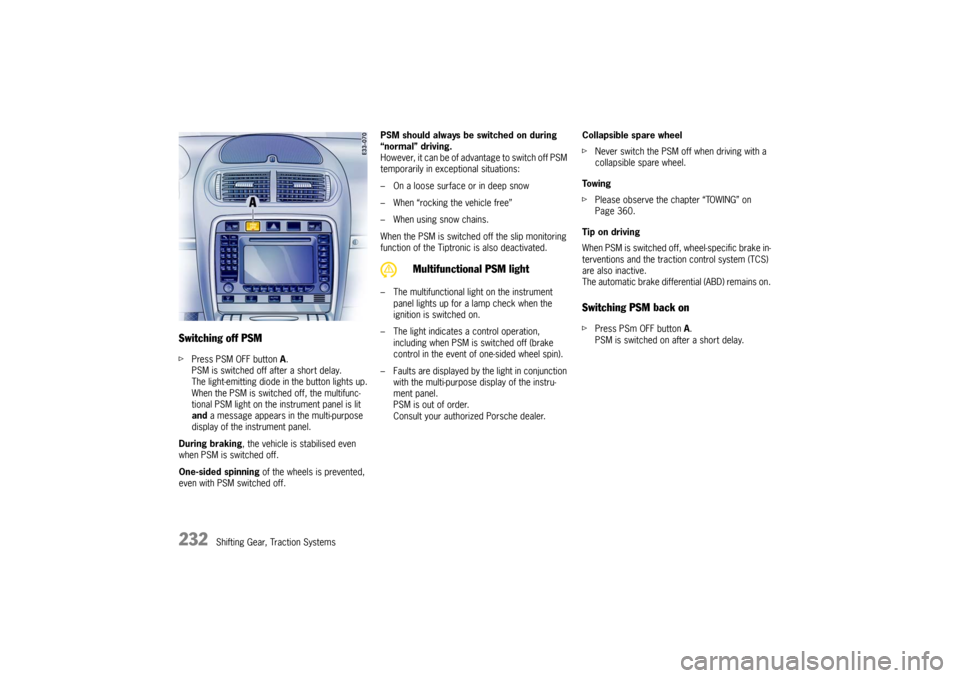
Switching off PSMfPress PSM OFF button A.
PSM is switched off after a short delay.
The light-emitting diode in the button lights up.
When the PSM is switched off, the multifunc-
tional PSM light on the instrument panel is lit
and a message appears in the multi-purpose
display of the instrument panel.
During braking, the vehicle is stabilised even
when PSM is switched off.
One-sided spinning of the wheels is prevented,
even with PSM switched off.PSM should always be switched on during
“normal” driving.
H o w e v e r, i t c a n b e o f a d v a n t a g e t o s w i t c h o f f P S M
temporarily in exceptional situations:
– On a loose surface or in deep snow
– When “rocking the vehicle free”
– When using snow chains.
When the PSM is switched off the slip monitoring
function of the Tiptronic is also deactivated.
– The multifunctional light on the instrument
panel lights up for a lamp check when the
ignition is switched on.
– The light indicates a control operation,
including when PSM is switched off (brake
control in the event of one-sided wheel spin).
– Faults are displayed by the light in conjunction
with the multi-purpose display of the instru-
ment panel.
PSM is out of order.
Consult your authorized Porsche dealer.Collapsible spare wheel
fNever switch the PSM off when driving with a
collapsible spare wheel.
To w i n g
fPlease observe the chapter “TOWING” on
Page 360.
Tip on driving
When PSM is switched off, wheel-specific brake in-
terventions and the traction control system (TCS)
are also inactive.
The automatic brake differential (ABD) remains on.
Switching PSM back onfPress PSm OFF button A.
PSM is switched on after a short delay.
Multifunctional PSM light
Page 236 of 387

236
Shifting Gear, Traction Systems
Off-Road DrivingfPlease read this chapter carefully before driv-
ing off road with your Porsche.
The information provided will familiarise you with
the special advantages of your vehicle, allowing
you to arrive at your destination safely every time.
We recommend practicing on less rugged terrain.
Vehicles with SportDesign package
Caution!
Risk of damage. On vehicles with
SportDesign package, front, rear, and side
member trim are painted and pulled down
lower. Off-road driving can seriously damage
these trim parts.
fWhen driving off-road, make sure these parts
are not damaged.
fMake sure there is sufficient clearance
between obstacles and the underside of the
vehicle.
fAvoid driving through water.
fDo not use side member trim as a running board.Maintenance note
Please bear in mind that off-road driving subjects
all vehicle components to considerably more wear
than normal use, making professional inspection
and maintenance after each use a vital precondi-
tion for functioning and safety.
Grains of sand, dirt particles and other abrasive
materials entering the brakes can cause exces-
sive wear or unpredictable braking action.
Rules for off-road drivingfEnsure vehicle is equipped with approved all-
terrain tires.
fPlease observe the chapter “GROUND CLEA-
RANCE” on Page 375.
fActivate Low Range.
fStow or fasten luggage and loads securely.
Please observe the chapter “LOADING INFOR-
MATION” on Page 207.
fIf unknown terrain is obscured from view, ex-
amine it on foot first and traverse it with ex-
treme caution.
This way, obstacles are easier to recognise
and damage to the vehicle is avoided.fAlways drive with the engine running.
Steering assistance is provided only with the
engine running.
fDrive slowly and uniformly.
fAlways make sure that the wheels touch the
ground.
fBefore driving through water, check the water
depth, the condition of the surface beneath it
and the speed of the water.
fLook out for obstacles such as boulders,
holes, tree stumps or ruts.
fAlways keep the sliding/lifting roof or
Panorama roof system and the side windows
closed while driving.
fDo not depart from marked routes or paths.
fRespect nature.
Always obey off-limits signs.
Page 260 of 387
260
Maintenance, Car Care
Power Steering
Warning!
Risk of accident. When the engine is station-
ary (e.g. when on tow) or the hydraulic sys-
tem fails, there is no assistance for steering.
Therefore, substantially more force will have
to be exerted.
fExercise great care when on tow.
fHave the fault remedied at your nearest author-ized Porsche dealer.The flow noise heard at full steering lock is design-
related and does not indicate a defect in the steer-
ing system.
Checking hydraulic fluidfPlease observe the chapter “EXERCISE
EXTREME CAUTION WHEN WORKING ON YOUR
VEHICLE” on Page 250.
fOnly use genuine Porsche hydraulic fluid or a
hydraulic fluid of similar quality which has been
approved according the Porsche specifica-
tions and product requirements.
fCheck the fluid level with the engine stopped
and cold (engine temperature approx. 68° F or
20°C).
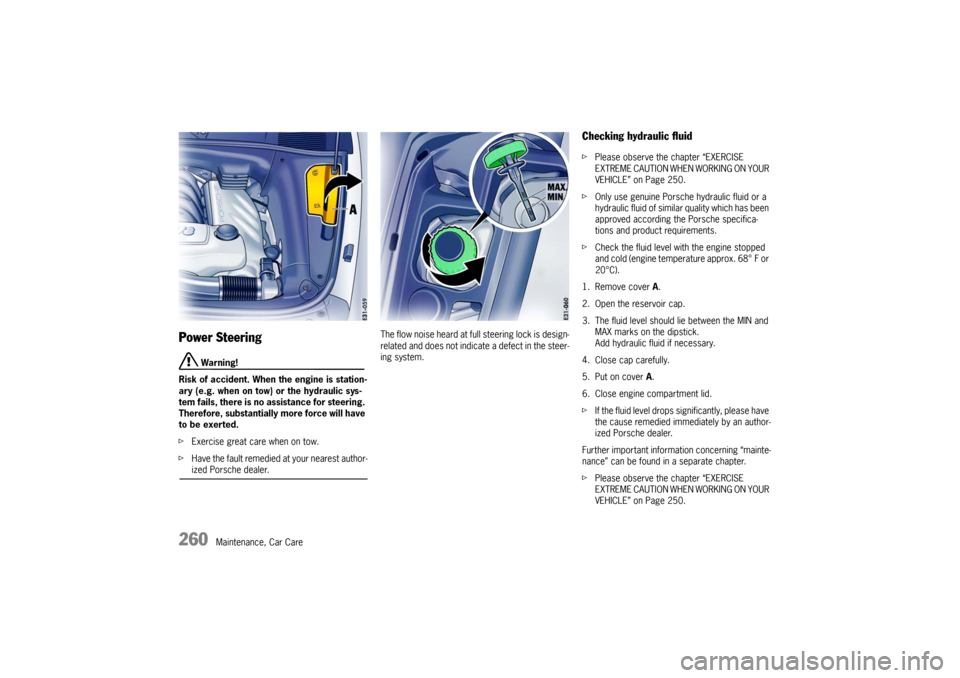
1. Remove cover A.
2. Open the reservoir cap.
3. The fluid level should lie between the MIN and
MAX marks on the dipstick.
Add hydraulic fluid if necessary.
4. Close cap carefully.
5. Put on cover A.
6. Close engine compartment lid.
fIf the fluid level drops significantly, please have
the cause remedied immediately by an author-
ized Porsche dealer.
Further important information concerning “mainte-
nance” can be found in a separate chapter.
fPlease observe the chapter “EXERCISE
EXTREME CAUTION WHEN WORKING ON YOUR
VEHICLE” on Page 250.
Page 261 of 387

Maintenance, Car Care
261
Air CleanerRegular replacement of the filter element is part of
servicing.
fIn dusty conditions, clean the filter element
more frequently and replace if necessary.
Further important information concerning “mainte-
nance” can be found in a separate chapter.
fPlease observe the chapter “EXERCISE
EXTREME CAUTION WHEN WORKING ON YOUR
VEHICLE” on Page 250.
Particle FilterThe fresh air passing through the particle filter into
the passenger compartment is virtually free of
dust and pollen.
fIf the outside air is polluted by exhaust fumes,
press the circulating-air button.
A dirty filter can be the cause of reduced air
throughput.
fHave filter replaced by your authorized
Porsche dealer.
Regular replacement of the filter is part of servic-
ing.
Automatic Transmission Fluid The torque converter and the transmission are lu-
bricated with Automatic Transmission Fluid (ATF).
fPlease observe the chapter “CAPACITIES” on
Page 371.
Do not tow the car or run the engine without ATF
in the transmission. The automatic transmission
may be damaged by even a tiny speck of dirt, only
a clean funnel or spout must be used when adding
AT F.
The ATF and transmission oil has to be checked
and changed at the intervals listed in your Mainte-
nance Schedule.
We recommend that you have the ATF and trans-
mission oil changed at your Porsche dealer, who
has the required lubricants and the necessary fill-
ing equipment.
If you suspect an oil leak in the transmission, have
your authorized Porsche dealer check it out imme-
diately.
Page 263 of 387
Maintenance, Car Care
263
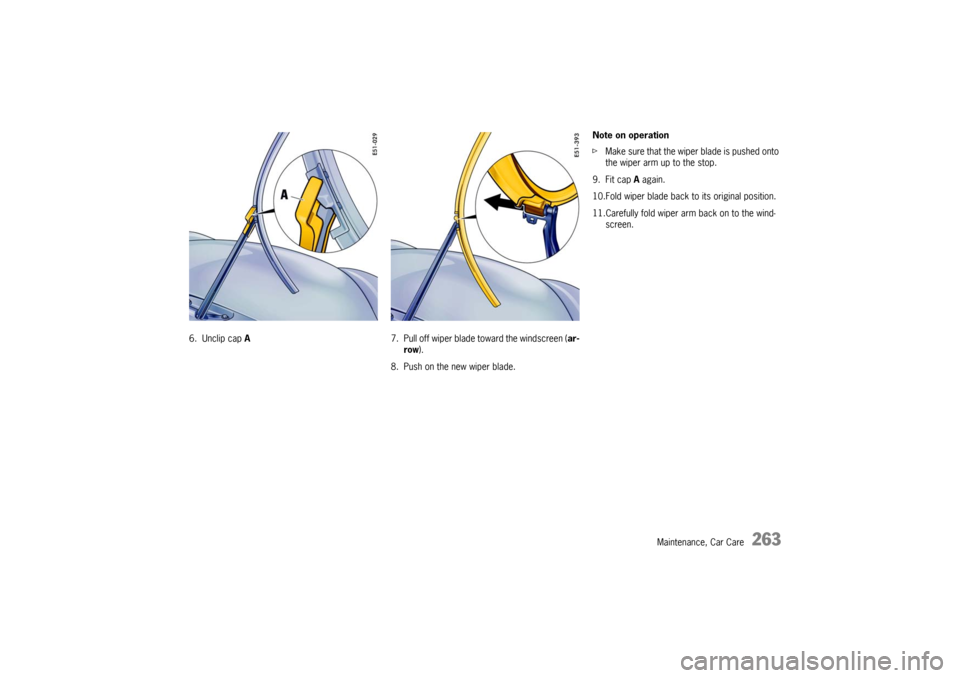
6. Unclip cap A7. Pull off wiper blade toward the windscreen (ar-
row).
8. Push on the new wiper blade.Note on operation
fMake sure that the wiper blade is pushed onto
the wiper arm up to the stop.
9. Fit cap A again.
10.Fold wiper blade back to its original position.
11.Carefully fold wiper arm back on to the wind-
screen.
Page 266 of 387

266
Maintenance, Car Care
Fuel
Warning!
Fuel is highly flammable and harmful to
health.
fFire, open flame and smoking are prohibited
when handling fuel.
fAvoid contact with skin or clothing.
fDo not inhale fuel vapours.
To prevent damage to the emission control
system and engine:
fNever drive the tank completely out of fuel.
fAvoid high cornering speeds after the warning lights have come on.To avoid permanent damage to the functionality of
the catalytic converters and oxygen sensors, use
only unleaded fuel.
The engine is designed to provide optimum
performance and fuel consumption if unleaded
premium fuel with 98 RON/88 MON is used.
If unleaded premium fuels with octane numbers of
at least 95 RON/85 MON are used, the en-
gine's knock control automatically adapts the igni-
tion timing.
The emission control system can be damaged in
various ways (e.g. fuelling incorrectly, shortage of
fuel, tow-starting).
fPlease observe the chapter “HOW EMISSION
CONTROL WORKS” on Page 272.
fPlease observe the chapter “LEVEL GAUGE”
on Page 86.
Page 272 of 387

272
Maintenance, Car Care
How Emission Control WorksWhen an automobile engine is running, it uses en-
ergy generated through the combustion of a mix-
ture of air and fuel. Depending on whether a car is
driven fast or slowly or whether the engine is cold
or hot, some of the fuel (hydrocarbons) may not
be burned completely, but may be discharged into
the engine crankcase or exhaust system. Additon-
al hydrocarbons may enter the atmosphere
through evaporation of fuel from the fuel tank.
These hydrocarbons (HC), when released into the
air, contribute to undesirable pollution.
In addition, carbon monoxide (CO) and oxides of
nitrogen (NOx) contribute to engine emissions.
They, too, are formed during the combustion proc-
ess and discharged into the exhaust system.
To reduce these pollutants, your Porsche is
equipped with a precisely calibrated fuel injection
system to assure a finely balanced air/fuel mixture
under all operating conditions.
Oxygen sensorThe oxygen sensor, installed in the exhaust pipe
continuously senses the oxygen content of the ex-
haust and signals the information to an electronic
control unit. The control unit corrects the air/fuel
ratio, so the engine always receives an accurately
metered air/fuel mixture.Crankcase ventilationThrough crankcase ventilation, undesirable emis-
sions from the engine crankcase are not permit-
ted to reach the outside atmosphere. These emis-
sions are recirculated from the crankcase to the
air intake system. From here the emissions mix
with the intake air and are later burned in the en-
gine.Catalytic convertersThe catalytic converters are efficient “clean-up“
devices built into the exhaust system of the vehi-
cle. The catalytic converters burn the undesirable
pollutants in the exhaust gas before it is released
into the atmosphere.
The exclusive use of unleaded fuel is critical-
ly important for the life of the catalytic con-
verters. Therefore, only unleaded fuel must
be used.The catalytic converters will be damaged by:
– push or tow starting the vehicle
– misfiring of the engine
– turning off the ignition while the vehicle is mov-
ing or
– driving until the fuel tank is completely empty
– by other unusual operating conditions.
fDo not continue to operate your vehicle under
these conditions, since raw fuel might reach
the catalytic converters. This could result in
overheating of the converters. Federal law pro-
hibits use of leaded fuel in this car.
Page 274 of 387

274
Maintenance, Car Care
High-pressure cleaning units
Warning!
High-pressure cleaning units can damage
the following components:
–Tires
– Logos, emblems
– Painted surfaces
– Widened fenders
– Lock and latch of the removable towing attach-
ment
– Seals of the electrically retractable ball hitch
– Alternator, valve covers
– ParkAssist sensors.
fPlease observe the operating instructions from
the unit manufacturer.
fAlways cover the lid over the brake fluid reser-
voir prior to cleaning. Never point the cleaning
jet directly at the lid.
fWhen cleaning with a flat-jet nozzle or the like,
maintain a minimum distance of 50 cm
(21 in.).fNever use high-pressure cleaning units with a
round-jet nozzle.
A high-pressure cleaning unit with round nozzle
will damage your vehicle. The tires are particu-
larly susceptible to damage.
fDo not point the cleaning jet directly at any of
the aforementioned components.
WashingThe best protection for the car from the damaging
effects of the environment is frequent washing and
preservation. The underside of the car should also
be thoroughly washed for cinders, salt or sanding
at winter‘s end.
The longer salt, road dust, industrial dust, insect
remains, bird excrement, and tree exudations (res-
in, pollen), etc. are allowed to remain on the body-
work, the more serious is their harmful effect.
New cars should be washed carefully with plenty
of clear water to protect the new paint work.
Dark paint finishes show up the smallest of sur-
face damage (e.g. scratches) more readily than
lighter colors.
Dark colors are also more susceptible to scratch-
ing because of the composition of their pigments
and require particularly careful paint care.fDo not wash your car in bright sunlight or while
the bodywork is still hot.
fWhen washing by hand, use abundant water, a
soft sponge or wash brush and Porsche car
shampoo.
fBegin by spraying the body thoroughly with wa-
ter to rinse away loose dirt.
fAfter washing, rinse the car with plenty of wa-
ter and then dry with a chamois leather.
Do not use the same chamois leather for dry-
ing as you use for cleaning the windshield and
windows.
Page 283 of 387

Practical Tips, Minor Repairs
283 Practical Tips, Minor Repairs
Exercise Extreme Caution when Working on your
Vehicle ...................................................... 284
Notes on Minor Repairs .............................. 285
Tires/Wheels ............................................. 285
Jack .......................................................... 299
Tool Kit ..................................................... 299
Lifting the Vehicle with a Lifting Platform or
Garage lift ................................................. 300
Compressor .............................................. 301
Wheel Bolts ............................................... 301
Spacers .................................................... 302
Changing Wheels........................................ 303
Flat Tire ..................................................... 304
Electrical System ....................................... 322
Battery ...................................................... 332
Emergency Starting with Jumper Cables ...... 343
Replacing the remote control battery ........... 346
Bulb Chart ................................................. 347
Replacing Bulbs ......................................... 348
Headlights ................................................. 349
Tail Light ................................................... 355
License Plate Lights................................... 357
Headlight Adjustment.................................. 358
Changing Headlights from Left to Right-Hand
Traffic ....................................................... 359
Towing ...................................................... 360
Page 285 of 387

Practical Tips, Minor Repairs
285
Notes on Minor RepairsTool kitThe tool kit is accommodated in the spare-wheel
well under the cover of the loadspace floor.
Tires/WheelsThe original equipment tires and wheel rims on
your Porsche comply with all applicable Federal
Motor Vehicle Safety Standards.
For your safety remember the following:
– Wheel rims and wheel bolts are matched to fit
your Porsche.
– If you intend to use other than original equip-
ment wheels, be sure that they conform to
Porsche specifications for your model.Only
tires with the same make and with the same
specification code (e.g. “N0“, “N1“...) can be
mounted.
– The use of wheel rims and wheel bolts that do
not meet specifications of the original factory
installed equipment will affect the safe opera-
tion of your vehicle.
– Before you plan on exchanging wheels, or
snow tires already mounted on the wheel rims,
consult your authorized Porsche dealer.
Your dealer has the technical information nec-
essary to advise you which wheel rims and
wheel bolts are compatible with the original
factory installations.
Danger!
Risk of loss of control and serious personal
injury or death.
fIf while driving, your vehicle experiences a sud-
den vibration or ride disturbance, and/or you
suspect that possible damage to your tires or
vehicle has occurred, you should immediately
reduce your speed without excessive use of
the brakes.
fStop the vehicle as soon as possible, and in-
spect the tires.
If you cannot determine the cause for the dis-
turbance, have your vehicle towed to the near-
est Porsche or tire dealer to have your vehicle
or tire(s) inspected.
fContinuing to operate the vehicle without cor-
rection could result in a loss of control and se-rious personal injury.