display PORSCHE PANAMERA 2009 1.G Information Manual
[x] Cancel search | Manufacturer: PORSCHE, Model Year: 2009, Model line: PANAMERA, Model: PORSCHE PANAMERA 2009 1.GPages: 343, PDF Size: 7.96 MB
Page 36 of 343

34
Opening and Locking
1. Open the driver’s door.
2. Pull the release lever (
arrow).
The engine compartment lid is now unlocked. 3. Pull the unlocking handle (
arrow).
4. Open the engine compartment fully.
Closing1. Lower lid and let it fa ll into the lock. If
necessary, push the lid closed with the palm
of your hand in the area of the lock.
2. Check that the lid is en gaged correctly in the
lock and that the release lever is back in its
initial position.
When the vehicle is in motion, a message will
appear on the multi-function display in the
instrument panel if the lid is not closed properly.
Page 42 of 343
40
Seats, Mirrors and Steering Wheel
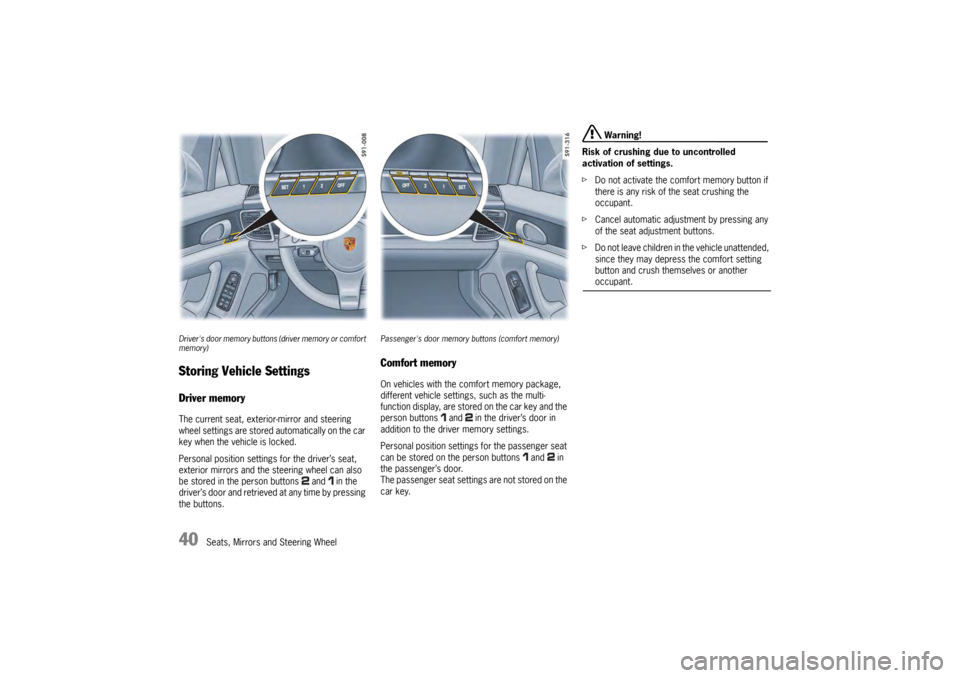
Driver's door memory buttons (driver memory or comfort
memory)Storing Vehicle SettingsDriver memoryThe current seat, exterior-mirror and steering
wheel settings are stored automatically on the car
key when the vehicle is locked.
Personal position settings for the driver’s seat,
exterior mirrors and the steering wheel can also
be stored in the person buttons and in the
driver’s door and retrieved at any time by pressing
the buttons.
Passenger's door memory buttons (comfort memory)Comfort memoryOn vehicles with the comfort memory package,
different vehicle settings, such as the multi-
function display, are stored on the car key and the
person buttons and in the driver’s door in
addition to the driver memory settings.
Personal position settings for the passenger seat
can be stored on the person buttons and in
the passenger’s door.
The passenger seat settings are not stored on the
car key.
Warning!
Risk of crushing due to uncontrolled
activation of settings.
f Do not activate the comfort memory button if
there is any risk of the seat crushing the
occupant.
f Cancel automatic adjustment by pressing any
of the seat adjustment buttons.
f Do not leave children in the vehicle unattended,
since they may depress the comfort setting
button and crush themselves or another occupant.
Page 44 of 343
42
Seats, Mirrors and Steering Wheel
Easy Entry FunctionThe Easy Entry function makes it easier for you to
get in and out of the vehicle.
Warning!
Risk of crushing if persons are behind the
driver’s seat when settings are retrieved.
Risk of damage if the rear seat bench is
folded forward when settings are retrieved.
f Switch off the Easy Entry function if there are
persons behind the driver’s seat or if the rear seat bench is folded forward.
Prerequisite
– Function must be activated on the multi- function display.
For information on swit ching the Easy Entry
function on and off:
f Please see the chapter “SWITCHING
COMFORT ENTRY ON AND OFF” on page 145. Entering the vehicle
When the driver’s door is opened, the steering
wheel and passenger seat
move upwards or to the
rear depending on the position of the seat and
steering wheel when the driver left the vehicle.
Once the driver’s door is closed and the ignition
key is inserted or, in the case of vehicles with
Porsche Entry & Drive, the ignition is switched on,
the seat and steering wheel move to the stored
position.
Exiting the vehicle
The steering wheel moves upwards:
– After the ignition key is removed or
– After the ignition is switched off and the
driver’s door is opened on vehicles with
Porsche Entry & Drive.
The driver’s seat moves to the rear:
– After the driver’s door is opened.
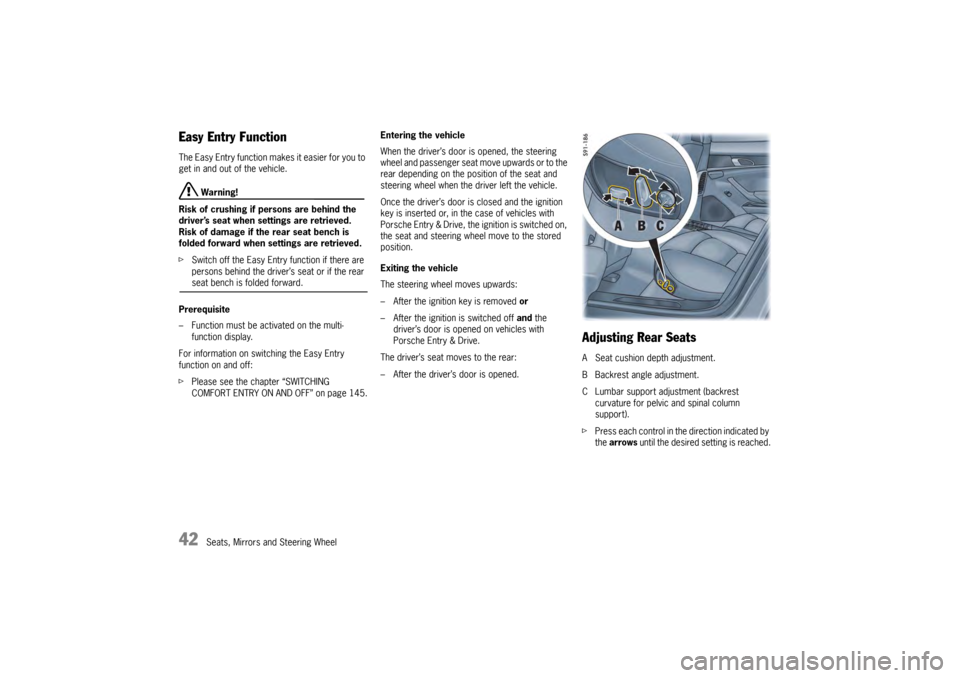
Adjusting Rear SeatsA Seat cushion depth adjustment.
B Backrest angle adjustment.
C Lumbar support adjustment (backrest curvature for pelvic and spinal column
support).
f Press each control in the direction indicated by
the arrows until the desired setting is reached.
Page 47 of 343

Seats, Mirrors and Steering Wheel
45
fDo not wear belts over rigid or breakable
objects in or on your clothing, such as eye
glasses, pens, keys, etc. as these may cause
injury.
f Several layers of heavy clothing may interfere
with proper positioning of belts.
f Belts must not rub against sharp objects or
damage may occur to the belt.
f Two occupants should never share the same
belt at the same time.
Care and maintenance
f Keep belt buckles free of any obstruction that
may prevent a secure locking.
f Belts that have been subjected to excessive
stretch forces in an accident must be
inspected or replaced to ensure their
continued effectiveness in restraining you.
The same applies to belt tensioner systems
which have been triggered. In addition, the
anchor points of the belts should be checked.
f If safety belts do not work properly, see your
authorized Porsche dealer immediately.
f If the belts show damage to webbing, bindings,
buckles or retractors, they should be replaced
to ensure safe operation.
f Do not modify or disassemble the safety belts
in your vehicle. f
The belts must be kept clean or the retractors
may not work properly.
Please see the chapter “CAR CARE
INSTRUCTIONS” on page 269.
f Never bleach or dye safety belts.
f Do not allow safety belts to retract until they
are completely dry after cleaning or this may
cause damage to the belt.
Belt tensionerDepending on the force of a collision, fastened
seat belts are automatically tightened in an
accident.
The belt tensioners are triggered in:
– Front and rear impacts of sufficient severity
– Side impacts
– In cases of vehicle rollover
Maintenance notes
The belt tensioner system can be triggered only
once; the system must be replaced afterwards.
If there is a fault in the belt tensioner system, the
air bag warning light lights up.
Work may be performed on the belt tensioner
system only by an authorized Porsche dealer.
Smoke is released when the belt tensioners are
triggered.
This does not indicate a fire in the vehicle. An audio-visual warning
system is
interconnected with the driver’s safety belt.
Every time the ignition is turned on, the gong will
sound for about 6 seconds to remind driver and
passenger to buckle up.
In addition, the gong will sound for approximately
90 seconds if vehicle speed exceeds 15 mph
(24 km/h).
The safety belt warning lights in the instrument
panel and multi-function display will go off as soon
as the driver has buckled up.
Safety Belt Warning System
Page 63 of 343
Seats, Mirrors and Steering Wheel
61
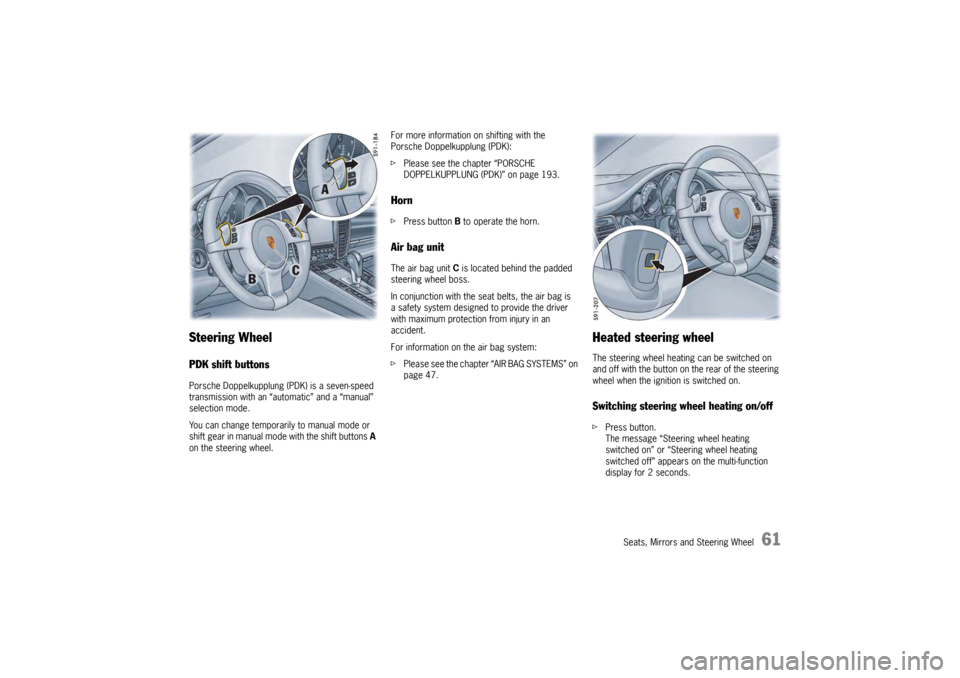
Steering WheelPDK shift buttonsPorsche Doppelkupplung (PDK) is a seven-speed
transmission with an “automatic” and a “manual”
selection mode.
You can change temporarily to manual mode or
shift gear in manual mode with the shift buttons A
on the steering wheel. For more information on shifting with the
Porsche Doppelkupplung (PDK):
f
Please see the chapter “PORSCHE
DOPPELKUPPLUNG (PDK)” on page 193.
Horn fPress button B to operate the horn.Air bag unitThe air bag unit C is located behind the padded
steering wheel boss.
In conjunction with the seat belts, the air bag is
a safety system designed to provide the driver
with maximum protection from injury in an
accident.
For information on the air bag system:
f Please see the chapter “AIR BAG SYSTEMS” on
page 47.
Heated steering wheelThe steering wheel heatin g can be switched on
and off with the button on the rear of the steering
wheel when the ignition is switched on.Switching steering wheel heating on/offf Press button.
The message “Steering wheel heating
switched on” or “Steering wheel heating
switched off” appears on the multi-function
display for 2 seconds.
Page 65 of 343
Seats, Mirrors and Steering Wheel
63
Multi-Function Steering Wheel
Warning!
There is a risk of accident if you set or
operate the multi-funct ion display, radio,
navigation system, telephone or other
equipment while driving.
Operating these devices while driving could
distract you from traffic and cause you to
lose control of the vehicle.
f Operate the equipment while driving only if the
traffic situation allows you to do so safely.
f Carry out any complicated operating or setting procedures only when the vehicle is stationary.
Depending on the equipment in your vehicle, you
can use the function keys of the multi-function
steering wheel to operate the following Porsche
communication systems:
– Telephone
–PCM
– Multi-function display in the instrument panel
Readiness for operation of the
multi-function steering wheel– With ignition switched on
f Please observe the operating instructions
supplied for the Porsche communication
systems before operating the function keys.
Note on operation
The Porsche communication systems cannot be
switched on and off using the multi-function
steering wheel.
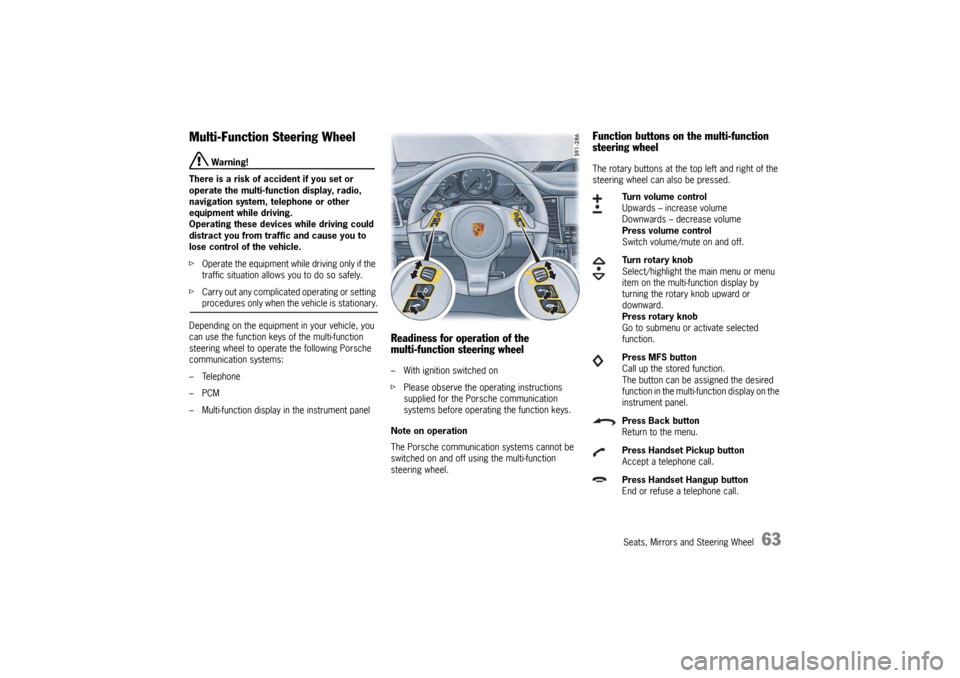
Function buttons on the multi-function
steering wheelThe rotary buttons at the top left and right of the
steering wheel can also be pressed.
Turn volume control
Upwards – increase volume
Downwards – decrease volume
Press volume control
Switch volume/mute on and off.
Turn rotary knob
Select/highlight the main menu or menu
item on the multi-function display by
turning the rotary knob upward or
downward.
Press rotary knob
Go to submenu or activate selected
function.
Press MFS button
Call up the stored function.
The button can be assigned the desired
function in the multi-fu nction display on the
instrument panel.
Press Back button
Return to the menu.
Press Handset Pickup button
Accept a telephone call.
Press Handset Hangup button
End or refuse a telephone call.
Page 68 of 343
66
Seats, Mirrors and Steering Wheel
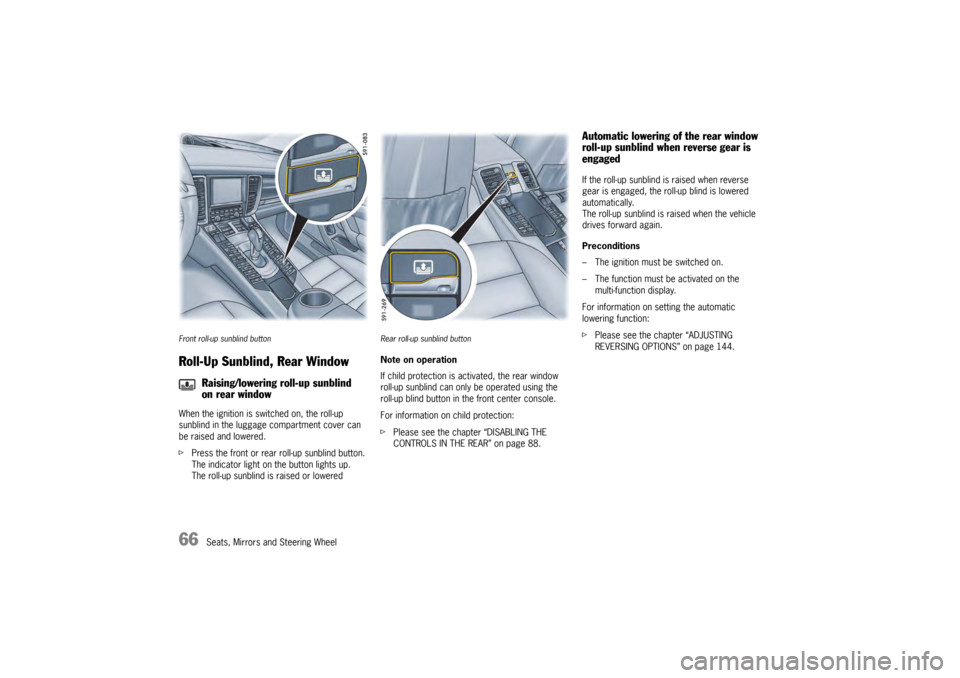
Front roll-up sunblind buttonRoll-Up Sunblind, Rear WindowWhen the ignition is switched on, the roll-up
sunblind in the luggage compartment cover can
be raised and lowered.
fPress the front or rear roll-up sunblind button.
The indicator light on the button lights up.
The roll-up sunblind is raised or lowered
Rear roll-up sunblind buttonNote on operation
If child protection is ac tivated, the rear window
roll-up sunblind can only be operated using the
roll-up blind button in the front center console.
For information on child protection:
f Please see the chapter “DISABLING THE
CONTROLS IN THE REAR” on page 88.
Automatic lowering of the rear window
roll-up sunblind when reverse gear is
engagedIf the roll-up sunblind is raised when reverse
gear is engaged, the roll-up blind is lowered
automatically.
The roll-up sunblind is raised when the vehicle
drives forward again.
Preconditions
– The ignition must be switched on.
– The function must be activated on the
multi-function display.
For information on setting the automatic
lowering function:
f Please see the chapter “ADJUSTING
REVERSING OPTIONS” on page 144.
Raising/lowering roll-up sunblind
on rear window
Page 73 of 343
Air Conditioning
71
General FunctionsNote on operation
Additional settings relating to the climate type and
extended ventilation panel can be adjusted in the
multi-function display on the instrument panel:
f Please see the chapter “AIR-CONDITIONING
SETTINGS ON THE MULTI-FUNCTION
DISPLAY” on page 83.
f Please see the chapter “SETTING AIR
CONDITIONING” on page 146.
On vehicles with comfort memory, all air-
conditioning settings are stored on the relevant
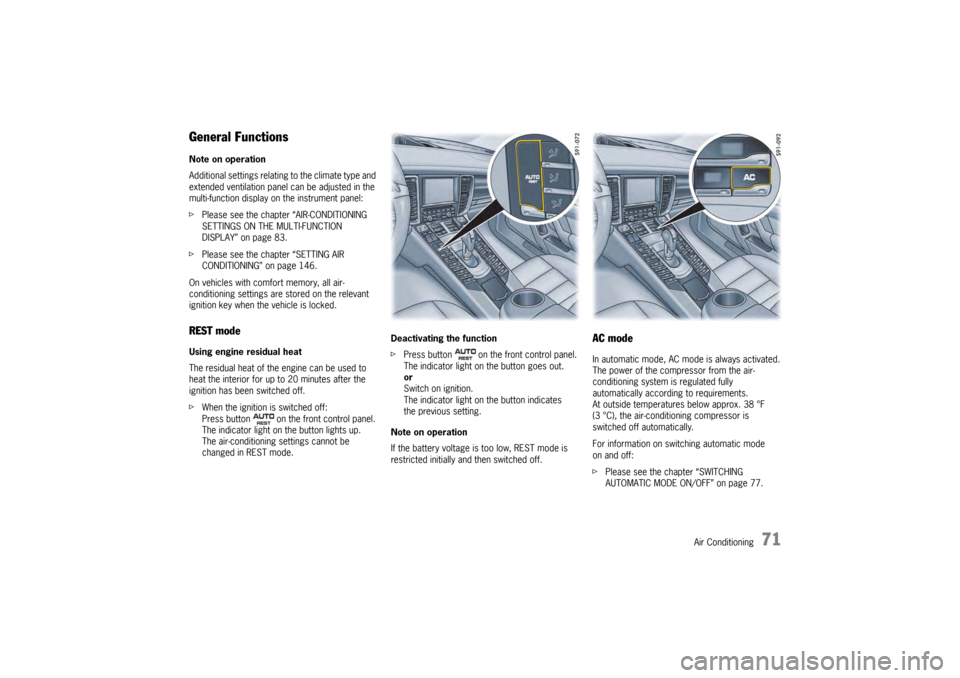
ignition key when the vehicle is locked.REST modeUsing engine residual heat
The residual heat of the engine can be used to
heat the interior for up to 20 minutes after the
ignition has been switched off.
f When the ignition is switched off:
Press button on the front control panel.
The indicator light on the button lights up.
The air-conditioning settings cannot be
changed in REST mode. Deactivating the function
f
Press button on the front control panel.
The indicator light on the button goes out.
or
Switch on ignition.
The indicator light on the button indicates
the previous setting.
Note on operation
If the battery voltage is too low, REST mode is
restricted initially and then switched off.
AC modeIn automatic mode, AC mode is always activated.
The power of the compressor from the air-
conditioning system is regulated fully
automatically according to requirements.
At outside temperatures below approx. 38 °F
(3 °C), the air-conditioning compressor is
switched off automatically.
For information on switching automatic mode
on and off:
f Please see the chapter “SWITCHING
AUTOMATIC MODE ON/OFF” on page 77.
Page 74 of 343
72
Air Conditioning
Switching on AC mode
If you wish to cool th
e passenger compartment
to a temperature lower than the outside
temperature, AC mode must be activated.
f Press button .
The indicator light on the button lights up.
The air-conditioning compressor is
switched on.
or
Press button .
Switching off AC mode
AC mode can be switched off manually to save
fuel, for example.
f Press button .
The indicator light on the button goes out.
The air-conditioning compressor is
switched off.
The cooling function is deactivated.
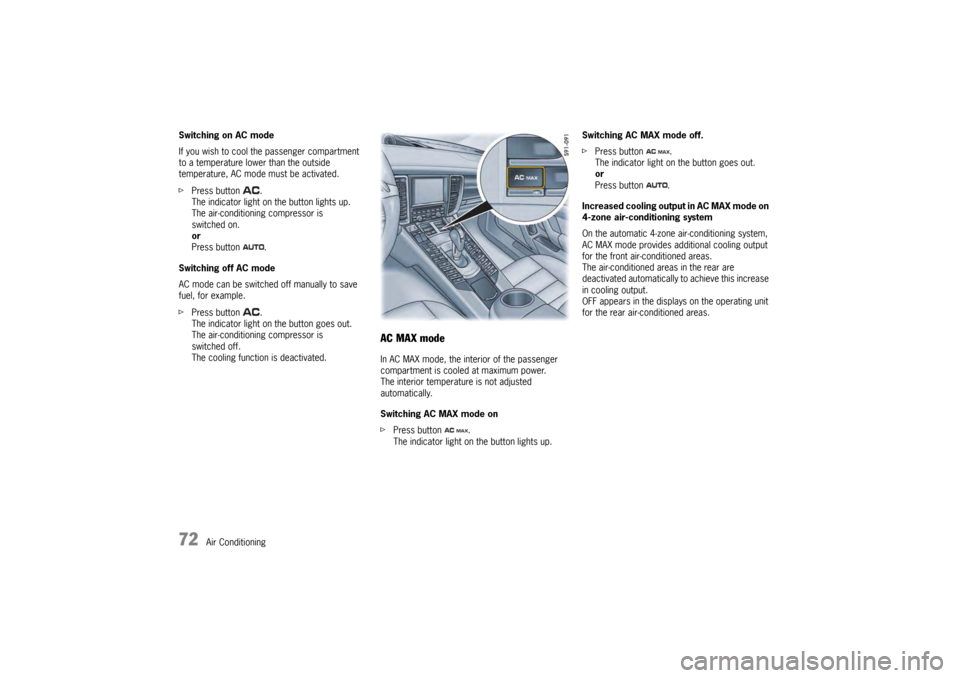
AC MAX modeIn AC MAX mode, the inte rior of the passenger
compartment is cooled at maximum power.
The interior temperature is not adjusted
automatically.
Switching AC MAX mode on
f Press button .
The indicator light on the button lights up. Switching AC MAX mode off.
f
Press button .
The indicator light on the button goes out.
or
Press button .
Increased cooling output in AC MAX mode on
4-zone air-conditioning system
On the automatic 4-zone air-conditioning system,
AC MAX mode provides a dditional cooling output
for the front air-conditioned areas.
The air-conditioned areas in the rear are
deactivated automatically to achieve this increase
in cooling output.
OFF appears in the displays on the operating unit
for the rear air-conditioned areas.
Page 75 of 343
Air Conditioning
73
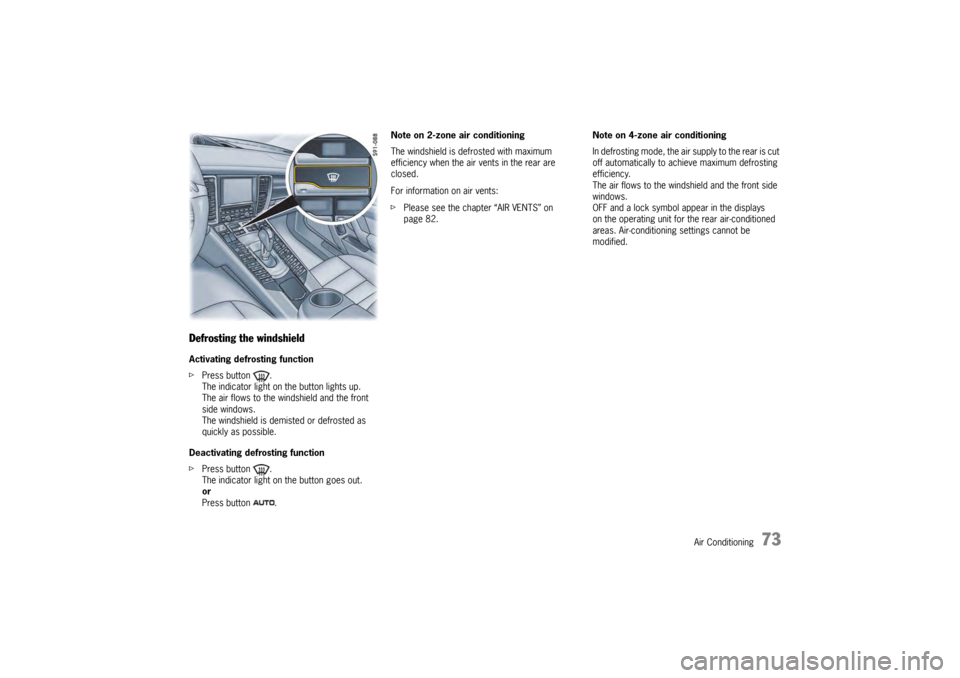
Defrosting the windshieldActivating defrosting function
fPress button .
The indicator light on the button lights up.
The air flows to the windshield and the front
side windows.
The windshield is demisted or defrosted as
quickly as possible.
Deactivating defrosting function
f Press button .
The indicator light on the button goes out.
or
Press button . Note on 2-zone air conditioning
The windshield is defrosted with maximum
efficiency when the air vents in the rear are
closed.
For information on air vents:
f
Please see the chapter “AIR VENTS” on
page 82. Note on 4-zone air conditioning
In defrosting mode, the air
supply to the rear is cut
off automatically to achieve maximum defrosting
efficiency.
The air flows to the windshield and the front side
windows.
OFF and a lock symbol appear in the displays
on the operating unit for the rear air-conditioned
areas. Air-conditioning settings cannot be
modified.