transmission PORSCHE PANAMERA 2009 1.G Information Manual
[x] Cancel search | Manufacturer: PORSCHE, Model Year: 2009, Model line: PANAMERA, Model: PORSCHE PANAMERA 2009 1.GPages: 343, PDF Size: 7.96 MB
Page 197 of 343

Driving and Driving Safety
195
Selector-Lever PositionsP – Parking lockfEngage parking lock only when the vehicle is
stationary.
If selector-lever position P is flashing in the
instrument panel, the parking lock is not
engaged. The vehicle can roll away.
Shift again from selector-lever position R to P.
f Activate the electric parking brake and then
engage the parking lock.
If selector-lever position P is flashing in the
instrument panel, the parking lock is not
engaged. The vehicle can roll away.
Shift again from selector-lever position R to P.
The ignition key can be removed only in selector-
lever position P.R – Reverse gearf Select only if the vehicl e is stationary and the
brake is applied.N – Neutral (idling)Selector-lever position N must be selected for
towing or in car washes, for example.
f Only select the desired position for driving off
(D , M or R) when the engine is idling and the
brake pedal is pressed.
D – Automatic selection modeSelect position D for “normal” driving. The gears
are shifted automatically according to the
accelerator position and speed.
Depending on the way the vehicle is driven
(economical, comfortable or sporty driving style)
and on the resistance (e.g. uphill), the gear-
changing points are shifted towards higher or
lower engine-speed ranges.
The accelerator position, driving speed, engine
speed, longitudinal and lateral acceleration and
the road profile all have an influence on the gear-
changing characteristic.
Unwanted upshifts, e.g. when entering
bends, are prevented by swiftly releasing the
accelerator pedal.
Depending on lateral acceleration, upshifts on
bends are not made until the engine-speed limit
is reached.
When you brake, and depending on the amount of
deceleration, the PDK transmission changes down
earlier.
For subsequent cornering, the right gear is
engaged when pressure is applied to the brakes
before the bend. The bend is taken in the right
gear, and when you accelerate out of the bend you
do not have to change down.
With a sporty driving style, downshifts are already
initiated when the brake pedal is touched lightly.
This further enhances a dynamic driving style. The PDK transmission temporarily changes to the
sportiest gear-changing map, i.e. to the highest
possible gear-changing points, if the accelerator
pedal is pressed quickly. The transmission
accordingly shifts down
immediately by one or
two gears (temporary change-down).
The transmission no longer selects 7th gear
at high driving speeds.
“Sport” and “Sport Plus” Mode “Sport” mode activated:
The PDK transmission switches to a sporty gear-
changing map and shortens the shifting times.
A sporty driving style is recognized more quickly
and the gear-changing speeds are adapted to
driving performance.
Deceleration downshifts are initiated earlier.
Downshifts occur for small decelerations,
even at higher revs.
“Sport Plus” mode activated:
In “Sport Plus” mode, the PDK transmission
changes to a shift program designed for driving
on race circuits. 7th gear is not selected.
The gear-changing performance is enhanced
significantly again compared with “Sport” mode.
f Please see the chapter ““SPORT” AND “SPORT
PLUS” MODE” on page 212.
Page 198 of 343

196
Driving and Driving Safety
Driving off with Launch Control
Launch Control allows you to achieve maximum
acceleration from standstill.
Warning!
There is a risk of endangering other road
users if you use this Control in an improper
location or in a situation where other persons
might need to take evas ive action due to the
rapid acceleration that this technology
permits.
Launch Control is designed to be used in a
controlled environment on closed circuit driving
courses where no vehicle cross traffic or
pedestrian traffic is present.
f Use Launch Control only if conditions permit it
to be applied in a safe manner.
f Do not use Launch Control if there is a
possibility it could endanger other persons.
Such a possibility exists if you cannot see that
you have a clear road with no possibility of
cross traffic in your intended direction of driving.
Caution!
Stress on components increases
dramatically when starting with maximum
acceleration in comparison with “normal”
driving off. Use of Launch Control will
inevitably reduce the life of the engaged
engine and transmission components.
Preconditions:
– Launch Control should on ly be used when the
engine has reached operating temperature.
– “Sport Plus” mode must be switched on (indicator light on the button comes on and
“SPORT PLUS” appears on the multi-function
display).
1. Press the brake with your left foot.
2. Quickly press the accelerator down fully (kickdown activated) and hold it.
The engine speed will level off at
around 5,000 rpm on the Panamera S,
around 5,500 rpm on the Panamera 4S,
around 4,550 rpm on the Panamera Turbo.
“Launch Control active” appears on the
multi-function display.
3. Release the brake within a few seconds. Remaining stationary for a long time with
“Launch Control active” can lead to
overloading of the transmission.
To protect the transmi ssion, the engine power
is then reduced and the “Launch Control
active” process is cancelled. Shifting gears on the steering wheel
With the shift buttons on the steering wheel, you
can change temporarily from automatic selection
mode D to manual mode
M.
For example:
– Shifting down before bends and on entering built-up areas.
– Shifting down on downward slopes (engine braking).
– Shifting down for brief spurts of acceleration.
The manual selection mode remains engaged:
– For cornering (depending on the lateral acceleration) and overrunning.
– When the vehicle is stationary (e.g. at a junction).
The system leaves manual selection mode:
– automatically after around 8 seconds (unless cornering or overrunning),
– after driving off.
Page 199 of 343
Driving and Driving Safety
197
Kickdown
The kickdown function is active in selector-lever
positions D and M.
f For optimum acceleration, e.g. when
overtaking, press the accelerator pedal
beyond the full-throttle point (kickdown).
The transmission shifts down depending on
the speed of travel and engine speed.
Upshifts occur at the highest possible engine
speeds.
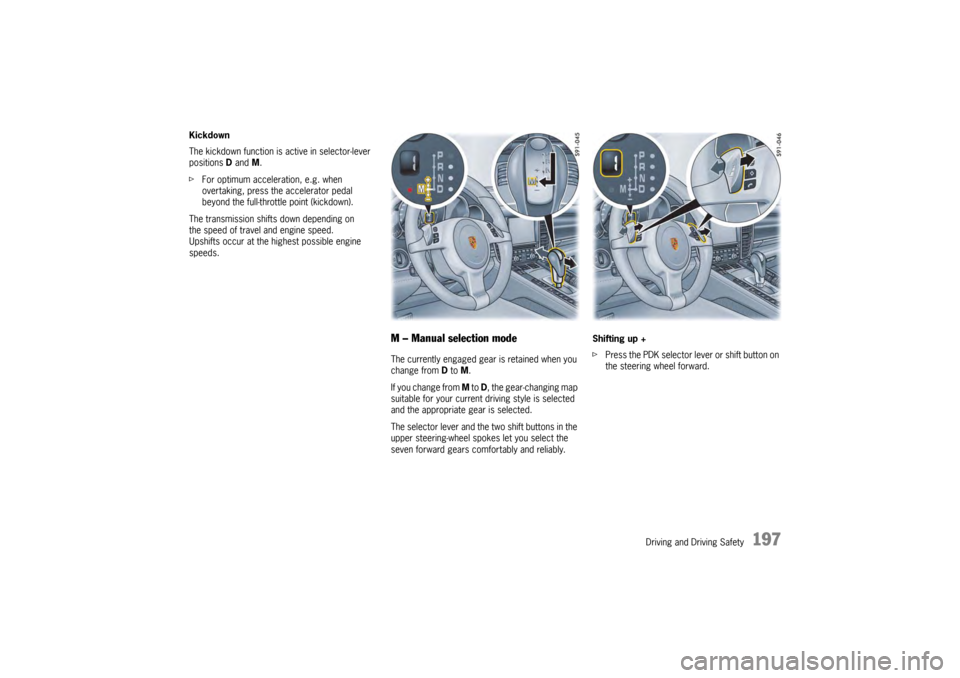
M – Manual selection modeThe currently engaged gear is retained when you
change from D to M.
If you change from M to D, the gear-changing map
suitable for your current driving style is selected
and the appropriate gear is selected.
The selector lever and the two shift buttons in the
upper steering-wheel spokes let you select the
seven forward gears comfortably and reliably. Shifting up +
f
Press the PDK selector lever or shift button on
the steering wheel forward.
Page 200 of 343
198
Driving and Driving Safety
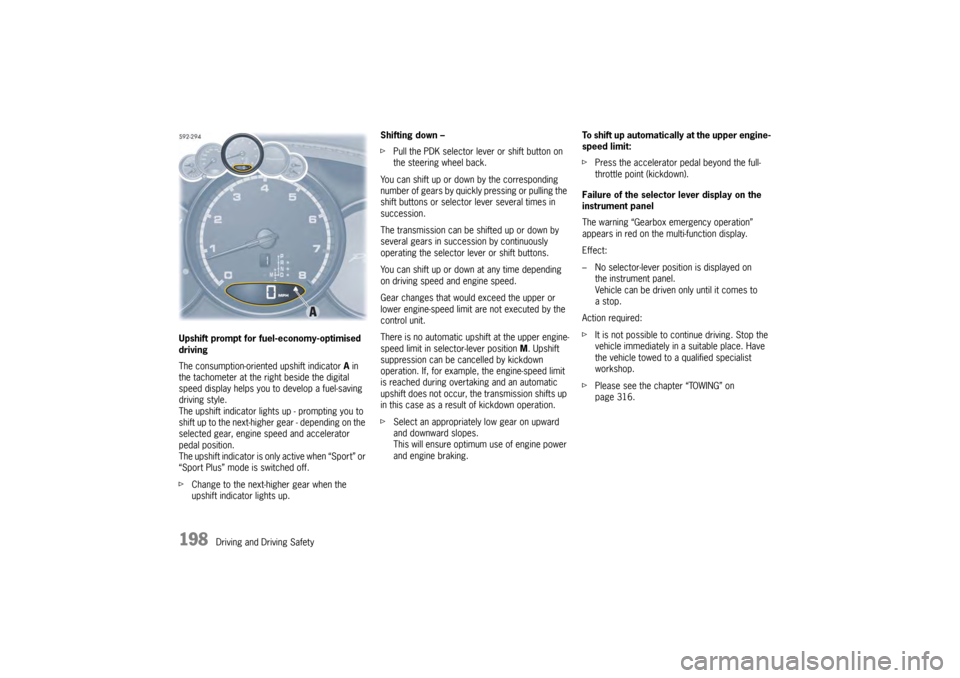
Upshift prompt for fuel-economy-optimised
driving
The consumption-oriente
d upshift indicator A in
the tachometer at the ri ght beside the digital
speed display helps you to develop a fuel-saving
driving style.
The upshift indicator lights up - prompting you to
shift up to the next-higher gear - depending on the
selected gear, engine speed and accelerator
pedal position.
The upshift indicator is only active when “Sport” or
“Sport Plus” mode is switched off.
f Change to the next-higher gear when the
upshift indicator lights up. Shifting down –
f
Pull the PDK selector lever or shift button on
the steering wheel back.
You can shift up or down by the corresponding
number of gears by quickly pressing or pulling the
shift buttons or selector lever several times in
succession.
The transmission can be shifted up or down by
several gears in succession by continuously
operating the selector lever or shift buttons.
You can shift up or down at any time depending
on driving speed and engine speed.
Gear changes that would exceed the upper or
lower engine-speed limit are not executed by the
control unit.
There is no automatic upshift at the upper engine-
speed limit in selector-lever position M. Upshift
suppression can be cancelled by kickdown
operation. If, for example, the engine-speed limit
is reached during overtaking and an automatic
upshift does not occur, the transmission shifts up
in this case as a result of kickdown operation.
f Select an appropriately low gear on upward
and downward slopes.
This will ensure optimum use of engine power
and engine braking. To shift up automatically
at the upper engine-
speed limit:
f Press the accelerator pedal beyond the full-
throttle point (kickdown).
Failure of the selector lever display on the
instrument panel
The warning “Gearbox emergency operation”
appears in red on the multi-function display.
Effect:
– No selector-lever position is displayed on the instrument panel.
Vehicle can be driven only until it comes to
astop.
Action required:
f It is not possible to continue driving. Stop the
vehicle immediately in a suitable place. Have
the vehicle towed to a qualified specialist
workshop.
f Please see the chapter “TOWING” on
page 316.
Page 201 of 343

Driving and Driving Safety
199
StoppingfFor a brief stop, e.g. at traffic lights, leave the
selector lever in drive position and hold the
vehicle with the brake pedal.
f Do not hold the vehicle on a slope using the
accelerator. Use the brake pedal or the
electric parking brake instead.
f Before leaving the vehicle, always apply the
electric parking brake and move the selector
lever to position P.Parkingf Go easy on the accelerator!
f When parking or maneuvering in a small
space, control the speed by careful use of
the footbrake.Driving in winterIn wintry road conditions, it is advisable to take
steep inclines in manual mode. This prevents gear
changes occurring that could cause wheel spin.Tow-starting, towingfPlease see the chapter “TOWING” on
page 316.
Reduced driving programIf there is a fault in the transmission
– Depending on priority, either the “Gearbox
emergency operation” warning in yellow or red
or the warning “Gearbox temperature too high”
will appear on the multi-function display.
“Gearbox emergency operation” warning in
yellow
Effects:
– Restricted gearshift comfort, reverse gear may not function.
Action required:
f Have the fault corrected immediately.
Please contact a qualified specialist workshop.
We recommend that you have an authorized
Porsche dealer to do this work as they have
trained workshop personnel and the necessary
parts and tools. “Gearbox emergency operation” warning in red
Effect:
– Vehicle can be driven
only until it comes to
astop.
Action required:
f It is not possible to continue driving. Stop the
vehicle immediately in a suitable place. Have
the vehicle towed to a qualified specialist
workshop.
f Please see the chapter “TOWING” on
page 316.
Warning “Gearbox temperature too high”
–Effects: “Warning jerks” can be fe lt when driving off and
the engine power may be restricted.
Action required:
Do not hold the vehicle with the accelerator on
a hill, for example. Hold the vehicle with the
brake. Reduce engine load. Stop the vehicle in
a suitable place if possib le. Allow the engine to
run in selector-lever position P or N until the
warning disappears.
Page 203 of 343

Driving and Driving Safety
201
Transmission and Chassis Control SystemsYour Porsche features a complex integrated system made up of all control systems acting in power transmission and in the chassis.
All control systems are networked with the aim of combining the best possible driving performance with maximum safety.
The following systems are invo lved, depending on equipment:
System/designation Scope
PTM
Porsche Traction Management – Active all-wheel drive with electronically
regulated map-controlled multiple-disc clutch
PSM
Porsche Stability Management – Driving stability control
– Anti-lock brake system (ABS)
– Brake system prefilling
– Brake booster (Hydraulic Brake Assist)
– Automatic brake differential (ABD)
– Anti-slip control (ASR)
– Engine drag torque control (MSR)
– HOLD function: standstill management
Air suspension
with level control and height adjustment – Full load-bearing air-spring stru
ts with integrated shock absorbers
– Height adjustment with Low Level setting in “S port Plus” mode and High Level setting for
maneuvering
PAS M
Porsche Active Suspension Management – Shock absorber system with adaptive, continuous shock absorber control
PDCC
Porsche Dynamic Chassis Control – Active chassis control system to stabilise
roll tendency of vehicle body when driving
– Controlled rear differential lock
Page 214 of 343

212
Driving and Driving Safety
“Sport” and “Sport Plus” Mode FunctionThe selectable chassis settings mean that the
vehicle can offer various modes for a sportier
overall setup.
When “Sport” or “Sport Plus” mode is selected, all
the vehicle’s control systems are intentionally
shifted towards greater agility and driving
performance:
– PASM (Porsche Active Suspension Management) is automa tically changed to
“PASM Sport” or “PASM Sport Plus” mode,
resulting in a stiffer suspension setup.
The vehicle switches to Low Level in “PASM
Sport Plus” mode.
f Please see the chapter “PORSCHE ACTIVE
SUSPENSION MANAGEMENT (PASM)” on
page 208.
– Just like PASM, PDCC is switched to the corresponding “Sport” or “Sport Plus” mode,
whereby the rolling movements of the vehicle
are reduced further, depending on the
selected mode.
f Please see the chapter “PORSCHE DYNAMIC
CHASSIS CONTROL (PDCC)” on page 211.
– The PDK transmission switches to a sporty gear-changing map and shortens the gear
shifting times when Sport mode is activated.
Gear changes take place faster. f
Please see the chapter ““SPORT” AND “SPORT
PLUS” MODE” on page 195.
– The electronic accelerator pedal reacts sooner, and the engine is more responsive to
throttle inputs. When Sport mode is switched
on and the vehicle is travelling at a speed of
less than 25 mph (40 km/h), this function is
activated only after the driver has floored the
accelerator pedal or released it briefly.
– The rpm limiter characteristic is “harder”. In other words: the engine is immediately
throttled when the performance limits are
reached (only in manual selection mode on
vehicles with PDK).
– The turbo overboost briefly increases the engine boost pressure in the engine speed
range from 2,500 rpm to approx. 4,000 rpm.
As a result, torque in this speed range is
increased by 70 Nm (52 ftlb.). This
considerably improves acceleration and
flexibility, particularly in the medium engine
speed range. This does not affect the
maximum power. Quickly flooring the
accelerator pedal acti vates turbo overboost
in the engine control system. Overboost has
an effective operating time of approx.
10 seconds. After this time, it can be re-
activated by quickly flooring the accelerator
pedal again. – PSM (Porsche Stability Management) control is
more sporty in “Sport Plus” mode. PSM
interventions are later than in Normal mode.
The driver can maneuver the vehicle with
greater agility at it s performance limits,
without having to dispense with the assistance
of PSM in emergency situations. This helps to
achieve optimal lap times, particularly on race
circuits with a dry road surface.
f Please see the chapter “PORSCHE STABILITY
MANAGEMENT (PSM)” on page 202.
– Adaptive cruise control regulates speed and distance more dynamically.
– The Auto Start Stop function is deactivated.
f Please see the chapter “AUTO START STOP
FUNCTION” on page 169.
– The rear spoiler extends earlier and retracts later (“Sport Plus” mode only).
f Please see the chapter “RETRACTABLE REAR
SPOILER” on page 214.
– The system switches from High Level.
f Please see the chapter “HIGH LEVEL” on
page 209.
Page 215 of 343
Driving and Driving Safety
213
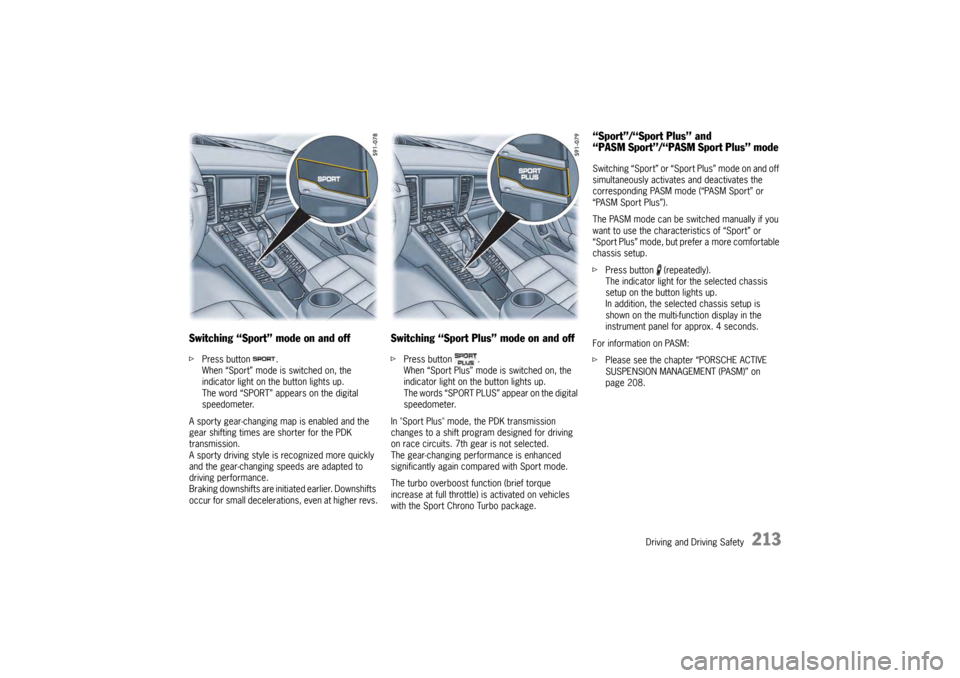
Switching “Sport” mode on and offfPress button .
When “Sport” mode is switched on, the
indicator light on the button lights up.
The word “SPORT” appears on the digital
speedometer.
A sporty gear-changing map is enabled and the
gear shifting times ar e shorter for the PDK
transmission.
A sporty driving style is recognized more quickly
and the gear-changing speeds are adapted to
driving performance.
Braking downshifts are initiated earlier. Downshifts
occur for small decelerations, even at higher revs.
Switching “Sport Plus” mode on and offf Press button .
When “Sport Plus” mode is switched on, the
indicator light on the button lights up.
The words “SPORT PLUS” appear on the digital
speedometer.
In "Sport Plus" mode, the PDK transmission
changes to a shift progra m designed for driving
on race circuits. 7th gear is not selected.
The gear-changing performance is enhanced
significantly again compared with Sport mode.
The turbo overboost function (brief torque
increase at full throttle) is activated on vehicles
with the Sport Chrono Turbo package.
“Sport”/“Sport Plus” and
“PASM Sport”/“PASM Sport Plus” mode Switching “Sport” or “Sport Plus” mode on and off
simultaneously activates and deactivates the
corresponding PASM mode (“PASM Sport” or
“PASM Sport Plus”).
The PASM mode can be sw itched manually if you
want to use the characteristics of “Sport” or
“Sport Plus” mode, but prefer a more comfortable
chassis setup.
f Press button (repeatedly).
The indicator light for the selected chassis
setup on the button lights up.
In addition, the selected chassis setup is
shown on the multi-function display in the
instrument panel for approx. 4 seconds.
For information on PASM:
f Please see the chapter “PORSCHE ACTIVE
SUSPENSION MANAGEMENT (PASM)” on
page 208.
Page 275 of 343

Maintenance and Car Care
273
Care of windshield wiper bladesWindshield wiper blades that are in perfect
condition are vital for a clear view.
fPlease see the chapter “WIPER BLADES” on
page 261.
f Have the wiper blades replaced twice per year
(before and after the cold season) or if wiper
performance deteriorates or the blades are
damaged.
f Clean the wiper blades with window cleaner at
regular intervals, especially after washing the
vehicle in a car wash.
We recommend Porsche window cleaner.
If wiper blades are very dirty (e.g. covered with
insect remains), they can be cleaned with
a sponge or cloth.
If the wiper blades rub or squeak, this may be due
to the following:
– If the vehicle is washed in an automatic car wash, wax residues may adhere to
the windshield. These wax residues can
be removed only by using window
cleaner concentrate.
f Please see the chapter “WASHER FLUID” on
page 259. Contact your authorized Porsche dealer for more
information.
– The wiper blades may be damaged or worn.
f
Have damaged wiper blades replaced
immediately.
UndercoatingThe underside of your car is durably protected
against chemical and mechanical influences.
As it is not possible to ex clude the risk of damage
to this protective coating in day to day driving, it
is advisable to have the underside of the car
inspected at certain intervals - preferably before
the start of winter and again in spring - and the
undercoating restored as necessary.
Your authorized Porsche dealer is familiar with the
bodyseal treatment procedures and has the
necessary equipment for applying factory
approved materials. We recommend that you
entrust them with such work and inspections.
Unlike conventional spray oils, undercoating and
rust-proofing compounds based on bitumen or
wax do not attack the sound-proofing materials
applied at the factory.
Warning!
Danger of fire resulting in serious personal
injury or death.
f Do not apply additional undercoating or rust-
proofing on or near the exhaust manifold,
exhaust pipes, catalytic converters or heat
shields. During driving the substance used for undercoating could overheat and ignite.
f Before applying fresh underseal, carefully
remove deposits or dirt and grease. Once it
has dried, the new undercoating compound
forms a tough protective coating which
provides efficient rust-proofing of the floor
panels and components.
f Always apply a fresh coating of suitable preser-
vative to unprotect areas after cleaning the
underside of the body, the transmission, the
engine or carrying out repairs to under-body,
engine or transmission components.
Effective rust-proofing is particularly important
during the cold weather season. If your car is
driven frequently in areas where salt has been
spread on the roads, the whole engine compart-
ment should be cleane d thoroughly after the
winter to prevent salt from causing any lasting
damage. A full under-body wash should also be
performed at the same time.
Page 292 of 343
290
Minor Repairs
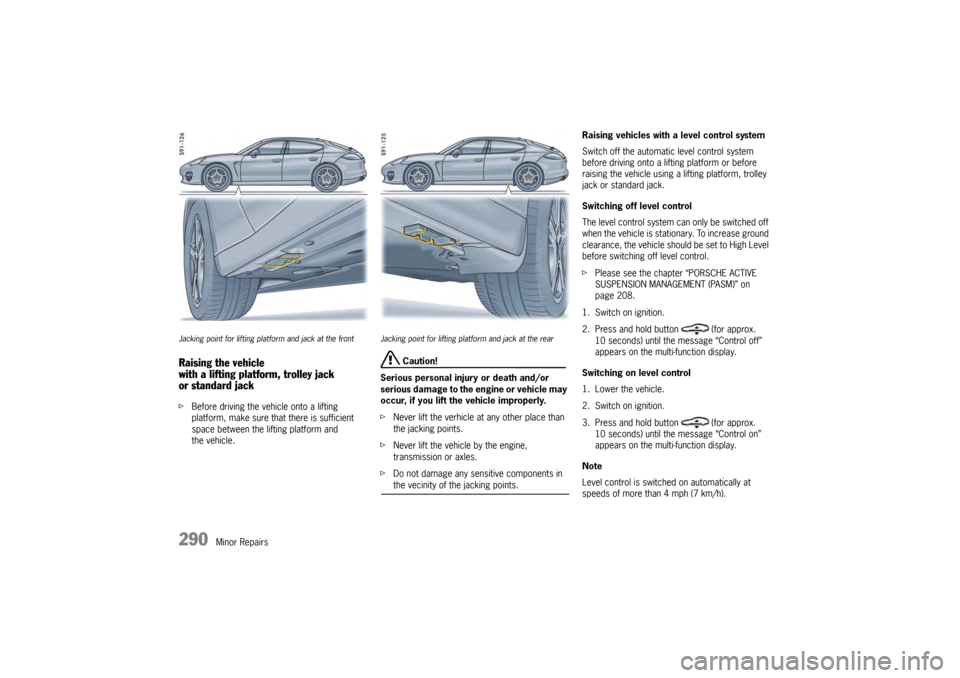
Jacking point for lifting platform and jack at the frontRaising the vehicle
with a lifting platform, trolley jack
or standard jack fBefore driving the vehicle onto a lifting
platform, make sure that there is sufficient
space between the lifting platform and
the vehicle.
Jacking point for lifting platform and jack at the rear
Caution!
Serious personal injury or death and/or
serious damage to the engine or vehicle may
occur, if you lift the vehicle improperly.
f Never lift the verhicle at any other place than
the jacking points.
f Never lift the vehicle by the engine,
transmission or axles.
f Do not damage any sensitive components in the vecinity of the jacking points. Raising vehicles with a level control system
Switch off the automatic level control system
before driving onto a lifting platform or before
raising the vehicle using a lifting platform, trolley
jack or standard jack.
Switching off level control
The level control system can only be switched off
when the vehicle is stationary. To increase ground
clearance, the vehicle shou
ld be set to High Level
before switching off level control.
f Please see the chapter “PORSCHE ACTIVE
SUSPENSION MANAGEMENT (PASM)” on
page 208.
1. Switch on ignition.
2. Press and hold button (for approx. 10 seconds) until the message “Control off”
appears on the multi-function display.
Switching on level control
1. Lower the vehicle.
2. Switch on ignition.
3. Press and hold button (for approx. 10 seconds) until the message “Control on”
appears on the multi-function display.
Note
Level control is switched on automatically at
speeds of more than 4 mph (7 km/h).