check engine PORSCHE PANAMERA 2009 1.G Information Manual
[x] Cancel search | Manufacturer: PORSCHE, Model Year: 2009, Model line: PANAMERA, Model: PORSCHE PANAMERA 2009 1.GPages: 343, PDF Size: 7.96 MB
Page 172 of 343
170
Driving and Driving Safety
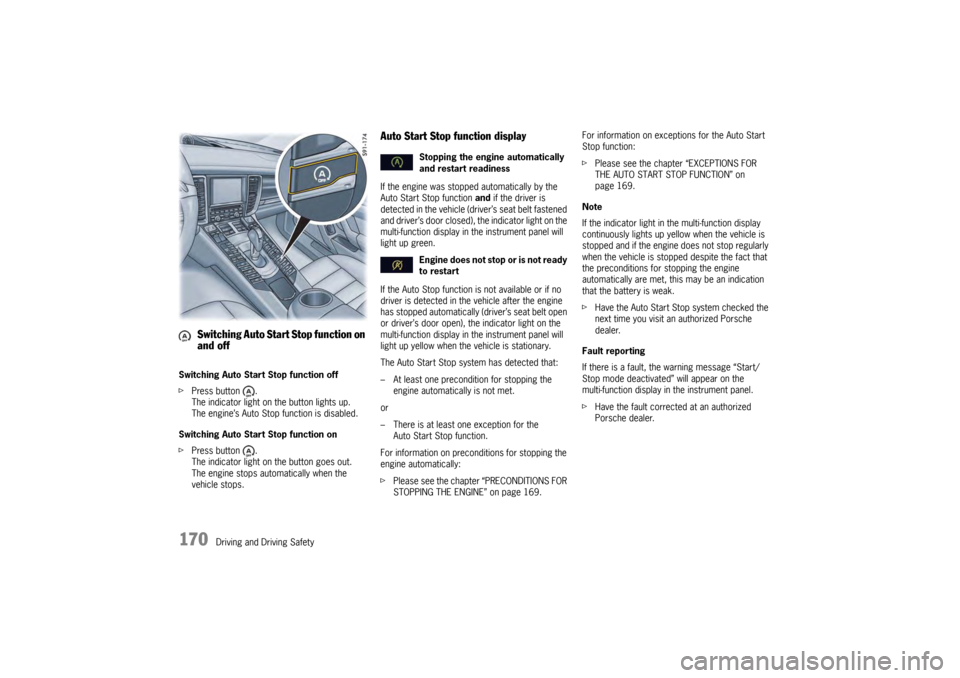
Switching Auto Start Stop function off
f
Press button .
The indicator light on the button lights up.
The engine’s Auto Stop function is disabled.
Switching Auto Start Stop function on
f Press button .
The indicator light on the button goes out.
The engine stops automatically when the
vehicle stops.
Auto Start Stop function displayIf the engine was stoppe d automatically by the
Auto Start Stop function and if the driver is
detected in the vehicle (driver’s seat belt fastened
and driver’s door closed), the indicator light on the
multi-function display in the instrument panel will
light up green.
If the Auto Stop function is not available or if no
driver is detected in the vehicle after the engine
has stopped automatically (driver’s seat belt open
or driver’s door open), the indicator light on the
multi-function display in the instrument panel will
light up yellow when the vehicle is stationary.
The Auto Start Stop system has detected that:
– At least one precondition for stopping the engine automatically is not met.
or
– There is at least one exception for the Auto Start Stop function.
For information on preconditions for stopping the
engine automatically:
f Please see the chapter “PRECONDITIONS FOR
STOPPING THE ENGINE” on page 169. For information on exceptions for the Auto Start
Stop function:
f
Please see the chapter “EXCEPTIONS FOR
THE AUTO START STOP FUNCTION” on
page 169.
Note
If the indicator light in the multi-function display
continuously lights up yellow when the vehicle is
stopped and if the engine does not stop regularly
when the vehicle is stoppe d despite the fact that
the preconditions for stopping the engine
automatically are met, this may be an indication
that the battery is weak.
f Have the Auto Start Stop system checked the
next time you visit an authorized Porsche
dealer.
Fault reporting
If there is a fault, the warning message “Start/
Stop mode deactivated” will appear on the
multi-function display in the instrument panel.
f Have the fault corrected at an authorized
Porsche dealer.
Switching Auto Start Stop function on
and off
Stopping the engine automatically
and restart readiness
Engine does not stop or is not ready
to restart
Page 176 of 343

174
Driving and Driving Safety
Brake boosterThe brake booster assists braking only when
the engine is running.
When the car is moving while the engine is not
running, or if the brake booster is defective, more
pressure on the brake pedal is required to bring
the car to a stop.
Moisture, road salt or grit on brakes affects
braking.
Brakes will dry after a few cautious brake
applications.
Warning!
Risk of an accident, resulting in serious
personal injury or death.
Driving through water may reduce the
traction. Moisture on brakes from road
water, car wash, or a coating of road salt or
grit may affect braking efficiency.
f Cautiously apply brakes to test brakes after exposure to road water, etc.
Brake wearYour car has excellent brakes, but they are still
subject to wear. The rate at which they wear
depends on how the brakes are used.
f Have the brake system inspected at the
intervals recommended in your Maintenance
Booklet.
Brake system warning light
You can check the functionality of the brake
system warning light by switching the ignition to
the “On” position (position 1) and verifying that the
warning light illuminates.
A warning message will be displayed on the multi-
function display of the instrument panel if the
brake pads are worn, excessively.
f Do not continue to operate the vehicle.
Have your authorized Porsche dealer inspect
or replace the brake pads.
For information on warning messages on the
multi-function display:
f Please see the chapter “OVERVIEW OF
WARNING MESSAGES” on page 152.
Brake pads and brake discsWear on the brake pads and brake discs depends
to a great extent on the driving style and the
conditions of use and therefore cannot be
expressed in actual miles on the road.
The high-performance brake system is designed
for optimal braking effect at all speeds and
temperatures.
Certain speeds, braking forces and ambient
conditions (e.g. temperature and humidity) can
therefore cause the brakes to “squeal”.
New brake pads or linings
New brake pads have to be “broken in”, and
therefore only attain optimal friction when the car
has covered several hundred miles or km.
The slightly reduced braking ability must be
compensated for by pressing the brake pedal
harder. This applies whenever the brake pads
and/or brake discs are replaced.
Brake wear warning message
Page 177 of 343

Driving and Driving Safety
175
Warning!
f Do not obstruct the pedal travel with floor mats
or other objects.
The brake booster is ready for operation only
while the engine is running.
If the engine is switched off or there is a defect in
the brake booster, much greater force has to be
applied to the pedal when braking.
f Vehicles with defective brakes must not
be towed and must be transported on a flat
bed.
For information on towing and tow-starting:
f Please see the chapter “TOWING” on
page 316.
In heavy rain, while driving through water or after
leaving a car wash, the braking action may be
delayed and increased pressure may be required.
f For this reason, keep further back from the
vehicle in front and “dry” the brakes by
applying them at interval s. Make sure that the
traffic behind you is not affected. After a long drive over salted or gritted roads,
a coating may form on the brake discs and pads
that significantly reduces
friction and therefore
also braking effect.
f Even though the brake discs consist of alloyed
grey cast iron, they will unavoidably start to
corrode if your vehicle is parked for an
extended period. The brakes will tend to “rub”
as a result.
The nature, extent and effects of corrosion
depend on the amount of time the vehicle was
parked, whether road salt or grit was spread
and whether grease-dissolving agents were
used in car washes (not on vehicles with
Porsche Ceramic Composite Brake).
To prevent corrosion of the brake discs,
“brake them dry” before parking the vehicle
(not on vehicles with Porsche Ceramic
Composite Brake).
If braking comfort is no ticeably impaired, we
recommend that you have the brake system
checked by an authorized Porsche dealer. f
To relieve the brake system on downhill
stretches, change down to a lower gear in
good time (engine braking).
If engine braking is insufficient on steep
stretches, operate the footbrake at intervals.
Avoid continuous braking as it overheats the
brakes and reduces the braking effect.
For information on brake fluid and checking the
brake fluid level:
f Please see the chapter “BRAKE FLUID” on
page 258.
Page 209 of 343

Driving and Driving Safety
207
ABS Brake System
(Anti-Lock Brake System)
Warning!
In spite of the advantages of ABS, it is still the
driver’s responsibility to adapt his driving style and
maneuvers in line with road and weather
conditions, as well as the traffic situation.
The increased safety that is provided should not
induce you to take greater risks with your safety.
The limits set by the physic s of driving cannot be
overcome, even with ABS.
Risk of accidents due to inappropriate speed
cannot be reduced by ABS.
ABS ensures
– Full steering control
The vehicle remains steerable
– Good driving stability
No skidding due to locked wheels
– Optimum braking distance
Shorter stopping distance in most cases
– Prevention of wheel locking
No flat spots on the tires Function
The decisive advantage of ABS lies in the driving
stability and maneuverability of the vehicle in
hazardous situations.
ABS prevents locking of
the wheels during full
braking, on almost all road surfaces, until just
before the vehicle stops.
ABS begins to control the braking process as
soon as a wheel shows a tendency to lock.
This controlled braking process is comparable
with extremely rapid cadence braking.
The pulsating brake pedal and a “juddering noise”
warn the driver to adapt his driving speed to the
road conditions.
f If full braking is necessary, press the brake
pedal fully during the whole braking operation,
even though the pedal is pulsating. Do not
reduce brake pressure. If the ABS warning light lig
hts up on the instrument
panel while the engine is running, the ABS has
switched off because of a fault.
The warning message “ABS failure” appears on
the multi-function display in the instrument panel.
For information on warning messages on the
multi-function display:
f Please see the chapter “OVERVIEW OF
WARNING MESSAGES” on page 152.
In this case, the brake system will operate without
lock prevention, as on vehicles without ABS.
f Adapt your driving style to the changed
braking behavior.
The ABS must be checked by your authorized
Porsche dealer in order to prevent the
occurrence of further faults with unpredictable
consequences.
Please contact a qualified specialist workshop.
We recommend that you have an authorized
Porsche dealer to do this work as they have
trained workshop personnel and the necessary
parts and tools.
The ABS control unit is adjusted for the approved
tire dimensions.
The use of tires with no n-approved dimensions can
lead to different wheel speeds, causing ABS to
switch off. Warning light USA
Warning light Canada
Page 252 of 343

250
Alarm System and Theft Protection
ImmobilizerThere is a transponder (an electronic component),
containing a stored code, in each key.
Before the ignition is switched on, the ignition lock
checks the code.
The immobiliser can be deactivated and
the engine started only using an authorised
ignition key.
Locking the Steering ColumnVehicles without Porsche Entry & Drive Unlocking the steering column automatically
f Insert the ignition key into the ignition lock.
Locking the steering column automatically
f Remove the ignition key.Vehicles with Porsche Entry & DriveUnlocking the steering column automatically
f Turn the control unit out of ignition lock
position 0 .
Locking the steering column automatically
f Open the driver’s door (with the ignition
switched off).
Locking the steering column manually
f Once the ignition is sw itched off, turn the
control unit to ignition lock position 3 again
and hold it there for 2seconds.
The steering column locks with an
audible click.
Theft ProtectionWhen leaving the vehicle, always:
f Close all door windows.
f Close the slide/tilt roof.
f Remove the ignition key (or switch ignition off
on vehicles with Porsche Entry & Drive).
f Lock the glove box.
f Close all storage compartments.
f Remove valuables, vehicle registration
documents, telephone and house keys from
the vehicle.
f Cover the luggage compartment with the
retractable luggage compartment cover.
f Close the tailgate.
f Lock all doors.
Page 253 of 343
Maintenance and Car Care
251
Maintenance and Car Care
Exercise Extreme Caution when Working
on your vehicle........
................................... 252
Engine Oil ............... ................................... 254
Checking Engine-Oil Le vel ........................... 254
Topping Up Engine Oil . .............................. 255
Checking Coolant Level and Adding
Coolant ........................................... .......... 257
Brake Fluid .................. .............................. 258
Washer Fluid .......... ................................... 259
Power Steering ...... ................................... 260
Changing Air Cleaner .................................. 261
Changing Particle Filt er ............................... 261
Wiper Blades ............... .............................. 261
Emission Control Syst em ............................ 262
How Emission Control Works ...................... 263
Fuel Economy .............. .............................. 264
Operating Your Porsche in other Countries ... 264
Fuel............................. .............................. 265
Fuel Can ...................... .............................. 267
Fuel Recommendation s............................... 268
Fuel Evaporation Contr ol ............................ 269
Car Care Instructions .................................. 269
Page 255 of 343

Maintenance and Car Care
253
Technical ModificationsfModifications may be carried out on your
vehicle only if approved by Porsche.
This ensures that your Porsche will remain
reliable and safe to drive, and that it will not be
damaged as a result of the modifications.
Your authorized Porsche dealer will be pleased
to advise you.
Safety notes!
f Only use genuine Porsche spare parts for your
vehicle or spare parts of similar quality which
have been manufactured according to the
specifications and production requirements of
Porsche. These parts are available from your
authorized Porsche dealer or a qualified
specialist workshop. Safety-related
accessories should only be used if they are
from the Porsche Tequipment range or are
tested and approved by Porsche. Your
authorized Porsche dealer will be pleased to
advise you and answer any questions you may
have.
However, the use of other parts or
accessories may adversel y affect the safety
of your vehicle, and Porsche can take no
responsibility for any loss or damage caused
by their use.
Even if the supplier of other accessories or
parts is a recognized supplier, the safety of
your vehicle may still be affected if such items
are installed.
Due to the large variety of products offered in the accessory market, it is not possible for
Porsche to inspect and approve every one.
f In addition, please note that the use of
replacement parts that are not genuine
Porsche parts or approved parts, or the use of
accessories not approved by Porsche may
also detrimentally affect your vehicle warranty.
f Check your vehicle regularly for signs of
damage. Damaged or missing aerodynamic
components, such as spoilers or underbody
panels, impair vehicle handling and must
therefore be replaced immediately.
Radiator fanFor information on radiator fans:
fPlease see the chapter “RADIATOR FANS” on
page 258.
Warning!
Danger of injury. After the ignition is
switched off, the engine compartment and
coolant temperatures are monitored for
approx. 30 minutes. During this period, and
depending on temperature, the radiator fan
may continue to run or start to run.
f Carry out work in these areas only with the engine off and exercise extreme caution.
Measurements on test standsPerformance test
Performance tests on roller-type test stands are
not approved by Porsche.
Brake tests
Brake tests must be performed only on roller-type
test stands.
The following limit values must not be exceeded
on roller-type test stands:
– Test speed 4.7 mph (7.5 km/h)
– Test duration 20 seconds
Testing the electric parking brake
Electric parking brake tests on the brake test
stand must only be performed with the ignition
switched on and with the manual gearshift lever in
neutral or the Porsche Doppelkupplung selector
lever in position N.
The vehicle switches auto matically to brake test
stand mode, in which the electric parking brake
can be tested.
The message “Electric parking brake in service
mode” appears on the multi-function display in the
instrument panel.
Balancing wheels on the vehicle
During finish balancing of the wheels, the entire
vehicle must be lifted and the wheels must be free
to turn.
Page 256 of 343

254
Maintenance and Car Care
Engine OilIt is important to perform oil changes regularly in
accordance with the intervals specified in your
Maintenance Schedule.Engine oil consumptionIt is normal for your engine to consume oil.
The rate of oil consumption depends on the quality
and viscosity of oil, the speed at which the engine
is operated, the climate, road conditions as well
as the amount of dilution and oxidation of the
lubricant.
If the vehicle is used for repeated short trips, and
consumes a normal amount of oil, the engine oil
measurement may not show any drop in the oil
level at all, even afte r 600 miles (1000 km) or
more. This is because the oil is gradually
becoming diluted with fuel or moisture, making it
appear that the oil level has not changed.
The diluting ingredients evaporate out when the
vehicle is driven at high speeds, as on an
expressway, making it then appear that oil is
excessively consumed after driving at high
speeds.
If the conditions you drive your vehicle in are
dusty, humid, or hot, the frequency of the oil
change intervals should be greater. If the vehicle is driven at a high rate of speed,
climatic conditions are warm, and the load is high,
the oil should be checked more frequently, as
driving conditions will de
termine the rate of oil
consumption.
– The engine in your vehicle depends on oil to lubricate and cool all of its moving parts.
Therefore, the engine oil should be checked
regularly and kept at the required level.
– Make it a habit to have the engine oil level checked with every refueling.
– The oil pressure warning light is not an oil level indicator.
The oil pressure warning light indicates serious
engine damage may be occuring when lit, if
engine rpm is above idle speed.
Checking Engine-Oil Levelf Check the oil level on the multi-function display
at regular intervals before refuelling.
f Please see the chapter “OIL LEVEL DISPLAY
AND MEASUREMENT OF THE ENGINE OIL
LEVEL” on page 121.
Warning!
Engine oil is hazardous to your health and
may be fatal if swallowed.
f Keep engine oil out of children's reach.
Used engine oil contains chemicals that have
caused cancer in laboratory animals.
f Always protect your skin by washing thoroughly with soap and water.
Top-up quantity
The difference between the minimum and
maximum marks on the segment display is
approx. 1.06 US quearts (1 liter).
One segment of the display corresponds to
a top-up quantity of approx. 0.26 US quarts
(0.25 liters).
f Never add more engine oil than required to
reach the maximum mark.
Page 258 of 343
256
Maintenance and Car Care
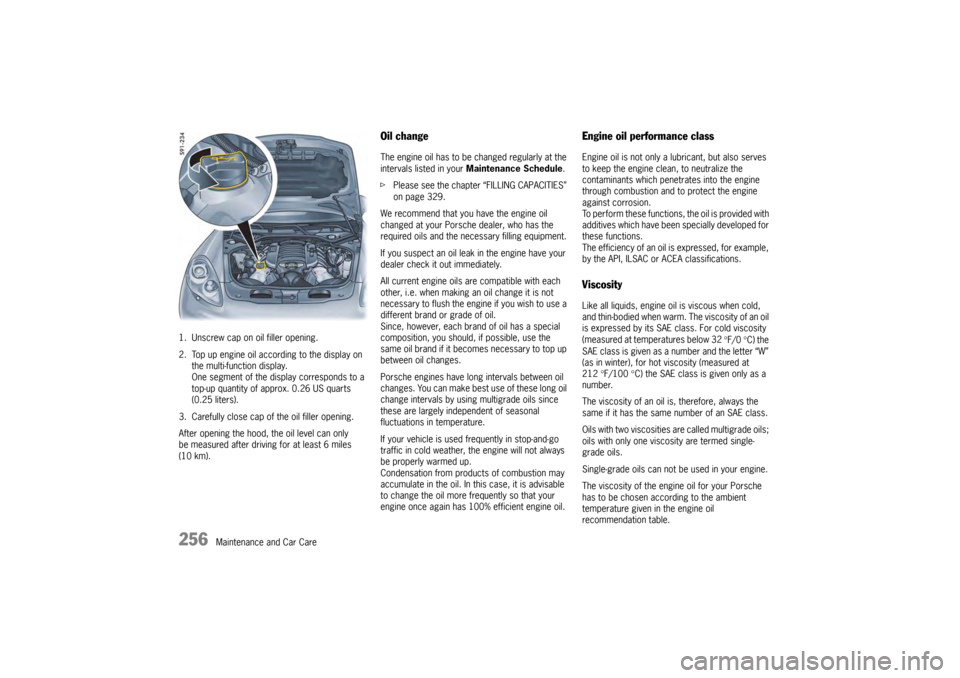
1. Unscrew cap on oil filler opening.
2. Top up engine oil according to the display on
the multi-function display.
One segment of the display corresponds to a
top-up quantity of approx. 0.26 US quarts
(0.25 liters).
3. Carefully close cap of the oil filler opening.
After opening the hood, the oil level can only
be measured after driving for at least 6 miles
(10 km).
Oil changeThe engine oil has to be changed regularly at the
intervals listed in your Maintenance Schedule .
f Please see the chapter “FILLING CAPACITIES”
on page 329.
We recommend that you have the engine oil
changed at your Porsche dealer, who has the
required oils and the necessary filling equipment.
If you suspect an oil leak in the engine have your
dealer check it out immediately.
All current engine oils are compatible with each
other, i.e. when making an oil change it is not
necessary to flush the engi ne if you wish to use a
different brand or grade of oil.
Since, however, each brand of oil has a special
composition, you should, if possible, use the
same oil brand if it beco mes necessary to top up
between oil changes.
Porsche engines have long intervals between oil
changes. You can make best use of these long oil
change intervals by usin g multigrade oils since
these are largely independent of seasonal
fluctuations in temperature.
If your vehicle is used frequently in stop-and-go
traffic in cold weather, the engine will not always
be properly warmed up.
Condensation from products of combustion may
accumulate in the oil. In this case, it is advisable
to change the oil more frequently so that your
engine once again has 100% efficient engine oil.
Engine oil performance class Engine oil is not only a lubricant, but also serves
to keep the engine clean, to neutralize the
contaminants which penetrates into the engine
through combustion and to protect the engine
against corrosion.
To perform these functions, the oil is provided with
additives which have been specially developed for
these functions.
The efficiency of an oil is expressed, for example,
by the API, ILSAC or ACEA classifications. Viscosity Like all liquids, engine oil is viscous when cold,
and thin-bodied when warm. The viscosity of an oil
is expressed by its SAE class. For cold viscosity
(measured at temperatures below 32 °
F/0 °
C) the
SAE class is given as a number and the letter “W”
(as in winter), for hot viscosity (measured at
212 °
F/100 °
C) the SAE class is given only as a
number.
The viscosity of an oil is, therefore, always the
same if it has the same number of an SAE class.
Oils with two viscosities are called multigrade oils;
oils with only one viscosity are termed single-
grade oils.
Single-grade oils can not be used in your engine.
The viscosity of the engine oil for your Porsche
has to be chosen according to the ambient
temperature given in the engine oil
recommendation table.
Page 259 of 343
Maintenance and Car Care
257
Checking Coolant Level and
Adding CoolantThe coolant provides year-round protection
from corrosion and freezing down to –31 °F
(–35 °C) (–40 °F (–40 °C) in Nordic countries).
Observe the following points:
fUse only antifreeze authorised by Porsche.
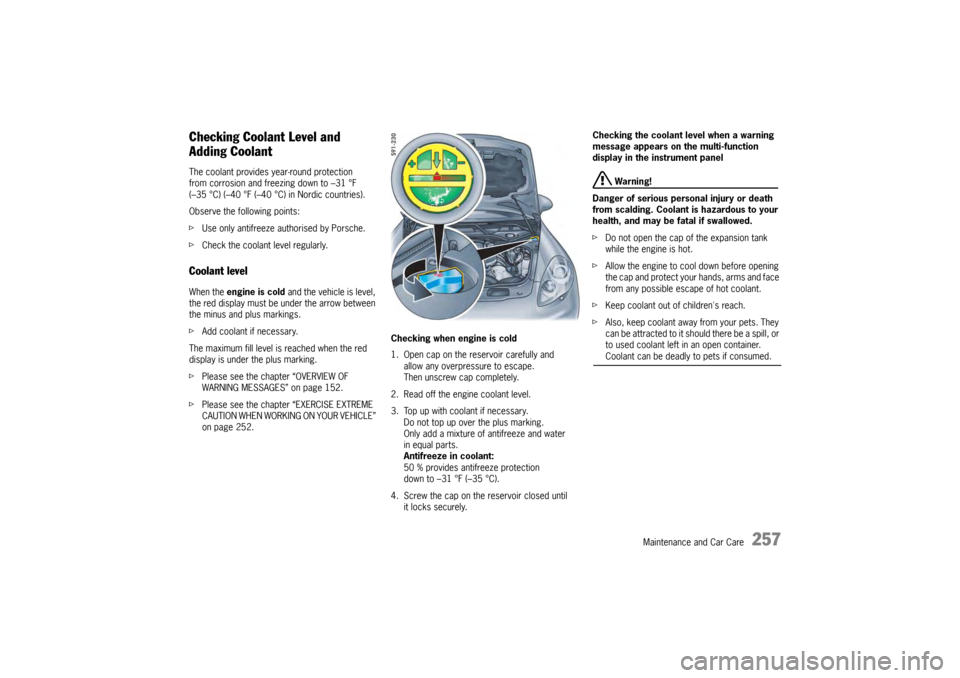
f Check the coolant level regularly.Coolant levelWhen the engine is cold and the vehicle is level,
the red display must be under the arrow between
the minus and plus markings.
f Add coolant if necessary.
The maximum fill level is reached when the red
display is under the plus marking.
f Please see the chapter “OVERVIEW OF
WARNING MESSAGES” on page 152.
f Please see the chapter “EXERCISE EXTREME
CAUTION WHEN WORKING ON YOUR VEHICLE”
on page 252. Checking when engine is cold
1. Open cap on the reservoir carefully and
allow any overpressure to escape.
Then unscrew cap completely.
2. Read off the engine coolant level.
3. Top up with coolant if necessary. Do not top up over the plus marking.
Only add a mixture of antifreeze and water
in equal parts.
Antifreeze in coolant:
50 % provides antifreeze protection
down to –31 °F (–35 °C).
4. Screw the cap on the reservoir closed until it locks securely. Checking the coolant level when a warning
message appears on the multi-function
display in the instrument panel
Warning!
Danger of serious personal injury or death
from scalding. Coolant is hazardous to your
health, and may be fatal if swallowed.
f Do not open the cap of the expansion tank
while the engine is hot.
f Allow the engine to cool down before opening
the cap and protect your hands, arms and face
from any possible escape of hot coolant.
f Keep coolant out of children's reach.
f Also, keep coolant away from your pets. They
can be attracted to it should there be a spill, or
to used coolant left in an open container. Coolant can be deadly to pets if consumed.