fuel PORSCHE PANAMERA 2010 1.G Information Manual
[x] Cancel search | Manufacturer: PORSCHE, Model Year: 2010, Model line: PANAMERA, Model: PORSCHE PANAMERA 2010 1.GPages: 80, PDF Size: 6.26 MB
Page 24 of 80

· 56 ·· 57 ·
Performance | Transmission
Power flow in 1st gear
Power flow in 2nd gear
The flow of power from the
engine is transmit ted through one
half gearbox and one clutch at a
time, while the next gear is pre -
selected in the other half gearbox.
During a gear change, therefore,
a complete shif t no longer takes
place. Instead, one clutch simply
opens and the other closes at the
same time. Gear changes can
therefore take place within a few
hundredths of a second.
Clutch 1 controls the first half
gearbox, which contains the odd
gears (1, 3, 5 and 7). Clutch 2
controls the second, which con -
tains the even gears (2, 4, 6 and
R). The gear which is engaged
is displayed on the instrument
cluster.
PDK has distinct benefits. A high
level of driving comfort and
very rapid gearshifts, with no
interruption in the flow of power,
produces faster acceleration.
Driving feels even sportier and
more dynamic, and agilit y is
increased. Depending on the gear -
shif t programme (SPORT but ton
activated or deactivated), the gear
change is optimised for comfort
or for sport y driving. Its high level
of ef ficiency combined with the
long-ratio 7th gear helps to
achieve reduced fuel consumption
and emission figures even when
compared with a standard manual
gearbox.
In conjunction with either the
optional Sport Chrono Package
Plus (p. 74) for all Panamera
models with a naturally aspirated
engine or the optional Sport
Chrono Package Turbo for the
Panamera Turbo (p. 76), PDK is
enhanced by a Launch Control
function which offers a sportier
acceleration and gearshift
strategy in automatic mode and
extremely smooth gear changes
in manual mode.
PDK offers sportiness with
efficiency and comfort. A new
definition of driving in the
pre
mium class from Porsche.
Page 27 of 80
· 62 ·· 63 ·
4
7
9
4
6
10
1
23
5
8
11
2
3
12
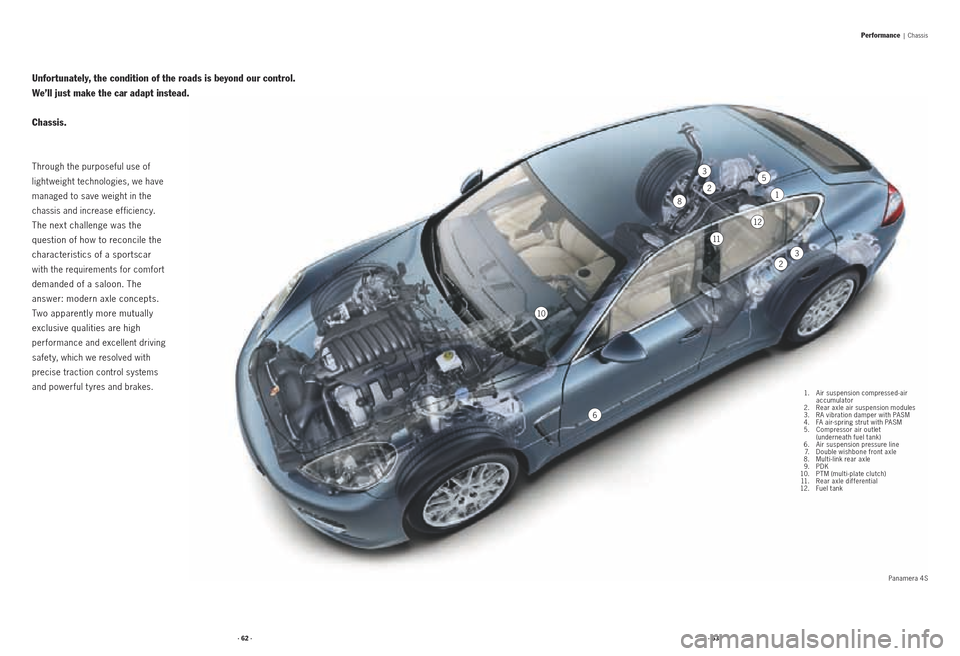
Through the purposeful use of
light weight technologies, we have
managed to save weight in the
chassis and increase ef ficiency.
The next challenge was the
question of how to reconcile the
characteristics of a sportscar
with the requirements for comfort
demanded of a saloon. The
answer: modern axle concepts.
Two apparently more mutually
exclusive qualities are high
performance and excellent driving
safet y, which we resolved with
precise traction control systems
and powerful t yres and brakes.
Panamera 4S
Performance | Chassis
Unfortunately, the condition of the roads is beyond our control.
We’ll just make the car adapt instead.
Chassis.
1. Air suspension compressed -air
accumulator
2. Rear axle air suspension modules
3. RA vibration damper with PASM
4. FA air-spring strut with PASM
5. Compressor air outlet
(underneath fuel tank)
6. Air suspension pressure line
7. Double wishbone front axle
8. Multi - link rear axle
9. PDK
10. PTM (multi - plate clutch)
11. Rear axle dif ferential
12. Fuel tank
Page 28 of 80
· 64 ·· 65 ·
Performance | Chassis
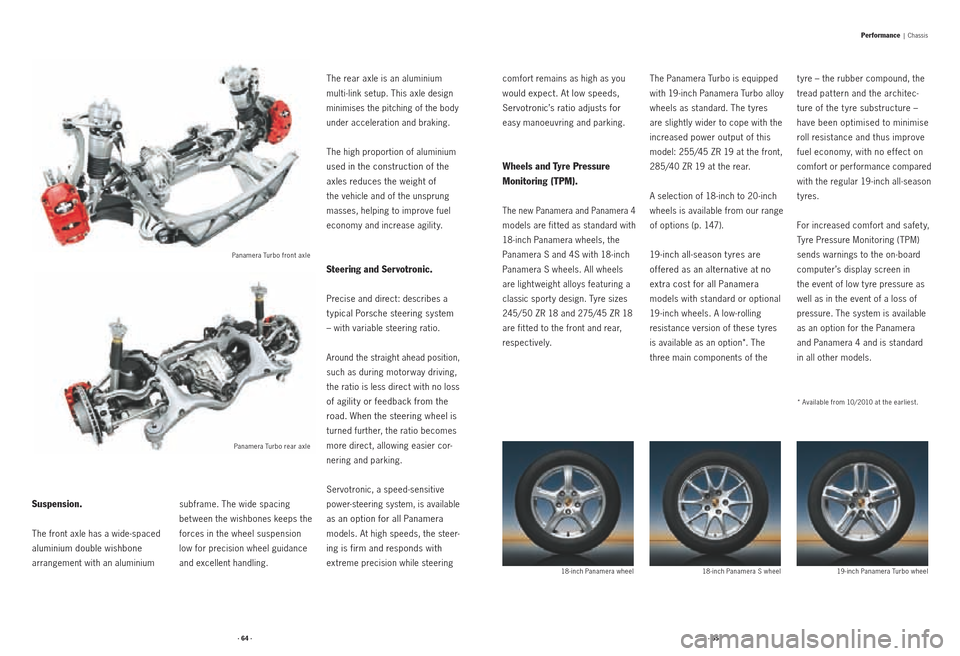
Suspension.
The front axle has a wide-spaced
aluminium double wishbone
arrangement with an aluminium subframe. The wide spacing
bet ween the wishbones keeps the
forces in the wheel suspension
low for precision wheel guidance
and excellent handling. The rear axle is an aluminium
multi-link setup. This axle design
minimises the pitching of the body
under acceleration and braking.
The high proportion of aluminium
used in the construction of the
axles reduces the weight of
the vehicle and of the unsprung
masses, helping to improve fuel
economy and increase agilit y.
Steering and Servotronic.
Precise and direct: describes a
t ypical Porsche steering system
–
with variable steering ratio.
Around the straight ahead position,
such as during motorway driving,
the ratio is less direct with no loss
of agilit y or feedback from the
road. When the steering wheel is
turned further, the ratio becomes
more direct, allowing easier cor -
nering and parking.
Servotronic, a speed-sensitive
power-steering system, is available
as an option for all Panamera
models. At high speeds, the steer -
ing is firm and responds with
extreme precision while steering comfort remains as high as you
would expect. At low speeds,
Servotronic’s ratio adjusts for
easy manoeuvring and parking.
Wheels and Tyre Pressure
Monitoring (TPM).
The new Panamera and Panamera 4
models are fit ted as standard with
18-inch Panamera wheels, the
Panamera S and 4S with 18-inch
Panamera S wheels. All wheels
are light weight alloys featuring a
classic sport y design. Tyre sizes
245/50 ZR 18 and 275/45 ZR 18
are fit ted to the front and rear,
respectively. The Panamera Turbo is equipped
with 19 -inch Panamera Turbo alloy
wheels as standard. The t yres
are slightly wider to cope with the
increased power output of this
model: 255/45 ZR 19 at the front,
285/40 ZR 19 at the rear.
A selection of 18-inch to 20 -inch
wheels is available from our range
of options (p. 147).
19-inch all-season t yres are
offered as an alternative at no
extra cost for all Panamera
models with standard or optional
19-inch wheels. A low-rolling
resistance version of these t yres
is available as an option*. The
three
main components of the
Panamera Turbo front axle
Panamera Turbo rear axle 19 - inch Panamera Turbo wheel
18 - inch Panamera S wheel
18 - inch Panamera wheel
t yre – the rubber compound, the
tread pat tern and the architec -
ture of the t yre substructure –
have been optimised to minimise
roll resistance and thus improve
fuel economy, with no ef fect on
comfort or performance compared
with the regular 19 -inch all-season
t yres.
For increased comfort and safet y,
Tyre Pressure Monitoring (TPM)
sends warnings to the on -board
computer’s display screen in
the event of low t yre pressure as
well as in the event of a loss of
pressure. The system is available
as an option for the Panamera
and Panamera 4 and is standard
in all other models.
* Available from 10/2010 at the earliest.
Page 39 of 80
· 86 ·· 87 ·
Balance | Safet y
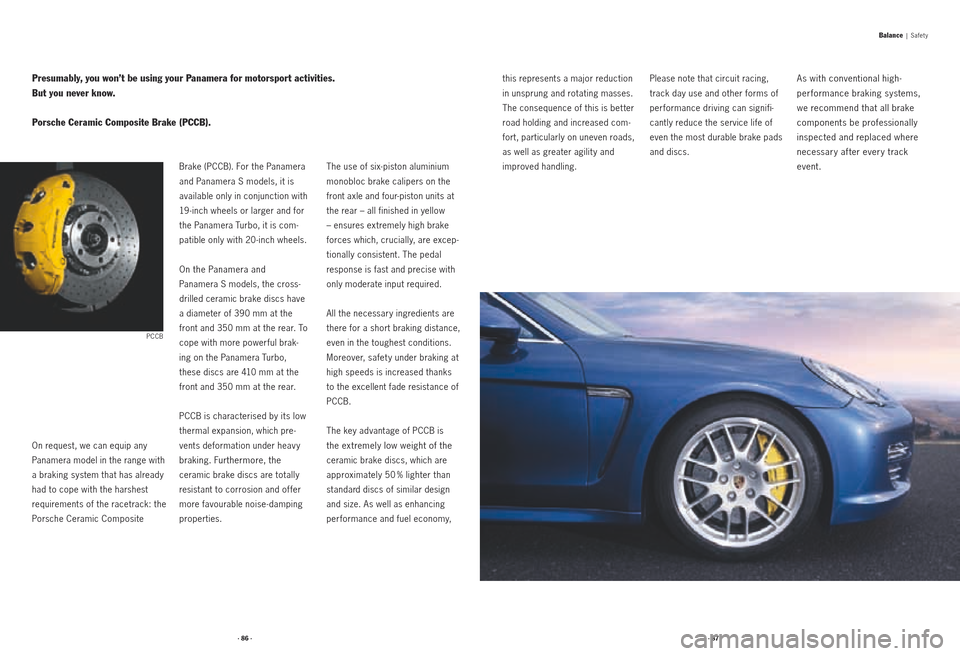
On request, we can equip any
Panamera model in the range with
a braking system that has already
had to cope with the harshest
requirements of the racetrack: the
Porsche Ceramic Composite Brake (PCCB). For the Panamera
and Panamera S models, it is
available only in conjunction with
19 -inch wheels or larger and for
the Panamera Turbo, it is com
-
patible only with 20 -inch wheels.
On the Panamera and
Panamera S models, the cross-
drilled ceramic brake discs have
a diameter of 390 mm at the
front and 350 mm at the rear. To
cope with more powerful brak -
ing on the Panamera Turbo,
these discs are 410 mm at the
front and 350 mm at the rear.
PCCB is characterised by its low
thermal expansion, which pre -
vents deformation under heav y
braking. Furthermore, the
ceramic brake discs are totally
resistant to corrosion and offer
more favourable noise- damping
properties. The use of six-piston aluminium
monobloc brake calipers on the
front axle and four-piston units at
the rear – all finished in yellow
– ensures extremely high brake
forces which, crucially, are excep
-
tionally consistent. The pedal
response is fast and precise with
only moderate input required.
All the necessary ingredients are
there for a short braking distance,
even in the toughest conditions.
Moreover, safet y under braking at
high speeds is increased thanks
to the excellent fade resistance of
PCCB.
The key advantage of PCCB is
the extremely low weight of the
ceramic brake discs, which are
approximately 50 % lighter than
standard discs of similar design
and size. As well as enhancing
performance and fuel economy, this represents a major reduction
in unsprung and rotating masses.
The consequence of this is bet ter
road holding and increased com
-
fort, particularly on uneven roads,
as well as greater agilit y and
improved handling. Please note that circuit racing,
track day use and other forms of
performance driving can signifi
-
cantly reduce the service life of
even the most durable brake pads
and discs.
As with conventional high-
performance braking systems,
we recommend that all brake
components be professionally
inspected and replaced where
necessary after every track
event.
PCCB
Presumably, you won’t be using your Panamera for motorsport activities.
But you never know.
Porsche Ceramic Composite Brake (PCCB).
Page 40 of 80
· 88 ·· 89 ·
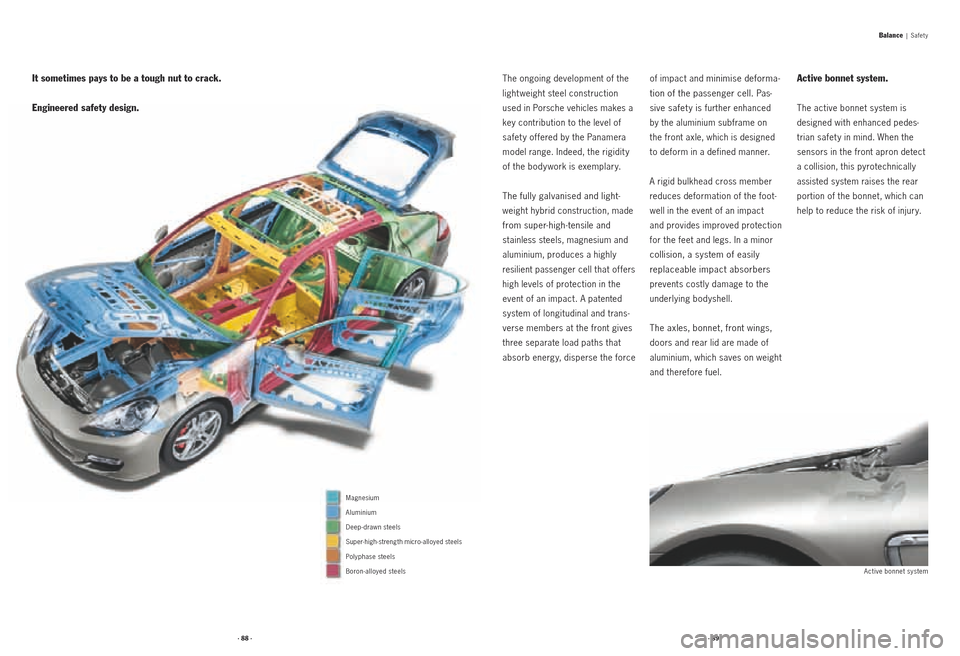
of impact and minimise deforma-
tion of the passenger cell. Pas -
sive safet y is
further enhanced
by the aluminium
subframe on
the front axle, which is designed
to deform in a defined manner.
A rigid bulkhead cross member
reduces deformation of the foot -
well in the event of an impact
and provides improved protection
for the feet and legs. In a minor
collision, a system of easily
replaceable impact absorbers
prevents costly damage to the
underlying bodyshell.
The axles, bonnet, front wings,
doors and rear lid are made of
aluminium, which saves on weight
and therefore fuel.
Active bonnet system.
The active bonnet system is
designed with enhanced pedes-
trian safet y in mind. When the
sensors in the front apron detect
a collision, this pyrotechnically
assisted system raises the rear
portion of the bonnet, which can
help to reduce the risk of injury.
The ongoing development of the
light weight steel construction
used in Porsche vehicles makes a
key contribution to the level of
safet y of fered by the Panamera
model range. Indeed, the rigidit y
of the body work is exemplary.
The fully galvanised and light
-
weight hybrid construction, made
from super- high -tensile and
stainless steels, magnesium and
aluminium, produces a highly
resilient passenger cell that of fers
high levels of protection in the
event of an impact. A patented
system of longitudinal and trans -
verse members at the front gives
three separate load paths that
absorb energy, disperse the force
Magnesium
Aluminium
Deep-drawn steels
Super- high -streng th micro -alloyed steels
Polyphase steels
Boron-alloyed steels
Balance | Safet y
It sometimes pays to be a tough nut to crack.
Engineered safety design.
Active bonnet system
Page 42 of 80
· 92 ·· 93 ·
concerned, we are already among
those manufacturers achieving
the lowest CO2 em issio ns. T h is
has been achieved through the
new ef ficient engine technology
(e.g. by DFI and VarioCam Plus),
light weight construction, optimum
aerodynamics and low rolling
resistance. This high level of environmental
responsibilit y is clearly demon
-
strated by our approach to envi -
ronmental management at the
Porsche Development Centre in
Weissach. Here, all technological
developments are carried out
with environmental protection in
mind. The goal is pure perform -
ance – but not at the expense of
the environment. A goal achieved
by the Panamera.
Fuel economy and emission
control.
Vehicles manufactured by Porsche
demonstrate that even high-
performance sportscars can
achieve moderate fuel consump -
tion and
exhaust emission values
in their
respective categor y.
The balance is exemplary: the
Panamera, Panamera 4 and
Panamera Turbo comply with the
Euro 5 emission standard in
Europe and the LEV regulations in
the USA, the Panamera S and
Panamera 4S meet the require -
ments of EU 5 and ULEV.
This is achieved through the use
of fuel- ef ficient technologies such
as direct fuel injection (DFI, p. 51)
and VarioCam Plus (p. 52).
Efficient emission control is
achieved by a t wo -stage cascade-
t ype cataly tic converter, which
comprises t wo monoliths arranged
in series. These specially coated
substrates contain ultra-fine honey -
comb
channels in which pollutants
are converted as exhaust gas
passes through.
The stereo Lambda control circuitr y
controls and monitors each cylin -
der bank separately. For each
exhaust tract, oxygen sensors
regulate the composition of the
exhaust gas, while another Lambda
s
ensor on each cylinder bank
monitors pollutant conversion in
the respective cataly tic converter.**
Environmental protection.
In an era of intensif ying debate
about global climate change and
CO
2 emissions, every automotive manufacturer is asking what it has
to of fer in terms of environmental
protection. Our answer has long
been the same: maximum effi
-
ciency. Porsche has been reducing the
CO
2 emissions of its vehicles
by an average of around 1.7 %*
every year for the past 15 years.
As far as engine output is
As a Panamera driver, you are responsible for four people.
We are responsible for everyone else.
Porsche and the environment.
Balance | Environment
* The stated reduction in fuel consumption
has been calculated from the NEDC (New
European Drive Cycle) fuel consumption
figures for the respective model years
of the vehicles and in relation to the
applicable European legislation.
** Not in markets with leaded fuel.
Page 43 of 80
· 94 ·· 95 ·
In models with the V8 engine,
exhaust gas cleaning is supported
by an air injection system. A com-
pressor pumps extra air into the
exhaust tract during the cataly tic
converter warm-up phase for
faster heating and, therefore,
lower emissions.
Other measures for improving fuel
economy are the Auto start/stop
function (p. 50) and electrical
system recuperation, whereby the
vehicle bat tery is charged pre-
dominantly under braking. Under
acceleration, on the other hand,
the charging current of the regu -
lated alternator is reduced so that
the engine does not need to work
as hard to charge the bat tery.
Lightweight construction and
recycling.
A fundamental objective in the
development of any Porsche is
intelligent lightweight construction.
For both economical and ecologi -
cal reasons. This forms the basis
for low fuel consumption values in conjunction with outstanding
performance. It is economical
thanks to the high proportion of
aluminium cast alloys, plastics
and super-high-strength sheet
steel used. This is substantially
more stable and lighter than
conventional steel. The Panamera
models have a bodyshell with a
light weight-metal content of 23 %.
For example, the bonnet, doors,
front wings and rear lid are made
of aluminium, which saves on
weight and has a positive ef fect
on the environmental balance:
according to eco balance sheets,
the extra energy used and the
higher emissions incurred in the
manufacturing of aluminium
are more than compensated by
the savings on fuel af ter only a
relatively short distance.
It is also responsible because all
materials used are meticulously
selected. We use only innovative
and environmentally friendly com -
ponents. All light weight materials
are easily recyclable and each
material is labelled to facilitate its
separation for recycling. The reduction in the number of plastic
variants helps to ensure more
efficient recycling. Recycled plas
-
tics are used where they meet our
exacting technical requirements
In all, the Panamera is approxi -
mately 95 % recyclable.
In addition, Porsche uses only
environmentally friendly water-
based paints, thus reducing
the need for solvents both in pro -
duction and in the workshop.
The Panamera is also absolutely
free of asbestos, CFCs and
components manufactured using
CFCs because, here at Porsche,
environmental protection does
not begin at the end of a vehicle’s
life. It starts at the planning and
development stage.
Balance | Environment
Page 44 of 80
· 96 ·· 97 ·
Balance | Environment
Fuel.
All Porsche models – including the
Panamera – are already designed
to operate on fuels with an ethanol
content of up to 10 %. Ethanol
has a positive impact on the CO
2 balance since the plants grown
for the production of this biofuel
also absorb CO
2 from the atmo
-
sphere.
The release of hydrocarbons
from the fuel system has been
minimised thanks in no small part
to the active carbon filter and the
multilayered material from which
the fuel tank is made. All fuel lines
are made from multilayered plastic,
steel or aluminium.
Noise.
The Panamera complies with
all applicable noise regulations
without any form of engine en -
capsulation. To achieve this,
noises are eliminated at source. Engine parts are stif f, moving
parts are light weight and toler-
ances are kept to a minimum.
No nuisance noise to be heard,
just the characteristic Porsche
sound.
Servicing.
Long service intervals are not
only more convenient, they
reduce ownership costs. They
also promote a more sparing
use of consumables and replace -
ment parts, which is in both our
interests. For you, lower costs
and saved time are t wo major
benefits, but perhaps the greatest
benefit is for the environment.
For full details of service intervals,
please refer to the separate price
list.
Page 73 of 80
· 160 ·· 161 ·
Porsche Exclusive
Let your car reflect your
c h ar a c t e r.
With the range of options featured
in this catalogue, you can make
your Pors che even more special.
In troducing Pors che Exclusive.
Have your vehicle individually and
exclus ively tailor ed to your wishes
even befor e it leaves the factory. A
estheti cally and t echnically, inside
and outside, using fine materials
and with cus tomary Porsche quality.
Our overriding principl e? That
your car is uniquely handcr afted
to your taste. You will find a
wid e range of design options in
the separat e Porsche Exclusive
P anamer a catalogue. Either your Pors
che Centre or the
cus tomer centre in Zuffenhausen
(tel. +49 (0)711 911-25977 or email:
[email protected])
will be happy to answer any questions
about Pors che Exclusive that you
may have. Please note that delivery
times may be ext ended for cer tain
Porsche Exclus ive equipment.
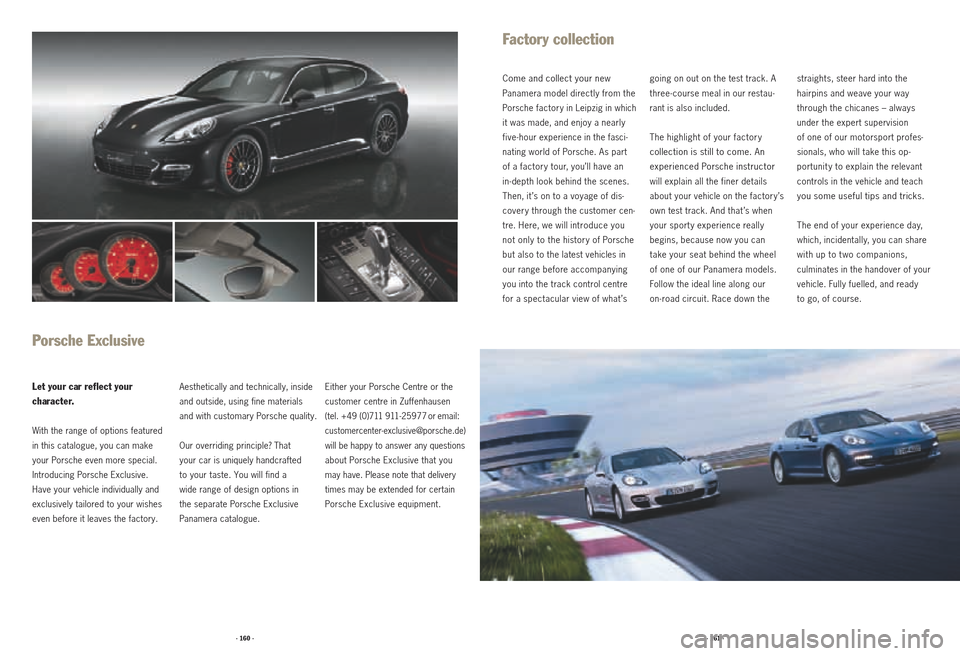
Come and collect your new
Panamera model directly from the
Porsche factory in Leipzig in which
it was made, and enjoy a nearly
five-hour
experience in the fasci-
nating world
of Porsche. As part
of a factory tour, you’ll have an
in - depth look behind the scenes.
Then, it ’s on to a voyage of dis -
covery through the customer cen -
tre. Here, we will introduce you
not only to the history of Porsche
but also to the latest vehicles in
our range before accompanying
you into the track control centre
for a spectacular view of what ’s going on out on the test track. A
three-course meal in our restau
-
rant is also included.
The highlight of your factor y collection is still to come. An
experienced Porsche instructor
will explain all the finer details
about your vehicle on the factory’s
own test track. And that ’s when
your sport y experience really
begins, because now you can
take your seat behind the wheel
of one of our Panamera models.
Follow the ideal line along our
on-road circuit. Race down the straights, steer hard into the
hairpins and weave your way
through the chicanes – always
under the expert supervision
of one of our motorsport profes
-
sionals, who will take this op -
portunit y to explain the relevant
controls in the vehicle and teach you some useful tips and tricks.
The end of your experience day,
which, incidentally, you can share
with up to t wo companions,
culminates in the handover of your
vehicle. Fully fuelled, and ready
to go, of course.
Factory collection
Page 76 of 80
· 166 ·· 167 ·
Panamera Panamera 4 Panamera SPanamera 4SPanamera Turbo
Engine
C y linders 66 888
Displacement 3,605 cm
33,605 cm34,806 cm34,806 cm34,806 cm3
Max. power (DIN)
at rpm220 kW (300 hp)
6,200220 kW (300 hp)
6,200 294 kW (400 hp)
6,500294 kW (400 hp)
6,500368 kW (500 hp)
6,000
Max. torque
at rpm 400 Nm
3,750400 Nm
3,750 500 Nm
3,500–5,000500 Nm
3,500–5,000700 Nm
2,250–4,500
Compression ratio 12.5 : 1 12.5 : 1 12.5 : 1 12.5 : 1 10.5 : 1
Transmission
Layout Rear-wheel driveAll-wheel drive Rear-wheel driveAll-wheel driveAll-wheel drive
Manual gearbox (6-speed) Standard– Standard––
PDK (7-speed) OptionalStandard OptionalStandardStandard
Chassis
Front axleFully independent large -format double
wishbone suspensionFully independent large -format double
wishbone suspension Fully independent large -format double
wishbone suspensionFully independent large -format double
wishbone suspensionFully independent large -format double
wishbone suspension
Rear axle Fully independent multi-link
suspension Fully independent multi-link
suspension Fully independent multi-link
suspension Fully independent multi-link
suspension Fully independent multi-link
suspension
Steering Power-assisted (hydraulic)Power-assisted (hydraulic) Power-assisted (hydraulic)Power-assisted (hydraulic)Power-assisted (hydraulic)
Brakes
Six- piston aluminium monobloc
fixed brake calipers at front,
four- piston aluminium monobloc
brakes at rear, internally vented
d iscs, A BS Six- piston aluminium monobloc
fixed brake calipers at front,
four- piston aluminium monobloc
brakes at rear, internally vented
d iscs, A BS Six- piston aluminium monobloc
fixed brake calipers at front,
four- piston aluminium monobloc
brakes at rear, internally vented
d iscs, A BS Six- piston aluminium monobloc
fixed brake calipers at front,
four- piston aluminium monobloc
brakes at rear, internally vented
d iscs, A BS Six- piston aluminium monobloc
fixed brake calipers at front,
four- piston aluminium monobloc
brakes at rear, internally vented
d iscs, A BS
Wheels
Front: 8 J x 18 ET 59
Rear: 9 J x 18 ET 53Front: 8 J x 18 ET 59
Rear: 9 J x 18 ET 53 Front: 8 J x 18 ET 59
Rear: 9 J x 18 ET 53Front: 8 J x 18 ET 59
Rear: 9 J x 18 ET 53Front: 9 J x 19 ET 60
Rear: 10 J x 19 ET 61
Tyres
Front: 245/50 ZR 18
Rear: 275/45 ZR 18Front: 245/50 ZR 18
Rear: 275/45 ZR 18 Front: 245/50 ZR 18
Rear: 275/45 ZR 18Front: 245/50 ZR 18
Rear: 275/45 ZR 18Front: 255/45 ZR 19
Rear: 285/40 ZR 19
WeightsManual/PDK
PDK Manual/PDKPDKPDK
Unladen weight (DIN) 1,73 0 k g / 1,76 0 k g1,820 k g 1,770 k g / 1,8 0 0 k g1,8 6 0 k g1,970 k g
Unladen weight (EC)
11,8 05 k g / 1,8 35 k g 1,895 k g 1,8 45 k g / 1,875 k g1,935 k g2,045 kg
Permissible gross weight 2,335 kg /2,365 kg2,400 kg 2,375 kg /2,405 kg2,440 kg2,500 kg
Max. payload 605 kg/605 kg580 kg 605 kg/605 kg580 kg530 kg
Technical data
Some items of equipment featured on or in the vehicles in this catalogue are available as extra - cost options only.
All information regarding construction, features, design, per formance, dimensions, weights, fuel consumption and running costs was correct to
the best of our knowledge at the time of going to print. Subject to change without notice.1 Weight is calculated in accordance with the relevant EC Directives and is valid for vehicles with standard specification only.
Optional equipment increases this figure. The figure given includes 68 kg for the driver and 7 kg for luggage.
Technical data