headlights PORSCHE PANAMERA 2010 1.G User Guide
[x] Cancel search | Manufacturer: PORSCHE, Model Year: 2010, Model line: PANAMERA, Model: PORSCHE PANAMERA 2010 1.GPages: 343, PDF Size: 7.96 MB
Page 276 of 343

274
Maintenance and Car Care
Cleaning headlights, lights, interior and
exterior plastic components, adhesive
foils, radar sensor for adaptive cruise
control and rearview cameraObserve the following points:
fUse only clean water and a little dishwashing
liquid or interior window cleaner to clean
headlights, lights, plastic components
and surfaces.
Use a soft sponge or a soft, lint-free cloth.
Note
An interior window cleane r can also be used to
clean plastic surfaces (always read the cleaning
instructions on the container!).
We recommend Porsche interior window cleaner.
f Gently wipe the surface without applying
too much pressure.
f Do not clean when dry.
f Never use other chemical cleaners
or solvents.
f Rinse cleaned surfaces with clear water.
Alloy wheelsMetal particles (e.g. brass or copper in brake
dust) must not remain too long on alloy wheels.
Contact corrosion can cause pitting.
Note
Cleaners with an oxide-removing effect or
wrong pH value, as are commonly used for
other metals, as well as mechanical tools and
products, will damage the oxide layer and are
therefore unsuitable.
fUse only cleaners for alloy wheels
(pH value 9.5). Products with the wrong
pH value can destroy the protective layer
on the wheels.
We recommend Porsche cleaner for light
alloy rims.
f If possible, wash the wheels every two weeks
with a sponge or washing brush. If the wheels
are exposed to road salt, grit or industrial dust,
weekly cleaning is necessary.
f Every three months, after cleaning, treat the
wheels with car wax or an acid-free grease
(e.g. Vaseline).
Rub the grease in well with a soft cloth.
f Please see the chapter “CLEANING IN CAR
WASHES” on page 271.
Danger!
Danger of accident resulting in serious
personal injury or death if cleaning agents
(e.g. wheel cleaning agents) come into
contact with the brake discs. The resulting
film on the brake discs can impair braking
performance.
f Make sure that no clea ning agent comes into
contact with the brake discs.
f If cleaning agent has come into contact with
the brake discs, clean the brake discs
thoroughly with a strong jet of water.
f Paying attention to any road users behind you, dry the brake discs by applying the brakes.
Stainless steel tailpipesStainless steel tailpipes can discolor due to
soiling, strong heat and combustion residues.
The original shine can be achieved again using
commercially available metal lustre paste or metal
polish.
Page 279 of 343
Minor Repairs
277
Minor Repairs
Exercise Extreme Caution when Working
on your Vehicle .......
................................... 278
Tires and Wheels..... ................................... 280
Wheel Bolts ................ .............................. 293
Flat Tire .................. ................................... 293
Electrical System .... ................................... 296
Battery ............................................ .......... 303
External Power Supply, Jump-Lead
Starting ........................................... .......... 306
Changing the Remote Co ntrol Battery .......... 307
Replacing Bulbs ...... ................................... 308
Headlights ....................................... .......... 308
Side Turn Signal Ligh t................................. 312
Licence Plate Lights ................................... 313
Side Marker Light .... ................................... 313
Changing Light-Emitting Diodes and
Long-Life Bulbs ......................................... 314
Headlight Adjustment .................................. 314
Towing ........................ .............................. 316
Fire Extinguisher .......................... .............. 321
Page 306 of 343

304
Minor Repairs
Battery carefEnsure that battery is securely mounted.
f Keep terminals and connections clean and
properly tightened. Corrosion can be
prevented by coating the terminals and
connections with petroleum jelly or silicone
spray.
f Ensure that vent caps ar e securely tightened to
prevent spillage.
Checking the electrolyte fluid level
(only on low-maintenance batteries)
Generally, the electrolyte level must be checked
more often in summer than in the winter, and more
often when driving long distances.
f When adding water, use only clean containers.
In no case may alcohol (e.g. window cleaner
residues) be permitted to enter the battery.
f Unscrew and open the filler vent caps of each
cell.
With the car on a level surface, the fluid level
should meet the indicator mark in each cell.
f If necessary, top up with distilled water. Do not
use acid. Only fill up to the mark, otherwise the
electrolyte will overflow when the battery is
being charged and cause damage.
Winter operationDuring the winter months, battery capacity tends
to decrease as temperatures drop. Additionally,
more power is consumed while starting, and the
headlights, heater, rear window defogger, etc.,
are used more frequently.
f Let your Porsche dealer test the battery's
capacity before winter sets in.Vehicle storageIf the car stands for long periods in the garage or
workshop, the doors and lids should be closed.
f Remove the ignition key and, if necessary,
disconnect the battery.
Notes on operation
f When the battery is disconnected, the alarm
system ceases to function.
If the vehicle was locked before the battery
was disconnected, the alarm will be triggered
when the battery is reconnected.
To deactivate the alarm system:
f Lock the vehicle and unlock it again.
Alarm system, central locking
f The status of the central locking and alarm
system is not changed by disconnecting the
battery. Maintenance notes
Even if you put your vehicle out of operation, the
battery still discharges.
The battery will discharge more quickly if your
vehicle is not driven on a daily basis over a
distance of several miles. The more often you
drive your vehicle, and
the longer the distance
driven on each trip, the more opportunity the
vehicle‘s charging system w ill have to recharge the
batteries.
f To preserve its efficiency, charge the battery
about every 6 weeks.
f Check the battery acid level and top off with
distilled water if necessary.
f Store a battery that has been removed in a
dark, cool place, but not subject to freezing.
Page 310 of 343

308
Minor Repairs
Changing the battery (CR 2032, 3V)
1. Remove the emergency key.
2. Lever off the cover on the back of the key
housing using a small screwdriver.
3. Change the battery (check polarity).
4. Re-fit cover and press together firmly.
5. Insert the emergency key.
Replacing Bulbs
Warning!
Risk of serious personal injury or death. The
headlights are under high voltage when
installed.
f Exercise extreme care when working close to
the headlights.
Risk of short circuit.
f Always switch off the relevant load when
changing bulbs.
Risk of damage. Bulbs of a high wattage can
damage the housing.
f Only use the bulbs specified in the bulb chart.
f Bulbs must be clean and free from grease.
f Never touch bulbs with your bare hands.
Use a cloth or soft paper when
replacing bulbs.
f Always carry spare bulbs with you.
In certain countries, it is mandatory to
carry spare bulbs.
Headlights
Caution!
Risk of damage to headlights due to abrasion
and excessive temperatures.
f Do not affix any coverings (e.g. “stone guards”
or films) on or around the headlights.
f Use soapy water only to clean light lenses and
plastic headlight lenses. In no case may
chemical cleaners or other volatile cleaning
fluids be used.
f To prevent scratches, do not rub with a dry or merely moist cloth, tissue or insect sponges.
Note
The headlights can mist up due to temperature
and humidity.
f To ensure optimum ventilation, do not cover
the gap between headlight and body.
Page 311 of 343
Minor Repairs
309
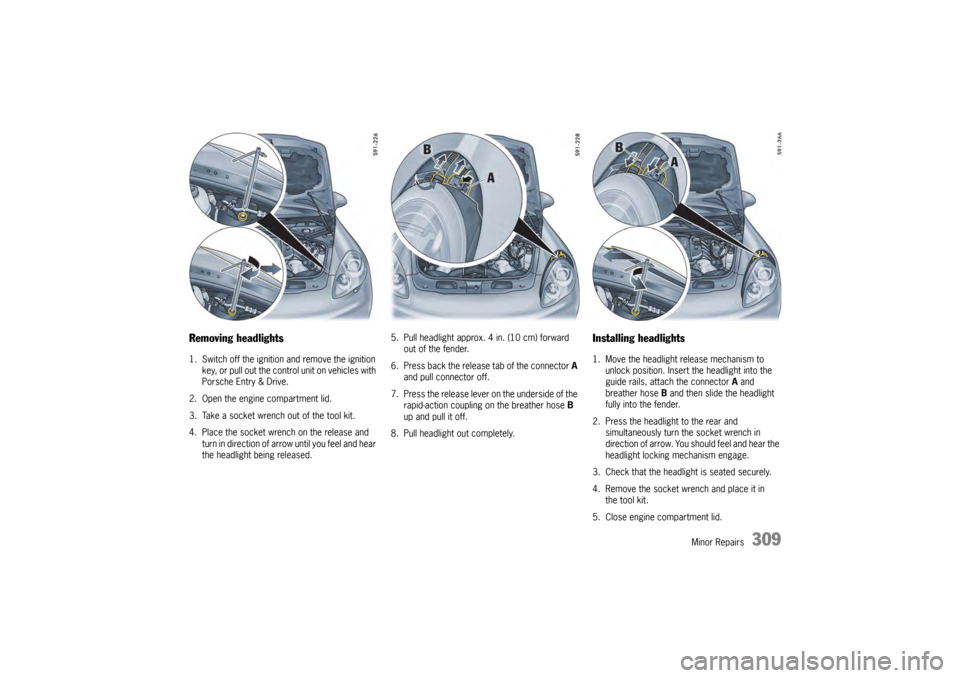
Removing headlights1. Switch off the ignition and remove the ignition
key, or pull out the control unit on vehicles with
Porsche Entry & Drive.
2. Open the engine compartment lid.
3. Take a socket wrench out of the tool kit.
4. Place the socket wrench on the release and turn in direction of arrow until you feel and hear
the headlight being released. 5. Pull headlight approx. 4 in. (10 cm) forward
out of the fender.
6. Press back the releas e tab of the connector A
and pull connector off.
7. Press the release lever on the underside of the rapid-action coupling on the breather hose B
up and pull it off.
8. Pull headlight out completely.
Installing headlights1. Move the headlight release mechanism to unlock position. Insert the headlight into the
guide rails, attach the connector A and
breather hose B and then slide the headlight
fully into the fender.
2. Press the headlight to the rear and simultaneously turn the socket wrench in
direction of arrow. You should feel and hear the
headlight locking mechanism engage.
3. Check that the headlight is seated securely.
4. Remove the socket wrench and place it in the tool kit.
5. Close engine compartment lid.
Page 312 of 343
310
Minor Repairs
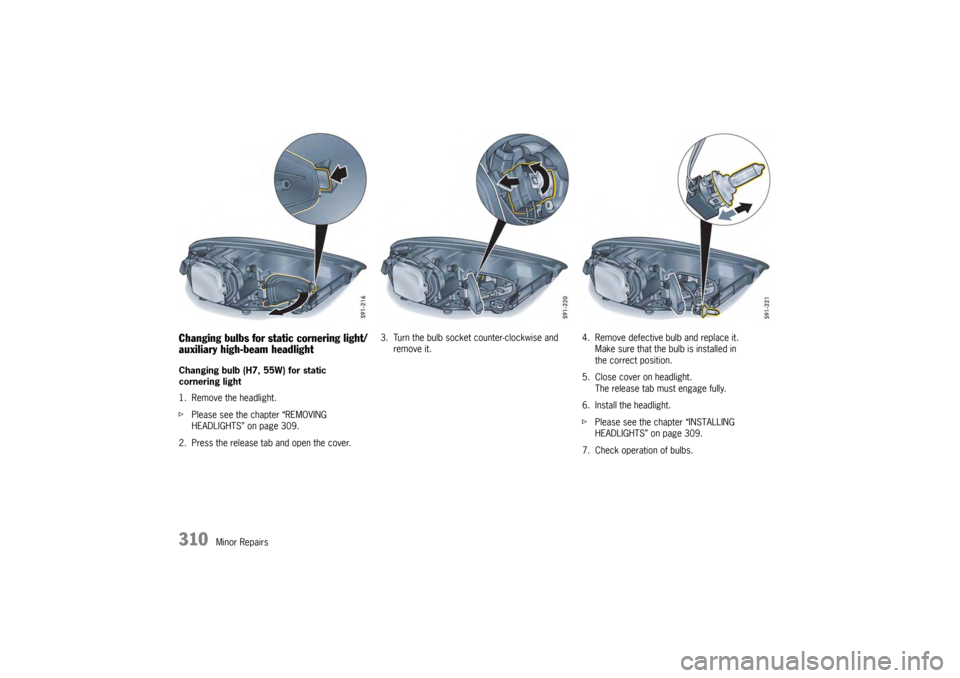
Changing bulbs for static cornering light/
auxiliary high-beam headlight Changing bulb (H7, 55W) for static
cornering light
1. Remove the headlight.
fPlease see the chapter “REMOVING
HEADLIGHTS” on page 309.
2. Press the release tab and open the cover. 3. Turn the bulb socket counter-clockwise and
remove it. 4. Remove defective bulb and replace it.
Make sure that the bulb is installed in
the correct position.
5. Close cover on headlight. The release tab must engage fully.
6. Install the headlight.
f Please see the chapter “INSTALLING
HEADLIGHTS” on page 309.
7. Check operation of bulbs.
Page 313 of 343
Minor Repairs
311
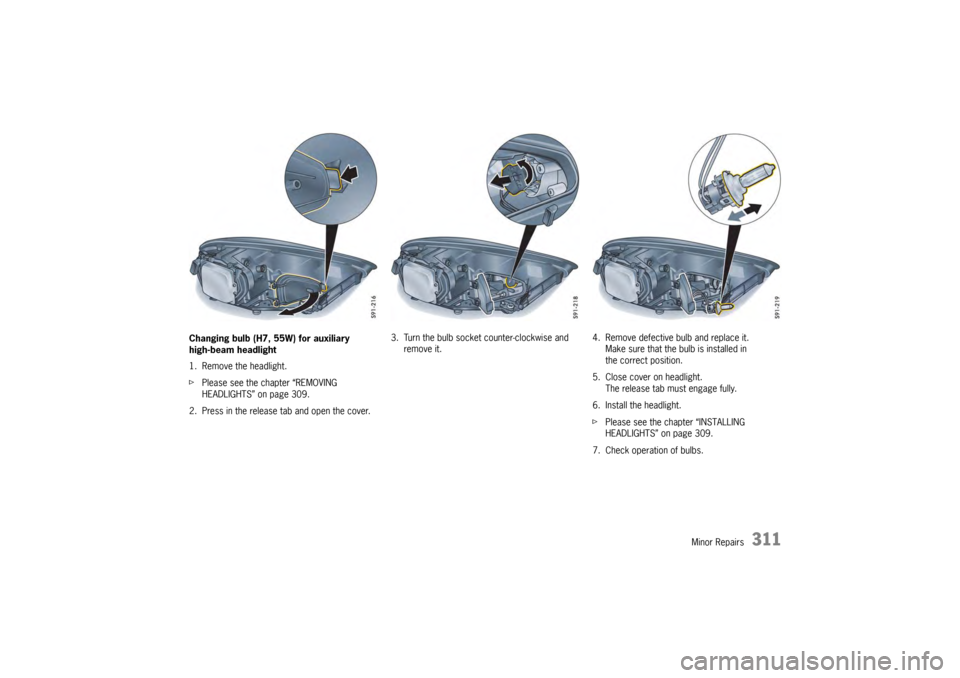
Changing bulb (H7, 55W) for auxiliary
high-beam headlight
1. Remove the headlight.
fPlease see the chapter “REMOVING
HEADLIGHTS” on page 309.
2. Press in the release tab and open the cover. 3. Turn the bulb socket counter-clockwise and
remove it. 4. Remove defective bulb and replace it.
Make sure that the bulb is installed in
the correct position.
5. Close cover on headlight. The release tab must engage fully.
6. Install the headlight.
f Please see the chapter “INSTALLING
HEADLIGHTS” on page 309.
7. Check operation of bulbs.
Page 316 of 343
314
Minor Repairs
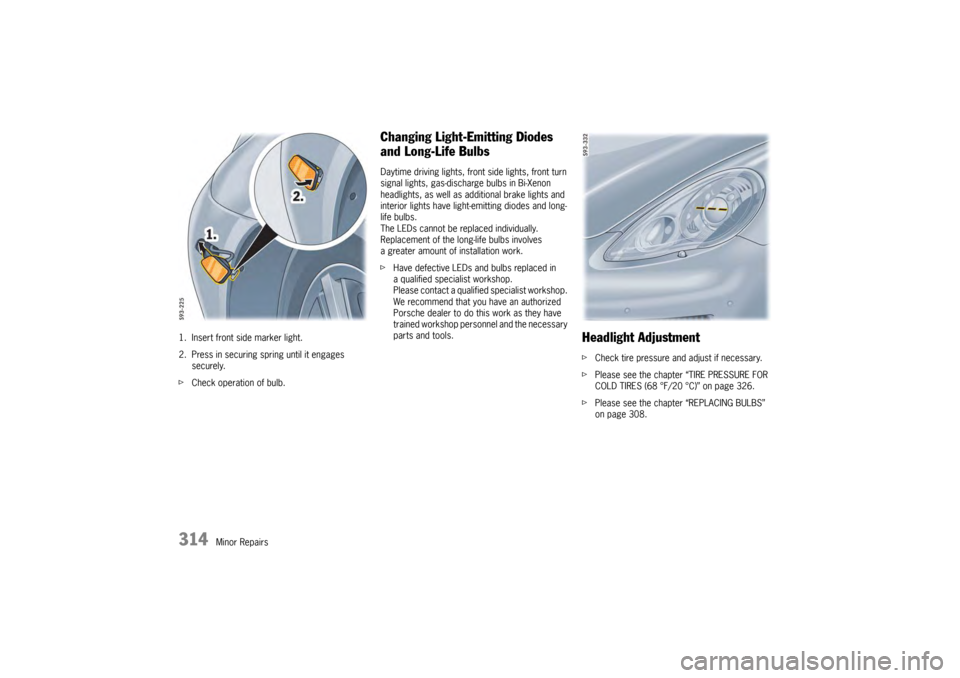
1. Insert front side marker light.
2. Press in securing spring until it engages
securely.
f Check operation of bulb.
Changing Light-Emitting Diodes
and Long-Life BulbsDaytime driving lights, front side lights, front turn
signal lights, gas-discharge bulbs in Bi-Xenon
headlights, as well as additional brake lights and
interior lights have light-emitting diodes and long-
life bulbs.
The LEDs cannot be replaced individually.
Replacement of the long-life bulbs involves
a greater amount of installation work.
fHave defective LEDs and bulbs replaced in
a qualified specialist workshop.
Please contact a qualified specialist workshop.
We recommend that you have an authorized
Porsche dealer to do this work as they have
trained workshop personnel and the necessary
parts and tools.
Headlight AdjustmentfCheck tire pressure and adjust if necessary.
f Please see the chapter “TIRE PRESSURE FOR
COLD TIRES (68 °F/20 °C)” on page 326.
f Please see the chapter “REPLACING BULBS”
on page 308.
Page 317 of 343
Minor Repairs
315
Adjustment
The adjustment is made with the vehicle ready to
drive and the fuel tank completely filled.
The driver's seat must be loaded by a person or a
165 lbs. (75 kg) weight and the tire pressures
must meet the prescribed values. After being
loaded, the car must be rolled a few meters so
that the suspension can settle.
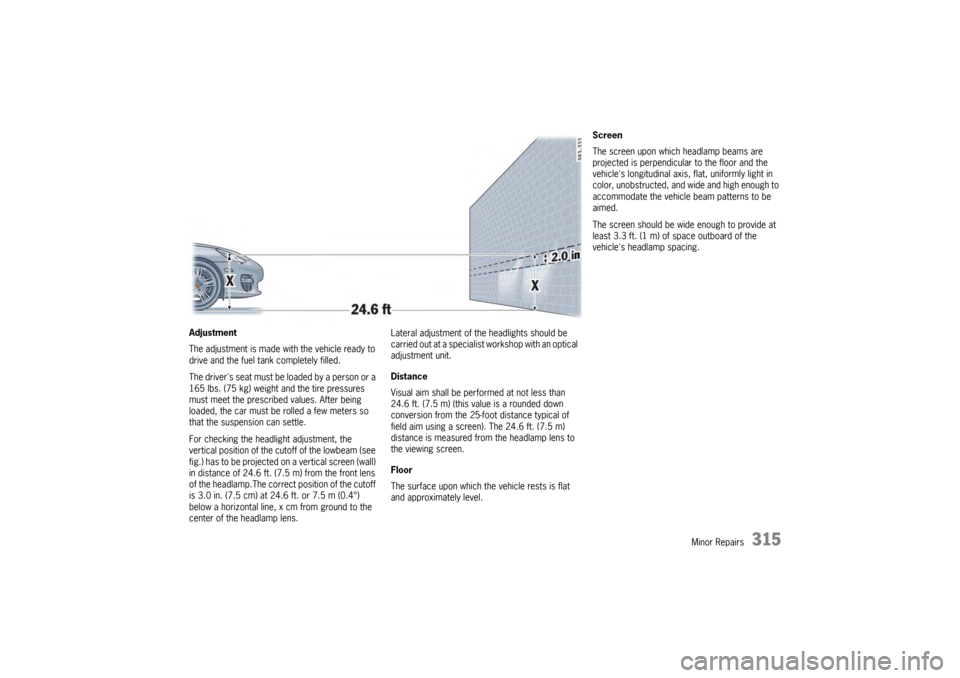
For checking the headlight adjustment, the
vertical position of the cutoff of the lowbeam (see
fig.) has to be projected on a vertical screen (wall)
in distance of 24.6 ft. (7.5 m) from the front lens
of the headlamp.The correc t position of the cutoff
is 3.0 in. (7.5 cm) at 24.6 ft. or 7.5 m (0.4°)
below a horizontal line, x cm from ground to the
center of the headlamp lens. Lateral adjustment of the headlights should be
carried out at a specialist workshop with an optical
adjustment unit.
Distance
Visual aim shall be performed at not less than
24.6 ft. (7.5 m) (this value is a rounded down
conversion from the 25-f
oot distance typical of
field aim using a screen). The 24.6 ft. (7.5 m)
distance is measured from the headlamp lens to
the viewing screen.
Floor
The surface upon which the vehicle rests is flat
and approximately level.
Screen
The screen upon which headlamp beams are
projected is perpendicular to the floor and the
vehicle's longitudinal axis, flat, uniformly light in
color, unobstructed, and wide and high enough to
accommodate the vehicle beam patterns to be
aimed.
The screen should be wide enough to provide at
least 3.3 ft. (1 m) of space outboard of the
vehicle's headlamp spacing.
Page 334 of 343
332
Index
Switching on and off .......................................... 170
Automatic (PDK transmission) Rocker switches on the st eering wheel .................. 61
Automatic brake differential (ABD) Functional description . ....................................... 204
Automatic driving light assistant Adaptive light system .. ......................................... 92
Automatic headlight levelling Functional description . ......................................... 94
Automatic speed control (cruise control) Accelerating ........ ...................................... ........ 177
Decelerating........................................... ........... 177
Functional description . ....................................... 176
Interrupting operation.. ....................................... 177
Storing speed.. .................................................. 176
Switching off .................. ................................... 178
Switching on .................. ................................... 176
Automatic transmission...... .......................................... 193
AUX interface, installation position ................................ 192
Auxiliary high-beam headlight Changing bulb ................ ................................... 311
Installing headlights..... ....................................... 309
Removing headlights ....... ................................... 309
BBaby seat
Installing with LATCH sy stem ................................ 56
LATCH restraint system .. ..................................... 56
Prescribed installation direction (depending on
weight of child) ........... ......................................... 53
Battery ........................................ ............................... 191
Care ................... ...................................... ........ 304
Changing in car key .... ....................................... 307
Charge state ... .................................................. 303
Charging ............. ...................................... ........ 307
General information..... ....................................... 303
Jump-lead starting .......... ................................... 306
Location.............. ...................................... ........ 303
Procedure after connectio n ................................ 305
Replacing .................................................. ........ 305
Vehicle electrical system voltage indication .......... 113
Winter driving ..................... ............................... 304
Before driving off .............. .............................................. 4
Belt tensioner Functional description . ......................................... 45 Belts...................
.......................................... ................ 44
Adjusting belt height .......................... ................... 47
Belt tensioner functional description ...................... 45
Care instructions........... ..................................... 276
Fastening ..................... ....................................... 46
Opening ............ ...................................... ............ 46
Warning light on the tach ometer ............................ 45
Bi-Xenon headlight Changing bulb for auxiliary high-beam headlight .... 311
Installing headlights ....... ..................................... 309
Removing headlights ......... ................................. 309
Brake booster ........................ ..................................... 174
Brake fluid Changing .............. ............................................. 259
Warning light on speedometer
............................. 259
Brake pads Breaking in new brake pa ds .................................... 6
Warning message, brakes . ................................. 174
Brake pedal............. .................................................... 173
Brake wear Warning message ............. ................................. 174
Brakes Applying/releasing parkin g brake ........................ 171
Brake pad warning messag e ............................... 174
Brake pedal ...................... ................................. 173
Brake wear warning mess age ............................. 174
Break in new brake pads ........................................ 6
Footbrake.......... ................................................ 172
Test stand ......... ................................................ 253
Break in hints ..................... ............................................. 6
Breaking in Engine ................. ................................................. 6
Engine oil and fuel consumption during break-in
period ...................................... ............................. 6
Hints .................... ................................................. 6
New brake pads and brake discs ............................ 6
New tires .......... .................................................... 6
Brief overview Air conditioning, front co ntrol panel ....................... 68
Air conditioning, rear co ntrol panel ........................ 69
Opening and locking the ve hicle from outside ......... 21
Windshield wipers ............. ................................. 101
Bulbs Changing bulb for auxiliary high-beam headlight .... 311
Changing bulb for licence plate light .................... 313
Changing bulb for side ma rker light ..................... 313 Changing bulb for
side turn signal light................ 312
CCar care
Air bags.............. .............................................. 276
Alcantara ............ .............................................. 276
Alloy wheels .................... .................................. 274
Cleaning the engine comp artment....................... 272
Fabric linings............... ...................................... 276
Headlights, plastic componen ts, adhesive foils .... 274
Laying up your Porsche ..................................... 276
Leather............... .............................................. 275
Paint .................. .............................................. 271
Seals.................. .............................................. 275
Seat belts ....... .................................................. 276
Undercoating ......................................... ........... 273
Use of high-pressure cleaning equipment ............ 270
Washing the vehicle, inst ructions ........................ 270
Wheel bolts ..................... .................................. 293
Windows ............. .............................................. 272
Car key (remote control) Emergency operation of key in ignition lock ......... 166
Locking vehicle door ....... .................................... 24
Unlocking vehicle door . ........................................ 23
Car Telephone ...................... ...................................... 190
Care instructions Air bags.............. .............................................. 276
Alcantara ............ .............................................. 276
Alloy wheels .................... .................................. 274
Car washing .................... .................................. 270
Carpet ................ .............................................. 275
Cleaning the engine comp artment....................... 272
Fabric linings............... ...................................... 276
Headlights, plastic componen ts, adhesive foils .... 274
Laying up your Porsche ..................................... 276
Leather............... .............................................. 275
Mats................... .............................................. 275
Paint .................. .............................................. 271
Radar sensor ......................................... ...........
274
Reversing camera ........... .................................. 274
Seals.................. .............................................. 275
Seat belts ....... .................................................. 276
Ultrasound sensors, Park Assist .......................... 274
Undercoating ......................................... ........... 273
Use of high-pressure cleaning equipment ............ 270