tow PORSCHE PANAMERA 2010 1.G User Guide
[x] Cancel search | Manufacturer: PORSCHE, Model Year: 2010, Model line: PANAMERA, Model: PORSCHE PANAMERA 2010 1.GPages: 343, PDF Size: 7.96 MB
Page 174 of 343

172
Driving and Driving Safety
If the electric parking brake could not be applied
fully when the vehicle is stopped, the brake
warning light on the instrument panel starts to
flash.
For information on warning messages on the
multi-function display:
f
Please see the chapter “OVERVIEW OF
WARNING MESSAGES” on page 152.
BrakesfMake it a habit to chec k the operation of your
brakes before driving.
Keep in mind that the braking distance increases
very rapidly as the speed increases. At 60 mph
(100 km/h), for example, it is not twice but four
times longer than 30 mph (50 km/h). Tire traction
is also less effective when the roads are wet or
slippery.
f Therefore, always maintain a safe distance
from the car in front of you.Vehicles without Porsche Ceramic
Composite Brake (PCCB)Even though the brake discs consist of alloyed
grey cast iron, they will unavoidably start to
corrode if your car is parked for an extended
period. The brakes will tend to “rub” as a result.
The nature, extent and effects of corrosion
depend on the amount of time the vehicle was
parked, whether road salt or grit was spread and
whether grease-dissolving agents were used in
car washes.
If the braking comfort is noticeably impaired, we
recommend having the brake system checked by
experts at an authorized Porsche dealer.
Brake system functionYour Porsche is equipped with a power assisted
hydraulic dual circuit brake system with disc
brakes at the front and rear.
Both circuits function independently. One brake
circuit operates the front left and rear right wheel
and the other operates the front right and rear left
wheel.
If one brake circuit has failed, the other will still
operate. However, you will notice an increased
pedal travel when you apply the brakes. Failure of
one brake circuit will cause the stopping distance
to increase.
Warning!
Risk of an accident, resulting in serious
personal injury or death.
In the unlikely event of hydraulic failure of
one brake circuit:
f Push the brake pedal down firmly and hold it in
that position. A mechanical linkage activates
the second circuit, and you will be able to bring
the vehicle to a stop.
f After bringing your vehicle to a complete stop,
avoid driving the vehicle and instead have it
towed to the nearest authorized Porsche dealer for repair.
Brake warning light USA
Brake warning light Canada
Page 177 of 343

Driving and Driving Safety
175
Warning!
f Do not obstruct the pedal travel with floor mats
or other objects.
The brake booster is ready for operation only
while the engine is running.
If the engine is switched off or there is a defect in
the brake booster, much greater force has to be
applied to the pedal when braking.
f Vehicles with defective brakes must not
be towed and must be transported on a flat
bed.
For information on towing and tow-starting:
f Please see the chapter “TOWING” on
page 316.
In heavy rain, while driving through water or after
leaving a car wash, the braking action may be
delayed and increased pressure may be required.
f For this reason, keep further back from the
vehicle in front and “dry” the brakes by
applying them at interval s. Make sure that the
traffic behind you is not affected. After a long drive over salted or gritted roads,
a coating may form on the brake discs and pads
that significantly reduces
friction and therefore
also braking effect.
f Even though the brake discs consist of alloyed
grey cast iron, they will unavoidably start to
corrode if your vehicle is parked for an
extended period. The brakes will tend to “rub”
as a result.
The nature, extent and effects of corrosion
depend on the amount of time the vehicle was
parked, whether road salt or grit was spread
and whether grease-dissolving agents were
used in car washes (not on vehicles with
Porsche Ceramic Composite Brake).
To prevent corrosion of the brake discs,
“brake them dry” before parking the vehicle
(not on vehicles with Porsche Ceramic
Composite Brake).
If braking comfort is no ticeably impaired, we
recommend that you have the brake system
checked by an authorized Porsche dealer. f
To relieve the brake system on downhill
stretches, change down to a lower gear in
good time (engine braking).
If engine braking is insufficient on steep
stretches, operate the footbrake at intervals.
Avoid continuous braking as it overheats the
brakes and reduces the braking effect.
For information on brake fluid and checking the
brake fluid level:
f Please see the chapter “BRAKE FLUID” on
page 258.
Page 179 of 343

Driving and Driving Safety
177
Accelerating (e.g. to overtake)Variant 1
fIncrease the speed as usual with the
accelerator pedal.
When you ease off the accelerator, the
previously stored value is set again.
Variant 2
f Push the control stalk on the steering wheel
forward (position 1).
The desired speed is increased in steps of
1mph (1km/h).
or
Press the control stalk on the steering wheel
forward and keep it pressed (position 1).
The desired speed is increased in steps of
5 mph (10 km/h).
The new desired speed is displayed on the
multi-function display in the instrument panel.
Deceleratingf Briefly pull the control stalk on the steering
wheel towards the steering wheel (position 2).
The desired speed is decreased in steps of
1 mph (1 km/h).
or
Pull the control stalk on the steering wheel
towards the steering whee l and keep it pulled
(position 2).
The desired speed is decreased in steps of
5 mph (10 km/h).
The new desired speed is displayed on the
multi-function display in the instrument panel.
Vehicles with PDK
Downshifts are carried out to help maintain the
pre-selected speed (especially when driving
downhill).
Interrupting cruise control
operation–OFFThe speed driven before the interruption remains
stored in the memory and can be reactivated by
pressing the control stalk.
f Please see the chapter “RESUMING THE
STORED SPEED – RESUME” on page 178.
f Press the control stalk down (position 3).
or
Press the brake or clutch pedal or move
the PDK selector lever to position N.
For more information on driving with Porsche
Doppelkupplung:
f Please see the chapter “PORSCHE
DOPPELKUPPLUNG (PDK)” on page 193.
Cruise control operation is interrupted
automatically:
– If the set vehicle speed is exceeded by more than approx. 16 mph (25 km/h) for longer
than 20 seconds.
– If the actual vehicle speed falls below the set vehicle speed by approx. 37 mph (60 km/h)
for longer than 60 seconds (e.g. gradients).
– If Porsche Stability Management (PSM) intervenes for longer than 0.5 seconds.
Page 185 of 343
Driving and Driving Safety
183
Increasing the desired speed
fPush the control stalk on the steering wheel
forward (position 1).
The desired speed is increased in steps of
1mph (1km/h).
or
Press the control stalk on the steering wheel
forward and keep it pressed (position 1).
The desired speed is increased in steps of
5 mph (10 km/h).
The status display A shows the new desired
speed.
The red triangle B under the progress bar for
the speed control range shows the speed of
your vehicle.
Reducing the desired speed
f Briefly pull the control stalk on the steering
wheel towards the steering wheel (position 2).
The desired speed is decreased in steps of
1mph (1km/h).
or
Pull the control stalk on the steering wheel
towards the steering wheel and keep it pulled
(position 2).
The desired speed is decreased in steps of
5 mph (10 km/h).
The status display A shows the new desired
speed.
The red triangle B under the progress bar for
the speed control range shows the speed of
your vehicle.
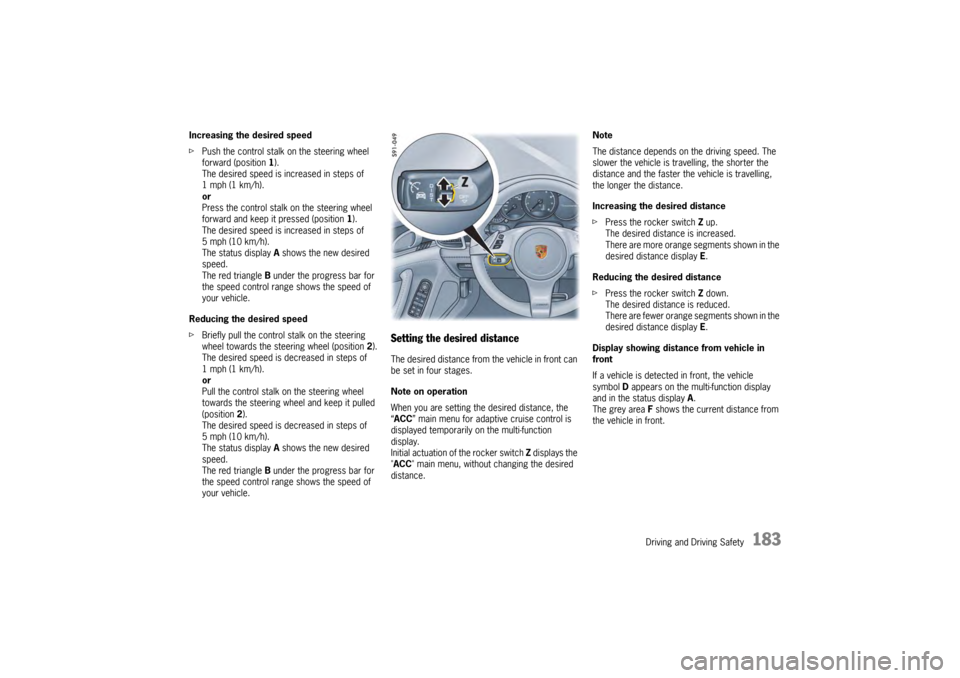
Setting the desired distanceThe desired distance from the vehicle in front can
be set in four stages.
Note on operation
When you are setting the desired distance, the
“ ACC ” main menu for adaptive cruise control is
displayed temporarily on the multi-function
display.
Initial actuation of the rocker switch Z displays the
"ACC " main menu, without changing the desired
distance. Note
The distance depends on the driving speed. The
slower the vehicle is travelling, the shorter the
distance and the faster the vehicle is travelling,
the longer the distance.
Increasing the desired distance
f
Press the rocker switch Z up.
The desired distance is increased.
There are more orange segments shown in the
desired distance display E.
Reducing the desired distance
f Press the rocker switch Z down.
The desired distance is reduced.
There are fewer orange segments shown in the
desired distance display E.
Display showing distance from vehicle in
front
If a vehicle is detected in front, the vehicle
symbol D appears on the multi-function display
and in the status display A.
The grey area F shows the current distance from
the vehicle in front.
Page 197 of 343

Driving and Driving Safety
195
Selector-Lever PositionsP – Parking lockfEngage parking lock only when the vehicle is
stationary.
If selector-lever position P is flashing in the
instrument panel, the parking lock is not
engaged. The vehicle can roll away.
Shift again from selector-lever position R to P.
f Activate the electric parking brake and then
engage the parking lock.
If selector-lever position P is flashing in the
instrument panel, the parking lock is not
engaged. The vehicle can roll away.
Shift again from selector-lever position R to P.
The ignition key can be removed only in selector-
lever position P.R – Reverse gearf Select only if the vehicl e is stationary and the
brake is applied.N – Neutral (idling)Selector-lever position N must be selected for
towing or in car washes, for example.
f Only select the desired position for driving off
(D , M or R) when the engine is idling and the
brake pedal is pressed.
D – Automatic selection modeSelect position D for “normal” driving. The gears
are shifted automatically according to the
accelerator position and speed.
Depending on the way the vehicle is driven
(economical, comfortable or sporty driving style)
and on the resistance (e.g. uphill), the gear-
changing points are shifted towards higher or
lower engine-speed ranges.
The accelerator position, driving speed, engine
speed, longitudinal and lateral acceleration and
the road profile all have an influence on the gear-
changing characteristic.
Unwanted upshifts, e.g. when entering
bends, are prevented by swiftly releasing the
accelerator pedal.
Depending on lateral acceleration, upshifts on
bends are not made until the engine-speed limit
is reached.
When you brake, and depending on the amount of
deceleration, the PDK transmission changes down
earlier.
For subsequent cornering, the right gear is
engaged when pressure is applied to the brakes
before the bend. The bend is taken in the right
gear, and when you accelerate out of the bend you
do not have to change down.
With a sporty driving style, downshifts are already
initiated when the brake pedal is touched lightly.
This further enhances a dynamic driving style. The PDK transmission temporarily changes to the
sportiest gear-changing map, i.e. to the highest
possible gear-changing points, if the accelerator
pedal is pressed quickly. The transmission
accordingly shifts down
immediately by one or
two gears (temporary change-down).
The transmission no longer selects 7th gear
at high driving speeds.
“Sport” and “Sport Plus” Mode “Sport” mode activated:
The PDK transmission switches to a sporty gear-
changing map and shortens the shifting times.
A sporty driving style is recognized more quickly
and the gear-changing speeds are adapted to
driving performance.
Deceleration downshifts are initiated earlier.
Downshifts occur for small decelerations,
even at higher revs.
“Sport Plus” mode activated:
In “Sport Plus” mode, the PDK transmission
changes to a shift program designed for driving
on race circuits. 7th gear is not selected.
The gear-changing performance is enhanced
significantly again compared with “Sport” mode.
f Please see the chapter ““SPORT” AND “SPORT
PLUS” MODE” on page 212.
Page 200 of 343
198
Driving and Driving Safety
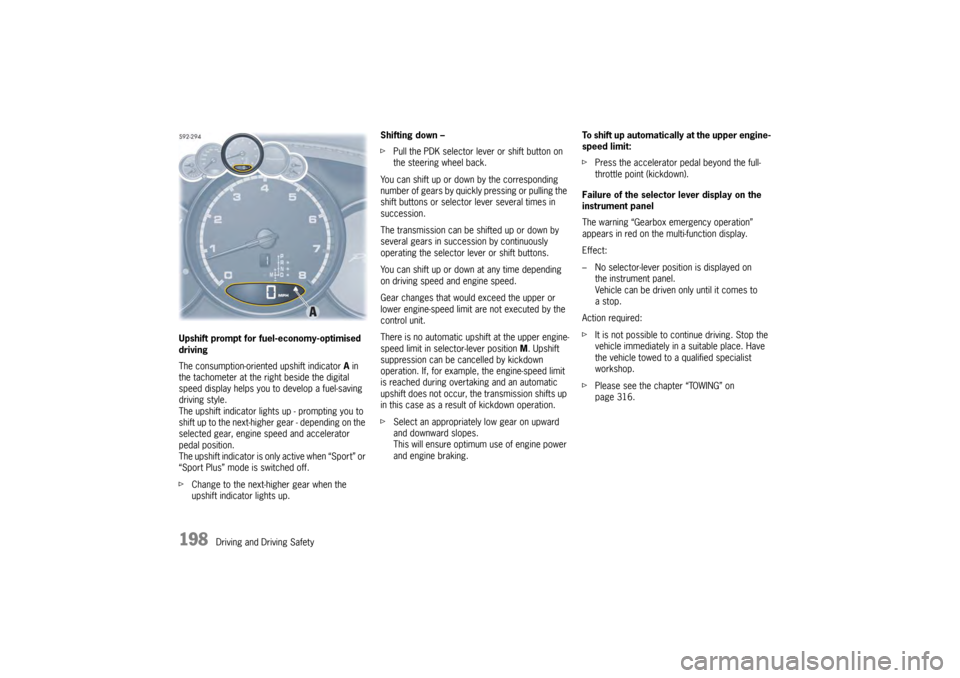
Upshift prompt for fuel-economy-optimised
driving
The consumption-oriente
d upshift indicator A in
the tachometer at the ri ght beside the digital
speed display helps you to develop a fuel-saving
driving style.
The upshift indicator lights up - prompting you to
shift up to the next-higher gear - depending on the
selected gear, engine speed and accelerator
pedal position.
The upshift indicator is only active when “Sport” or
“Sport Plus” mode is switched off.
f Change to the next-higher gear when the
upshift indicator lights up. Shifting down –
f
Pull the PDK selector lever or shift button on
the steering wheel back.
You can shift up or down by the corresponding
number of gears by quickly pressing or pulling the
shift buttons or selector lever several times in
succession.
The transmission can be shifted up or down by
several gears in succession by continuously
operating the selector lever or shift buttons.
You can shift up or down at any time depending
on driving speed and engine speed.
Gear changes that would exceed the upper or
lower engine-speed limit are not executed by the
control unit.
There is no automatic upshift at the upper engine-
speed limit in selector-lever position M. Upshift
suppression can be cancelled by kickdown
operation. If, for example, the engine-speed limit
is reached during overtaking and an automatic
upshift does not occur, the transmission shifts up
in this case as a result of kickdown operation.
f Select an appropriately low gear on upward
and downward slopes.
This will ensure optimum use of engine power
and engine braking. To shift up automatically
at the upper engine-
speed limit:
f Press the accelerator pedal beyond the full-
throttle point (kickdown).
Failure of the selector lever display on the
instrument panel
The warning “Gearbox emergency operation”
appears in red on the multi-function display.
Effect:
– No selector-lever position is displayed on the instrument panel.
Vehicle can be driven only until it comes to
astop.
Action required:
f It is not possible to continue driving. Stop the
vehicle immediately in a suitable place. Have
the vehicle towed to a qualified specialist
workshop.
f Please see the chapter “TOWING” on
page 316.
Page 201 of 343

Driving and Driving Safety
199
StoppingfFor a brief stop, e.g. at traffic lights, leave the
selector lever in drive position and hold the
vehicle with the brake pedal.
f Do not hold the vehicle on a slope using the
accelerator. Use the brake pedal or the
electric parking brake instead.
f Before leaving the vehicle, always apply the
electric parking brake and move the selector
lever to position P.Parkingf Go easy on the accelerator!
f When parking or maneuvering in a small
space, control the speed by careful use of
the footbrake.Driving in winterIn wintry road conditions, it is advisable to take
steep inclines in manual mode. This prevents gear
changes occurring that could cause wheel spin.Tow-starting, towingfPlease see the chapter “TOWING” on
page 316.
Reduced driving programIf there is a fault in the transmission
– Depending on priority, either the “Gearbox
emergency operation” warning in yellow or red
or the warning “Gearbox temperature too high”
will appear on the multi-function display.
“Gearbox emergency operation” warning in
yellow
Effects:
– Restricted gearshift comfort, reverse gear may not function.
Action required:
f Have the fault corrected immediately.
Please contact a qualified specialist workshop.
We recommend that you have an authorized
Porsche dealer to do this work as they have
trained workshop personnel and the necessary
parts and tools. “Gearbox emergency operation” warning in red
Effect:
– Vehicle can be driven
only until it comes to
astop.
Action required:
f It is not possible to continue driving. Stop the
vehicle immediately in a suitable place. Have
the vehicle towed to a qualified specialist
workshop.
f Please see the chapter “TOWING” on
page 316.
Warning “Gearbox temperature too high”
–Effects: “Warning jerks” can be fe lt when driving off and
the engine power may be restricted.
Action required:
Do not hold the vehicle with the accelerator on
a hill, for example. Hold the vehicle with the
brake. Reduce engine load. Stop the vehicle in
a suitable place if possib le. Allow the engine to
run in selector-lever position P or N until the
warning disappears.
Page 202 of 343
200
Driving and Driving Safety
PDK selector lever emergency releaseIn the event of an electronics failure, the PDK
selector lever can only be moved from selector-
lever position P if an emergency release operation
has already been performed.
Note
If a selector lever emergency release was
performed, the vehicle must not be towed.
f Please see the chapter “TOWING” on
page 316.
f Secure the vehicle to prevent it from
rolling away.
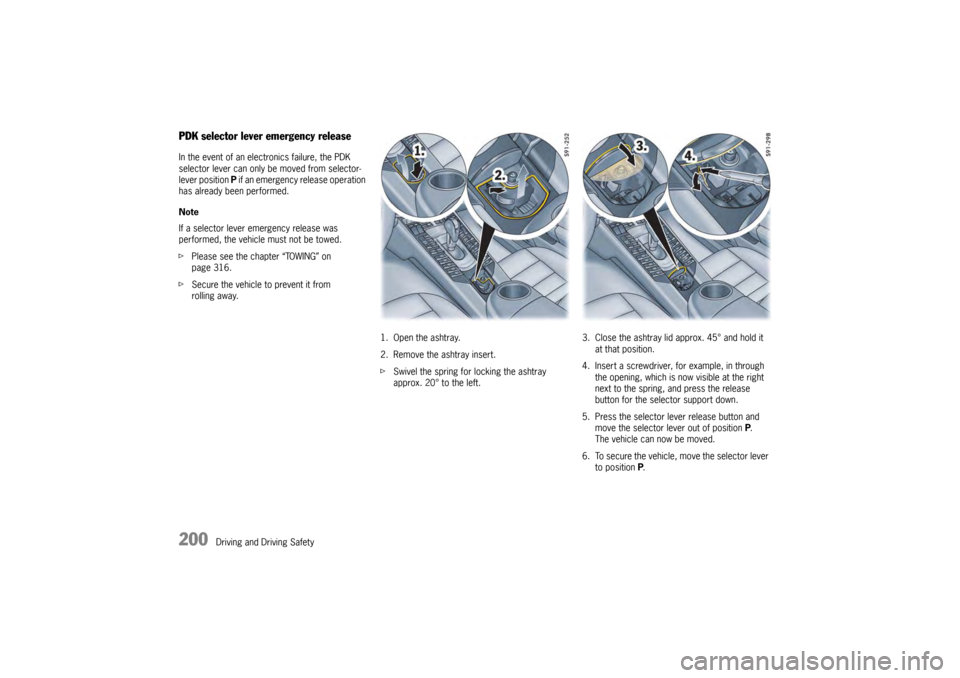
1. Open the ashtray.
2. Remove the ashtray insert.
fSwivel the spring for locking the ashtray
approx. 20° to the left. 3. Close the ashtray lid a
pprox. 45° and hold it
at that position.
4. Insert a screwdriver, for example, in through the opening, which is now visible at the right
next to the spring, and press the release
button for the selector support down.
5. Press the selector lever release button and move the selector lever out of position P.
The vehicle can now be moved.
6. To secure the vehicle, move the selector lever
to position P.
Page 207 of 343

Driving and Driving Safety
205
When you brake in the ABS control range,
the vehicle is stabilised even when PSM is
switched off.
One-sided spinning of the wheels is prevented,
even with PSM switched off.
PSM should always be switched on during
“normal” driving.
H o w e v e r, i t m a y b e a g o o d i d e a to s w it c h o f f P S M
temporarily in exceptional situations:
– On a loose surface and in deep snow.
– When “rocking the vehicle free”.
– When using snow chains.
Tip on driving
The vehicle retains its enhanced braking readiness
through prefilling of the br ake system even when
PSM is switched off.
When PSM is switched off, wheel-specific brake
interventions and the anti-slip control system (ASR)
are also switched off.
The automatic brake differential (ABD) remains on.
Adaptive cruise control is deactivated when PSM
is switched off.
When PSM is switched off, the slip monitoring
function of Porsche Doppelkupplung (PDK) is also
deactivated.
Switching PSM back onf Press button .
PSM is active immediately.
The indicator light on the button and the
PSM OFF warning light on the instrument
panel go out.
The message “PSM switched on” appears on
the multi-function disp lay in the instrument
panel.“Sport Plus” modeA sportier setup is obtained when “Sport Plus”
mode is switched on.
PSM interventions occur later than in Normal
mode. The vehicle can be maneuvered with
greater agility at its pe rformance limits, without
having to dispense with th e assistance of PSM in
emergency situations. This helps to achieve
optimal lap times, particular ly on race circuits and
on a dry road surface. – The PSM warning light on the instrument panel
lights up for a lamp check when the ignition is
switched on.
– The light indicates a control operation, even when PSM is switched off, e.g. brake control in
the event of one-sided wheel spin.
– The light - in conjunction with the multi-function display - indicates a fault.
The warning message “PSM failure” appears
on the multi-function display in the instrument
panel.
For information on warning messages on the multi-
function display:
f Please see the chapter “OVERVIEW OF
WARNING MESSAGES” on page 152.
f Adapt your driving style according to the
changed conditions.
f Contact a qualified spec ialist workshop in
order to correct the fault. We recommend that
you have an authorized Porsche dealer to do
this work, as they have the trained workshop
personnel and the necessary parts and tools
for this type of work.
To w i n g
For information on towing:
f Please see the chapter “TOWING” on
page 316.
PSM warning light
Page 214 of 343

212
Driving and Driving Safety
“Sport” and “Sport Plus” Mode FunctionThe selectable chassis settings mean that the
vehicle can offer various modes for a sportier
overall setup.
When “Sport” or “Sport Plus” mode is selected, all
the vehicle’s control systems are intentionally
shifted towards greater agility and driving
performance:
– PASM (Porsche Active Suspension Management) is automa tically changed to
“PASM Sport” or “PASM Sport Plus” mode,
resulting in a stiffer suspension setup.
The vehicle switches to Low Level in “PASM
Sport Plus” mode.
f Please see the chapter “PORSCHE ACTIVE
SUSPENSION MANAGEMENT (PASM)” on
page 208.
– Just like PASM, PDCC is switched to the corresponding “Sport” or “Sport Plus” mode,
whereby the rolling movements of the vehicle
are reduced further, depending on the
selected mode.
f Please see the chapter “PORSCHE DYNAMIC
CHASSIS CONTROL (PDCC)” on page 211.
– The PDK transmission switches to a sporty gear-changing map and shortens the gear
shifting times when Sport mode is activated.
Gear changes take place faster. f
Please see the chapter ““SPORT” AND “SPORT
PLUS” MODE” on page 195.
– The electronic accelerator pedal reacts sooner, and the engine is more responsive to
throttle inputs. When Sport mode is switched
on and the vehicle is travelling at a speed of
less than 25 mph (40 km/h), this function is
activated only after the driver has floored the
accelerator pedal or released it briefly.
– The rpm limiter characteristic is “harder”. In other words: the engine is immediately
throttled when the performance limits are
reached (only in manual selection mode on
vehicles with PDK).
– The turbo overboost briefly increases the engine boost pressure in the engine speed
range from 2,500 rpm to approx. 4,000 rpm.
As a result, torque in this speed range is
increased by 70 Nm (52 ftlb.). This
considerably improves acceleration and
flexibility, particularly in the medium engine
speed range. This does not affect the
maximum power. Quickly flooring the
accelerator pedal acti vates turbo overboost
in the engine control system. Overboost has
an effective operating time of approx.
10 seconds. After this time, it can be re-
activated by quickly flooring the accelerator
pedal again. – PSM (Porsche Stability Management) control is
more sporty in “Sport Plus” mode. PSM
interventions are later than in Normal mode.
The driver can maneuver the vehicle with
greater agility at it s performance limits,
without having to dispense with the assistance
of PSM in emergency situations. This helps to
achieve optimal lap times, particularly on race
circuits with a dry road surface.
f Please see the chapter “PORSCHE STABILITY
MANAGEMENT (PSM)” on page 202.
– Adaptive cruise control regulates speed and distance more dynamically.
– The Auto Start Stop function is deactivated.
f Please see the chapter “AUTO START STOP
FUNCTION” on page 169.
– The rear spoiler extends earlier and retracts later (“Sport Plus” mode only).
f Please see the chapter “RETRACTABLE REAR
SPOILER” on page 214.
– The system switches from High Level.
f Please see the chapter “HIGH LEVEL” on
page 209.