weight PORSCHE PANAMERA 2010 1.G User Guide
[x] Cancel search | Manufacturer: PORSCHE, Model Year: 2010, Model line: PANAMERA, Model: PORSCHE PANAMERA 2010 1.GPages: 343, PDF Size: 7.96 MB
Page 239 of 343
Storage, Luggage Compartment and Roof Transport System
237
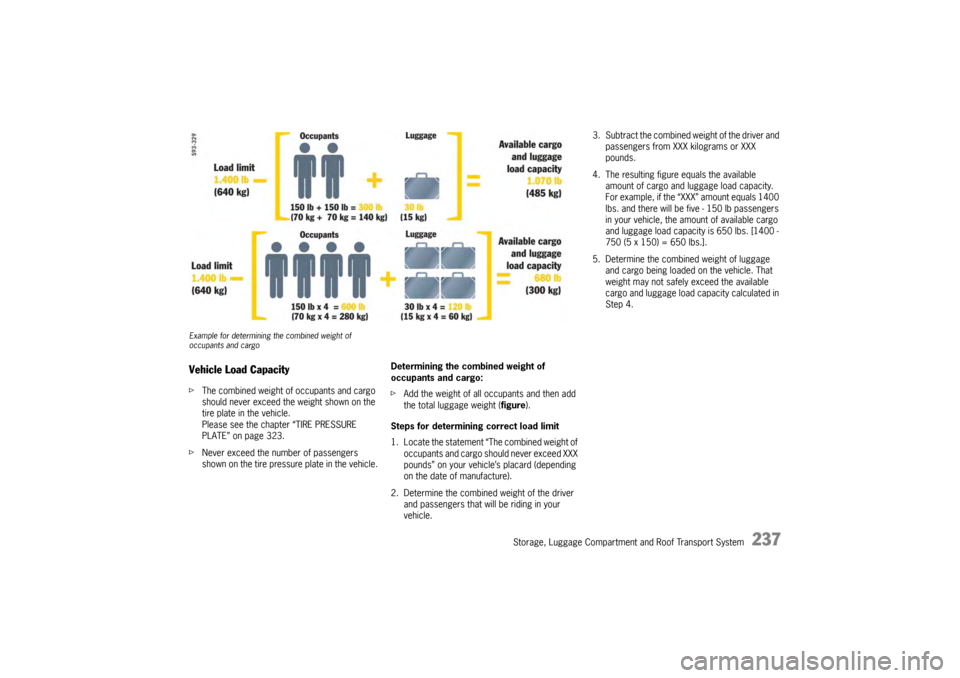
Example for determining the combined weight of
occupants and cargoVehicle Load CapacityfThe combined weight of occupants and cargo
should never exceed the weight shown on the
tire plate in the vehicle.
Please see the chapter “TIRE PRESSURE
PLATE” on page 323.
f Never exceed the number of passengers
shown on the tire pressure plate in the vehicle. Determining the combined weight of
occupants and cargo:
f
Add the weight of all occupants and then add
the total luggage weight ( figure).
Steps for determining correct load limit
1. Locate the statement “The combined weight of occupants and cargo should never exceed XXX
pounds” on your vehicle’s placard (depending
on the date of manufacture).
2. Determine the combined weight of the driver and passengers that will be riding in your
vehicle.
3. Subtract the combined weight of the driver and passengers from XXX kilograms or XXX
pounds.
4. The resulting figure equals the available amount of cargo and luggage load capacity.
For example, if the “XXX” amount equals 1400
lbs. and there will be five - 150 lb passengers
in your vehicle, the am ount of available cargo
and luggage load capacity is 650 lbs. [1400 -
750 (5 x 150) = 650 lbs.].
5. Determine the combined weight of luggage and cargo being loaded on the vehicle. That
weight may not safely exceed the available
cargo and luggage load ca pacity calculated in
Step 4.
Page 266 of 343

264
Maintenance and Car Care
Fuel EconomyFuel economy will vary depending on where,
when and how you drive, optional equipment
installed, and the general condition of your
car.
A car tuned to specifications and correctly
maintained, will help you to achieve optimal
fuel economy.
fHave your vehicle tuned to specifications. Air
cleaner should be dirt free to allow proper
engine “breathing”.
Battery should be fully charged.
Wheels should be properly aligned.
Tires should be inflated to the correct
pressure.
f Always monitor your fuel consumption.
f Drive smoothly, avoid abrupt changes in speed
as much as possible.
f Avoid jack rabbit starts and sudden stops.
f Do not drive longer than necessary in the lower
gears. Shifting into a higher gear early without
lugging the engine will help save fuel.
f Prolonged “warm up” idling wastes gas. Start
the vehicle just before you are ready to drive.
Accelerate slowly and smoothly.
f Switch off the engine if stationary for longer
periods.
f Any additional weight carried in the vehicle
reduces fuel economy. Always keep cargo to
a minimum and remove all unnecessary items. f
Organize your trips to take in several errands
in one trip.
f All electrical accessories contribute to
increased fuel consumption.
f Only switch on the air conditioning when
necessary.
f Do not drive with the Ro of Transport System
mounted unless you need it.
The EPA estimated miles per gallon (mpg) is
to be used for comparison purposes, actual
mileage may be different from the estimated
mpg, depending on your driving speed,
weather conditions and trip length. Your
actual highway mileage may be less than the
estimated mpg.
f Please observe all local and national speed
limits.
Operating Your Porsche in other
CountriesGovernment regulations in the United States and
Canada require that automobiles meet specific
emission regulations and safety standards.
Therefore, cars built for the U.S. and Canada differ
from vehicles sold in other countries.
If you plan to take your Porsche outside the
continental limits of the United States or Canada,
there is the possibility that
– unleaded fuel may not be available;
– unleaded fuel may have a considerably lower
octane rating. Excessi ve engine knock and
serious damage to both engine and catalytic
converters could result;
– service may be inadequate due to lack of proper service facilities, tools or diagnostic
equipment;
– replacement parts may not be available or very difficult to get.
Porsche cannot be responsible for the
mechanical damage that could result
because of inadequate fuel, service or parts
availability.
If you purchased your Porsche abroad and want to
bring it back home, be sure to find out about
shipping and forwarding requirements, as well as
current import and customs regulations.
Page 285 of 343
Minor Repairs
283
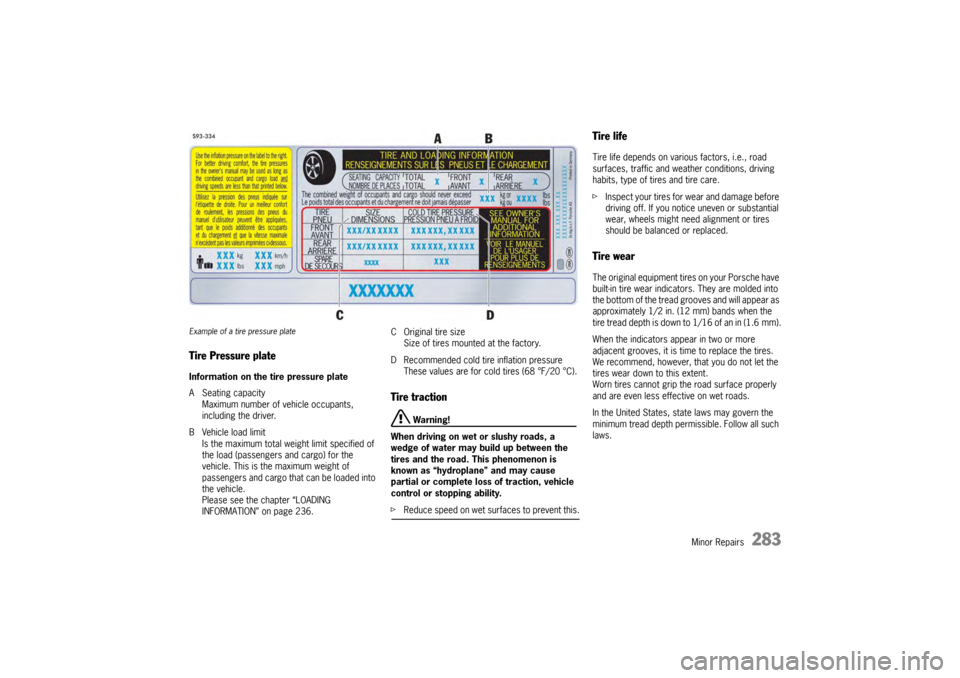
Example of a tire pressure plateTire Pressure plateInformation on the tire pressure plate
A Seating capacityMaximum number of vehicle occupants,
including the driver.
B Vehicle load limit Is the maximum total weight limit specified of
the load (passengers and cargo) for the
vehicle. This is the maximum weight of
passengers and cargo that can be loaded into
the vehicle.
Please see the chapter “LOADING
INFORMATION” on page 236. C Original tire size
Size of tires mounted at the factory.
D Recommended cold tire inflation pressure These values are for cold tires (68 °F/20 °C).
Tire traction
Warning!
When driving on wet or slushy roads, a
wedge of water may bu ild up between the
tires and the road. This phenomenon is
known as “hydroplane” and may cause
partial or complete loss of traction, vehicle
control or stopping ability.
f Reduce speed on wet surfaces to prevent this.
Tire lifeTire life depends on various factors, i.e., road
surfaces, traffic and weather conditions, driving
habits, type of tires and tire care.
f Inspect your tires for wear and damage before
driving off. If you notice uneven or substantial
wear, wheels might need alignment or tires
should be balanced or replaced.Tire wearThe original equipment tires on your Porsche have
built-in tire wear indicators. They are molded into
the bottom of the tread grooves and will appear as
approximately 1/2 in. (12 mm) bands when the
tire tread depth is down to 1/16 of an in (1.6 mm).
When the indicators appear in two or more
adjacent grooves, it is time to replace the tires.
We recommend, however, that you do not let the
tires wear down to this extent.
Worn tires cannot grip the road surface properly
and are even less effective on wet roads.
In the United States, state laws may govern the
minimum tread depth permissible. Follow all such
laws.
Page 287 of 343

Minor Repairs
285
In case of tire damage, where it is uncertain
whether there is a break in the ply with all its
consequences or tire damage caused by thermal
or mechanical overloading due to loss of pressure
or any other prior damage, we recommend that
the tire be replaced for safety reasons.
If one faulty tire is replac ed it should be noted that
the difference in tread depth on one axle must not
exceed 30%. Handling inconsistencies may result.
f Perform a visual inspection if necessary.Tire replacementsfUse only tire makes and types tested by
Porsche.
If you do not use a Porsche recommended
replacement tire, make sure that you
purchase your new tires from a reputable tire
dealer and that the dealer complies with all
manufacturers warnings for those tires.
Only tires with the same manufacturer and
with the same specific ation code (e.g. “N0”,
“N1”…) should be mounted on the vehicle.
Before mounting new tires, check with your
Porsche dealer about the current release
status.
Tires should be replaced no less than on one axle
at the time. Only tires of the same make and type
must be used. Mixed tire s are not permissible and
will affect vehicle performance, safety, and can
affect vehicle warranty. Porsche dealers can recommend the most current
replacement tire options for your vehicle.
Initially, new tires do not have their full traction.
You should therefore drive at moderate speeds
during the first 60 - 120 miles (100 - 200 km).
Tires must always remain
on the same side of
the vehicle.
When wheels are removed, the direction of
rotation and position of each wheel should be
marked.
If new tires are installed only on one axle, a
noticeable change in hand ling occurs due to the
different tread depth of the other tires. This
happens especially if only rear tires are replaced.
However, this condition disappears as the new
tires are broken in.
f Please adjust your driving style accordingly.
Installation of new tires should only be done by a
qualified tire technician.
Valves
f Use only plastic valve caps.
f The rubber valves must be replaced whenever
the tires are changed.
f The fitting and replacement specifications
must be observed for metal valves.
f Only use Original Porsche metal valves.
f Protect the valve inserts against soiling with
valve caps. Soiled valve inserts can cause a
gradual loss of air.
Parking at the curb
Danger!
Hard impacts against curbs (or traffic
islands) are dangerous and may cause
hidden tire damage which is not noticeable
until later. Such damage can result in
accidents at high speeds causing serious
personal injury or death. Depending on the
force of impact, the edge of the rim can also
be damaged.
f After such an impact, have the wheel checked
by an expert.
f If you must drive over a curb or other obstacle,
drive slowly and at an obtuse angle. Exercise care when parking along curbs.
Maintenance note
Tire repairs are not permissible under any
circumstances.
Wheel alignment, wheel balancingAs a precaution, have wheels with summer tires
balanced in the spring, and those with mud and
snow tires before winter. Unbalanced wheels may
affect car handling and tire life.
Only the specified weights may be used for wheel
balancing.
Page 288 of 343

286
Minor Repairs
Self-adhesive weights must not come into contact
with cleaning agents, since they could drop off.
Uneven tread wear indica
tes wheel imbalance. In
this event, the vehicle should be checked at an
authorized Porsche dealer.
Danger!
If, during a trip, uneven running or vibrations
occur that could be caused by damage to
tires or the car, the speed must be reduced
immediately, but without braking sharply. If
you continue your trip without having the
cause of the fault reme died, you might lose
control of your vehicle which could cause
serious personal injury or death.
f Stop the vehicle and check the tires.
f If no cause for the fault can be found, drive
carefully to the nearest authorized Porsche dealer.
Wheels with Tire Pressure Monitoring
(TPM) sensorsBefore changing wheels, make sure that the
wheels are compatible with your vehicle’s TPM.
fCheck this with your authorized Porsche
dealer.Removing and storing tiresfAfter changing, adjust tire pressure and torque
wheel bolts diagonally.
Please see the chapter “CHANGING A WHEEL”
on page 291.
f Store tires in a co ol and dry place. Rotate
periodically to avoid flat spots.
f Avoid contact with fuel, oil and grease.
Tires must always remain on the same side of
the vehicle.
When wheels are removed, the direction of
rotation and position of each wheel should be
marked. Example
FR (front right), FL, RR and RL.
Wheels must always be fitted in accordance with
their marking.
The perception that tire durability and
performance are not affected by storage and age
is unfounded.
Chemical additives, which make the rubber
elastic, lose their effectiveness over the course of
time and the rubber becomes brittle and cracks.
Therefore, the tires should be inspected from
time to time.
Note
Under no circumstances should tires older than
6 years be used on your Porsche.
The age of the tire can be obtained from the ”DOT“
code number. If, for example, the last three
numbers read 1208, then the tire was produced in
the 12th week of 2008.
Page 317 of 343
Minor Repairs
315
Adjustment
The adjustment is made with the vehicle ready to
drive and the fuel tank completely filled.
The driver's seat must be loaded by a person or a
165 lbs. (75 kg) weight and the tire pressures
must meet the prescribed values. After being
loaded, the car must be rolled a few meters so
that the suspension can settle.
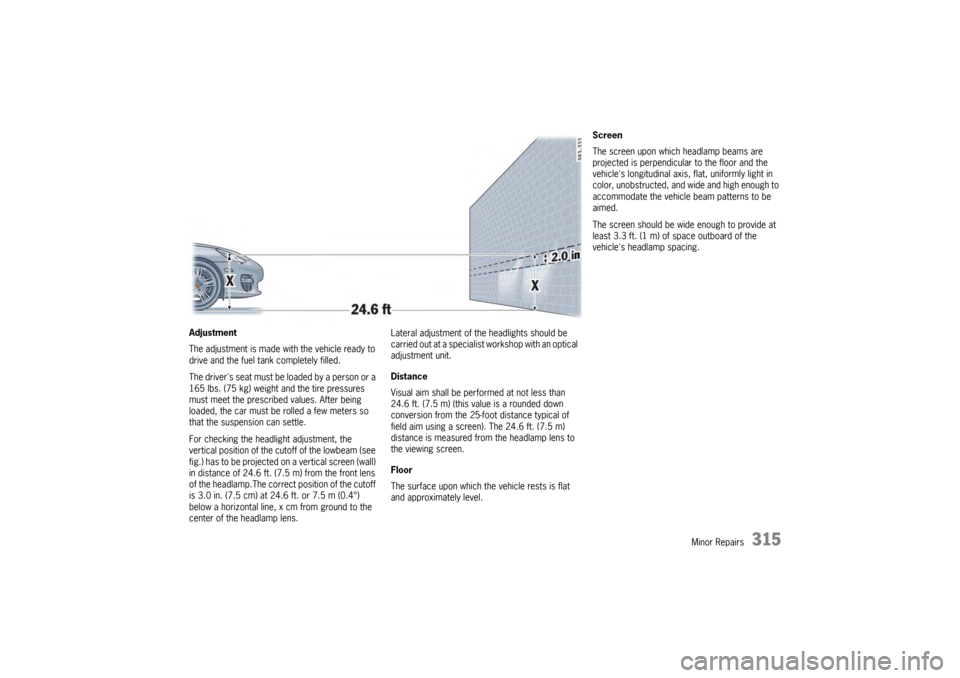
For checking the headlight adjustment, the
vertical position of the cutoff of the lowbeam (see
fig.) has to be projected on a vertical screen (wall)
in distance of 24.6 ft. (7.5 m) from the front lens
of the headlamp.The correc t position of the cutoff
is 3.0 in. (7.5 cm) at 24.6 ft. or 7.5 m (0.4°)
below a horizontal line, x cm from ground to the
center of the headlamp lens. Lateral adjustment of the headlights should be
carried out at a specialist workshop with an optical
adjustment unit.
Distance
Visual aim shall be performed at not less than
24.6 ft. (7.5 m) (this value is a rounded down
conversion from the 25-f
oot distance typical of
field aim using a screen). The 24.6 ft. (7.5 m)
distance is measured from the headlamp lens to
the viewing screen.
Floor
The surface upon which the vehicle rests is flat
and approximately level.
Screen
The screen upon which headlamp beams are
projected is perpendicular to the floor and the
vehicle's longitudinal axis, flat, uniformly light in
color, unobstructed, and wide and high enough to
accommodate the vehicle beam patterns to be
aimed.
The screen should be wide enough to provide at
least 3.3 ft. (1 m) of space outboard of the
vehicle's headlamp spacing.
Page 324 of 343
322
Tire Pressure and Technical Data
Tire Pressure and Technical DataVehicle Identification Data ............................ 323
Engine Data................................................ 324
Wheels, Tires.............. ................................ 325
Tire Pressure for Cold Tires (68 °F/20 °C) .... 326
Weights...................................................... 328
Filling Capacities ......... ................................ 329
Driving Performance ... ................................ 329
Dimensions .................... ............................ 330
Page 325 of 343
Tire Pressure and Technical Data
323
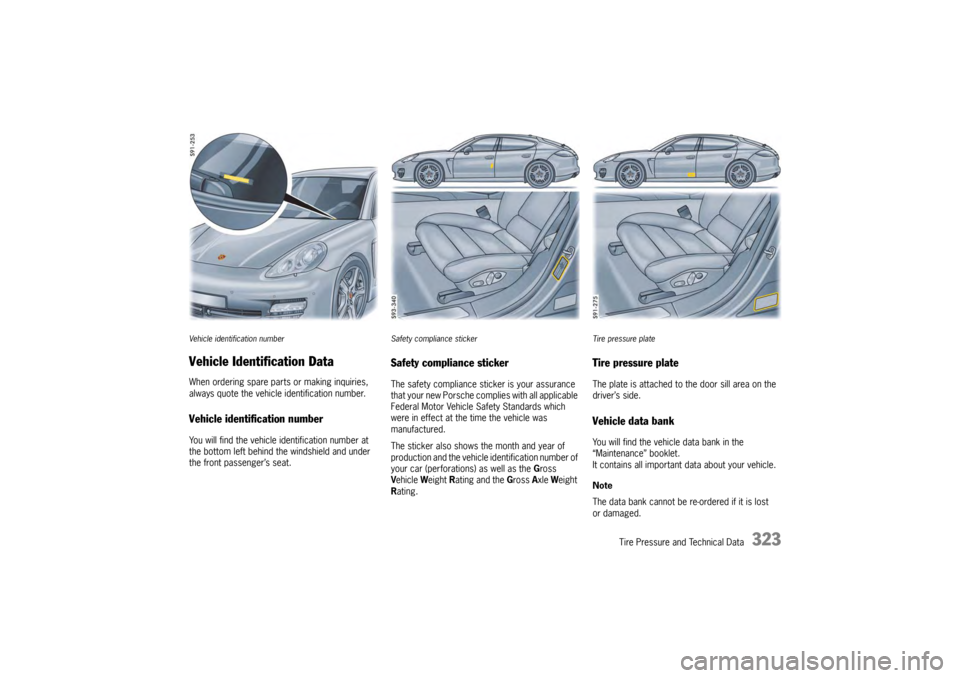
Vehicle identification numberVehicle Identification DataWhen ordering spare parts or making inquiries,
always quote the vehicle identification number.Vehicle identification numberYou will find the vehicle identification number at
the bottom left behind the windshield and under
the front passenger’s seat.
Safety compliance stickerSafety compliance stickerThe safety compliance sticker is your assurance
that your new Porsche complies with all applicable
Federal Motor Vehicle Safety Standards which
were in effect at the time the vehicle was
manufactured.
The sticker also shows the month and year of
production and the vehicle identification number of
your car (perforations) as well as the Gross
V ehicle Weight Rating and the Gross Axle Weight
R ating.
Tire pressure plateTire pressure plateThe plate is attached to the door sill area on the
driver’s side.Vehicle data bankYou will find the vehicle data bank in the
“Maintenance” booklet.
It contains all important data about your vehicle.
Note
The data bank cannot be re-ordered if it is lost
or damaged.
Page 330 of 343

328
Tire Pressure and Technical Data
Weights1)Curb weight includes 175 lbs (75 kg) driver and baggage.2)The maximum vehicle weight and maximum axle loads must not be exceeded.
Note: If additional accessories are installed, the maximum load will be correspondingly less.3)Only use roof transport systems from the Po rsche Tequipment range for your vehicle or roof transport systems that have been tested and approved
by Porsche. Panamera S Panamera 4S Panamera Turbo
Curb weight (depending on equipment)
per DIN 70020 3968 lbs – 4497 lbs
(1800 kg – 2040 kg) 4101 lbs – 4597 lbs
(1860 kg – 2085 kg) 4343 lbs – 4729 lbs
(1970 kg – 2145 kg)
per 70/156/EEC
1)
4143 lbs – 4672 lbs
(1875 kg – 2115 kg) 4276 lbs – 4772 lbs
(1935 kg – 2160 kg) 4518 lbs – 4904 lbs
(2045 kg – 2220 kg)
Maximum axle load, front
2)
2568 lbs (1165 kg) 2590 lbs (1175 kg) 2756 lbs (1250 kg)
Maximum axle load, rear
2)
2943 lbs (1335 kg) 2954 lbs (1340 kg) 2888 lbs (1310 kg)
Gross vehicle weight
2)
5302 lbs (2405 kg) 5379 lbs (2440 kg) 5512 lbs (2500 kg)
Roof load
Maximum roof load
3)
175 lbs (75 kg)
Page 331 of 343

Tire Pressure and Technical Data
329
Filling CapacitiesOnly use fluids and fuels approved by Porsche. Your authorized Porsche dealer can advise you.Driving PerformanceThe specifications refer to a vehicle with DIN curb weight witho ut performance-reducing additional equipment (e.g. special tires).
Engine oil change quantity without/with oil filter Approx. 2.17
US gallons (8.2 liters)/approx. 2.38 US gallons (9.0 liters)
Fuel tank Panamera S:
Approx. 80 litres, of which approx. 3.96 US gallons (15 liters) are reserve
Panamera 4S, Panamera Turbo: Approx. 100 litres, including approx. 3.96 US gallons (15 liters)
reserve
Fuel octane rating The engine is designed to provide optimum perf
ormance and fuel consumption if unleaded premium
fuel with 98 RON/88 MON (93 CLC or AKI) is us ed. If unleaded fuels with octane ratings of less than
98 RON/88 MON (93 CLC or AKI) are used, the engine’s knock control automatically adapts the
ignition timing. Porsche recommends that you use fuel with at least 95 RON/85 MON (90 CLC or
AKI) in your vehicle.
Window/
headlight cleaning system Approx. 1.45 US gallons (5.5 liters)
Maximum speed Acceleration 0 – 60 mph
(96 km/h) Acceleration 0 – 62 mph
(100 km/h) (values in brackets relate to Sport Plus mode)
Panamera S 176 mph (283 km/h)5.2 seconds5.4 (5.2) seconds
Panamera 4S 175 mph/h (282 km)4.8 seconds5.0 (4.8) seconds
Panamera Turbo 188 mph (303 km/h)4.0 seconds4.2 (4.0) seconds