steering PORSCHE PANAMERA 2010 1.G Manual PDF
[x] Cancel search | Manufacturer: PORSCHE, Model Year: 2010, Model line: PANAMERA, Model: PORSCHE PANAMERA 2010 1.GPages: 343, PDF Size: 7.96 MB
Page 204 of 343

202
Driving and Driving Safety
Porsche Traction Management
(PTM)Porsche Traction Management is an active all-
wheel control system designed to influence
longitudinal and lateral dynamics. It is closely
linked with the Porsche Stability Management
(PSM) system.
The permanently driven rear axle enhances the
vehicle’s sporty features. Drive power is
distributed fully variably to the front axle,
depending on the driving situation.
In conjunction with PSM, the PTM system ensures
perfect distribution of power among all four
wheels in every driving situation. This improves
traction and driving stabil ity and ensures the same
high level of agility and dynamic response.
Warning!
In spite of the advantages of PTM and four-wheel
drive, it is still the driver’s responsibility to adapt
his driving style and maneuvers in line with road
and weather conditions, as well as the traffic
situation.
The increased safety that is provided should not
induce you to take greate r risks with your safety.
The limits set by the physics of driving cannot be
overcome, even with PTM or four-wheel drive.
Risk of accidents due to inappropriate speed
cannot be reduced by PTM or four-wheel drive. Advantages of PTM
– Clearly perceptible improvement in traction,
driving stability and steering ability of the
vehicle.
– Vehicle is more manageable when driven at its performance limits.
– Improved straight-ahead tracking and greater stability.
– More sporty vehicle setup while making full use of all the advantages of four-wheel drive.
– ASR and ABD further enhance traction for all wheels.
For information on ASR and ABD:
f Please see the chapter “PORSCHE STABILITY
MANAGEMENT (PSM)” on page 202.
Porsche Stability Management
(PSM)PSM is an active control system for stabilisation of
the vehicle during extreme driving maneuvers.
It operates together with the Porsche Traction
Management (PTM) system provided the vehicle is
fitted with the relevant equipment.
PSM makes use of both the ABD and ASR
systems, as well as the known functions of the
anti-lock brake system (ABS) and engine drag
torque control system (MSR).
Warning!
In spite of the advantages of PSM, it is still the
driver’s responsibility to adapt his driving style and
maneuvers in line with road and weather
conditions, as well as the traffic situation.
The increased safety that is provided should not
induce you to take greater risks with your safety.
The limits set by the physics of driving cannot be
overcome, even with PSM.
Risk of accidents due to inappropriate speed
cannot be reduced by PSM.
Page 205 of 343

Driving and Driving Safety
203
Advantages of PSM
– Best possible traction and lane-holding ability
in all driving situations – even on road surfaces
with varying friction.
– The system compensates for undesired vehicle reactions (Ferraria effect) when the
driver releases the accelerator pedal or brakes
on bends. This compensation functions up to
the maximum lateral acceleration.
– PSM actively stabilises the vehicle if necessary during dynamic driving maneuvers (e.g. rapid
steering movements, during lane changes, or
on alternating bends).
– Improved braking stability on bends and on different or varying road surfaces.
– Improved brake function and shorter stopping distance in the event of emergency braking. Readiness for operation
PSM is switched on automatically every time you
start the engine.
Function
Sensors at the wheels, brakes, steering system
and engine continuously measure:
–Speed
– Direction of travel (steering angle)
– Lateral acceleration
– Axial acceleration
– Rate of turn about the vertical axis
PSM uses these values to determine the direction
of travel desired by the driver.
PSM intervenes and corrects the course if the
actual direction of motion deviates from the
desired course (steering-wheel position):
It brakes individual wheels as required.
If necessary, PSM also influences the engine
power or the gear-changing characteristic of
Porsche Doppelkupplung (PDK) in order to
stabilise the vehicle. The events below inform the driver of PSM control
operations and warn him to adapt his driving style
to the road conditions:
– PSM warning light on the instrument panel
flashes.
– Hydraulic noises can be heard.
– The vehicle decelerates and steering-wheel forces are altered as PSM controls the brakes.
– Reduced engine power.
– The brake pedal pulsates and its position is changed during braking.
In order to achieve full vehicle deceleration,
foot pressure must be increased after the
brake pedal has begun vibrating.
Examples of PSM control operations
– If the “front wheels of the vehicle drift” on
a bend, the engine power is reduced and the
rear wheel on the inside of the bend is braked
if necessary.
– If the rear of the vehicle swings out on a bend, the front wheel on the outside of the bend is
braked.
Page 209 of 343

Driving and Driving Safety
207
ABS Brake System
(Anti-Lock Brake System)
Warning!
In spite of the advantages of ABS, it is still the
driver’s responsibility to adapt his driving style and
maneuvers in line with road and weather
conditions, as well as the traffic situation.
The increased safety that is provided should not
induce you to take greater risks with your safety.
The limits set by the physic s of driving cannot be
overcome, even with ABS.
Risk of accidents due to inappropriate speed
cannot be reduced by ABS.
ABS ensures
– Full steering control
The vehicle remains steerable
– Good driving stability
No skidding due to locked wheels
– Optimum braking distance
Shorter stopping distance in most cases
– Prevention of wheel locking
No flat spots on the tires Function
The decisive advantage of ABS lies in the driving
stability and maneuverability of the vehicle in
hazardous situations.
ABS prevents locking of
the wheels during full
braking, on almost all road surfaces, until just
before the vehicle stops.
ABS begins to control the braking process as
soon as a wheel shows a tendency to lock.
This controlled braking process is comparable
with extremely rapid cadence braking.
The pulsating brake pedal and a “juddering noise”
warn the driver to adapt his driving speed to the
road conditions.
f If full braking is necessary, press the brake
pedal fully during the whole braking operation,
even though the pedal is pulsating. Do not
reduce brake pressure. If the ABS warning light lig
hts up on the instrument
panel while the engine is running, the ABS has
switched off because of a fault.
The warning message “ABS failure” appears on
the multi-function display in the instrument panel.
For information on warning messages on the
multi-function display:
f Please see the chapter “OVERVIEW OF
WARNING MESSAGES” on page 152.
In this case, the brake system will operate without
lock prevention, as on vehicles without ABS.
f Adapt your driving style to the changed
braking behavior.
The ABS must be checked by your authorized
Porsche dealer in order to prevent the
occurrence of further faults with unpredictable
consequences.
Please contact a qualified specialist workshop.
We recommend that you have an authorized
Porsche dealer to do this work as they have
trained workshop personnel and the necessary
parts and tools.
The ABS control unit is adjusted for the approved
tire dimensions.
The use of tires with no n-approved dimensions can
lead to different wheel speeds, causing ABS to
switch off. Warning light USA
Warning light Canada
Page 248 of 343
246
Alarm System and Theft Protection
Alarm System and Theft ProtectionAlarm System and Passenger
Compartment Monitoring............................. 247
Immobilizer ................ ................................ 250
Locking the Steering Column ....................... 250
Theft Protection .......... ................................ 250
Page 252 of 343

250
Alarm System and Theft Protection
ImmobilizerThere is a transponder (an electronic component),
containing a stored code, in each key.
Before the ignition is switched on, the ignition lock
checks the code.
The immobiliser can be deactivated and
the engine started only using an authorised
ignition key.
Locking the Steering ColumnVehicles without Porsche Entry & Drive Unlocking the steering column automatically
f Insert the ignition key into the ignition lock.
Locking the steering column automatically
f Remove the ignition key.Vehicles with Porsche Entry & DriveUnlocking the steering column automatically
f Turn the control unit out of ignition lock
position 0 .
Locking the steering column automatically
f Open the driver’s door (with the ignition
switched off).
Locking the steering column manually
f Once the ignition is sw itched off, turn the
control unit to ignition lock position 3 again
and hold it there for 2seconds.
The steering column locks with an
audible click.
Theft ProtectionWhen leaving the vehicle, always:
f Close all door windows.
f Close the slide/tilt roof.
f Remove the ignition key (or switch ignition off
on vehicles with Porsche Entry & Drive).
f Lock the glove box.
f Close all storage compartments.
f Remove valuables, vehicle registration
documents, telephone and house keys from
the vehicle.
f Cover the luggage compartment with the
retractable luggage compartment cover.
f Close the tailgate.
f Lock all doors.
Page 253 of 343
Maintenance and Car Care
251
Maintenance and Car Care
Exercise Extreme Caution when Working
on your vehicle........
................................... 252
Engine Oil ............... ................................... 254
Checking Engine-Oil Le vel ........................... 254
Topping Up Engine Oil . .............................. 255
Checking Coolant Level and Adding
Coolant ........................................... .......... 257
Brake Fluid .................. .............................. 258
Washer Fluid .......... ................................... 259
Power Steering ...... ................................... 260
Changing Air Cleaner .................................. 261
Changing Particle Filt er ............................... 261
Wiper Blades ............... .............................. 261
Emission Control Syst em ............................ 262
How Emission Control Works ...................... 263
Fuel Economy .............. .............................. 264
Operating Your Porsche in other Countries ... 264
Fuel............................. .............................. 265
Fuel Can ...................... .............................. 267
Fuel Recommendation s............................... 268
Fuel Evaporation Contr ol ............................ 269
Car Care Instructions .................................. 269
Page 262 of 343

260
Maintenance and Car Care
The warning light on the instrument panel and
the warning message on the multi-function display
alert you to the fact that the washer fluid level
is too low.
f
Add washer fluid at the next opportunity.
In this case, the remaining quantity is only approx.
1 litre. The maximum filling capacity is approx.
5.8USquarts (5.5liters).
Adding washer fluid
1. Open cap on washer fluid reservoir.
2. Add washer fluid.
3. Close cap carefully.
Power Steering
Warning!
Risk of accidents. When the engine is
stationary (e.g. when on tow) or the hydraulic
system fails, there is no power steering
assistance available.
Therefore, substantially more force will have
to be exerted to steer the vehicle.
f Exercise extreme care when your vehicle is
being towed.
f Have the fault corrected. Please contact a
qualified specialist workshop. We recommend
that you have an authorized Porsche dealer to
do this work as they have trained workshop personnel and the necessary parts and tools.
Regular checking of hydraulic fluid is part of
servicing.
The flow noise heard at full steering lock is design-
related and does not indicate a defect in the
steering system. Vehicles with Porsche Dynamic Chassis
Control (PDCC)
If the fluid level is too
low, the message “Check
steering oil level” will appe ar on the multi-function
display.
f Have the fluid level checked immediately.
f Please contact a qualified specialist workshop.
We recommend that you have an authorized
Porsche dealer to do this work as they have
trained workshop personnel and the necessary
parts and tools.
Warning light and warning
message
Page 273 of 343

Maintenance and Car Care
271
fStart washing the vehicle by thoroughly
wetting the paintwork and rinsing the heavy
dirt off.
f After washing the vehicle, rinse it thoroughly
with water and rub it dry with chamois-leather.
Do not use the same chamois for rubbing
dry as you use for cleaning the windshield
and windows.
Warning!
Risk of accidents! Reduced or uneven
braking action may be caused by wet
brakes.
f After washing the vehicle, test the brakes
and steering and briefly brake the discs dry.
When doing so, make sure that vehicles travelling behind you are not affected. Cleaning in car washes
Optional add-on parts or parts that project beyond
the contours of the vehi
cle may be damaged by
design features of car washes.
The following parts are particularly at risk:
– Windshield wipers and rear wiper (always switch them off – wiper stalk in
position 0 – to prevent them wiping
unintentionally in intermittent or sensor
operation).
– Exterior mirrors (always fold in).
– External antenna (always unscrew).
– Roof transport system (always remove completely).
– Spoiler.
– Wheels (the wider the rim and the lower the tire height, the greater the risk of damage).
f Please consult the operator before using
automatic car washes.
f All parts not reached by a car wash, such
as door and lid seams or door sills, must
be washed and polished by hand.
Paint careIn order to protect the pa int on your vehicle in
the best possible way against mechanical and
chemical damage, you should
– preserve it regularly,
– polish it if necessary,
– remove spots and stains, and
– repair damaged paintwork.
General Notes
f Never rub a dusty vehicle with a dry cloth,
because the grains of dirt will damage
the paintwork.
f Do not treat matt-painted components with
preservatives or polishes as these remove
the matt effect.
Preservation
The paint surface becomes dull over time due
to weathering.
f Preserve paint regularly.
f Apply paint preservative after washing the
vehicle and polish it smooth to preserve
the paintwork.
This keeps the paint shin y and elastic. Dirt is
prevented from adhering to the paint surface and
industrial dust is prevented from penetrating
the paint.
Page 278 of 343

276
Maintenance and Car Care
Cleaning air bag covers
Danger!
Risk of serious or fatal injury from impaired
operation of the air bag system caused by
incorrect cleaning.
f While it is appropriate to use normal surface
cleaning methods on the interior of your
vehicle, do not undertake deep cleaning of air
bag-related components, such as the
padded covers on the steering wheel,
the underside of the instrument panel,
front seats, roof pillars, roof liners and the
rear interior trim panels, and around the
seat backrest.
f Have your authorized Porsche dealer to clean these components.
Cleaning fabric liningsfFabric linings on pillars, roofliner and sun
blinds, etc. must be cleaned only using
suitable cleaning agents or a suitable dry
foam and a soft brush.
Alcantara careDo not use leather care products to
clean Alcantara.
For regular care, it is sufficient to clean the
cover with a soft brush.
Strong abrasion or rubbing when cleaning will
produce a lasting change to the surface.
Cleaning when lightly soiled
f Wet a soft cloth with water or a neutral
soap solution and wipe off the dirt.
Cleaning when heavily soiled
f Wet a soft cloth with lukewarm water or diluted
white spirit and dab the dirt from the outside
in.Cleaning the seat beltsfUse mild detergent to clean soiled belts.
f When drying, avoid direct sunlight.
f Only use suitable cleaning agents.
f Do not tint or bleach the belts.
The belt fabric could be weakened,
thus affecting safety.
Storing your PorscheIf you wish to keep your Porsche off the road for
a lengthy period, we recommend that you contact
your authorized Porsche dealer.
They will be glad to advise you about the
necessary measures, e.g. corrosion prevention,
care, maintenance and storage.
Further important information on laying up your
Porsche can be found in other sections.
fPlease see the chapter “BATTERY” on
page 303.
For information on locking the vehicle when
the battery is disconnected:
f Please see the chapter “NOT ALL VEHICLE
DOORS ARE LOCKED” on page 36.
Page 295 of 343
Minor Repairs
293
Wheel Bolts fAlways clean the wheel bolts before fitting.
f Wheel bolts must not be greased.
f Replace damaged wheel bolts.
Only use genuine Porsche wheel bolts
assigned especially to this model or wheel
bolts of similar quality that have been
manufactured according to Porsche
specifications and production requirements.
Tightening torque
Tightening torque for wheel bolts: 160 Nm
(118 ftlb.) .
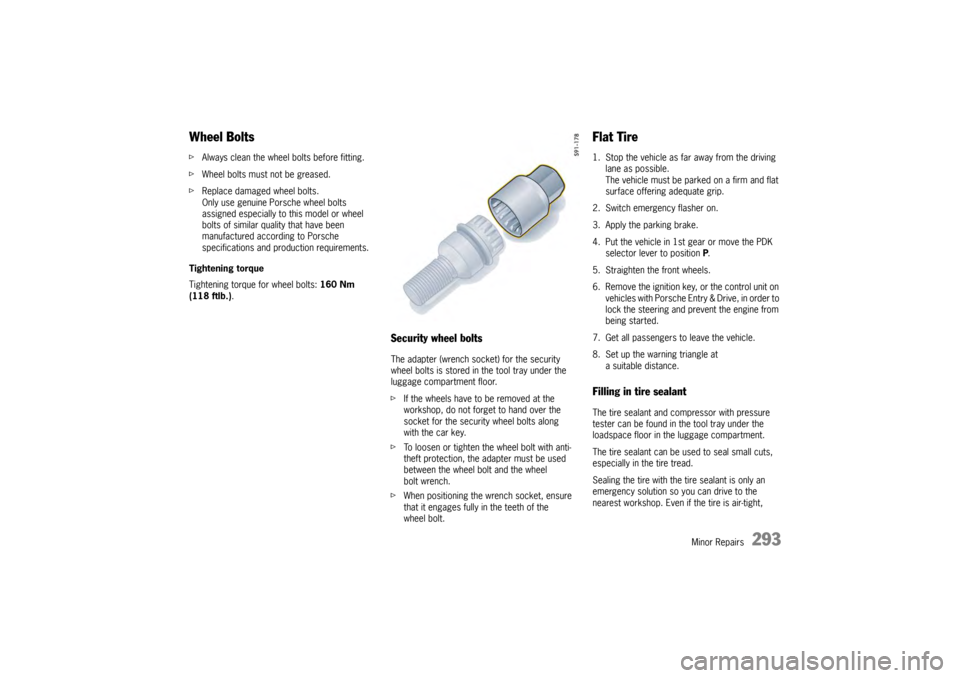
Security wheel boltsThe adapter (wrench socket) for the security
wheel bolts is stored in the tool tray under the
luggage compartment floor.
fIf the wheels have to be removed at the
workshop, do not forget to hand over the
socket for the security wheel bolts along
with the car key.
f To loosen or tighten the wheel bolt with anti-
theft protection, the adapter must be used
between the wheel bolt and the wheel
bolt wrench.
f When positioning the wrench socket, ensure
that it engages fully in the teeth of the
wheel bolt.
Flat Tire 1. Stop the vehicle as far away from the driving lane as possible.
The vehicle must be parked on a firm and flat
surface offering adequate grip.
2. Switch emergency flasher on.
3. Apply the parking brake.
4. Put the vehicle in 1st gear or move the PDK selector lever to position P.
5. Straighten the front wheels.
6. Remove the ignition key, or the control unit on vehicles with Porsche Entry & Drive, in order to
lock the steering and pr event the engine from
being started.
7. Get all passengers to leave the vehicle.
8. Set up the warning triangle at a suitable distance.Filling in tire sealantThe tire sealant and compressor with pressure
tester can be found in the tool tray under the
loadspace floor in the luggage compartment.
The tire sealant can be used to seal small cuts,
especially in the tire tread.
Sealing the tire with the tire sealant is only an
emergency solution so you can drive to the
nearest workshop. Even if the tire is air-tight,