fuel PORSCHE PANAMERA 2013 1.G Information Manual
[x] Cancel search | Manufacturer: PORSCHE, Model Year: 2013, Model line: PANAMERA, Model: PORSCHE PANAMERA 2013 1.GPages: 78, PDF Size: 13.39 MB
Page 20 of 78
4041
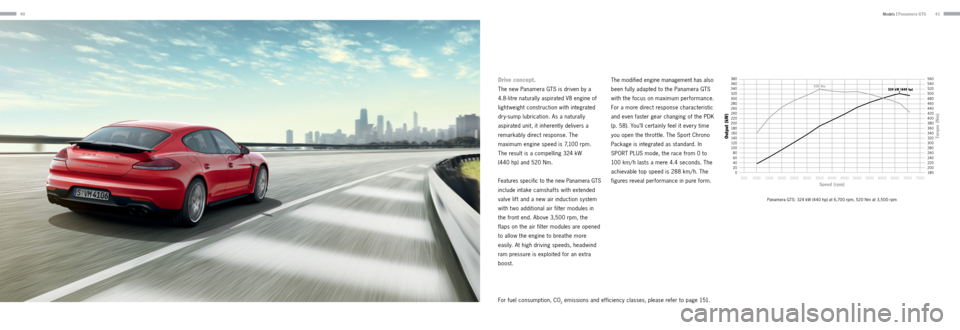
Drive concept.
The new Panamera GTS is driven by a
4.8-litre naturally aspirated V8 engine of
lightweight construction with integrated
dry-sump lubrication. As a naturally
aspirated unit, it inherently delivers a
remarkably direct response. The
maximum engine speed is 7,100 rpm.
The result is a compelling 324 kW
(440 hp) and 520 Nm.
Features specific to the new Panamera GTS
include intake camshafts with extended
valve lift and a new air induc tion system
with t wo additional air filter modules in
the front end. Above 3,500 rpm, the
flaps on the air filter modules are opened
to allow the engine to breathe more
easily. At high driving speeds, headwind
ram pressure is exploited for an extra
boost.
The modified engine management has also
been fully adapted to the Panamera GTS
with the focus on maximum performance.
For a more direct response characteristic
and even faster gear changing of the PDK
(p. 58). You’ll certainly feel it every time
you open the throt tle. The Sport Chrono
Package is integrated as standard. In
SPORT PLUS mode, the race from 0 to
100 km/ h lasts a mere 4.4 seconds. The
achievable top speed is 288 km/ h. The
figures reveal performance in pure form.
For fuel consumption, CO
2 emissions and efficiency classes, please refer to page 151.
Models |
Panamera GTS
Panamera GTS: 324 kW (440 hp) at 6,700 rpm, 520 Nm at 3,500 rpm
380
360
340 320
300 280260 240
220
200 18 016 0
14 012 0
10 0 8060
40
20
0
500 1000 15 0 02000 25003000 35004000 45005000 55006000 65007000 7500560
540
520
500
480 460
440 420
400 380360
340 320
300 280260 240
220
200 18 0
Torque (Nm)
Output (kW)
Speed (rpm)
520 Nm324 kW (440 hp)
Page 21 of 78
4243
Selected key features of the
standard specification.
•
Porsche Doppelkupplung (PDK)
with auto start/stop function
• Bi-Xenon headlights in black including
Porsche Dynamic Light System (PDLS)
• Porsche Traction Management (PTM)
active all-wheel drive
•
Adaptive air suspension (Normal Level
−10 mm) including Porsche Active
Suspension Management (PASM)
• Panamera Turbo brake system with
red brake calipers
• SportDesign steering wheel with
gearshif t paddles
•
Sports exhaust system (not for
Panamera, Panamera 4 and
Panamera S E-Hybrid) in black
• Sport Chrono Package
• Park Assist (rear)
• Leather interior package with
selected items in Alcantara •
Adaptive Sports seats with
memory package
• Adaptive rear spoiler (four-way)
• Tyre Pressure Monitoring (TPM)
• 19-inch Panamera Turbo II wheels
with 5 mm spacers at rear axle
Technical data.
• 4.8-litre naturally aspirated V8 engine
• 324 kW (440 hp)
• 0 –100 km/ h in 4.4 secs
• 288 km/ h top speed
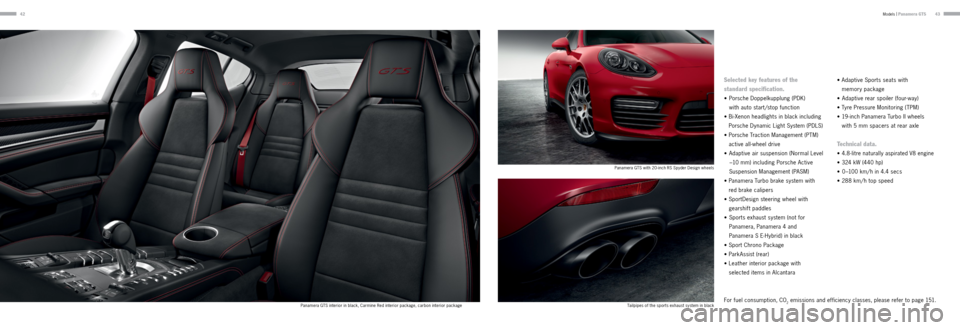
Panamera GTS with 20 - inch RS Spyder Design wheels
Tailpipes of the sports exhaust system in black
Panamera GTS interior in black, Carmine Red interior package, carbon interior package
For fuel consumption, CO2 emissions and efficiency classes, please refer to page 151.
Models |
Panamera GTS
Page 22 of 78
4445
Supreme performance can take the
breath away. Or it can force us to
keep calm and breathe deeply. It ’s like
sit ting behind the wheel of the new
Panamera Turbo.
Here, comfort and sportiness intertwine
without compromise. Its 4.8-litre t win-
turbo V8 engine delivers 382 kW (520 hp)
and offers a maximum torque of 700 Nm
bet ween 2,250 and 4,500 rpm. The
new 19-inch Panamera Turbo II wheels
afford a glimpse of the brake system
and its red brake calipers.
520 hp unleashes a mighty force.
The kind to put a smile on your face.
The new Panamera Turbo.
The twin dual-tube tailpipes are in the
unmistakable Turbo design. Just like
the chrome- coloured air outlets behind
the front wheels.
The front end features large air intakes to
increase the volume of cooling air, while
the four-way rear spoiler helps to reduce
lift at the rear axle.
Porsche Doppelkupplung (PDK, p. 58) is
fit ted as standard, as is Porsche Traction
Management (PTM, p. 61) with active
all-wheel drive and an electronic and map - controlled multi - plate clutch.
Displays in the instrument cluster and
Porsche Communication Management
(PCM, p. 92) inform you of the
longitudinal and lateral acceleration
forces currently acting on the vehicle.
Integrated as standard, the adaptive air
suspension including Porsche Active
Suspension Management (PASM, p.
65)
enhances sport y per formance –
or comfort. At the push of a but ton.
In the interior, the Turbo presents its own
interpretation of the sport y st yle that characterises any Porsche. It achieves
this with electric eight-way power seats
(front) with memory package (p. 88),
and seat heating (p. 91) for the driver,
front passenger and also in the rear; and
with an interior in smooth-finish leather
and the walnut interior package. Porsche
Communication Management (PCM)
including navigation module and BOSE
®
Surround Sound System (p. 98) are fit ted
as standard. The High-End Surround
Sound System from Burmester
® (p. 98)
is available as an option.
Models |
P anamera Turb o
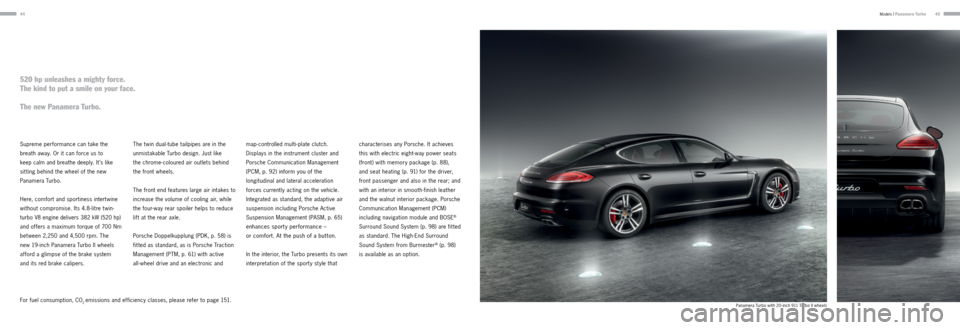
Panamera Turbo with 20 - inch 911 Turbo II wheelsFor fuel consumption, CO2 emissions and efficiency classes, please refer to page 151.
Page 23 of 78
4647
Drive concept.
The new Panamera Turbo is powered by a
4.8-litre t win-turbo V8 engine with direct
fuel injection (DFI, p. 53), VarioCam Plus
(p. 54) and charge-air cooling. It features
t wo turbochargers arranged in parallel –
one for each cylinder bank. Intake air is
compressed and then fed to the engine
by the respective charge-air cooler for
each cylinder strand.
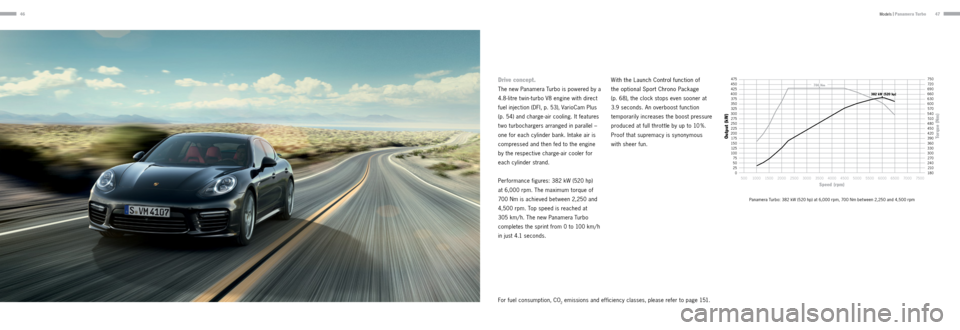
Performance figures: 382 kW (520 hp)
at 6,000 rpm. The maximum torque of
700 Nm is achieved bet ween 2,250 and
4,500 rpm. Top speed is reached at
305 km/ h. The new Panamera Turbo
completes the sprint from 0 to 100 km/ h
in just 4.1 seconds.
With the Launch Control function of
the optional Sport Chrono Package
(p. 68), the clock stops even sooner at
3.9 seconds. An overboost function
temporarily increases the boost pressure
produced at full throt tle by up to 10 %.
Proof that supremacy is synonymous
with sheer fun.
For fuel consumption, CO
2 emissions and efficiency classes, please refer to page 151.
Models |
Panamera Turbo
Panamera Turbo: 382 kW (520 hp) at 6,000 rpm, 700 Nm bet ween 2,250 and 4,500 rpm
475
450 425
400 375
350 325
300 275
250 225
200 17 5
15 0 12 5
10 0 75
50
25
0
500 1000 15 0 02000 25003000 35004000 45005000 55006000 65007000 7500750
720
690
660 630
600 570
540 510
480 450420
390
360 330
300 270
240 210
18 0
Torque (Nm) Output (kW)
Speed (rpm)
382 kW (520 hp)
700
Nm
Page 24 of 78
4948
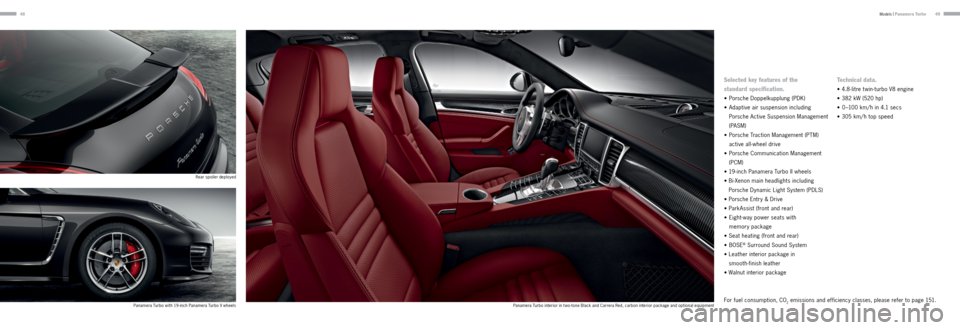
Selected key features of the
standard specification.
•
Porsche Doppelkupplung (PDK)
•
Adaptive air suspension including
Porsche Active Suspension Management
(PASM)
• Porsche Traction Management (PTM)
active all-wheel drive
•
Porsche Communication Management
(PCM)
• 19-inch Panamera Turbo II wheels
• Bi-Xenon main headlights including
Porsche Dynamic Light System (PDLS)
• Porsche Entry & Drive
• Park Assist (front and rear)
•
Eight-way power seats with
memory package
• Seat heating (front and rear)
• BOSE
® Surround Sound System
• Leather interior package in
smooth-finish leather
• Walnut interior package
Panamera Turbo interior in two-tone Black and Carrera Red, carbon interior package and optional equipment
Panamera Turbo with 19 - inch Panamera Turbo II wheels Rear spoiler deployed
Technical data.
•
4.8-litre twin-turbo V8 engine
• 382 kW (520 hp)
• 0 –100 km/ h in 4.1 secs
• 305 km/ h top speed
For fuel consumption, CO
2 emissions and efficiency classes, please refer to page 151.
Models |
Panamera Turbo
Page 26 of 78
5
12
3
4
56
7
8
9
10
11
12
13
14
5253
Engines.
Increasing power output, reducing fuel
consumption. Brief fulfilled. With engines
characterised by sporty performance
and yet comparatively low energy
consumption and CO
2 emissions.
This has been achieved thanks to
technologies such as direct fuel injection
(DFI), VarioCam Plus or variable camshaft
control, turbocharging, recuperation,
the auto start/stop function, the coasting
function or the use of plug-in hybrid
technology. The engines are structurally
rigid and, thanks to aluminium cylinder
heads and magnesium valve covers (except the Panamera S E-Hybrid), they
are comparatively light weight. This helps
to ensure a decent weight-to -power
ratio and balanced weight distribution.
Let’s take the new engine generation of
the Panamera S and Panamera 4S as
an example. It may have been stripped
of t wo cylinders and its displacement
reduced by 1.8 litres compared with
that of its predecessor, but it has been
given a twin-turbocharger arrangement.
This is where the figures begin an
upward trend. Increased power output,
greater dynamics and enhanced
e f f ici e n cy.
Direct fuel injection (DFI).
With millisecond precision, DFI injects
fuel at up to 120 bar directly into the
combustion chamber by means of
electromagnetically actuated injection
valves. DFI also improves the internal
cooling of the combustion chamber by
having the mixture prepared directly in
the cylinder. The higher compression ratio
helps to deliver more output at the same
time as enhanced engine efficiency.
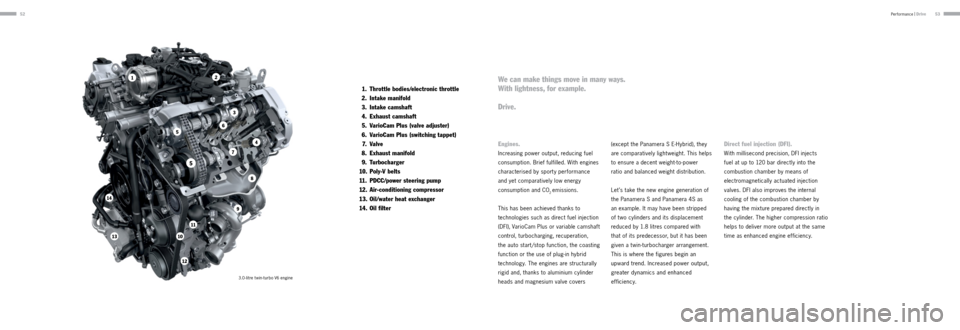
3.0-litre twin-turbo V6 engine
We can make things move in many ways.
With lightness, for example.
Drive.
Performance |
Drive
1. Throttle bodies/electronic throttle
2. Intake manifold
3. Intake camshaft
4. Exhaust camshaft
5. VarioCam Plus (valve adjuster)
6. VarioCam Plus (switching tappet)
7. V a l v e
8. Exhaust manifold
9. Turbocharger
10. Poly-V belts
11. PDCC/power steering pump
12. Air-conditioning compressor
13. Oil/water heat exchanger
14. Oil filter
Page 27 of 78
5455
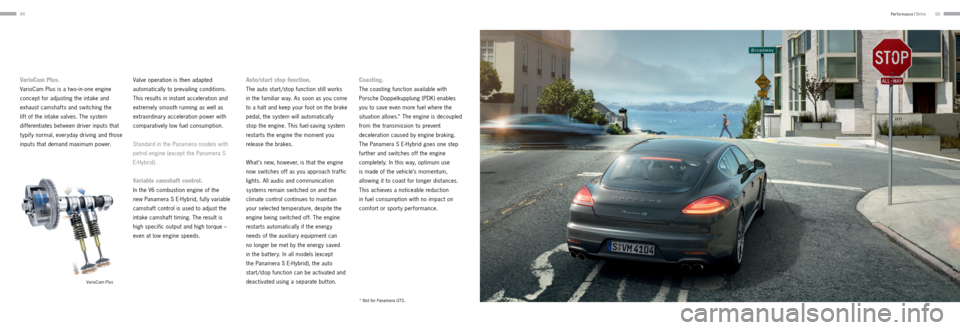
VarioCam Plus.
VarioCam Plus is a two-in-one engine
concept for adjusting the intake and
exhaust camshafts and switching the
lift of the intake valves. The system
differentiates between driver inputs that
typify normal, everyday driving and those
inputs that demand maximum power.
Valve operation is then adapted
automatically to prevailing conditions.
This results in instant acceleration and
extremely smooth running as well as
extraordinary acceleration power with
comparatively low fuel consumption.
Standard in the Panamera models with
petrol engine (except the Panamera S
E-Hybrid).
Variable camshaft control.
In the V6 combustion engine of the
new Panamera S E-Hybrid, fully variable
camshaft control is used to adjust the
intake camshaft timing. The result is
high specific output and high torque –
even at low engine speeds.
Auto/start stop function.
The auto start /stop function still works
in the familiar way. As soon as you come
to a halt and keep your foot on the brake
pedal, the system will automatically
stop the engine. This fuel-saving system
restarts the engine the moment you
release the brakes.
What’s new, however, is that the engine
now switches off as you approach traffic
lights. All audio and communication
systems remain switched on and the
climate control continues to maintain
your selected temperature, despite the
engine being switched off. The engine
restarts automatically if the energy
needs of the auxiliary equipment can
no longer be met by the energy saved
in the bat tery. In all models (except
the Panamera S E-Hybrid), the auto
start /stop function can be activated and
deactivated using a separate but ton.
Coasting.
The coasting function available with
Porsche Doppelkupplung (PDK) enables
you to save even more fuel where the
situation allows.* The engine is decoupled
from the transmission to prevent
deceleration caused by engine braking.
The Panamera S E-Hybrid goes one step
further and switches off the engine
completely. In this way, optimum use
is made of the vehicle’s momentum,
allowing it to coast for longer distances.
This achieves a noticeable reduction
in fuel consumption with no impact on
comfort or sporty performance.
VarioCam Plus
Performance |
Drive
* Not for Panamera GTS.
Page 29 of 78
5859
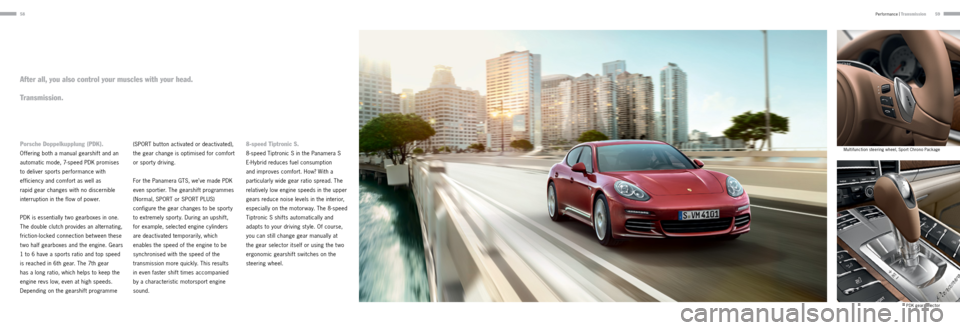
Porsche Doppelkupplung (PDK).
Offering both a manual gearshift and an
automatic mode, 7-speed PDK promises
to deliver sports performance with
efficiency and comfort as well as
rapid gear changes with no discernible
interruption in the flow of power.
PDK is essentially t wo gearboxes in one.
The double clutch provides an alternating,
friction-locked connection between these
t wo half gearboxes and the engine. Gears
1 to 6 have a sports ratio and top speed
is reached in 6th gear. The 7th gear
has a long ratio, which helps to keep the
engine revs low, even at high speeds.
Depending on the gearshift programme (SPORT button activated or deactivated),
the gear change is optimised for comfort
or sporty driving.
For the Panamera GTS, we’ve made PDK
even sportier. The gearshift programmes
(Normal, SPORT or SPORT PLUS)
configure the gear changes to be sport y
to extremely sport y. During an upshift,
for example, selected engine cylinders
are deactivated temporarily, which
enables the speed of the engine to be
synchronised with the speed of the
transmission more quickly. This results
in even faster shift times accompanied
by a characteristic motorsport engine
sound.
After all, you also control your muscles with your head.
Transmission.
8-speed Tiptronic S.
8-speed Tiptronic S in the Panamera S
E-Hybrid reduces fuel consumption
and improves comfort. How? With a
particularly wide gear ratio spread. The
relatively low engine speeds in the upper
gears reduce noise levels in the interior,
especially on the motorway. The 8-speed
Tiptronic S shifts automatically and
adapts to your driving st yle. Of course,
you can still change gear manually at
the gear selector itself or using the t wo
ergonomic gearshift switches on the
steering wheel.Multifunction steering wheel, Sport Chrono Package
PDK gear selector
Performance |
Transmission
Page 34 of 78
6869
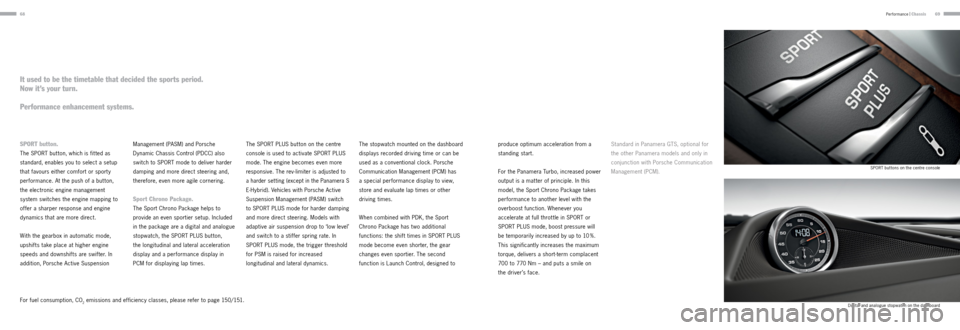
SPORT button.
The SPORT but ton, which is fit ted as
standard, enables you to select a setup
that favours either comfort or sport y
performance. At the push of a but ton,
the electronic engine management
system switches the engine mapping to
offer a sharper response and engine
dynamics that are more direct.
With the gearbox in automatic mode,
upshifts take place at higher engine
speeds and downshifts are swifter. In
addition, Porsche Active Suspension Management (PASM) and Porsche
Dynamic Chassis Control (PDCC) also
switch to SPORT mode to deliver harder
damping and more direct steering and,
therefore, even more agile cornering.
Sport Chrono Package.
The Sport Chrono Package helps to
provide an even sportier setup. Included
in the package are a digital and analogue
stopwatch, the SPORT PLUS button,
the longitudinal and lateral acceleration
display and a performance display in
PCM for displaying lap times.
It used to be the timetable that decided the sports period.
Now it’s your turn.
Performance enhancement systems.
The SPORT PLUS but ton on the centre
console is used to activate SPORT PLUS
mode. The engine becomes even more
responsive. The rev- limiter is adjusted to
a harder set ting (except in the Panamera S
E- Hybrid). Vehicles with Porsche Active
Suspension Management (PASM) switch
to SPORT PLUS mode for harder damping
and more direct steering. Models with
adaptive air suspension drop to ‘low level’
and switch to a stiffer spring rate. In
SPORT PLUS mode, the trigger threshold
for PSM is raised for increased
longitudinal and lateral dynamics. The stopwatch mounted on the dashboard
displays recorded driving time or can be
used as a conventional clock. Porsche
Communication Management (PCM) has
a special performance display to view,
store and evaluate lap times or other
driving times.
When combined with PDK, the Sport
Chrono Package has t wo additional
functions: the shift times in SPORT PLUS
mode become even shorter, the gear
changes even sportier. The second
function is Launch Control, designed to produce optimum acceleration from a
standing start.
For the Panamera Turbo, increased power
output is a mat ter of principle. In this
model, the Sport Chrono Package takes
performance to another level with the
overboost function. Whenever you
accelerate at full throt tle in SPORT or
SPORT PLUS mode, boost pressure will
be temporarily increased by up to 10 %.
This significantly increases the maximum
torque, delivers a short-term complacent
700 to 770 Nm – and puts a smile on
the driver’s face. Standard in Panamera GTS, optional for
the other Panamera models and only in
conjunction with Porsche Communication
Management (PCM).
SPORT but tons on the centre console
Digital and analogue stopwatch on the dashboard
For fuel consumption, CO2 emissions and efficiency classes, please refer to page 150/151.
Performance |
Chassis
Page 38 of 78
7677
Sometimes even short distances mean major progress.
Brakes.
The Panamera models have a braking
system equipped with six-piston aluminium
monobloc fixed brake calipers at the
front and four-piston units at the rear. The
brake calipers on the Panamera and
Panamera 4 are finished in black; on the
Panamera S models, they are silver-
coloured; on the Panamera S E-Hybrid
they are Acid Green, and on the Panamera
GTS and Panamera Turbo they are red.
The brake discs are slot ted and internally
vented for enhanced braking performance
– even under extreme conditions – and
rapid heat dispersal. The brake discs on
the Panamera Turbo and Panamera GTS
have a diameter of 390 mm at the front and 350 mm at the rear, whilst on the
other Panamera models the discs are
360 mm in diameter at the front and
330 mm at the rear.
The electric parking brake, which you can
activate and deactivate manually, releases
automatically as you pull away. Thanks
to the hold function, you can pull away
without ever rolling back.
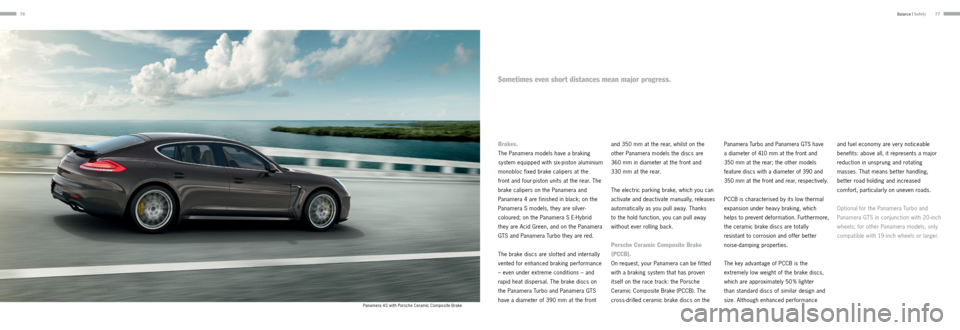
Porsche Ceramic Composite Brake
(PCCB).
On request, your Panamera can be fit ted
with a braking system that has proven
itself on the race track: the Porsche
Ceramic Composite Brake (PCCB). The
cross-drilled ceramic brake discs on the
Panamera Turbo and Panamera GTS have
a diameter of 410 mm at the front and
350 mm at the rear; the other models
feature discs with a diameter of 390 and
350 mm at the front and rear, respectively.
PCCB is characterised by its low thermal
expansion under heavy braking, which
helps to prevent deformation. Furthermore,
the ceramic brake discs are totally
resistant to corrosion and of fer bet ter
noise-damping properties.
The key advantage of PCCB is the
extremely low weight of the brake discs,
which are approximately 50 % lighter
than standard discs of similar design and
size. Although enhanced performance and fuel economy are very noticeable
benefits: above all, it represents a major
reduction in unsprung and rotating
masses. That means better handling,
bet ter road holding and increased
comfort, particularly on uneven roads.
Optional for the Panamera Turbo and
Panamera GTS in conjunction with 20-inch
wheels; for other Panamera models, only
compatible with 19-inch wheels or larger.
Panamera 4S with Porsche Ceramic Composite Brake
Balance |
Safety