Res mode Ram 1500 2011 Owners Manual
[x] Cancel search | Manufacturer: RAM, Model Year: 2011, Model line: 1500, Model: Ram 1500 2011Pages: 636, PDF Size: 4.88 MB
Page 318 of 636
transmission will automatically shift from third gear to
OVERDRIVE if the following conditions are present:
•the shift lever is in DRIVE
•the engine coolant has reached normal operating tem-
perature
•vehicle speed is above approximately 30 mph
(48 km/h)
•the TOW/HAUL switch has not been activated
•the transmission has reached normal operating
temperature
NOTE: If the vehicle is started in extremely cold tem-
peratures, the transmission may not shift into OVER-
DRIVE and will automatically select the most desirable
gear for operation at this temperature. Normal operation
will resume when the transmission fluid temperature has
risen to a suitable level. If the transmission temperature gets extremely hot, the
transmission will automatically select the most desirable
gear for operation at this temperature. If the transmission
temperature becomes hot enough, the “Transmission
Temperature Warning Light” may illuminate and the
transmission may downshift out of OVERDRIVE until
the transmission cools down. After the transmission cools
down, the transmission will resume normal operation.
The transmission will downshift from OVERDRIVE to
DRIVE if the accelerator pedal is fully pressed at vehicle
speeds above approximately 35 mph (56 km/h).
When To Use TOW/HAUL Mode
When driving in hilly areas, towing a trailer, carrying a
heavy load, etc., and frequent transmission shifting oc-
curs, press the TOW/HAUL switch. This will improve
performance and reduce the potential for transmission
overheating or failure due to excessive shifting. When
316 STARTING AND OPERATING
Page 319 of 636

operating in TOW/HAUL mode, the transmission will
shift to third gear and fourth gear will be enabled under
steady cruise conditions.
The “TOW/HAUL Indicator Light” will illuminate in the
instrument cluster to indicate when the switch has been
activated. Pressing the switch a second time restoresnormal operation. If the TOW/HAUL mode is desired,
the switch must be pressed each time the engine is
started.
Transmission Limp Home Mode
Transmission function is monitored for abnormal condi-
tions. If a condition is detected that could result in
transmission damage, the Transmission Limp Home
Mode will be engaged. In this mode, the transmission
will operate (when in DRIVE) in second gear only.
To reset the transmission, use the following procedure:
1. Stop the vehicle.
2. Move the shift lever to the PARK position.
3. Turn OFF the engine and be sure to turn the key fob to
the LOCK position.
4. Wait approximately 10 seconds, then restart the en-
gine.
TOW/HAUL Switch
5
STARTING AND OPERATING 317
Page 322 of 636
through third gear are underdrive gears, and fourth gear
is direct drive. ERS fifth gear (Overdrive) is the same as
the normal fourth gear.
When in the DRIVE position in first through fourth gear,
the first tap down (-), will display the ERS designation for
the current gear (the transmission will not downshift).
For example, if you are in DRIVE and are in third (direct)
gear, when you tap the shift lever/switch one time in the
(-) direction, the display will show 4 (ERS 4 is direct gear).
Another tap down (-) will shift the transmission down to
ERS 3 (the added underdrive gear). When in the DRIVE
position in fifth gear, the first tap down (-) will downshift
the transmission and display 5 (ERS 5 is the same as
normal fourth gear). Another tap down (-) will shift the
transmission down to ERS 4 (direct gear).
To exit ERS mode, press and hold the shift lever/switch
in the (+) position until “D” is once again highlighted in
the instrument cluster display.WARNING!
Do not downshift for additional engine braking on a
slippery surface. The drive wheels could lose their
grip and the vehicle could skid.
Screen Display12345*D
Actual Gear(s)
Allowed 1 1-2 1-3 1-4 1-5 1-5
* Applies to vehicles equipped with 4.7L and 5.7L
engines only.
NOTE: To select the proper gear position for maximum
deceleration (engine braking), hold the shift lever/switch
in the (-) position continuously while braking. The trans-
mission will shift to the range from which the vehicle can
best be slowed down.
320 STARTING AND OPERATING
Page 325 of 636
Overdrive Operation
The Overdrive automatic transmission contains an elec-
tronically controlled fourth and fifth gear (Overdrive).
The transmission will automatically shift from DRIVE to
Overdrive if the following conditions are present:
•the shift lever is in DRIVE;
•the engine coolant (antifreeze) has reached normal
operating temperature;
•vehicle speed is above approximately 30 mph
(48 km/h);
•the TOW/HAUL switch has not been activated;
•transmission has reached normal operating
temperature.
NOTE: If the vehicle is started in extremely cold tem-
peratures, the transmission may not shift into Overdrive
and will automatically select the most desirable gear for operation at this temperature. Normal operation will
resume when the transmission fluid temperature has
risen to a suitable level.
If the transmission temperature gets extremely hot, the
transmission will automatically select the most desirable
gear for operation at this temperature. If the transmission
temperature becomes hot enough, the “Transmission
Temperature Warning Light” may illuminate and the
transmission may downshift out of Overdrive until the
transmission cools down. After cool down, the transmis-
sion will resume normal operation.
The transmission will downshift from Overdrive to
DRIVE if the accelerator pedal is fully pressed at vehicle
speeds above approximately 35 mph (56 km/h).
When To Use TOW/HAUL Mode
When driving in hilly areas, towing a trailer, carrying a
heavy load, etc., and frequent transmission shifting oc-
curs, press the TOW/HAUL switch. This will improve
5
STARTING AND OPERATING 323
Page 326 of 636
performance and reduce the potential for transmission
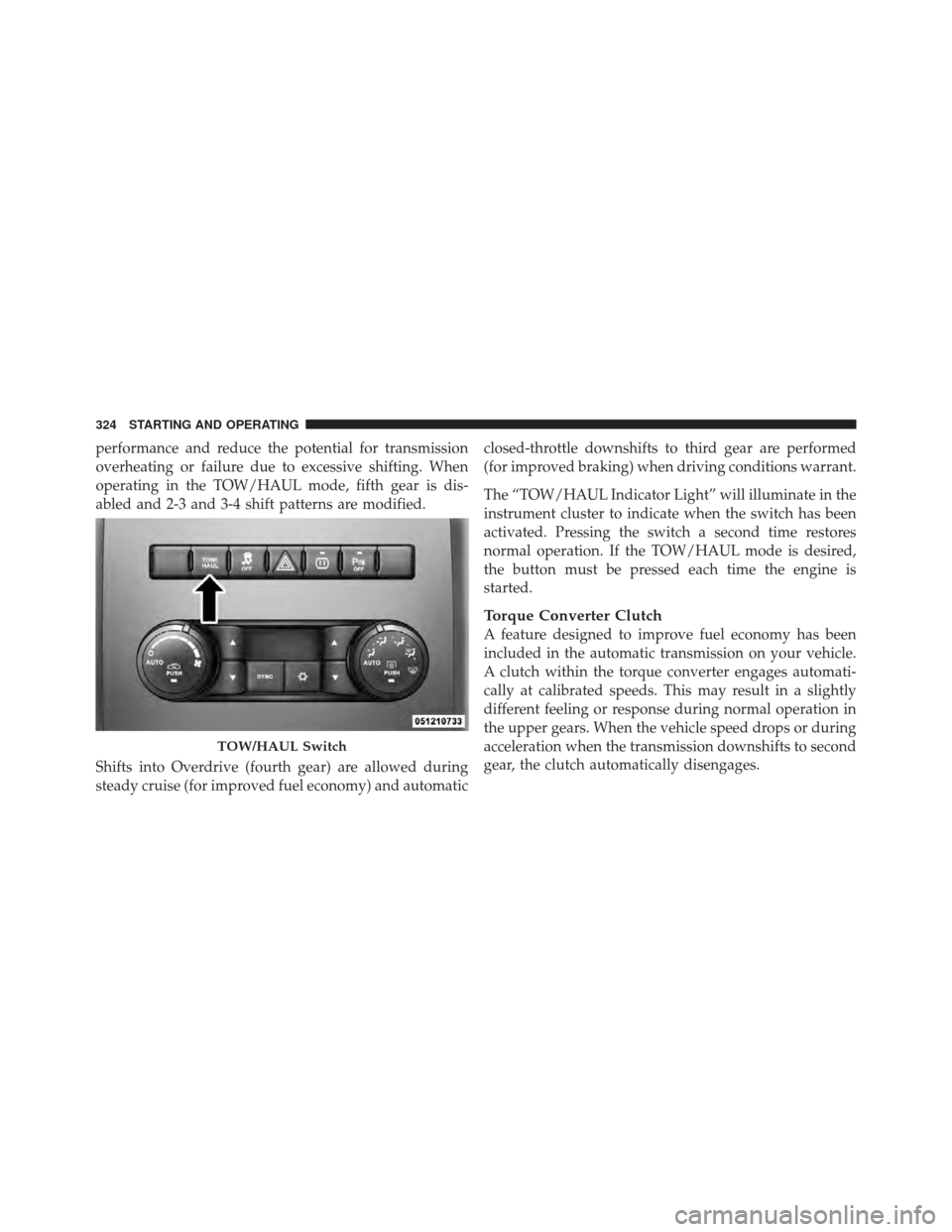
overheating or failure due to excessive shifting. When
operating in the TOW/HAUL mode, fifth gear is dis-
abled and 2-3 and 3-4 shift patterns are modified.
Shifts into Overdrive (fourth gear) are allowed during
steady cruise (for improved fuel economy) and automaticclosed-throttle downshifts to third gear are performed
(for improved braking) when driving conditions warrant.
The “TOW/HAUL Indicator Light” will illuminate in the
instrument cluster to indicate when the switch has been
activated. Pressing the switch a second time restores
normal operation. If the TOW/HAUL mode is desired,
the button must be pressed each time the engine is
started.
Torque Converter Clutch
A feature designed to improve fuel economy has been
included in the automatic transmission on your vehicle.
A clutch within the torque converter engages automati-
cally at calibrated speeds. This may result in a slightly
different feeling or response during normal operation in
the upper gears. When the vehicle speed drops or during
acceleration when the transmission downshifts to second
gear, the clutch automatically disengages.
TOW/HAUL Switch
324 STARTING AND OPERATING
Page 327 of 636
![Ram 1500 2011 Owners Manual NOTE:
•The torque converter clutch will not engage until the
transmission fluid and engine coolant (antifreeze) are
warm [usually after 1 to 3 miles (1.6 to 4.8 km) of
driving]. Because the engine s](/img/34/12551/w960_12551-326.png "Ram 1500 2011 Owners Manual NOTE:
•The torque converter clutch will not engage until the
transmission fluid and engine coolant (antifreeze) are
warm [usually after 1 to 3 miles (1.6 to 4.8 km) of
driving]. Because the engine s")
NOTE:
•The torque converter clutch will not engage until the
transmission fluid and engine coolant (antifreeze) are
warm [usually after 1 to 3 miles (1.6 to 4.8 km) of
driving]. Because the engine speed is higher when the
torque converter clutch is not engaged, it may seem as
if the transmission is not shifting into Overdrive when
cold. This is normal. Pressing the TOW/HAUL switch
when the transmission is sufficiently warm will dem-
onstrate that the transmission is able to shift into and
out of Overdrive.
•If the vehicle has not been driven in several days, the
first few seconds of operation after shifting the trans-
mission into gear may seem sluggish. This is due to the
fluid partially draining from the torque converter into
the transmission. This condition is normal and will not
cause damage to the transmission. The torque con-
verter will refill within five seconds after starting the
engine.
FOUR-WHEEL DRIVE OPERATION — IF
EQUIPPED
Four-wheel drive trucks are equipped with either a
manually shifted transfer case or an electronically shifted
transfer case. Refer to the operating instructions for your
transfer case, located in this section for further informa-
tion.
Manually Shifted Transfer Case – If Equipped
The transfer case provides four mode positions.
•Two-wheel drive high range (2H)
•Four-wheel drive high range (4H)
•Neutral (N)
•Four-wheel drive low range (4L)
This transfer case is intended to be driven in the 2H
position for normal street and highway conditions such
as dry, hard surfaced roads.
5
STARTING AND OPERATING 325
Page 329 of 636
NOTE:Delayed shifts out of four-wheel drive may be
experienced due to uneven tire wear, low or uneven tire
pressures, excessive vehicle loading, or cold tempera-
tures.
WARNING!
You or others could be injured if you leave the
vehicle unattended with the transfer case in the
NEUTRAL position without first fully engaging the
parking brake. The transfer case NEUTRAL position
disengages both the front and rear driveshafts from
the powertrain and will allow the vehicle to move
regardless of the transmission position. The parking
brake should always be applied when the driver is
not in the vehicle. For additional information on the appropriate use of each
transfer case mode position, see the information below:
2H
Rear-Wheel Drive High Range - This range is for normal
street and highway driving on dry hard surfaced roads.
4H
Four-Wheel Drive High Range - This range locks the
front and rear driveshafts together forcing the front and
rear wheels to rotate at the same speed. Additional
traction for loose, slippery road surfaces only.
N
Neutral - This range disengages the front and rear
driveshafts from the powertrain. To be used for flat
towing behind another vehicle. Refer to “Recreational
Towing” in “Starting and Operating” for further
information.
5
STARTING AND OPERATING 327
Page 332 of 636
This electronically shifted transfer case provides four
mode positions:
•Two-wheel drive high range (2WD)
•Four-wheel drive lock range (4WD LOCK)
•Four-wheel drive low range (4WD LOW)
•Neutral (NEUTRAL)
This electronically shifted transfer case is designed to be
driven in the two-wheel drive position (2WD) for normal
street and highway conditions on dry, hard surfaced
roads.
When additional traction is required, the transfer case
4WD LOCK and 4WD LOW positions can be used to lock
the front and rear driveshafts together, forcing the front
and rear wheels to rotate at the same speed. This is
accomplished by rotating the 4WD Control Switch to the
desired position. Refer to “Shifting Procedure” in this section for specific shifting instructions. The 4WD LOCK
and 4WD LOW positions are designed for loose, slippery
road surfaces only. Driving in the 4WD LOCK and 4WD
LOW positions on dry hard surfaced roads may cause
increased tire wear and damage to the driveline compo-
nents.
NOTE:
The transfer case NEUTRAL position is selected
by pressing the recessed button located on the lower left
hand corner of the 4WD Control Switch. The transfer case
NEUTRAL position is to be used for recreational towing
only. Refer to “Recreational Towing” in “Starting and
Operating” for further information.
Transfer Case Position Indicator Lights
The Transfer Case Position Indicator Lights (4WD and
4LOW) are located in the instrument cluster and indicate
the current and desired transfer case selection. When you
select a different transfer case position, the indicator
lights will do the following:
330 STARTING AND OPERATING
Page 334 of 636
NOTE:Do not attempt to make a shift while only the
front or rear wheels are spinning, as this can cause
damage to driveline components.
When operating your vehicle in 4WD LOW, the engine
speed is approximately three times that of the 2WD or
4WD LOCK positions at a given road speed. Take care
not to overspeed the engine and do not exceed 25 mph
(40 km/h).
Proper operation of four-wheel drive vehicles depends
on tires of equal size, type and circumference on each
wheel. Any difference in tire size can cause damage to the
drivetrain.
Because four-wheel drive provides improved traction,
there is a tendency to exceed safe turning and stopping
speeds. Do not go faster than road conditions permit.WARNING!
You or others could be injured if you leave the
vehicle unattended with the transfer case in the
NEUTRAL position without first fully engaging the
parking brake. The transfer case NEUTRAL position
disengages both the front and rear driveshafts from
the powertrain and will allow the vehicle to move
regardless of the transmission position. The parking
brake should always be applied when the driver is
not in the vehicle.
For additional information on the appropriate use of each
transfer case mode position, see the information below:
2WD
Rear Wheel Drive High Range - This range is for normal
street and highway driving on dry, hard surfaced roads.
332 STARTING AND OPERATING
Page 339 of 636
drive will be automatically engaged when the vehicle
senses a loss of traction. Because the front axle is en-
gaged, this mode will result in lower fuel economy than
the 2WD mode.
When additional traction is required, the transfer case
4WD LOCK and 4WD LOW positions can be used to lock
the front and rear driveshafts together forcing the front
and rear wheels to rotate at the same speed. This is
accomplished by rotating the 4WD Control Switch to the
desired position. Refer to “Shifting Procedure” for spe-
cific shifting instructions. The 4WD LOCK and 4WD
LOW positions are designed for loose, slippery road
surfaces only. Driving in the 4WD LOCK and 4WD LOW
positions on dry hard surfaced roads may cause in-
creased tire wear and damage to the driveline compo-
nents.
NOTE:The transfer case NEUTRAL position is selected
by depressing the recessed button located on the lower left hand corner of the 4WD Control Switch. The transfer
case NEUTRAL position is to be used for recreational
towing only. Refer to “Recreational Towing” in “Starting
and Operating” for further information.
Transfer Case Position Indicator Lights
The Transfer Case Position Indicator Lights (4WD,
4LOW, and 4WD AUTO) are located on the instrument
cluster and indicate the current and desired transfer case
selection. When you select a different transfer case posi-
tion, the position indicator lights will do the following:
If All Shift Conditions Are Met:
1. The current position indicator light will turn OFF.
2. The selected position indicator light will flash until the
transfer case completes the shift.
3. When the shift is complete, the indicator light for the
selected position will stop flashing and remain ON.
5
STARTING AND OPERATING 337