heating Ram 1500 2011 User Guide
[x] Cancel search | Manufacturer: RAM, Model Year: 2011, Model line: 1500, Model: Ram 1500 2011Pages: 636, PDF Size: 4.88 MB
Page 235 of 636
If the light remains lit with the engine running, your
vehicle will usually be drivable. However, see an autho-
rized dealer for service as soon as possible. If the light is
flashing when the engine is running, immediate service is
required. You may experience reduced performance, an
elevated/rough idle or engine stall and your vehicle may
require towing.
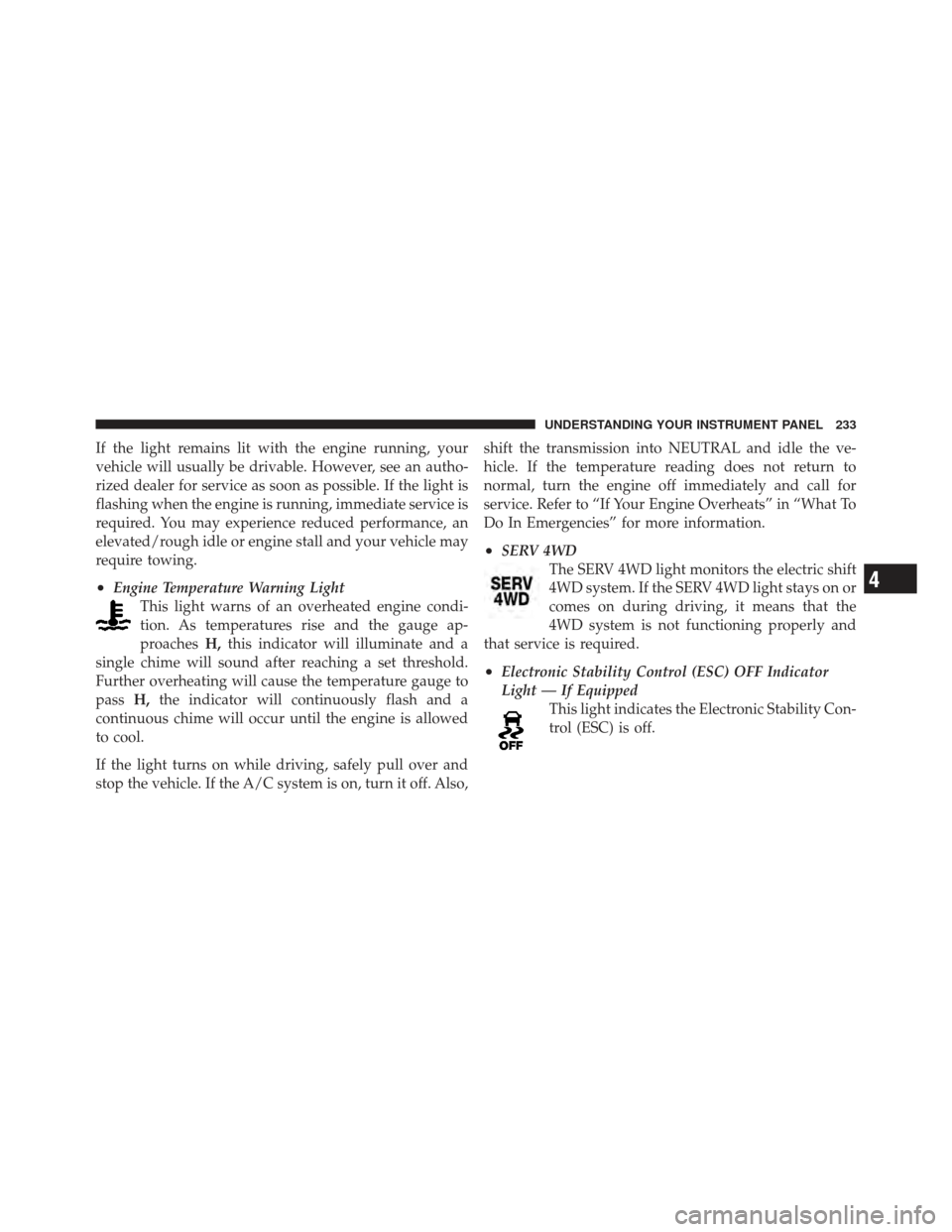
•Engine Temperature Warning LightThis light warns of an overheated engine condi-
tion. As temperatures rise and the gauge ap-
proaches H,this indicator will illuminate and a
single chime will sound after reaching a set threshold.
Further overheating will cause the temperature gauge to
pass H,the indicator will continuously flash and a
continuous chime will occur until the engine is allowed
to cool.
If the light turns on while driving, safely pull over and
stop the vehicle. If the A/C system is on, turn it off. Also, shift the transmission into NEUTRAL and idle the ve-
hicle. If the temperature reading does not return to
normal, turn the engine off immediately and call for
service. Refer to “If Your Engine Overheats” in “What To
Do In Emergencies” for more information.
•SERV 4WD
The SERV 4WD light monitors the electric shift
4WD system. If the SERV 4WD light stays on or
comes on during driving, it means that the
4WD system is not functioning properly and
that service is required.
•Electronic Stability Control (ESC) OFF Indicator
Light — If Equipped This light indicates the Electronic Stability Con-
trol (ESC) is off.
4
UNDERSTANDING YOUR INSTRUMENT PANEL 233
Page 293 of 636
throughout the vehicle. The controls are located on the
instrument panel below the radio.
NOTE:During snowplow usage on vehicles equipped
with outside temperature display, the display may show
higher temperatures than the outside ambient tempera-
ture. The higher displayed temperature is due to blocked
or reduced airflow to the underhood ambient tempera-
ture sensor caused by the snowplow. In addition, on
vehicles equipped with Automatic Temperature Control
(ATC), it is suggested that the interior cabin temperature
be manually controlled should the system not perform as
desired while in automatic mode. Both the outside tem-
perature display and ATC operation will return to nor-
mal when the snowplow is removed.
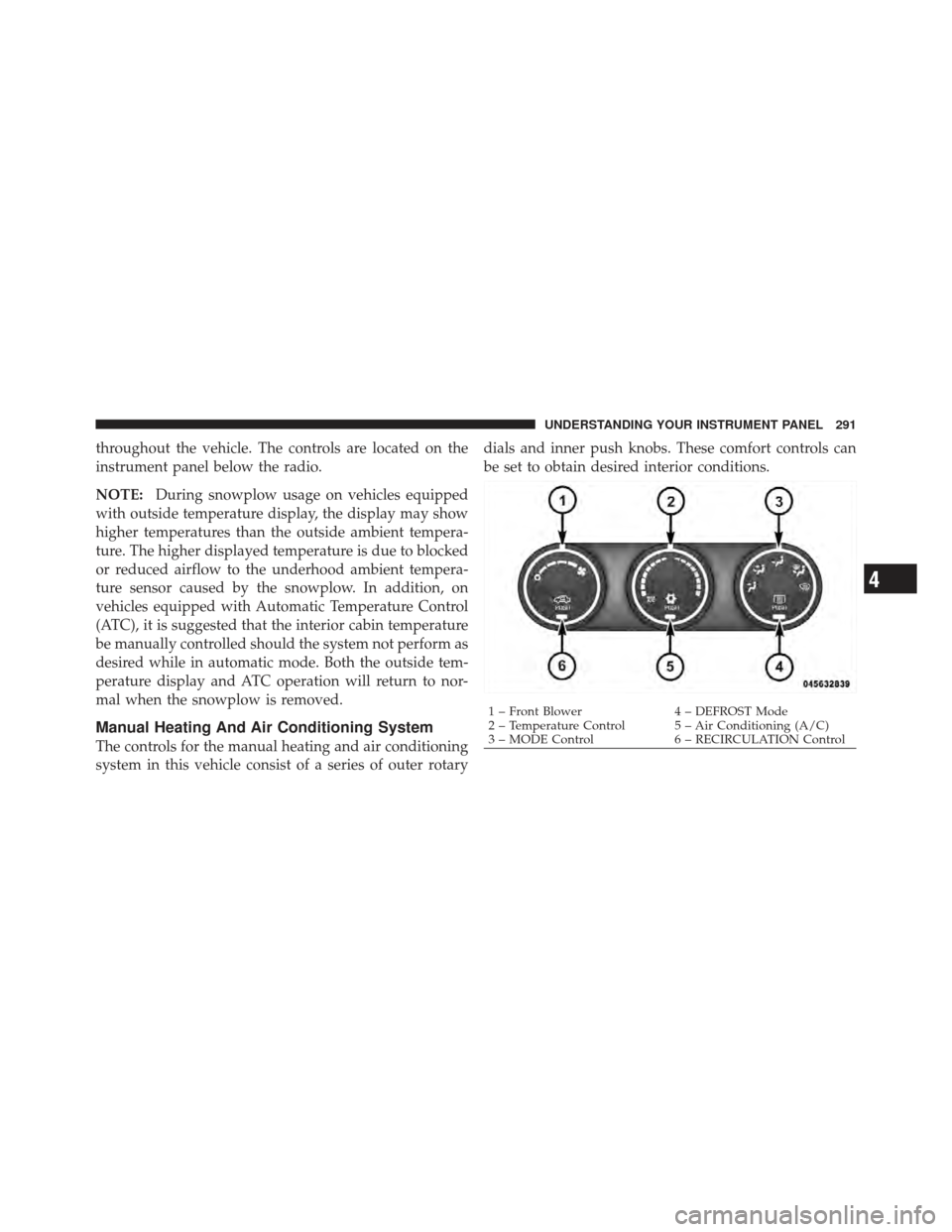
Manual Heating And Air Conditioning System
The controls for the manual heating and air conditioning
system in this vehicle consist of a series of outer rotary dials and inner push knobs. These comfort controls can
be set to obtain desired interior conditions.
1 – Front Blower
4 – DEFROST Mode
2 – Temperature Control 5 – Air Conditioning (A/C)
3 – MODE Control 6 – RECIRCULATION Control
4
UNDERSTANDING YOUR INSTRUMENT PANEL 291
Page 302 of 636
Recirculation mode should only be used temporarily. The
recirculation LED will illuminate on the blower control
knob when this button is selected. Push the button a
second time to turn off the Recirculation mode LED and
allow outside air into the vehicle.
NOTE:In cold weather, use of Recirculation mode may
lead to excessive window fogging. The Recirculation
mode is not allowed in the Floor/Defrost Mix and
Defrost modes to improve window clearing operation.
Recirculation will be disabled automatically if these
modes are selected.Summer Operation
The engine cooling system in air conditioned vehicles
must be protected with a high-quality antifreeze coolant
to provide proper corrosion protection and to protect
against engine overheating. A solution of 50% ethylene
glycol antifreeze coolant and 50% water is recommended.
Refer to “Maintenance Procedures” in “Maintaining Your
Vehicle” for proper coolant selection.
Winter Operation
To ensure the best possible heater and defroster perfor-
mance, make sure the engine cooling system is function-
ing properly and the proper amount, type, and concen-
tration of coolant is used. Refer to “Maintenance
Procedures” in “Maintaining Your Vehicle” for proper
coolant selection. Use of the air Recirculation mode
during Winter months is not recommended because it
may cause window fogging.
300 UNDERSTANDING YOUR INSTRUMENT PANEL
Page 311 of 636

STARTING PROCEDURES
Before starting your vehicle, adjust your seat, adjust both
inside and outside mirrors, and fasten your seat belt.
The starter should not be operated for more than 15-
second intervals. Waiting a few seconds between such
intervals will protect the starter from overheating.
WARNING!
Never leave children alone in a vehicle. Leaving
unattended children in a vehicle is dangerous for a
number of reasons. A child or others could be seri-
ously or fatally injured. Do not leave the key fob in
the ignition. A child could operate power windows,
other controls, or move the vehicle.
Normal Starting
Normal starting of either a warm or cold engine is
obtained without pumping or pressing the acceleratorpedal. Turn the key fob to the START position and release
when the engine starts. If the engine fails to start within
10 seconds, turn the key fob to the OFF position, wait five
seconds, then repeat the “Normal Starting” procedure.
Automatic Transmission
Start the engine with the shift lever in the NEUTRAL or
PARK position. Apply the brake before shifting into any
driving range.
NOTE: This vehicle is equipped with a transmission
shift interlocking system. The brake pedal must be
pressed to shift out of PARK.
Tip Start Feature
Do not
press the accelerator. Turn the ignition switch
briefly to the START position and release it. The starter
motor will continue to run but will automatically disen-
gage when the engine is running.
5
STARTING AND OPERATING 309
Page 318 of 636
transmission will automatically shift from third gear to
OVERDRIVE if the following conditions are present:
•the shift lever is in DRIVE
•the engine coolant has reached normal operating tem-
perature
•vehicle speed is above approximately 30 mph
(48 km/h)
•the TOW/HAUL switch has not been activated
•the transmission has reached normal operating
temperature
NOTE: If the vehicle is started in extremely cold tem-
peratures, the transmission may not shift into OVER-
DRIVE and will automatically select the most desirable
gear for operation at this temperature. Normal operation
will resume when the transmission fluid temperature has
risen to a suitable level. If the transmission temperature gets extremely hot, the
transmission will automatically select the most desirable
gear for operation at this temperature. If the transmission
temperature becomes hot enough, the “Transmission
Temperature Warning Light” may illuminate and the
transmission may downshift out of OVERDRIVE until
the transmission cools down. After the transmission cools
down, the transmission will resume normal operation.
The transmission will downshift from OVERDRIVE to
DRIVE if the accelerator pedal is fully pressed at vehicle
speeds above approximately 35 mph (56 km/h).
When To Use TOW/HAUL Mode
When driving in hilly areas, towing a trailer, carrying a
heavy load, etc., and frequent transmission shifting oc-
curs, press the TOW/HAUL switch. This will improve
performance and reduce the potential for transmission
overheating or failure due to excessive shifting. When
316 STARTING AND OPERATING
Page 326 of 636
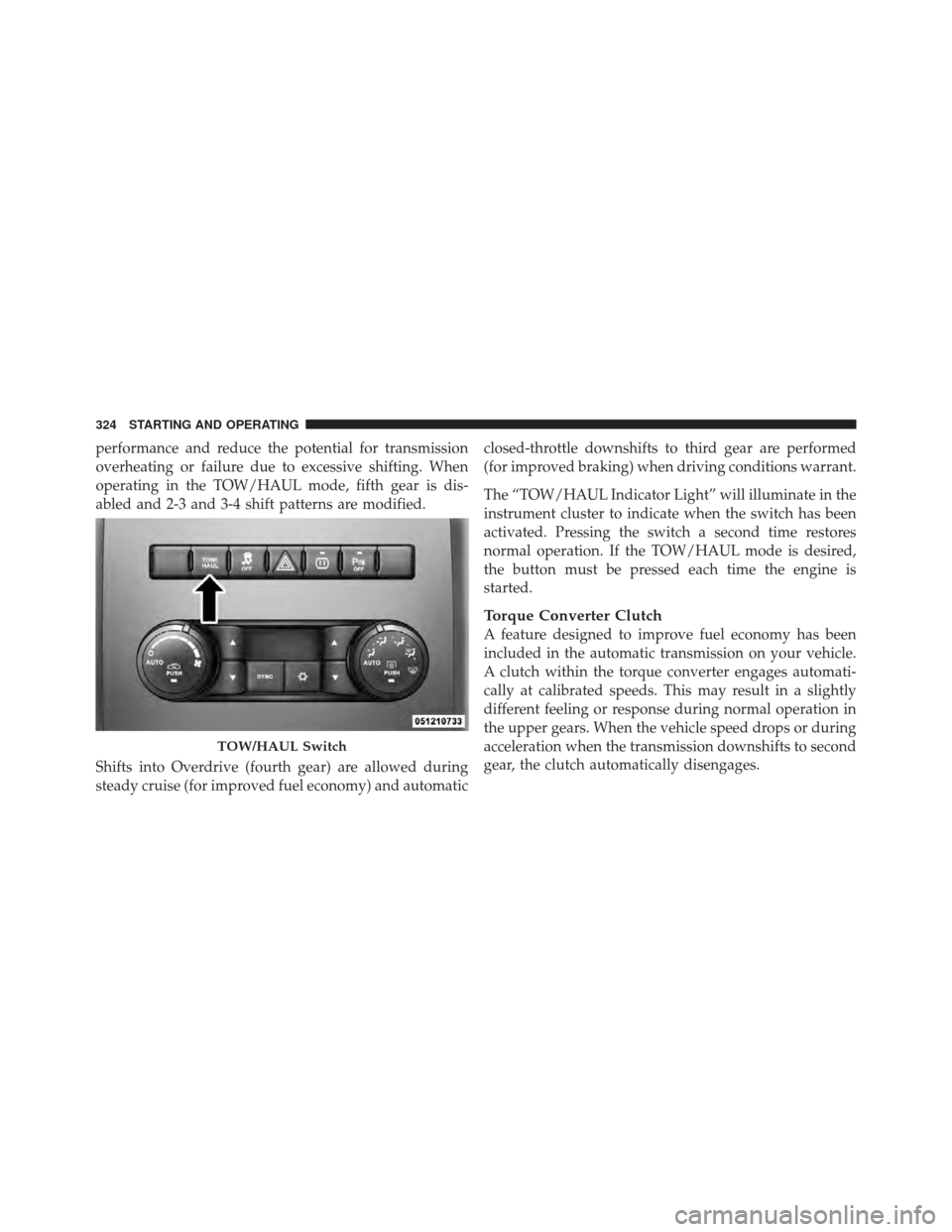
performance and reduce the potential for transmission
overheating or failure due to excessive shifting. When
operating in the TOW/HAUL mode, fifth gear is dis-
abled and 2-3 and 3-4 shift patterns are modified.
Shifts into Overdrive (fourth gear) are allowed during
steady cruise (for improved fuel economy) and automaticclosed-throttle downshifts to third gear are performed
(for improved braking) when driving conditions warrant.
The “TOW/HAUL Indicator Light” will illuminate in the
instrument cluster to indicate when the switch has been
activated. Pressing the switch a second time restores
normal operation. If the TOW/HAUL mode is desired,
the button must be pressed each time the engine is
started.
Torque Converter Clutch
A feature designed to improve fuel economy has been
included in the automatic transmission on your vehicle.
A clutch within the torque converter engages automati-
cally at calibrated speeds. This may result in a slightly
different feeling or response during normal operation in
the upper gears. When the vehicle speed drops or during
acceleration when the transmission downshifts to second
gear, the clutch automatically disengages.
TOW/HAUL Switch
324 STARTING AND OPERATING
Page 387 of 636
For additional assistance, the winched vehicle can be
slowly driven while being pulled by the winch. Continue
pulling until the vehicle is on stable ground. If you are
able to drive the vehicle, the winching operation is
complete.NOTE:
•Avoid overheating the winch motor. For extended
winching, stop at reasonable intervals to allow the
winch motor to cool down.
•What to look for under load:
The wire rope must
always spool onto the drum as indicated by the drum
rotation decal on the winch. As you power-in, make
sure the wire rope winds evenly and tightly on the
drum. This prevents the outer wire wraps from draw-
ing into the inner wraps, binding and damaging the
wire rope. Avoid shock loads by using the control
switch intermittently to take up wire rope slack. Shock
loads can momentarily far exceed the winch and wire
rope ratings. During side pulls the wire rope tends to
stack up at one end of the drum. This stack can become
large enough to cause serious damage to the winch.
So, line up pulls as straight ahead as possible and stop
winching if the wire rope comes close to the tie rods or
mounting plate. To fix an uneven stack, spool out that
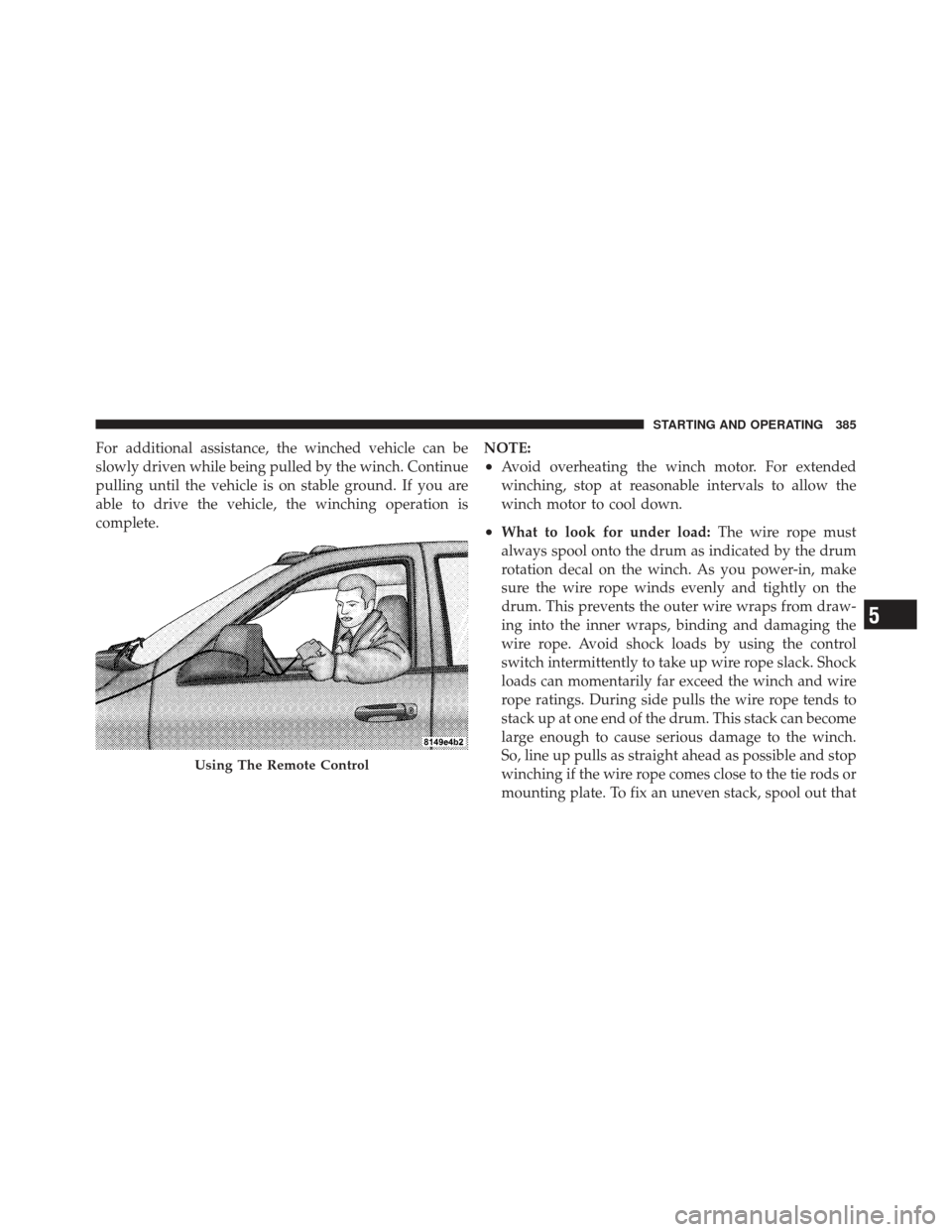
Using The Remote Control
5
STARTING AND OPERATING 385
Page 417 of 636
WARNING!
Overloading of your tires is dangerous. Overloading
can cause tire failure, affect vehicle handling, and
increase your stopping distance. Use tires of the
recommended load capacity for your vehicle. Never
overload them.
TIRES — GENERAL INFORMATION
Tire Pressure
Proper tire inflation pressure is essential to the safe and
satisfactory operation of your vehicle. Three primary
areas are affected by improper tire pressure:
Safety
WARNING!
•Improperly inflated tires are dangerous and can
cause collisions.
•Under-inflation increases tire flexing and can re-
sult in over-heating and tire failure.
•Over-inflation reduces a tire’s ability to cushion
shock. Objects on the road and chuckholes can
cause damage that result in tire failure.
•Over-inflated or under-inflated tires can affect
vehicle handling and can fail suddenly, resulting
in loss of vehicle control.
•Unequal tire pressures can cause steering prob-
lems. You could lose control of your vehicle.(Continued)
5
STARTING AND OPERATING 415
Page 475 of 636
NOTE:Using “TOW/HAUL” mode or a lower gear
range while operating the vehicle under heavy operating
conditions will improve performance and extend trans-
mission life by reducing excessive shifting and heat build
up. This action will also provide better engine braking.
The automatic transmission fluid and filter should be
changed if you regularly tow a trailer for more than
45 minutes of continuous operation. Refer to “Mainte-
nance Schedule” for the proper maintenance intervals.
NOTE: Check the automatic transmission fluid level
before towing.
Tow/Haul
To reduce potential for automatic transmission overheat-
ing, turn the “TOW/HAUL” feature ON when driving in
hilly areas, or select a lower gear range (using the
Electronic Range Select (ERS) feature) on more severe
grades.
Electronic Speed Control – If Equipped
Do not use in hilly terrain or with heavy loads.
When using the speed control, if you experience speed
drops greater than 10 mph (16 km/h), disengage until
you can get back to cruising speed.
Use speed control in flat terrain and with light loads to
maximize fuel efficiency.
Cooling System
To reduce potential for engine and transmission over-
heating, take the following actions:
City Driving
When stopped for short periods of time, shift the trans-
mission into NEUTRAL and increase engine idle speed.
Highway Driving
Reduce speed.
5
STARTING AND OPERATING 473
Page 479 of 636
Operating Tips
Under ideal snow plowing conditions, 20 mph (32 km/h)
should be maximum operating speed. The operator
should be familiar with the area and surface to be
cleaned. Reduce speed and use extreme caution when
plowing unfamiliar areas or under poor visibility.
NOTE:During snowplow usage on vehicles equipped
with outside temperature display, the display may show
higher temperatures than the outside ambient tempera-
ture. The higher displayed temperature is due to blocked
or reduced airflow to the underhood ambient tempera-
ture sensor caused by the snowplow. In addition, on
vehicles equipped with Automatic Temperature Control
(ATC), it is suggested that the interior cabin temperature
be manually controlled should the system not perform as
desired while in automatic mode. Both the outside tem-
perature display and ATC operation will return to nor-
mal when the snowplow is removed.
General Maintenance
Snowplows should be maintained in accordance with the
plow manufacturer’s instructions.
Keep all snowplow electrical connections and battery
terminals clean and free of corrosion.
When plowing snow, to avoid transmission and drivetrain
damage, the following precautions should be observed.
•Operate with transfer case in 4L when plowing small or
congested areas where speeds are not likely to exceed
15 mph (24 km/h). At higher speeds operate in 4H.
•Vehicles with automatic transmissions should use 4L
range when plowing deep or heavy snow for extended
periods of time to avoid transmission overheating.
•Do not shift the transmission unless the engine has
returned to idle and wheels have stopped. Make a
practice of stepping on the brake pedal before shifting
the transmission.
5
STARTING AND OPERATING 477