airbag Ram 1500 2011 Owner's Guide
[x] Cancel search | Manufacturer: RAM, Model Year: 2011, Model line: 1500, Model: Ram 1500 2011Pages: 636, PDF Size: 4.88 MB
Page 71 of 636
•The belt-positioning booster seat is for children weigh-
ing more than 40 lbs (18 kg), but who are still too small
to fit the vehicle’s seat belts properly. If the child
cannot sit with knees bent over the vehicle’s seat
cushion while the child’s back is against the seat back,
they should use a belt-positioning booster seat. The
child and booster seat are held in the vehicle by the
lap/shoulder belt.
NOTE: For additional information, refer to
www.seatcheck.org or call 1–866–SEATCHECK. Cana-
dian residents should refer to Transport Canada’s web-
site for additional information: http://www.tc.gc.ca/
roadsafety/safedrivers/childsafety/index.htmWARNING!
•Improper installation can lead to failure of an
infant or child restraint. It could come loose in a
collision. The child could be badly injured or
killed. Follow the manufacturer’s directions ex-
actly when installing an infant or child restraint.
•A rearward-facing child restraint should only be
used in a rear seat.
•A rearward-facing infant restraint in the front seat
may be struck by a deploying a passenger airbag
which may cause severe or fatal injury to the
infant.
2
THINGS TO KNOW BEFORE STARTING YOUR VEHICLE 69
Page 83 of 636
Transporting Pets
Airbags deploying in the front seat could harm your pet.
An unrestrained pet will be thrown about and possibly
injured, or injure a passenger during panic braking or in
an accident. Pets should be restrained in the rear seat in
pet harnesses or pet carriers that are secured by seat belts.
ENGINE BREAK-IN RECOMMENDATIONS
A long break-in period is not required for the engine and
drivetrain (transmission and axle) in your vehicle.
Drive moderately during the first 300 miles (500 km).
After the initial 60 miles (100 km), speeds up to 50 or
55 mph (80 or 90 km/h) are desirable.
While cruising, brief full-throttle acceleration within the
limits of local traffic laws contributes to a good break-in.
Wide-open throttle acceleration in low gear can be detri-
mental and should be avoided.The engine oil installed in the engine at the factory is a
high-quality energy conserving type lubricant. Oil
changes should be consistent with anticipated climate
conditions under which vehicle operations will occur. For
the recommended viscosity and quality grades, refer to
“Maintenance Procedures” in “Maintaining Your Ve-
hicle”. NON-DETERGENT OR STRAIGHT MINERAL
OILS MUST NEVER BE USED.
A new engine may consume some oil during its first few
thousand miles (kilometers) of operation. This should be
considered a normal part of the break-in and not inter-
preted as an indication of difficulty.
2
THINGS TO KNOW BEFORE STARTING YOUR VEHICLE 81
Page 85 of 636
If it is necessary to sit in a parked vehicle with the engine
running, adjust your heating or cooling controls to force
outside air into the vehicle. Set the blower at high speed.
If you are required to drive with the trunk/liftgate open,
make sure that all windows are closed and the climate
control BLOWER switch is set at high speed. DO NOT
use the recirculation mode.
The best protection against carbon monoxide entry into
the vehicle body is a properly maintained engine exhaust
system.
Whenever a change is noticed in the sound of the exhaust
system, when exhaust fumes can be detected inside the
vehicle, or when the underside or rear of the vehicle is
damaged, have a competent mechanic inspect the com-
plete exhaust system and adjacent body areas for broken,
damaged, deteriorated, or mispositioned parts. Open
seams or loose connections could permit exhaust fumes
to seep into the passenger compartment. In addition,inspect the exhaust system each time the vehicle is raised
for lubrication or oil change. Replace as required.
Safety Checks You Should Make Inside The
Vehicle
Seat Belts
Inspect the belt system periodically, checking for cuts,
frays, and loose parts. Damaged parts must be replaced
immediately. Do not disassemble or modify the system.
Front seat belt assemblies must be replaced after a
collision. Rear seat belt assemblies must be replaced after
a collision if they have been damaged (i.e., bent retractor,
torn webbing, etc.). If there is any question regarding belt
or retractor condition, replace the belt.
Airbag Warning Light
The light should come on and remain on for four to eight
seconds as a bulb check when the ignition switch is first
turned ON. If the light is not lit during starting, see your
2
THINGS TO KNOW BEFORE STARTING YOUR VEHICLE 83
Page 226 of 636
Although your vehicle will usually be drivable and not
need towing, see your authorized dealer for service as
soon as possible.
CAUTION!
Prolonged driving with the MIL on could cause
damage to the engine control system. It also could
affect fuel economy and drivability. If the MIL is
flashing, severe catalytic converter damage and
power loss will soon occur. Immediate service is
required.
WARNING!
A malfunctioning catalytic converter, as referenced
above, can reach higher temperatures than in normal
operating conditions. This can cause a fire if you
drive slowly or park over flammable substances such
as dry plants, wood, cardboard, etc. This could result
in death or serious injury to the driver, occupants or
others.
27. Airbag Warning Light This light will turn on for four to eight seconds
as a bulb check when the ignition switch is first
turned to ON/RUN. If the light is either not on
during starting, stays on, or turns on while
driving, have the system inspected at an authorized
dealer as soon as possible. Refer to “Occupant Restraints”
in “Things To Know Before Starting Your Vehicle” for
further information.
224 UNDERSTANDING YOUR INSTRUMENT PANEL
Page 476 of 636

Air Conditioning
Turn off temporarily.
SNOWPLOW
1500 Models Only
NOTE: Do not use this model vehicle for snowplow
applications.
WARNING!
Snowplows and other aftermarket equipment should
not be added to the front end of your vehicle. The
airbag crash sensors may be affected by the change in
the front end structure. The airbags could deploy
unexpectedly or could fail to deploy during a colli-
sion resulting in serious injury or death.
CAUTION!
Using this vehicle for snowplow applications can
cause damage to the vehicle.
WARNING!
Attaching a snowplow to this vehicle could adversely
affect performance of the airbag system in a collision.
Do not expect that the airbag will perform as de-
scribed earlier in this manual
2500/3500 Models Only
Snowplow Prep Packages are available as a factory
installed option. These packages include components
necessary to equip your vehicle with a snowplow.
NOTE: Before installation of a snowplow it is highly
recommended that the owner/installer obtain and follow
the recommendations contained within the current Body
474 STARTING AND OPERATING
Page 477 of 636
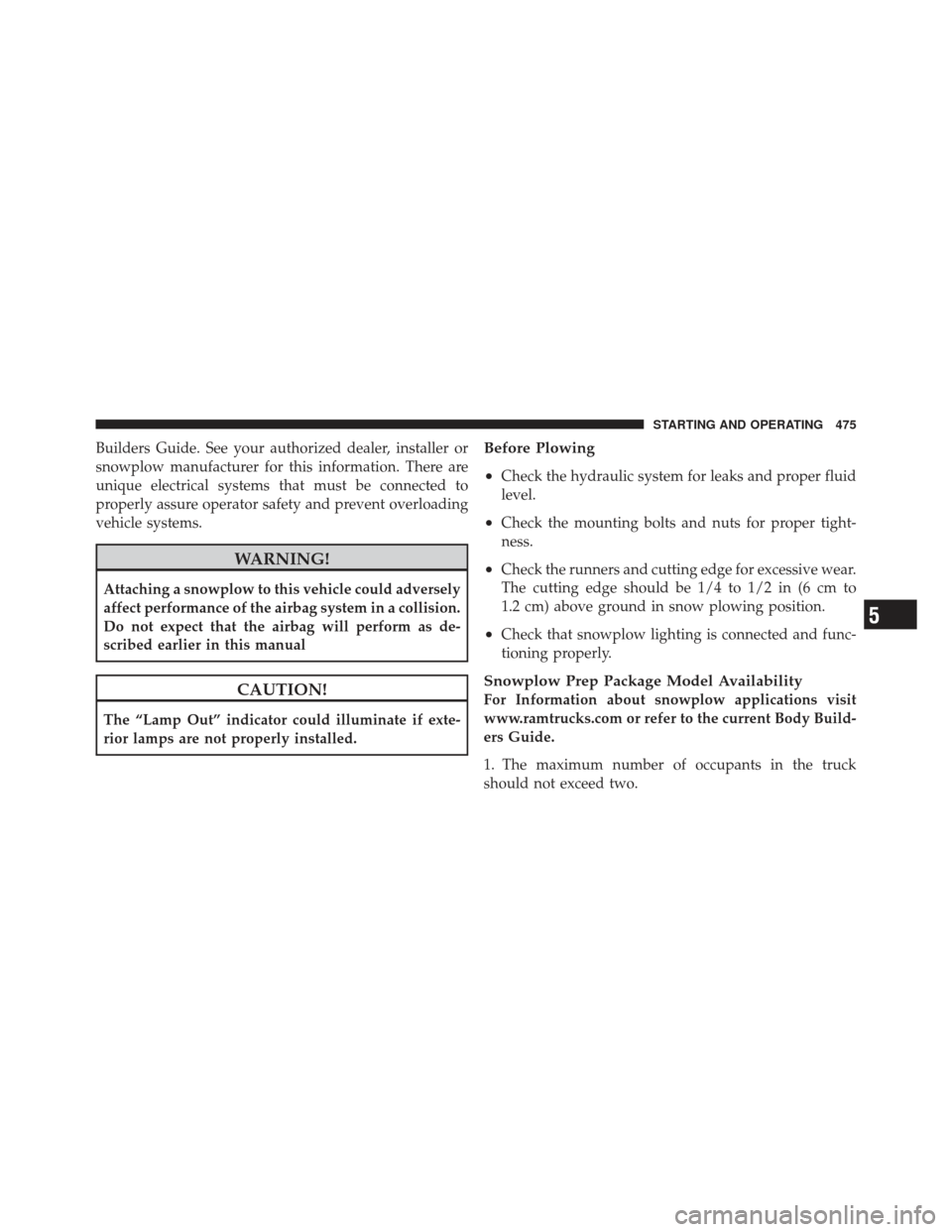
Builders Guide. See your authorized dealer, installer or
snowplow manufacturer for this information. There are
unique electrical systems that must be connected to
properly assure operator safety and prevent overloading
vehicle systems.
WARNING!
Attaching a snowplow to this vehicle could adversely
affect performance of the airbag system in a collision.
Do not expect that the airbag will perform as de-
scribed earlier in this manual
CAUTION!
The “Lamp Out” indicator could illuminate if exte-
rior lamps are not properly installed.
Before Plowing
•
Check the hydraulic system for leaks and proper fluid
level.
•Check the mounting bolts and nuts for proper tight-
ness.
•Check the runners and cutting edge for excessive wear.
The cutting edge should be 1/4 to 1/2 in (6 cm to
1.2 cm) above ground in snow plowing position.
•Check that snowplow lighting is connected and func-
tioning properly.
Snowplow Prep Package Model Availability
For Information about snowplow applications visit
www.ramtrucks.com or refer to the current Body Build-
ers Guide.
1. The maximum number of occupants in the truck
should not exceed two.
5
STARTING AND OPERATING 475
Page 569 of 636
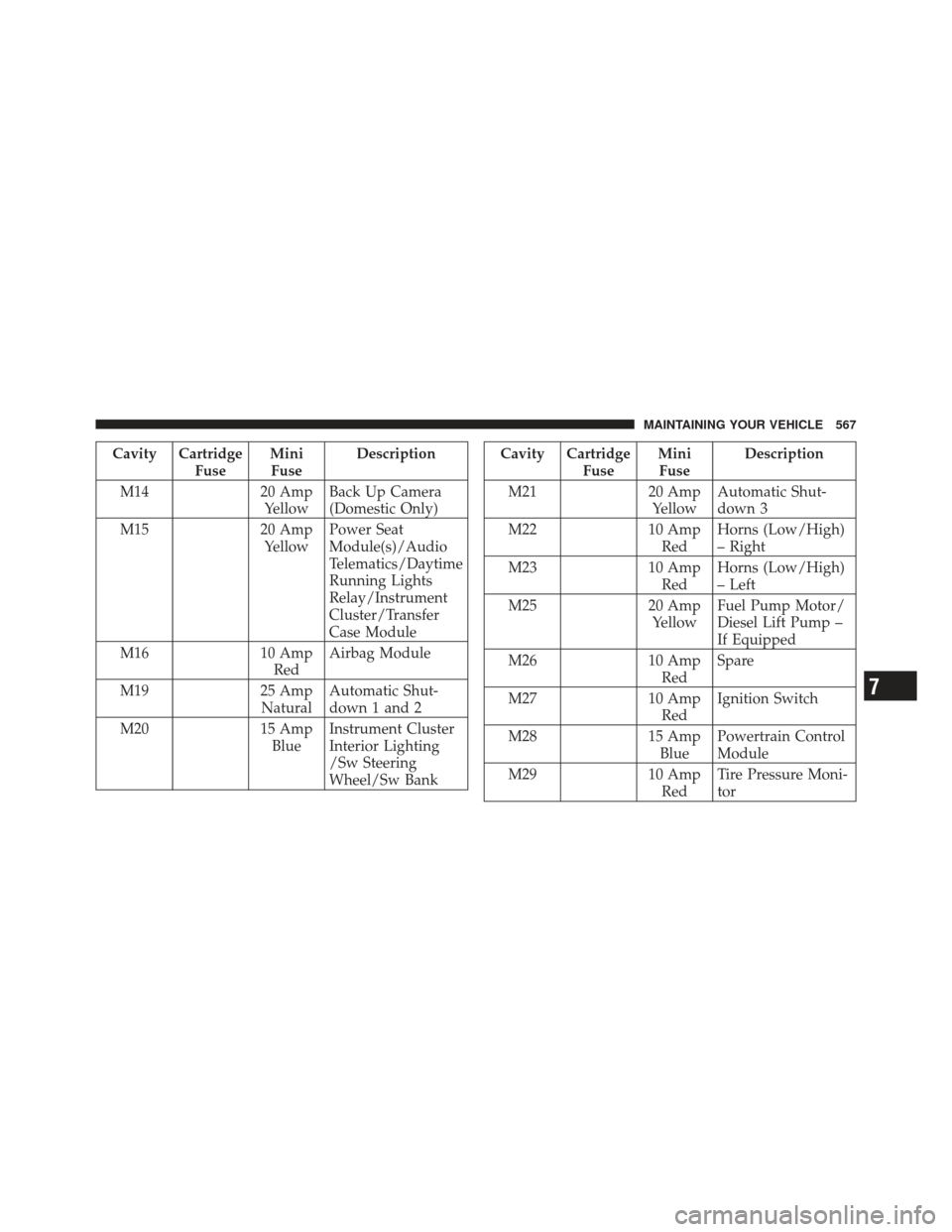
Cavity CartridgeFuseMini
Fuse Description
M14 20 Amp
Yellow Back Up Camera
(Domestic Only)
M15 20 Amp
Yellow Power Seat
Module(s)/Audio
Telematics/Daytime
Running Lights
Relay/Instrument
Cluster/Transfer
Case Module
M16 10 Amp
Red Airbag Module
M19 25 Amp
Natural Automatic Shut-
down 1 and 2
M20 15 Amp
Blue Instrument Cluster
Interior Lighting
/Sw Steering
Wheel/Sw BankCavity Cartridge
FuseMini
Fuse Description
M21 20 Amp
Yellow Automatic Shut-
down 3
M22 10 Amp
Red Horns (Low/High)
– Right
M23 10 Amp
Red Horns (Low/High)
– Left
M25 20 Amp
Yellow Fuel Pump Motor/
Diesel Lift Pump –
If Equipped
M26 10 Amp
Red Spare
M27 10 Amp
Red Ignition Switch
M28 15 Amp
Blue Powertrain Control
Module
M29 10 Amp
Red Tire Pressure Moni-
tor
7
MAINTAINING YOUR VEHICLE 567
Page 570 of 636
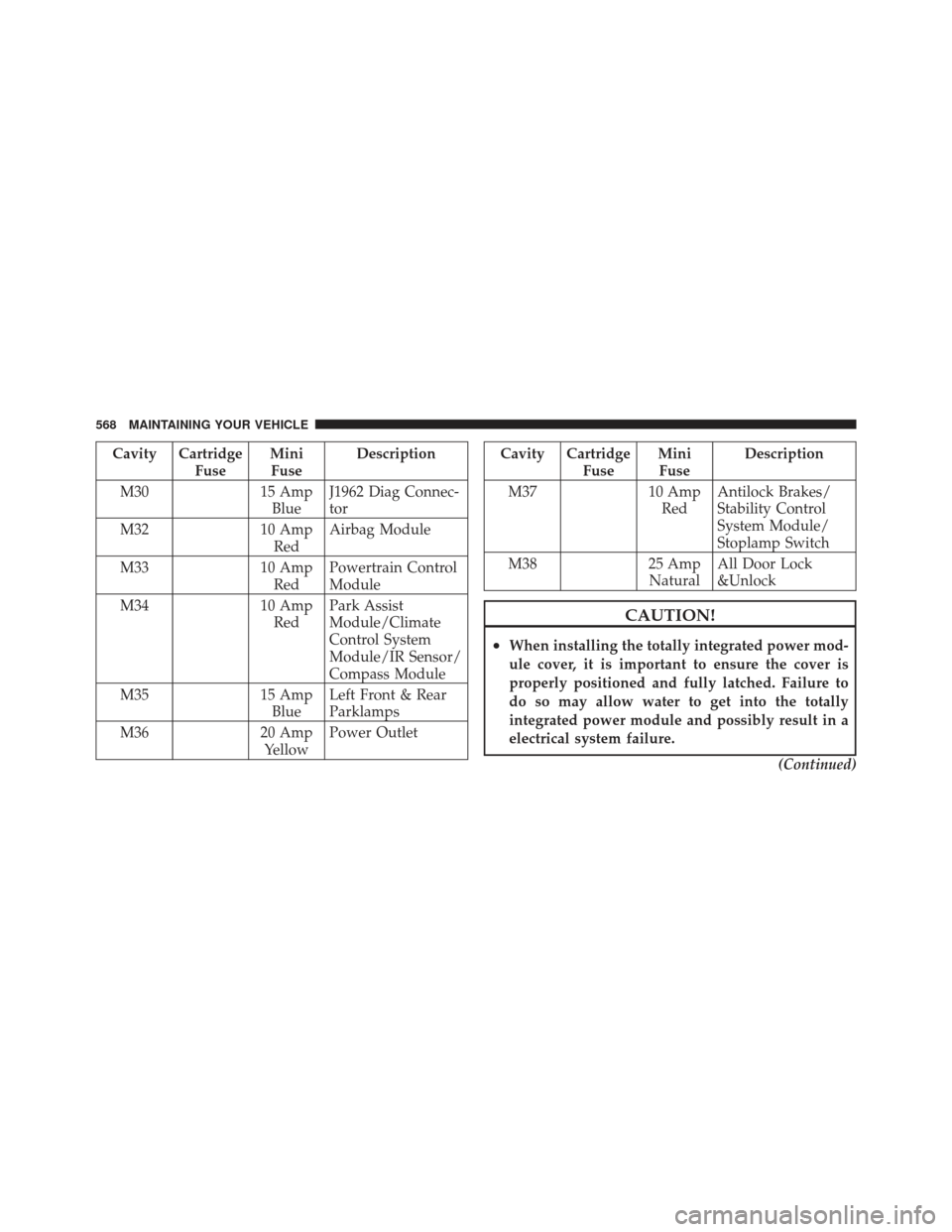
Cavity CartridgeFuseMini
Fuse Description
M30 15 Amp
Blue J1962 Diag Connec-
tor
M32 10 Amp
Red Airbag Module
M33 10 Amp
Red Powertrain Control
Module
M34 10 Amp
Red Park Assist
Module/Climate
Control System
Module/IR Sensor/
Compass Module
M35 15 Amp
Blue Left Front & Rear
Parklamps
M36 20 Amp
Yellow Power OutletCavity Cartridge
FuseMini
Fuse Description
M37 10 Amp
Red Antilock Brakes/
Stability Control
System Module/
Stoplamp Switch
M38 25 Amp
Natural All Door Lock
&Unlock
CAUTION!
•When installing the totally integrated power mod-
ule cover, it is important to ensure the cover is
properly positioned and fully latched. Failure to
do so may allow water to get into the totally
integrated power module and possibly result in a
electrical system failure.
(Continued)
568 MAINTAINING YOUR VEHICLE
Page 616 of 636
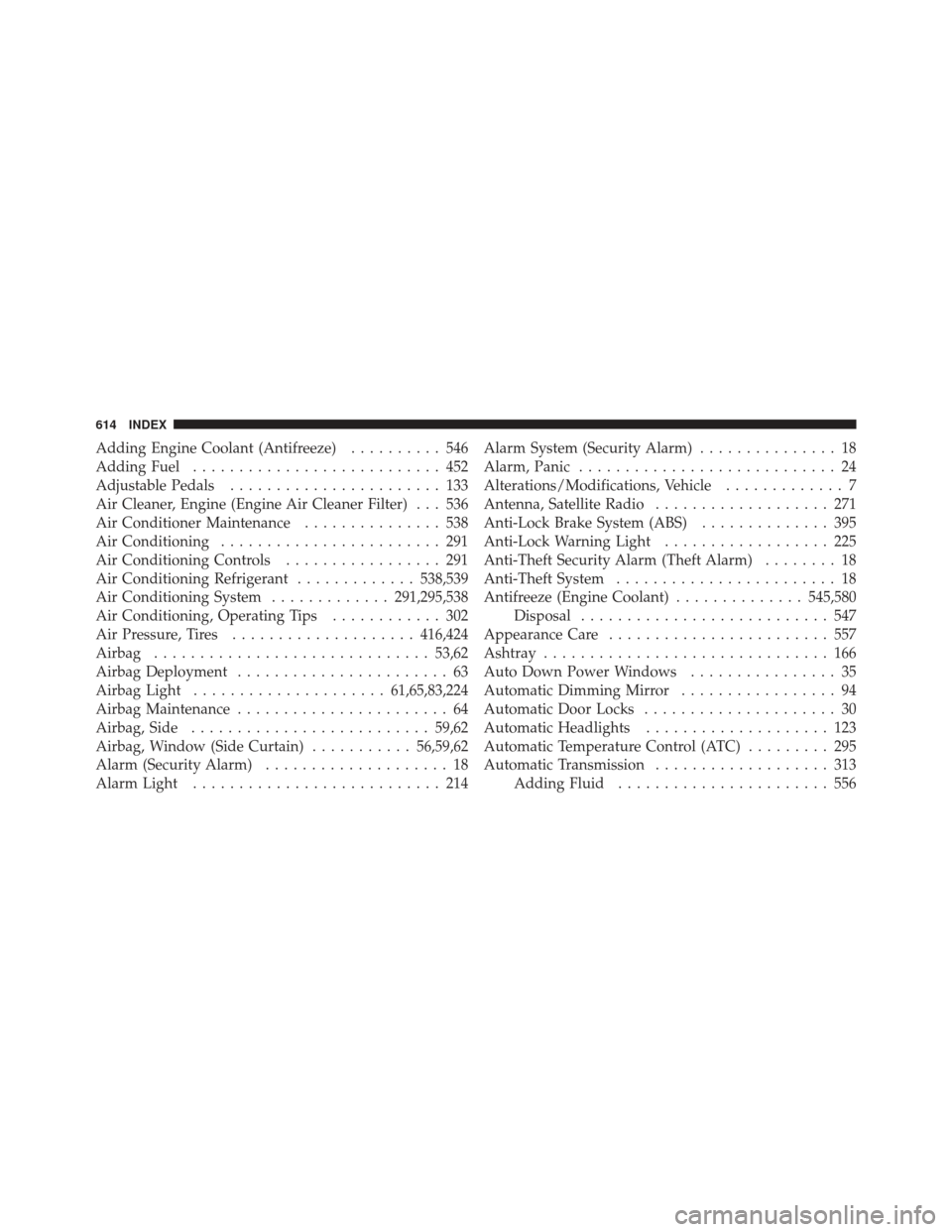
Adding Engine Coolant (Antifreeze).......... 546
Adding Fuel ........................... 452
Adjustable Pedals ....................... 133
Air Cleaner, Engine (Engine Air Cleaner Filter) . . . 536
Air Conditioner Maintenance ............... 538
Air Conditioning ........................ 291
Air Conditioning Controls ................. 291
Air Conditioning Refrigerant .............538,539
Air Conditioning System .............291,295,538
Air Conditioning, Operating Tips ............ 302
Air Pressure, Tires .................... 416,424
Airbag .............................. 53,62
Airbag Deployment ....................... 63
Airbag Light ..................... 61,65,83,224
Airbag Maintenance ....................... 64
Airbag, Side .......................... 59,62
Airbag, Window (Side Curtain) ...........56,59,62
Alarm (Security Alarm) .................... 18
Alarm Light ........................... 214 Alarm System (Security Alarm)
............... 18
Alarm, Panic ............................ 24
Alterations/Modifications, Vehicle ............. 7
Antenna, Satellite Radio ................... 271
Anti-Lock Brake System (ABS) .............. 395
Anti-Lock Warning Light .................. 225
Anti-Theft Security Alarm (Theft Alarm) ........ 18
Anti-Theft System ........................ 18
Antifreeze (Engine Coolant) ..............545,580
Disposal ........................... 547
Appearance Care ........................ 557
Ashtray ............................... 166
Auto Down Power Windows ................ 35
Automatic Dimming Mirror ................. 94
Automatic Door Locks ..................... 30
Automatic Headlights .................... 123
Automatic Temperature Control (ATC) ......... 295
Automatic Transmission ................... 313
Adding Fluid ....................... 556
614 INDEX
Page 624 of 636
Information Center, Vehicle................. 227
Inside Rearview Mirror .................... 93
Instrument Cluster ................. 206,208,210
Instrument Panel and Controls .............. 205
Instrument Panel Lens Cleaning ............. 562
Integrated Power Module (Fuses) ............ 564
Integrated Trailer Brake Controls ............. 466
Interior Appearance Care .................. 560
Interior Lights .......................... 125
Intermittent Wipers (Delay Wipers) ........... 130
Introduction ............................. 4
Inverter Outlet (115V) ..................... 167
Jack Location ........................... 491
Jump Starting .......................... 510
Key-In Reminder ......................... 15
Key, Programming ........................ 17
Key, Replacement ........................ 17 Key, Sentry (Immobilizer)
................... 16
Keyless Entry System ...................... 20
Keys ................................. 12
Lane Change and Turn Signals .............. 128
Lane Change Assist ...................... 128
Lap Belts .............................. 48
Lap/Shoulder Belts ....................... 39
LATCH (Lower Anchors and Tether for
CHildren) .............................. 72
Latches ................................ 85
Leaks, Fluid ............................ 86
Life of Tires ............................ 422
Light Bulbs ............................. 85
Lights .............................. 85,121
Airbag ...................... 61,65,83,224
Alarm ............................ 214
Anti-Lock .......................... 225
Automatic Headlights ................. 123
622 INDEX