inflation pressure Ram 1500 2011 Owner's Guide
[x] Cancel search | Manufacturer: RAM, Model Year: 2011, Model line: 1500, Model: Ram 1500 2011Pages: 636, PDF Size: 4.88 MB
Page 435 of 636
•Seasonal temperature changes will affect tire pressure,
and the TPMS will monitor the actual tire pressure in
the tire.
Base System
The Tire Pressure Monitor System (TPMS) uses wireless
technology with wheel rim mounted electronic sensors to
monitor tire pressure levels. Sensors mounted to each
wheel as part of the valve stem transmit tire pressure
readings to the receiver module.
NOTE:It is particularly important for you to check the
tire pressure in all of the tires on your vehicle monthly
and to maintain the proper pressure.
The TPMS consists of the following components:
•Receiver module,
•Four TPM sensors, and
•TPM Telltale Light The matching full size spare wheel and tire assembly (if
equipped) has a TPM sensor. The matching full size spare
can be used in place of any of the four road tires. The
TPMS will only monitor the pressure in the full size spare
when it is used in place of a road tire. Otherwise, a spare
with a pressure below the low-pressure limit will not
cause the TPM Telltale Light to illuminate or the chime to
sound.
Tire Pressure Monitoring Low Pressure Warnings
The TPM Telltale Light will illuminate in the
instrument cluster and a chime will sound when
tire pressure is low in one or more of the four
active road tires. Should this occur, you should stop as
soon as possible, check the inflation pressure of each tire
on your vehicle, and inflate each tire to the vehicle’s
recommended cold placard pressure value. Once the
system receives the updated tire pressures, the system
will automatically update and the TPM Telltale Light will5
STARTING AND OPERATING 433
Page 438 of 636

Tire Pressure Monitoring Low Pressure Warnings
The TPM Telltale Light will illuminate in the
instrument cluster and a chime will sound when
tire pressure is low in one or more of the four
active road tires. In addition, the EVIC will display one or
more low pressure messages (Left Front, Left Rear, Right
Front, Right Rear) for three seconds and a graphic
showing the pressure values of each tire with the low tire
pressure values flashing.
Should this occur, you should stop as soon as possible
and inflate the tires with a low pressure condition (those
flashing in the EVIC graphic) to the vehicle’s recom-
mended cold placard pressure inflation value. Once the
system receives the updated tire pressures, the system
will automatically update, the graphic display in the
EVIC will stop flashing, and the TPM Telltale Light will
436 STARTING AND OPERATING
Page 441 of 636
Tire Pressure Monitor System (TPMS) Tire Light
Load Inflation Switch Description (2500 Models) –
If Equipped
WARNING!
Never operate your vehicle with the TPMS and tire
pressures set to the Light Load Inflation Pressure
settings if carrying more than two occupants (150 lbs
[68 kg] each) plus 200 lbs (91 kg) of cargo. The vehicle
“Light Load Definition” is found in the Supplemen-
tal Tire Pressure Information Label which is located
on the rear face of the driver door opening. Failure to
do so may cause you to lose control resulting in a
collision, causing serious or fatal injury.The TPMS tire light load inflation switch will allow the
driver to switch between the max load inflation pressure
(cold) low pressure warning threshold and the light load
inflation pressure (cold) low pressure warning threshold
depending on the vehicle’s load condition. The Tire and
Loading Information label defines the recommended
front and rear cold tire inflation pressures for the vehicle
when operating in the Max Load condition. A Supple-
mental Tire Pressure Information label is also available
defining Light Load tire inflation pressures when oper-
ating in the Light Load condition. When the tire light
5
STARTING AND OPERATING 439
Page 442 of 636
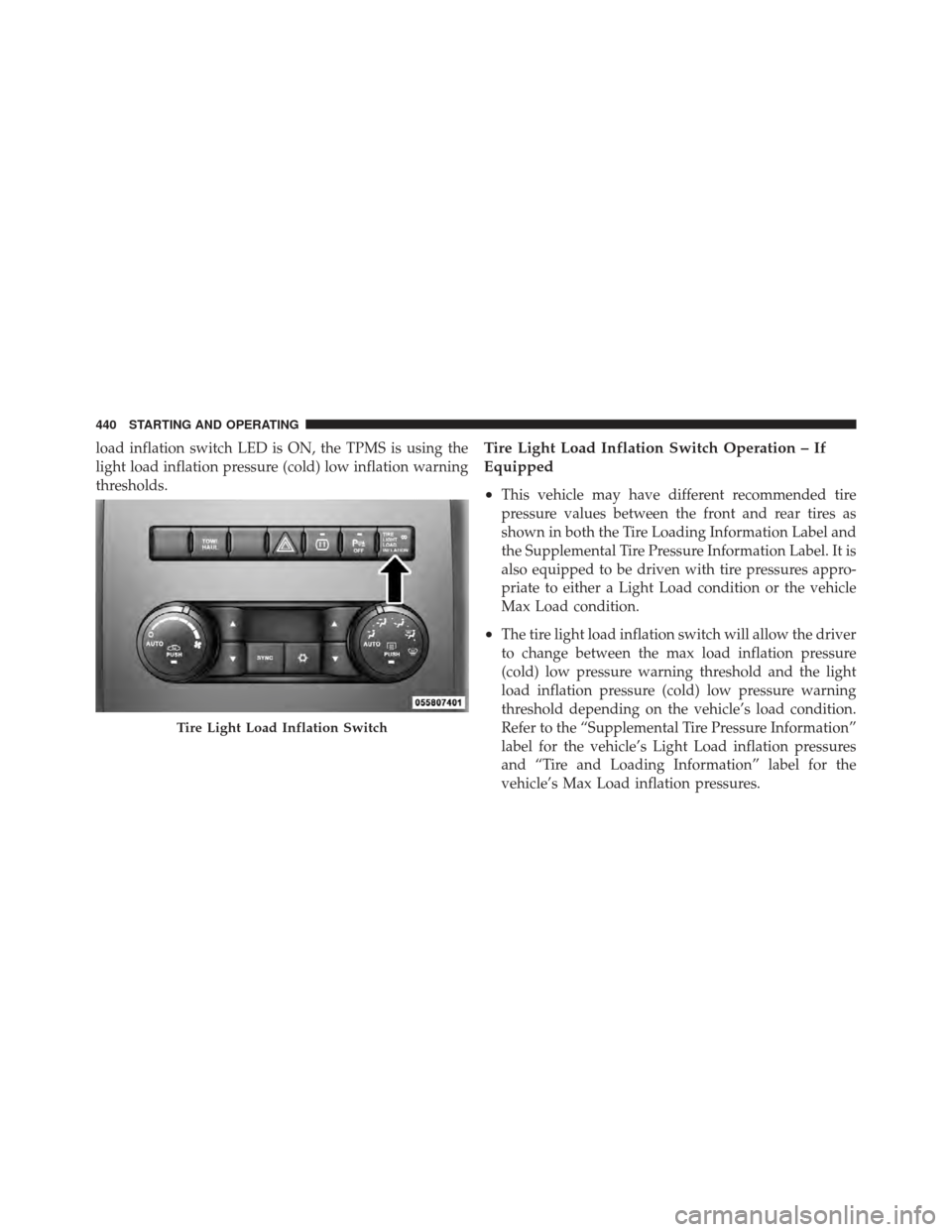
load inflation switch LED is ON, the TPMS is using the
light load inflation pressure (cold) low inflation warning
thresholds.Tire Light Load Inflation Switch Operation – If
Equipped
•
This vehicle may have different recommended tire
pressure values between the front and rear tires as
shown in both the Tire Loading Information Label and
the Supplemental Tire Pressure Information Label. It is
also equipped to be driven with tire pressures appro-
priate to either a Light Load condition or the vehicle
Max Load condition.
•The tire light load inflation switch will allow the driver
to change between the max load inflation pressure
(cold) low pressure warning threshold and the light
load inflation pressure (cold) low pressure warning
threshold depending on the vehicle’s load condition.
Refer to the “Supplemental Tire Pressure Information”
label for the vehicle’s Light Load inflation pressures
and “Tire and Loading Information” label for the
vehicle’s Max Load inflation pressures.
Tire Light Load Inflation Switch
440 STARTING AND OPERATING
Page 443 of 636
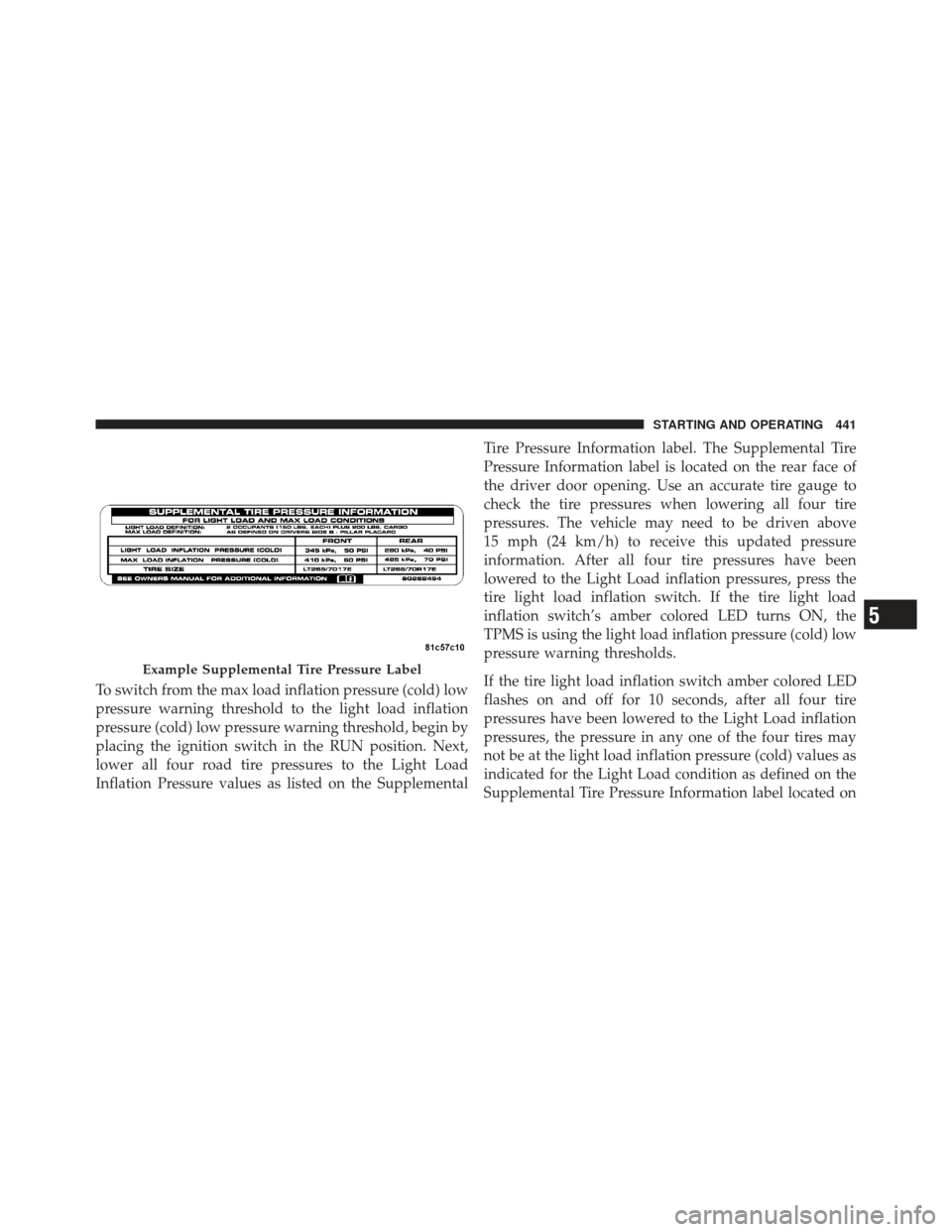
To switch from the max load inflation pressure (cold) low
pressure warning threshold to the light load inflation
pressure (cold) low pressure warning threshold, begin by
placing the ignition switch in the RUN position. Next,
lower all four road tire pressures to the Light Load
Inflation Pressure values as listed on the SupplementalTire Pressure Information label. The Supplemental Tire
Pressure Information label is located on the rear face of
the driver door opening. Use an accurate tire gauge to
check the tire pressures when lowering all four tire
pressures. The vehicle may need to be driven above
15 mph (24 km/h) to receive this updated pressure
information. After all four tire pressures have been
lowered to the Light Load inflation pressures, press the
tire light load inflation switch. If the tire light load
inflation switch’s amber colored LED turns ON, the
TPMS is using the light load inflation pressure (cold) low
pressure warning thresholds.
If the tire light load inflation switch amber colored LED
flashes on and off for 10 seconds, after all four tire
pressures have been lowered to the Light Load inflation
pressures, the pressure in any one of the four tires may
not be at the light load inflation pressure (cold) values as
indicated for the Light Load condition as defined on the
Supplemental Tire Pressure Information label located on
Example Supplemental Tire Pressure Label
5
STARTING AND OPERATING 441
Page 444 of 636
the rear face of the driver door. Using an accurate tire
pressure gauge, re-check the tire pressures for the light
load inflation pressure (cold) value.
WARNING!
It is the driver ’s responsibility to change to the max
load inflation pressure (cold) low pressure warning
threshold condition when not driving in the light
load condition as defined as two occupants (150 lbs
[68 kg] each) plus 200 lbs (91 kg) of cargo. The vehicle
“Light Load Definition” is found in the Supplemen-
tal Tire Pressure Information label located on the rear
face of the driver door. Failure to do so may cause you
to lose control resulting in a collision, causing seri-
ous or fatal injury.
To switch back to the max load inflation pressure (cold)
low pressure warning threshold, press the tire light load
inflation switch. It is not necessary to first fill the tires to the max load inflation pressure (cold) values to switch
the TPMS system to the max load inflation pressure
(cold) low pressure warning threshold. If after pressing
the tire light load inflation switch, and tire pressures are
below the max load inflation pressure (cold) low pressure
warning thresholds, the TPMS low pressure warning
telltale light (located in the instrument cluster) will turn
ON and a chime will sound. The tire pressures are now
required to be inflated to the max load inflation pressure
(cold) values described on the Tire and Loading Informa-
tion label. The Tire and Loading Information label is
located on the drivers side B-pillar. If the tire light load
inflation switch LED turns OFF, the TPMS has been reset
and the TPMS is using the max load inflation pressure
(cold) low pressure warning thresholds.
General Information
This device complies with Part 15 of the FCC rules and
RSS 210 of Industry Canada. Operation is subject to the
following conditions:
442 STARTING AND OPERATING
Page 457 of 636
Inflation Pressure
This is the cold tire inflation pressure for your vehicle for
all loading conditions up to full GAWR.
Curb Weight
The curb weight of a vehicle is defined as the total weight
of the vehicle with all fluids, including vehicle fuel, at full
capacity conditions, and with no occupants or cargo
loaded into the vehicle. The front and rear curb weight
values are determined by weighing your vehicle on a
commercial scale before any occupants or cargo are
added.
Loading
The actual total weight and the weight of the front and
rear of your vehicle at the ground can best be determined
by weighing it when it is loaded and ready for operation.The entire vehicle should first be weighed on a commer-
cial scale to insure that the GVWR has not been exceeded.
The weight on the front and rear of the vehicle should
then be determined separately to be sure that the load is
properly distributed over the front and rear axle. Weigh-
ing the vehicle may show that the GAWR of either the
front or rear axles has been exceeded but the total load is
within the specified GVWR. If so, weight must be shifted
from front to rear or rear to front as appropriate until the
specified weight limitations are met. Store the heavier
items down low and be sure that the weight is distributed
equally. Stow all loose items securely before driving.
Improper weight distributions can have an adverse effect
on the way your vehicle steers and handles and the way
the brakes operate.
5
STARTING AND OPERATING 455
Page 467 of 636
WARNING! (Continued)
2. GTW
3. GAWR
4. Trailer tongue weight rating for the trailer hitch
utilized (This requirement may limit the ability to
always achieve the 10% to 15% range of tongue
weight as a percentage of total trailer weight).
Towing Requirements – Tires
•
Do not attempt to tow a trailer while using a compact
spare tire.
•Proper tire inflation pressures are essential to the safe
and satisfactory operation of your vehicle. Refer to
“Tires – General Information” in “Starting and Oper-
ating” for proper tire inflation procedures.
•Check the trailer tires for proper tire inflation pres-
sures before trailer usage.
•Check for signs of tire wear or visible tire damage
before towing a trailer. Refer to “Tires – General
Information” in “Starting and Operating” for the
proper inspection procedure.
•When replacing tires, refer to “Tires – General Infor-
mation” in “Starting and Operating” for proper tire
replacement procedures. Replacing tires with a higher
load carrying capacity will not increase the vehicle’s
GVWR and GAWR limits.
Towing Requirements – Trailer Brakes
•
Donot interconnect the hydraulic brake system or
vacuum system of your vehicle with that of the trailer.
This could cause inadequate braking and possible
personal injury.
•An electronically actuated trailer brake controller is
required when towing a trailer with electronically
5
STARTING AND OPERATING 465
Page 623 of 636
Gross Axle Weight Rating.................. 457
Gross Vehicle Weight Rating ................ 456
Guide, Body Builders ...................... 6
GVWR ............................... 454
Hands-Free Phone (Uconnect™) ............. 101
Hazard Driving Through Flowing, Rising, or Shallow
Standing Water ...................... 366
Hazard Warning Flasher ................... 491
Head Restraints ......................... 114
Headlights ............................ 571
Automatic ......................... 123
Cleaning ........................... 561
High Beam ......................... 129
High Beam/Low Beam Select Switch ...... 129
Lights On Reminder .................. 127
Passing ............................ 128
Switch ............................ 123 Heated Mirrors
....................... 99,180
Heated Seats ........................... 104
Heater ............................... 291
Heater, Engine Block ..................... 311
High Beam/Low Beam Select (Dimmer) Switch . . 129
Hitches Trailer Towing ....................... 460
Hoisting .............................. 510
HomeLink® (Garage Door Opener) Transmitter . . 152
Hood Release .......................... 120
Hub Caps ............................. 505
Ignition ............................... 14
Key ............................. 12,14
Ignition Key Removal ..................... 14
Illuminated Entry ........................ 19
Immobilizer (Sentry Key) ................... 16
Infant Restraint ........................ 67,68
Inflation Pressure Tires .................... 424
10
INDEX 621
Page 632 of 636
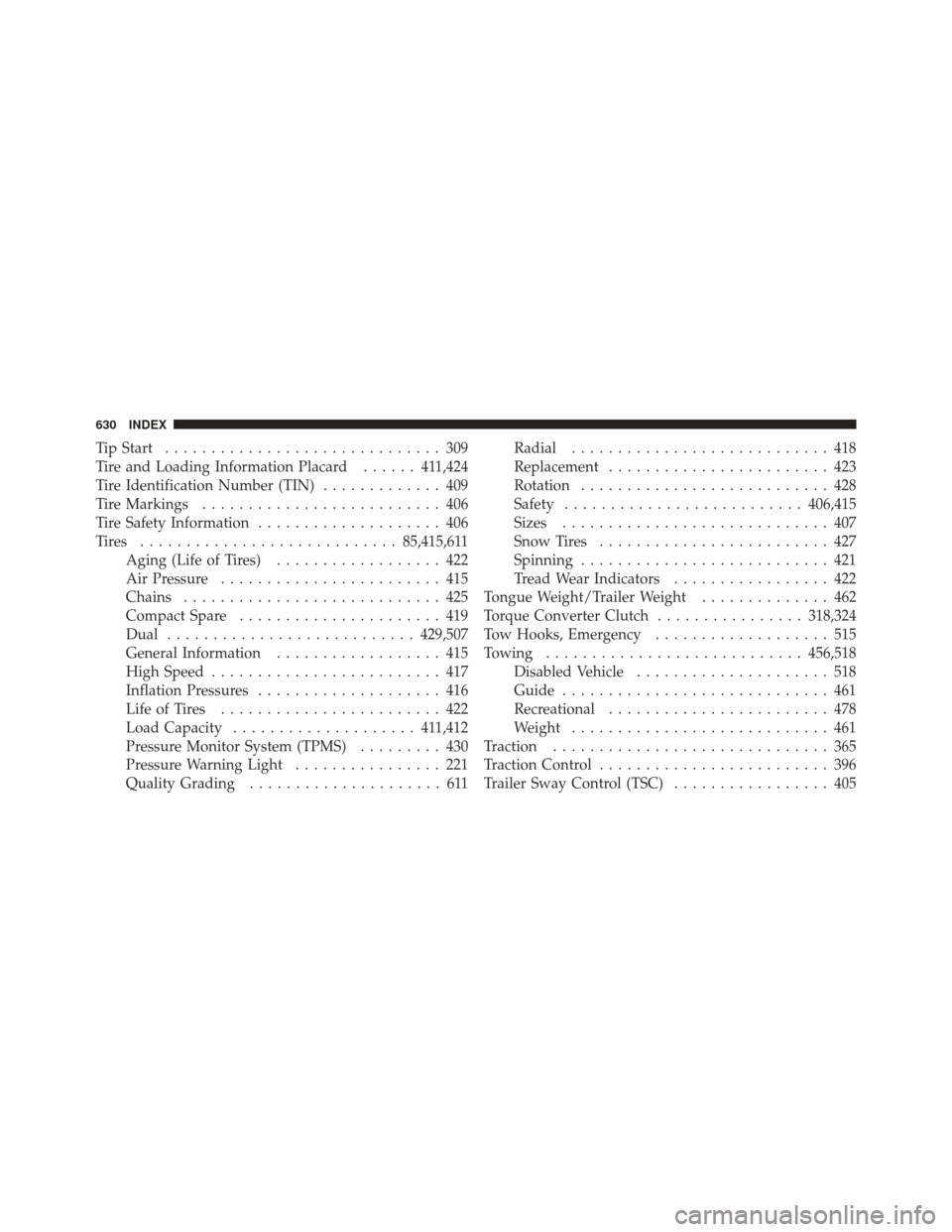
Tip Start.............................. 309
Tire and Loading Information Placard ...... 411,424
Tire Identification Number (TIN) ............. 409
Tire Markings .......................... 406
Tire Safety Information .................... 406
Tires ............................ 85,415,611
Aging (Life of Tires) .................. 422
Air Pressure ........................ 415
Chains ............................ 425
Compact Spare ...................... 419
Dual ........................... 429,507
General Information .................. 415
High Speed ......................... 417
Inflation Pressures .................... 416
Life of Tires ........................ 422
Load Capacity .................... 41 1,412
Pressure Monitor System (TPMS) ......... 430
Pressure Warning Light ................ 221
Quality Grading ..................... 611 Radial
............................ 418
Replacement ........................ 423
Rotation ........................... 428
Safety .......................... 406,415
Sizes ............................. 407
Snow Tires ......................... 427
Spinning ........................... 421
Tread Wear Indicators ................. 422
Tongue Weight/Trailer Weight .............. 462
Torque Converter Clutch ................318,324
Tow Hooks, Emergency ................... 515
Towing ............................ 456,518
Disabled Vehicle ..................... 518
Guide ............................. 461
Recreational ........................ 478
Weight ............................ 461
Traction .............................. 365
Traction Control ......................... 396
Trailer Sway Control (TSC) ................. 405
630 INDEX