radiator Ram 1500 2015 Diesel Supplement
[x] Cancel search | Manufacturer: RAM, Model Year: 2015, Model line: 1500, Model: Ram 1500 2015Pages: 347, PDF Size: 2.02 MB
Page 303 of 347
(antifreeze) solution. The use of lower quality water
will reduce the amount of corrosion protection in the
engine cooling system.
Please note that it is the owner’s responsibility to main-
tain the proper level of protection against freezing ac-
cording to the temperatures occurring in the area where
the vehicle is operated.
NOTE:
• Some vehicles require special tools to add coolant
properly. Failure to fill these systems properly could
lead to severe internal engine damage. If any coolant is
needed to be added to the system please contact your
local authorized dealer. •
Mixing engine coolant (antifreeze) types is not recom-
mended and can result in cooling system damage. If
HOAT and OAT coolant are mixed in an emergency,
have a authorized dealer drain, flush, and refill with
OAT coolant (conforming to MS.90032) as soon as
possible.
Cooling System Pressure Cap
The cap must be fully tightened to prevent loss of engine
coolant (antifreeze), and to ensure that the engine coolant
(antifreeze) will return to the radiator from the coolant
expansion bottle.
The cap should be inspected and cleaned if there is any
accumulation of foreign material on the sealing surfaces.
6
MAINTAINING YOUR VEHICLE 301
Page 304 of 347
WARNING!
•Do not open hot engine cooling system. Never add
engine coolant (antifreeze) when the engine is
overheated. Do not loosen or remove the cap to cool
an overheated engine. Heat causes pressure to
build up in the cooling system. To prevent scalding
or injury, do not remove the pressure cap while the
system is hot or under pressure.
• Do not use a pressure cap other than the one
specified for your vehicle. Personal injury or en-
gine damage may result.
Disposal Of Used Engine Coolant
Used ethylene glycol-based engine coolant (antifreeze) is
a regulated substance requiring proper disposal. Check
with your local authorities to determine the disposal
rules for your community. To prevent ingestion by ani-
mals or children, do not store ethylene glycol-based engine coolant (antifreeze) in open containers or allow it
to remain in puddles on the ground. If ingested by a child
or pet, seek emergency assistance immediately. Clean up
any ground spills immediately.
Points To Remember
NOTE:
When the vehicle is stopped after a few miles/
kilometers of operation, you may observe vapor coming
from the front of the engine compartment. This is nor-
mally a result of moisture from rain, snow, or high
humidity accumulating on the radiator and being vapor-
ized when the thermostat opens, allowing hot engine
coolant (antifreeze) to enter the radiator.
If an examination of your engine compartment shows no
evidence of radiator or hose leaks, the vehicle may be
safely driven. The vapor will soon dissipate.
• Do not overfill the coolant expansion bottle.
302 MAINTAINING YOUR VEHICLE
Page 305 of 347
•Check the coolant freeze point in the radiator and in
the coolant expansion bottle. If engine coolant (anti-
freeze) needs to be added, the contents of the coolant
expansion bottle must also be protected against freez-
ing.
• If frequent engine coolant (antifreeze) additions are
required, the cooling system should be pressure tested
for leaks.
• Maintain engine coolant (antifreeze) concentration at a
minimum of 50% OAT coolant (conforming to
MS.90032) and distilled water for proper corrosion
protection of your engine which contains aluminum
components.
• Make sure that the coolant expansion bottle overflow
hoses are not kinked or obstructed.
• Keep the front of the radiator clean. If your vehicle is
equipped with air conditioning, keep the front of the
condenser clean. •
Do not change the thermostat for Summer or Winter
operation. If replacement is ever necessary, install
ONLY the correct type thermostat. Other designs may
result in unsatisfactory engine coolant (antifreeze)
performance, poor gas mileage, and increased emis-
sions.
Charge Air Cooler — Inter-Cooler
The charge air cooler is positioned below the radiator and
the air conditioner condenser. Air enters the engine
through the air cleaner and passes through the turbo-
charger, where it is pressurized. This pressurized air
rapidly reaches high temperature. The air is then directed
through a hose to the charge air cooler and through
another hose to the intake manifold of the engine. The air
entering the engine has been cooled by about 50° to 100°F
(10° to 38°C). This cooling process enables more efficient
burning of fuel resulting in fewer emissions.
6
MAINTAINING YOUR VEHICLE 303
Page 306 of 347
To guarantee optimum performance of the system, keep
the surfaces of the charge air cooler, condenser and
radiator clean and free of debris. Periodically check the
hoses leading to and from the charge air cooler for cracks
or loose clamps resulting in loss of pressure and reduced
engine performance.
Brake System
Brake Master Cylinder — Brake Fluid Level Check
The fluid level of the master cylinder should be checked
when performing under the hood service, or immedi-
ately if the “Brake System Warning Light” indicates
system failure.
The brake master cylinder has a translucent plastic
reservoir. On the outboard side of the reservoir, there is a
“MAX” mark and a “MIN” mark. The fluid level must be
kept within these two marks. Do not add fluid above the
full mark because leakage may occur at the cap.With disc brakes, the fluid level can be expected to fall as
the brake linings wear. However, an unexpected drop in
fluid level may be caused by a leak and a system check
should be conducted.
Refer to “Fluids, Lubricants, and Genuine Parts” in
“Maintaining Your Vehicle” for further information.
WARNING!
•
Use only manufacturer’s recommended brake
fluid. Refer to “Fluids, Lubricants, and Genuine
Parts” in “Maintaining Your Vehicle” for further
information. Using the wrong type of brake fluid
can severely damage your brake system and/or
impair its performance. The proper type of brake
fluid for your vehicle is also identified on the
original factory installed hydraulic master cylinder
reservoir.
(Continued)
304 MAINTAINING YOUR VEHICLE
Page 336 of 347
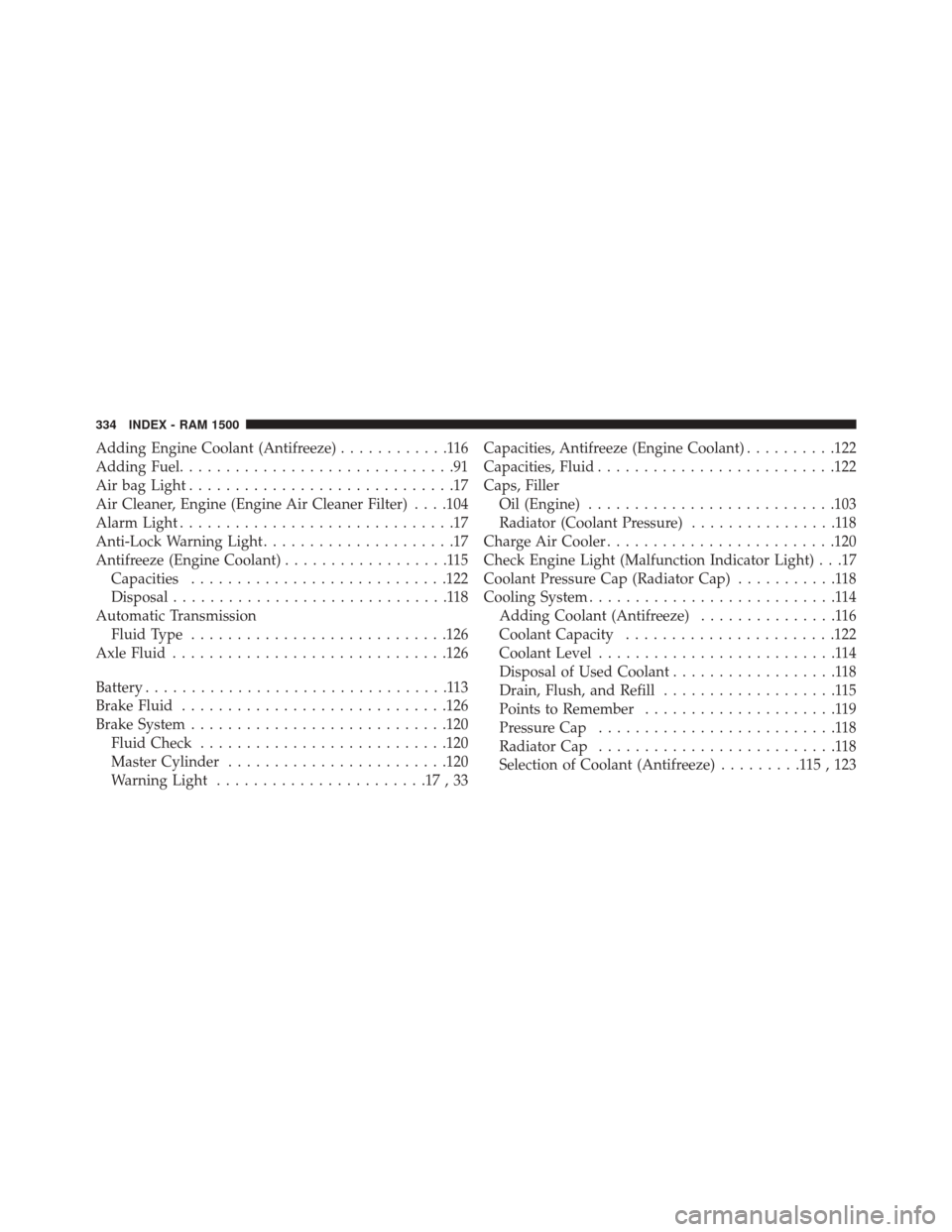
Adding Engine Coolant (Antifreeze)............116
Adding Fuel ..............................91
Air bag Light .............................17
Air Cleaner, Engine (Engine Air Cleaner Filter) . . . .104
Alarm Light ..............................17
Anti-Lock Warning Light .....................17
Antifreeze (Engine Coolant) ..................115
Capacities ........................... .122
Disposal ..............................118
Automatic Transmission Fluid Type ........................... .126
Axle Fluid ............................. .126
Battery .................................113
Brake Fluid ............................ .126
Brake System ........................... .120
Fluid Check .......................... .120
Master Cylinder ....................... .120
Warning Light .......................17,33 Capacities, Antifreeze (Engine Coolant)
..........122
Capacities, Fluid ......................... .122
Caps, Filler Oil (Engine) .......................... .103
Radiator (Coolant Pressure) ................118
Charge Air Cooler ........................ .120
Check Engine Light (Malfunction Indicator Light) . . .17
Coolant Pressure Cap (Radiator Cap) ...........118
Cooling System ...........................114
Adding Coolant (Antifreeze) ...............116
Coolant Capacity ...................... .122
Coolant Level ..........................114
Disposal of Used Coolant ..................118
Drain, Flush, and Refill ...................115
Points to Remember .....................119
Pressure Cap ..........................118
Radiator Cap ..........................118
Selection of Coolant (Antifreeze) .........115,123
334 INDEX - RAM 1500
Page 339 of 347
Disposal............................. .104
Filter ........................... .104 , 123
Filter Disposal ........................ .104
Materials Added to ..................... .104
Recommendation ...................... .102
Viscosity ............................ .103
Radiator Cap (Coolant Pressure Cap) ...........115
Remote Starting System ......................12
Schedule, Maintenance .....................128
Seat Belts Reminder ..........................17,35
Selection of Coolant (Antifreeze) ...............123
Signals, Turn .............................17
Speedometer .............................17
Starting .................................75
Automatic Transmission ...................76
Engine Block Heater ...................78,84 Remote
...............................12
Starting Procedures .........................75
Starting Procedures (Diesel Engines) .............75
Tachometer ..............................17
Tip Start ................................76
Ti re s Pressure Warning Light ....................36
Transfer Case Fluid ............................... .126
Transmission
Turn Signals ..............................17
Viscosity, Engine Oil ...................... .103
Voltmeter ................................80
Warning Lights (Instrument Cluster Description) ....17
Water Separator, Diesel Fuel ..................107
INDEX - RAM 1500 337
Page 340 of 347
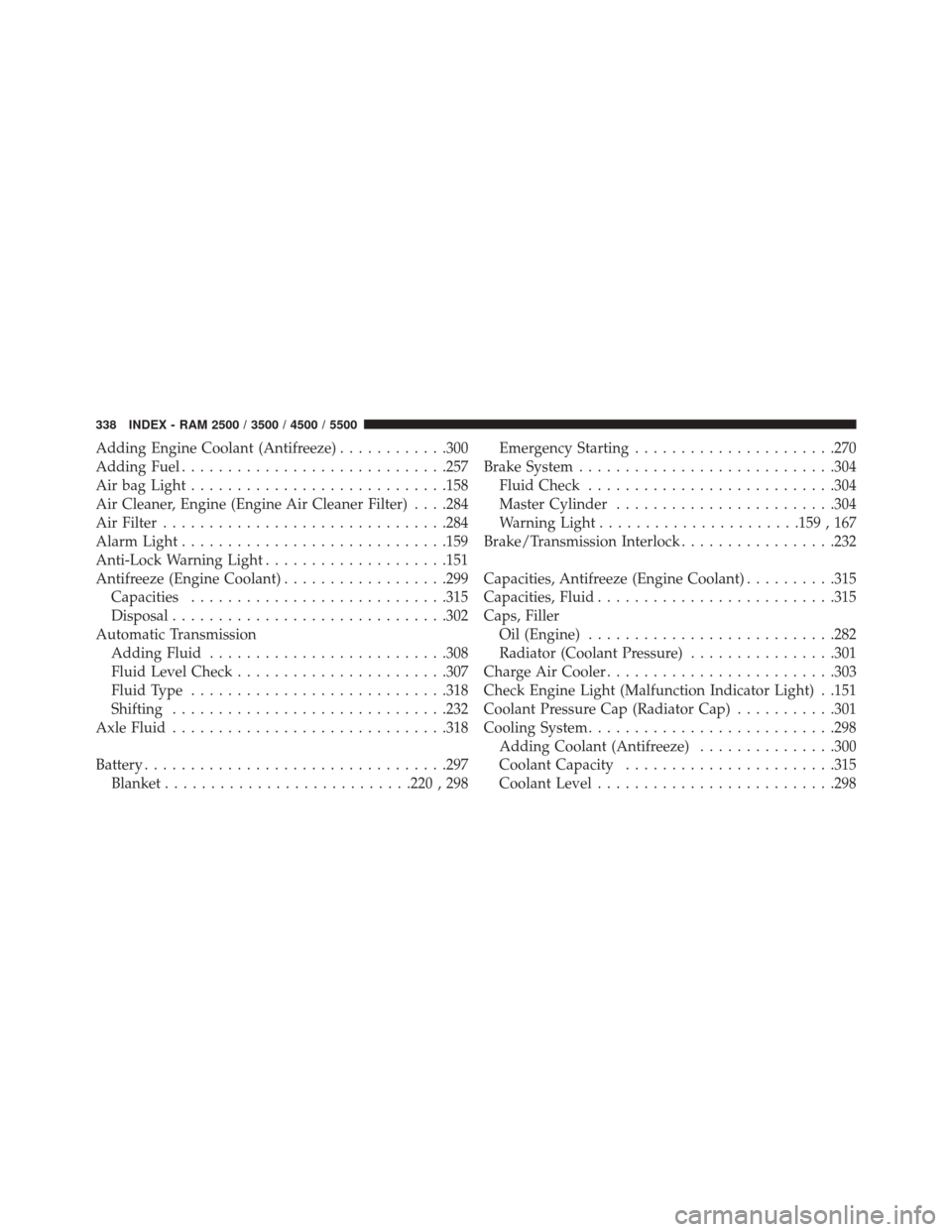
Adding Engine Coolant (Antifreeze)............300
Adding Fuel ............................ .257
Air bag Light ........................... .158
Air Cleaner, Engine (Engine Air Cleaner Filter) . . . .284
Air Filter .............................. .284
Alarm Light ............................ .159
Anti-Lock Warning Light ....................151
Antifreeze (Engine Coolant) ..................299
Capacities ........................... .315
Disposal ............................. .302
Automatic Transmission Adding Fluid ......................... .308
Fluid Level Check ...................... .307
Fluid Type ........................... .318
Shifting ............................. .232
Axle Fluid ............................. .318
Battery ................................ .297
Blanket .......................... .220 , 298Emergency Starting
..................... .270
Brake System ........................... .304
Fluid Check .......................... .304
Master Cylinder ....................... .304
Warning Light ..................... .159 , 167
Brake/Transmission Interlock .................232
Capacities, Antifreeze (Engine Coolant) ..........315
Capacities, Fluid ......................... .315
Caps, Filler Oil (Engine) .......................... .282
Radiator (Coolant Pressure) ................301
Charge Air Cooler ........................ .303
Check Engine Light (Malfunction Indicator Light) . .151
Coolant Pressure Cap (Radiator Cap) ...........301
Cooling System .......................... .298
Adding Coolant (Antifreeze) ...............300
Coolant Capacity ...................... .315
Coolant Level ......................... .298
338 INDEX - RAM 2500 / 3500 / 4500 / 5500
Page 341 of 347
Disposal of Used Coolant.................302
Drain, Flush, and Refill ...................299
Points to Remember .....................302
Pressure Cap ......................... .301
Radiator Cap ......................... .301
Selection of Coolant (Antifreeze) .........299 , 316
Diesel Exhaust Brake ...................... .227
Diesel Fuel ............................. .252
Diesel Fuel Requirements ....................252
Bulk Storage of ........................ .261
Diesel Fuel System, Re-Priming ...............294
Disposal Antifreeze (Engine Coolant) ................302
Draining Fuel/Water Separator Filter ...........288
Electronic Range Select (ERS) .................240
Electronic Vehicle Information Center (EVIC) ......174Emergency, In Case of
Jump Starting ......................... .270
Engine ................................ .277
Air Cleaner .......................... .284
Block Heater .......................211,227
Break-In Recommendations ................147
Compartment ..................... .277 , 278
Coolant (Antifreeze) .....................316
Identification ..................... .277 , 278
Idling .............................. .221
Jump Starting ......................... .270
Oil............................. .280 , 316
Oil Filler Cap ......................... .282
Oil Synthetic ......................... .283
Runaway ............................ .251
Exhaust Brake ........................... .227
Exhaust System ...........................311
INDEX - RAM 2500 / 3500 / 4500 / 5500 339
Page 344 of 347
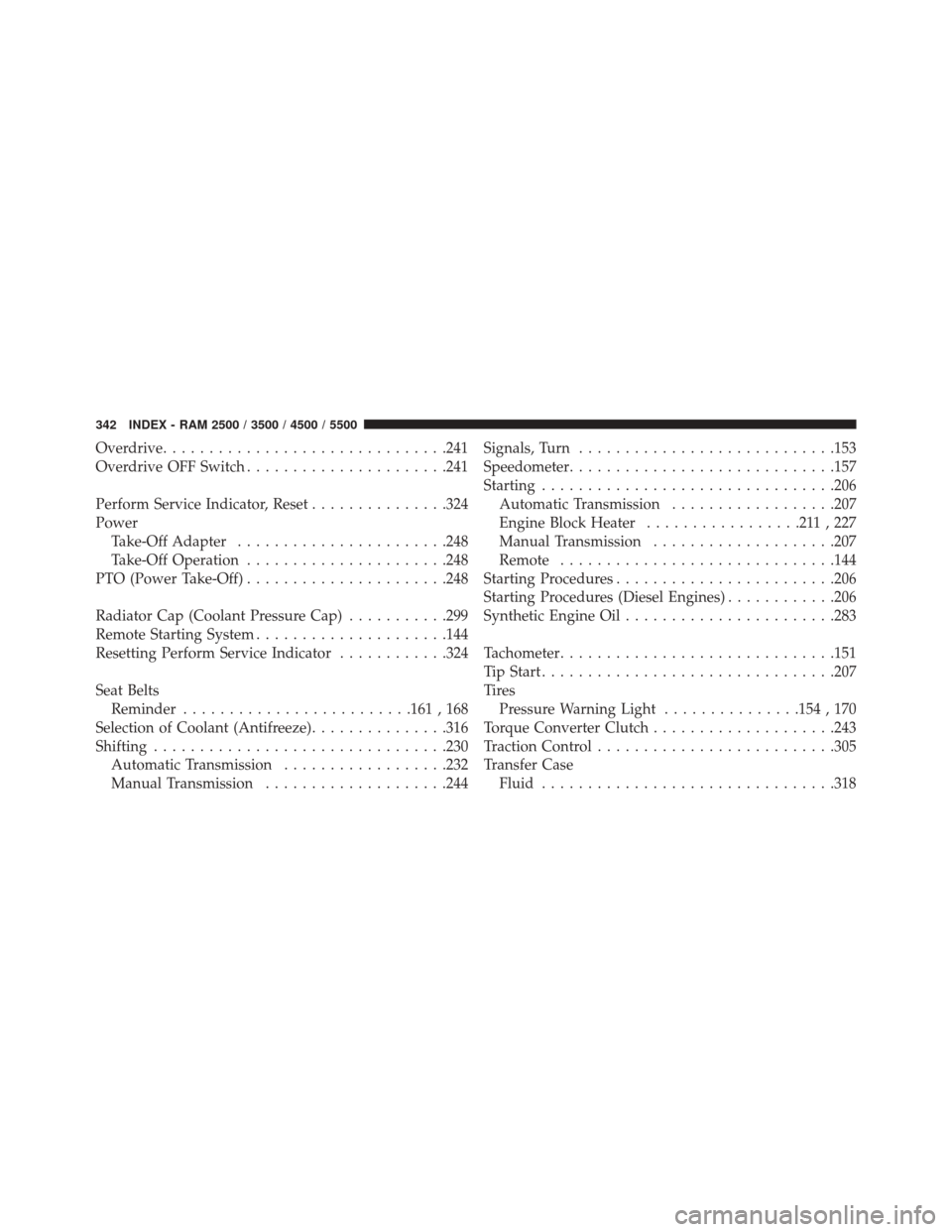
Overdrive.............................. .241
Overdrive OFF Switch ..................... .241
Perform Service Indicator, Reset ...............324
Power Take-Off Adapter ...................... .248
Take-Off Operation ..................... .248
PTO (Power Take-Off) ..................... .248
Radiator Cap (Coolant Pressure Cap) ...........299
Remote Starting System .....................144
Resetting Perform Service Indicator ............324
Seat Belts Reminder ........................ .161 , 168
Selection of Coolant (Antifreeze) ...............316
Shifting ............................... .230
Automatic Transmission ..................232
Manual Transmission ....................244 Signals, Turn
........................... .153
Speedometer ............................ .157
Starting ............................... .206
Automatic Transmission ..................207
Engine Block Heater .................211,227
Manual Transmission ....................207
Remote ............................. .144
Starting Procedures ....................... .206
Starting Procedures (Diesel Engines) ............206
Synthetic Engine Oil ...................... .283
Tachometer ............................. .151
Tip Start ............................... .207
Ti re s Pressure Warning Light ...............154 , 170
Torque Converter Clutch ....................243
Traction Control ......................... .305
Transfer Case Fluid ............................... .318
342 INDEX - RAM 2500 / 3500 / 4500 / 5500