key Ram 1500 2015 Diesel Supplement
[x] Cancel search | Manufacturer: RAM, Model Year: 2015, Model line: 1500, Model: Ram 1500 2015Pages: 347, PDF Size: 2.02 MB
Page 217 of 347
•Automatic equipped vehicles with optional Keyless
Enter-N-Go™ – If the start button is pushed once
while in park with the ignition off and driver ’s foot on
the brake pedal, the vehicle will automatically crank
and start after the Wait to Start time has elapsed. If it is
desired to abort the start process before it completes,
the driver ’s foot should be fully removed from the
brake pedal prior to pushing the start button again in
order for the ignition to move directly to off.
• If the engine stalls, or if the ignition switch is left ON
for more than two minutes after the “Wait To Start”
telltale goes out, reset the grid heaters by turning the
ignition switch to the OFF position for at least five
seconds and then back ON. Repeat steps 1 through 5 of
“Starting Procedure – Engine Manifold Air Tempera-
ture Below 66°F (19°C).”Starting Procedure — Engine Manifold Air
Temperature Below 0°F (-18°C)
In extremely cold weather below 0°F (-18°C) it may be
beneficial to cycle the manifold heaters twice before
attempting to start the engine. This can be accomplished
by turning the ignition OFF for at least five seconds and
then back ON after the “Wait To Start” telltale has turned
off, but before the engine is started. However, excessive
cycling of the manifold heaters will result in damage to
the heater elements or reduced battery voltage.
NOTE:If multiple pre-heat cycles are used before start-
ing, additional engine run time may be required to
maintain battery state of charge at a satisfactory level.
1. If the engine stalls after the initial start, the ignition must be turned to the OFF position for at least five
seconds and then to the ON position to recycle the
manifold heaters.
4
STARTING AND OPERATING 215
Page 219 of 347
Starting Fluids
WARNING!
Starting fluids or flammable liquids must never be
used in the Cummins® diesel engine (see Warning
label). Never pour diesel fuel, flammable liquid, start-
ing fluids (ether) into the air cleaner canister, air intake
piping, or turbocharger inlet in an attempt to start the
vehicle. This could result in a flash fire and explosion
causing serious personal injury and engine damage.
The engine is equipped with an automatic electric air
preheating system. If the instructions in this manual are
followed, the engine should start in all conditions.
WARNING!
•Do not leave children or animals inside parked
vehicles in hot weather. Interior heat build up may
cause serious injury or death.
• When leaving the vehicle, always make sure the
ignition is in the OFF position, remove the key fob
from the vehicle, and lock the vehicle.
(Continued)
4
STARTING AND OPERATING 217
Page 220 of 347
WARNING!(Continued)
•Never leave children alone in a vehicle, or with
access to an unlocked vehicle. Allowing children to
be in a vehicle unattended is dangerous for a
number of reasons. A child or others could be
seriously or fatally injured. Children should be
warned not to touch the parking brake, brake pedal
or the transmission gear selector. Do not leave the
key fob in or near the vehicle (or in a location
accessible to children), and do not leave the igni-
tion (of a vehicle equipped with Keyless Enter-N-
Go™) in the ACC or ON/RUN mode. A child could
operate power windows, other controls, or move
the vehicle.
NORMAL OPERATION — DIESEL ENGINE
Observe the following when the engine is operating.
• All message center lights are off.
• Malfunction Indicator Light (MIL) is off.
• Engine oil pressure is above 10 psi (69 kPa) at idle.
• Voltmeter operation:
The voltmeter may show a gauge fluctuation at various
engine temperatures. This cycling operation is caused by
the post-heat cycle of the intake manifold heater system.
The number of cycles and the length of the cycling
operation is controlled by the engine control module.
Post-heat operation can run for several minutes, and then
the electrical system and voltmeter needle will stabilize.
The cycling action will cause temporary dimming of the
headlamps, interior lamps, and also a noticeable reduc-
tion in blower motor speed.
218 STARTING AND OPERATING
Page 233 of 347
WARNING!(Continued)
•Unintended movement of a vehicle could injure
those in or near the vehicle. As with all vehicles,
you should never exit a vehicle while the engine is
running. Before exiting a vehicle, always apply the
parking brake, shift the transmission into PARK,
turn the engine OFF, and remove the key fob. When
the ignition is in the LOCK/OFF (key removal)
position, the transmission is locked in PARK, se-
curing the vehicle against unwanted movement.
• When leaving the vehicle, always make sure the
ignition is in the OFF position, remove the key fob
from the vehicle, and lock the vehicle.
(Continued)
WARNING! (Continued)
•Never leave children alone in a vehicle, or with
access to an unlocked vehicle. Allowing children to
be in a vehicle unattended is dangerous for a
number of reasons. A child or others could be
seriously or fatally injured. Children should be
warned not to touch the parking brake, brake pedal
or the transmission gear selector.
• Do not leave the key fob in or near the vehicle (or
in a location accessible to children), and do not
leave the ignition (of a vehicle equipped with
Keyless Enter-N-Go™) in the ACC or ON/RUN
mode. A child could operate power windows, other
controls, or move the vehicle.
NOTE: You must press and hold the brake pedal while
shifting out of PARK.
4
STARTING AND OPERATING 231
Page 234 of 347
Key Ignition Park Interlock
This vehicle is equipped with a Key Ignition Park Inter-
lock which requires the transmission to be in PARK
before the ignition switch can be turned to the LOCK/
OFF (key removal) position. The key fob can only be
removed from the ignition when the ignition is in the
LOCK/OFF position, and the transmission is locked in
PARK whenever the ignition switch is in the LOCK/OFF
position.
Brake/Transmission Shift Interlock System
This vehicle is equipped with a Brake Transmission Shift
Interlock System (BTSI) that holds the shift lever in PARK
unless the brakes are applied. To shift the transmission
out of PARK, the ignition switch must be turned to the
ON/RUN position (engine running or not) and the brake
pedal must be pressed.
Six-Speed Automatic Transmission — If Equipped
Chassis Cab models (with automatic transmission) use
the AS69RC transmission (which is equipped with a
Power Take-Off [PTO] access cover on the side of the
transmission case). Pickup models may use either the
AS69RC transmission, or the 68RFE transmission (which
has no PTO access cover).
The transmission gear position display (located in the
instrument cluster) indicates the transmission gear range.
The shift lever is mounted on the right side of the steering
column. You must press the brake pedal to move the shift
lever out of PARK (refer to “Brake/Transmission Shift
Interlock System” in this section). To drive, move the shift
lever from PARK or NEUTRAL to the DRIVE position.
Pull the shift lever toward you when shifting into RE-
VERSE or PARK, or when shifting out of PARK.
The electronically-controlled transmission provides a
precise shift schedule. The transmission electronics are
232 STARTING AND OPERATING
Page 237 of 347
WARNING!(Continued)
•Unintended movement of a vehicle could injure
those in or near the vehicle. As with all vehicles,
you should never exit a vehicle while the engine is
running. Before exiting a vehicle, always apply the
parking brake, shift the transmission into PARK,
turn the engine OFF, and remove the key fob. When
the ignition is in the LOCK/OFF (key removal)
position, the transmission is locked in PARK, se-
curing the vehicle against unwanted movement.
• When leaving the vehicle, always make sure the
ignition is in the OFF position, remove the key fob
from the vehicle, and lock the vehicle.
(Continued)
WARNING! (Continued)
•Never leave children alone in a vehicle, or with
access to an unlocked vehicle. Allowing children to
be in a vehicle unattended is dangerous for a
number of reasons. A child or others could be
seriously or fatally injured. Children should be
warned not to touch the parking brake, brake pedal
or the shift lever.
• Do not leave the key fob in or near the vehicle (or
in a location accessible to children), and do not
leave the ignition (in a vehicle equipped with
Keyless Enter-N-Go™) in the ACC or ON/RUN
position. A child could operate power windows,
other controls, or move the vehicle.
4
STARTING AND OPERATING 235
Page 250 of 347
To shift out of REVERSE bring the vehicle to a complete
stop and press the clutch. Shifting out of REVERSE prior
to a complete stop may cause high shift effort.
AUXILIARY SWITCHES — IF EQUIPPED
There can be up to five auxiliary switches located in the
lower switch bank of the instrument panel which can be
used to power various electronic devices and PTO
(Power Take Off) – If Equipped. Connections to the
switches are found under the hood in the connectors
attached to the auxiliary Power Distribution Center.
You have the ability to configure the functionality of the
auxiliary switches via the Electronic Vehicle Information
Center (EVIC) or Driver Information Display (DID). All
switches can now be configured for ignition or battery
power, saving or not saving state across a key cycle, and
momentary or latching switch operation.For further information on using the auxiliary switches,
please refer to the Ram Body Builders Guide by accessing
www.rambodybuilder.comand choosing the appropri-
ate links.
POWER TAKE OFF OPERATION — IF EQUIPPED
(CHASSIS CAB ONLY)
This vehicle when equipped with PTO Prep and either
the AS69RC automatic six-speed or G-56 manual six-
speed transmissions, will allow for an aftermarket upfit
with a transmission driven PTO (power take off). The
customer will have the ability to operate the PTO in
either a “stationary” or “mobile” mode. The vehicles will
be factory set to the “stationary” mode. To select ’mobile
mode’ You will need to enter the commercial vehicle
menu on the EVIC/DID screen and select mobile PTO
mode. Details of the PTO selection modes and further
PTO information is available at the Ram Truck Body-
builders web site. www.rambodybuilder.com
248 STARTING AND OPERATING
Page 298 of 347
To achieve these emissions standards, your vehicle is
equipped with a state-of-the-art engine and exhaust
system. The engine and exhaust after-treatment system
work together to achieve the EPA Heavy Duty Diesel
Engine Emissions Standards. These systems are seam-
lessly integrated into your vehicle and managed by the
Cummins® Powertrain Control Module (PCM). The
PCM manages engine combustion to allow the exhaust
system’s catalyst to trap and burn Particulate Matter
(PM) pollutants, with no input or interaction on your
part.
Additionally, your vehicle has the ability to alert you to
additional maintenance required on your truck or engine.
Refer to “Electronic Vehicle Information Center (EVIC)”
or “Driver Information Display (DID)” in “Understand-
ing Your Instrument Panel” for further information.WARNING!
A hot exhaust system can start a fire if you park over
materials that can burn. Such materials might be
grass or leaves coming into contact with your exhaust
system. Do not park or operate your vehicle in areas
where your exhaust system can contact anything that
can burn.
Diesel Exhaust Fluid
Diesel Exhaust Fluid (DEF) sometimes known simply by
the name of its active component, UREA—is a key
component of selective catalytic reduction (SCR) systems,
which help diesel vehicles meet stringent emission regu-
lations. DEF is a liquid reducing agent that reacts with
engine exhaust in the presence of a catalyst to convert
smog-forming nitrogen oxides (NOx) into harmless ni-
trogen and water vapor.
296 MAINTAINING YOUR VEHICLE
Page 338 of 347
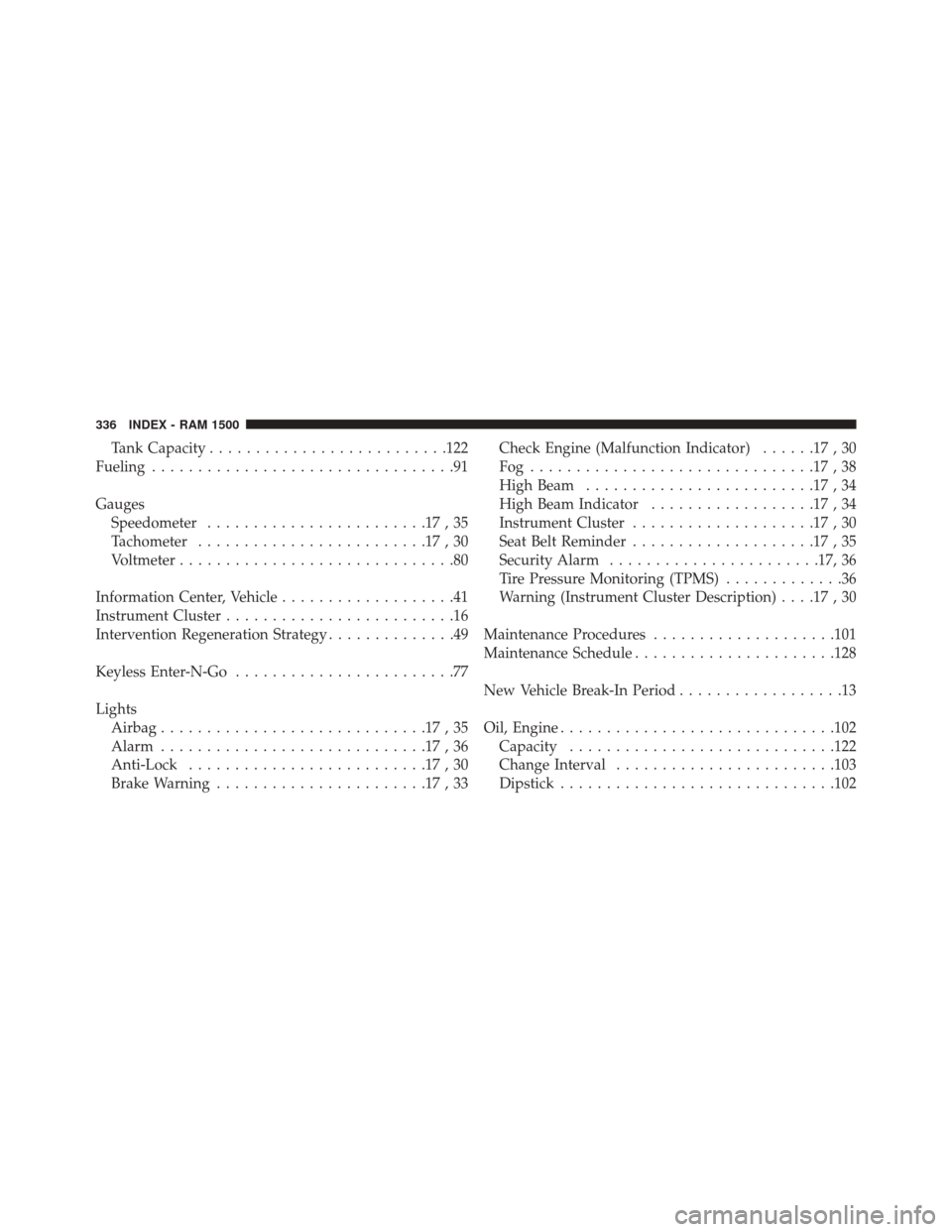
Tank Capacity......................... .122
Fueling .................................91
Gauges Speedometer ........................17,35
Tachometer .........................17,30
Voltmeter ..............................80
Information Center, Vehicle ...................41
Instrument Cluster .........................16
Intervention Regeneration Strategy ..............49
Keyless Enter-N-Go ........................77
Lights Airbag .............................17,35
Alarm .............................17,36
Anti-Lock ..........................17,30
Brake Warning .......................17,33 Check Engine (Malfunction Indicator)
......17,30
Fog ...............................17,38
High Beam .........................17,34
High Beam Indicator ..................17,34
Instrument Cluster ....................17,30
Seat Belt Reminder ....................17,35
Security Alarm ...................... .17, 36
Tire Pressure Monitoring (TPMS) .............36
Warning (Instrument Cluster Description) . . . .17 , 30
Maintenance Procedures ....................101
Maintenance Schedule ..................... .128
New Vehicle Break-In Period ..................13
Oil, Engine ............................. .102
Capacity ............................ .122
Change Interval ....................... .103
Dipstick ............................. .102
336 INDEX - RAM 1500
Page 342 of 347
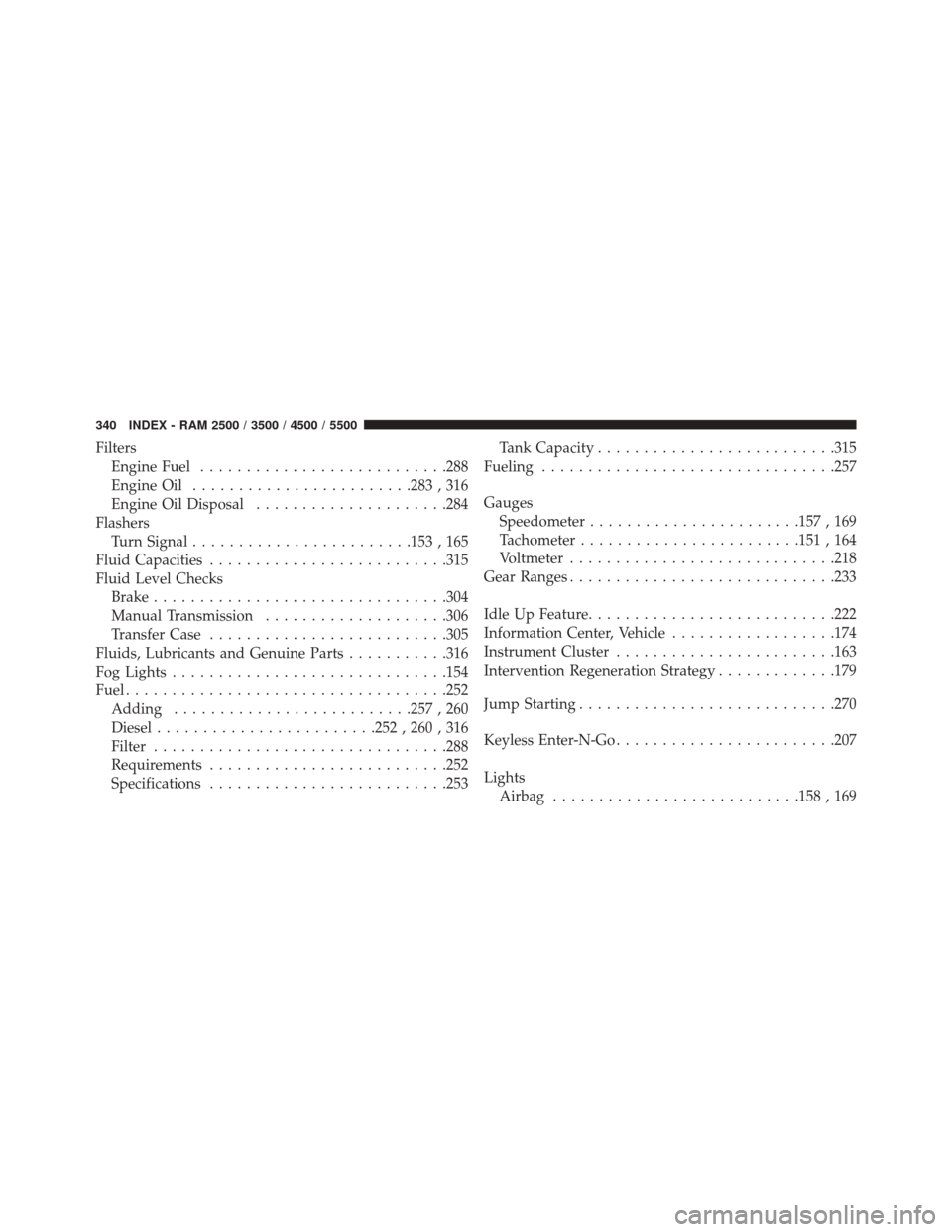
FiltersEngine Fuel .......................... .288
Engine Oil ....................... .283 , 316
Engine Oil Disposal .....................284
Flashers Turn Signal ....................... .153 , 165
Fluid Capacities ......................... .315
Fluid Level Checks Brake ............................... .304
Manual Transmission ....................306
Transfer Case ......................... .305
Fluids, Lubricants and Genuine Parts ...........316
Fog Lights ............................. .154
Fuel .................................. .252
Adding ......................... .257 , 260
Diesel ....................... .252 , 260 , 316
Filter ............................... .288
Requirements ......................... .252
Specifications ......................... .253Tank Capacity
......................... .315
Fueling ............................... .257
Gauges Speedometer ...................... .157 , 169
Tachometer ....................... .151 , 164
Voltmeter ............................ .218
Gear Ranges ............................ .233
Idle Up Feature .......................... .222
Information Center, Vehicle ..................174
Instrument Cluster ....................... .163
Intervention Regeneration Strategy .............179
Jump Starting ........................... .270
Keyless Enter-N-Go ....................... .207
Lights Airbag .......................... .158 , 169
340 INDEX - RAM 2500 / 3500 / 4500 / 5500