brake light Ram 1500 2015 Diesel Supplement
[x] Cancel search | Manufacturer: RAM, Model Year: 2015, Model line: 1500, Model: Ram 1500 2015Pages: 347, PDF Size: 2.02 MB
Page 220 of 347
WARNING!(Continued)
•Never leave children alone in a vehicle, or with
access to an unlocked vehicle. Allowing children to
be in a vehicle unattended is dangerous for a
number of reasons. A child or others could be
seriously or fatally injured. Children should be
warned not to touch the parking brake, brake pedal
or the transmission gear selector. Do not leave the
key fob in or near the vehicle (or in a location
accessible to children), and do not leave the igni-
tion (of a vehicle equipped with Keyless Enter-N-
Go™) in the ACC or ON/RUN mode. A child could
operate power windows, other controls, or move
the vehicle.
NORMAL OPERATION — DIESEL ENGINE
Observe the following when the engine is operating.
• All message center lights are off.
• Malfunction Indicator Light (MIL) is off.
• Engine oil pressure is above 10 psi (69 kPa) at idle.
• Voltmeter operation:
The voltmeter may show a gauge fluctuation at various
engine temperatures. This cycling operation is caused by
the post-heat cycle of the intake manifold heater system.
The number of cycles and the length of the cycling
operation is controlled by the engine control module.
Post-heat operation can run for several minutes, and then
the electrical system and voltmeter needle will stabilize.
The cycling action will cause temporary dimming of the
headlamps, interior lamps, and also a noticeable reduc-
tion in blower motor speed.
218 STARTING AND OPERATING
Page 272 of 347
JUMP STARTING
WARNING!
•To prevent personal injury or damage to clothing,
do not allow battery fluid to contact eyes, skin or
fabrics. Do not lean over a battery when connecting
jumper cables or allow cable clamps to touch each
other. Keep open flames or sparks away from
battery vent holes. Always wear eye protection
when working with batteries.
• Do not use a booster battery or any other booster
source that has a greater than 12 Volt system, i.e., do
not use a 24 Volt power source.
NOTE: Replacement batteries should both be of equal
size to prevent damage to the vehicle’s charging system.
Your vehicle is equipped with two 12 Volt batteries. If it
becomes necessary to use a booster battery with jumper cables to start a vehicle’s engine because its batteries are
discharged, the following procedure should be used:
Set the parking brake and place an automatic transmis-
sion in PARK (or NEUTRAL for a manual transmission).
Turn off lights, heater and other electrical loads. Observe
charge indicator (if equipped) in both batteries. If the
indicator (if equipped) is light or yellow on either battery,
replace that battery.
CAUTION!
Use the jump start procedure only when the charge
indicator (if equipped) in both batteries is dark in the
center. Do not attempt jump starting when either
battery charge indicator (if equipped) is bright or
yellow. If the charge indicator (if equipped) has a
green dot in the center, failure to start is not due to a
discharged battery and cranking system should be
checked.
270 WHAT TO DO IN EMERGENCIES
Page 306 of 347
To guarantee optimum performance of the system, keep
the surfaces of the charge air cooler, condenser and
radiator clean and free of debris. Periodically check the
hoses leading to and from the charge air cooler for cracks
or loose clamps resulting in loss of pressure and reduced
engine performance.
Brake System
Brake Master Cylinder — Brake Fluid Level Check
The fluid level of the master cylinder should be checked
when performing under the hood service, or immedi-
ately if the “Brake System Warning Light” indicates
system failure.
The brake master cylinder has a translucent plastic
reservoir. On the outboard side of the reservoir, there is a
“MAX” mark and a “MIN” mark. The fluid level must be
kept within these two marks. Do not add fluid above the
full mark because leakage may occur at the cap.With disc brakes, the fluid level can be expected to fall as
the brake linings wear. However, an unexpected drop in
fluid level may be caused by a leak and a system check
should be conducted.
Refer to “Fluids, Lubricants, and Genuine Parts” in
“Maintaining Your Vehicle” for further information.
WARNING!
•
Use only manufacturer’s recommended brake
fluid. Refer to “Fluids, Lubricants, and Genuine
Parts” in “Maintaining Your Vehicle” for further
information. Using the wrong type of brake fluid
can severely damage your brake system and/or
impair its performance. The proper type of brake
fluid for your vehicle is also identified on the
original factory installed hydraulic master cylinder
reservoir.
(Continued)
304 MAINTAINING YOUR VEHICLE
Page 311 of 347
NOTE:If it is necessary to check the transmission below
the operating temperature, the fluid level should be
between the two “COLD” (lower) holes on the dipstick
with the fluid at 60-70°F / 16-21°C for 68RFE transmis-
sion, or 68-86°F / 20-30°C for AS69RC transmission. Only
use the COLD region of the dipstick as a rough reference
when setting the fluid level after a transmission service
or fluid change. Re-check the fluid level, and adjust as
required, once the transmission reaches normal operating
temperature.
CAUTION!
If the fluid temperature is below 50°F (10°C) it may
not register on the dipstick. Do not add fluid until
the temperature is elevated enough to produce an
accurate reading. Run the engine at idle, in PARK, to
warm the fluid. 8. Reinsert the dipstick. Check for leaks. Release the
parking brake.
NOTE: To prevent dirt and water from entering the
transmission after checking or replenishing fluid, make
sure that the dipstick cap is properly reseated. It is
normal for the dipstick cap to spring back slightly from
its fully seated position, as long as its seal remains
engaged in the dipstick tube.
Fluid And Filter Changes
Refer to the “Maintenance Schedule” for the proper
maintenance intervals.
In addition, change the fluid and filter(s) if the fluid
becomes contaminated (with water, etc.), or if the trans-
mission is disassembled for any reason.6
MAINTAINING YOUR VEHICLE 309
Page 336 of 347
Adding Engine Coolant (Antifreeze)............116
Adding Fuel ..............................91
Air bag Light .............................17
Air Cleaner, Engine (Engine Air Cleaner Filter) . . . .104
Alarm Light ..............................17
Anti-Lock Warning Light .....................17
Antifreeze (Engine Coolant) ..................115
Capacities ........................... .122
Disposal ..............................118
Automatic Transmission Fluid Type ........................... .126
Axle Fluid ............................. .126
Battery .................................113
Brake Fluid ............................ .126
Brake System ........................... .120
Fluid Check .......................... .120
Master Cylinder ....................... .120
Warning Light .......................17,33 Capacities, Antifreeze (Engine Coolant)
..........122
Capacities, Fluid ......................... .122
Caps, Filler Oil (Engine) .......................... .103
Radiator (Coolant Pressure) ................118
Charge Air Cooler ........................ .120
Check Engine Light (Malfunction Indicator Light) . . .17
Coolant Pressure Cap (Radiator Cap) ...........118
Cooling System ...........................114
Adding Coolant (Antifreeze) ...............116
Coolant Capacity ...................... .122
Coolant Level ..........................114
Disposal of Used Coolant ..................118
Drain, Flush, and Refill ...................115
Points to Remember .....................119
Pressure Cap ..........................118
Radiator Cap ..........................118
Selection of Coolant (Antifreeze) .........115,123
334 INDEX - RAM 1500
Page 337 of 347
Diesel Fuel...............................85
Diesel Fuel Requirements ....................85
Bulk Storage of .........................94
Diesel Fuel System, Re-Priming ...............111
Disposal Antifreeze (Engine Coolant) ................118
Draining Fuel/Water Separator Filter ...........107
Electronic Vehicle Information Center (EVIC) ......41
Engine ................................ .100
Air Cleaner .......................... .104
Block Heater ........................78,84
Break-In Recommendations .................13
Compartment ......................... .100
Coolant (Antifreeze) .....................123
Identification ......................... .100
Idling ................................82
Oil............................. .102 , 123
Oil Filler Cap ......................... .103Filters
Air Cleaner .......................... .104
Engine Fuel .......................... .107
Engine Oil ....................... .104 , 123
Engine Oil Disposal .....................104
Flashers Turn Signal .........................17,32
Fluid Capacities ......................... .122
Fluid Level Checks Brake ............................... .120
Fluid, Brake ............................ .126
Fluids, Lubricants and Genuine Parts ...........123
Fog Lights ...............................17
Fuel ...................................85
Adding ...............................91
Diesel ............................85,123
Filter ............................... .107
Requirements ...........................85
Specifications ...........................86
INDEX - RAM 1500 335
Page 338 of 347
Tank Capacity......................... .122
Fueling .................................91
Gauges Speedometer ........................17,35
Tachometer .........................17,30
Voltmeter ..............................80
Information Center, Vehicle ...................41
Instrument Cluster .........................16
Intervention Regeneration Strategy ..............49
Keyless Enter-N-Go ........................77
Lights Airbag .............................17,35
Alarm .............................17,36
Anti-Lock ..........................17,30
Brake Warning .......................17,33 Check Engine (Malfunction Indicator)
......17,30
Fog ...............................17,38
High Beam .........................17,34
High Beam Indicator ..................17,34
Instrument Cluster ....................17,30
Seat Belt Reminder ....................17,35
Security Alarm ...................... .17, 36
Tire Pressure Monitoring (TPMS) .............36
Warning (Instrument Cluster Description) . . . .17 , 30
Maintenance Procedures ....................101
Maintenance Schedule ..................... .128
New Vehicle Break-In Period ..................13
Oil, Engine ............................. .102
Capacity ............................ .122
Change Interval ....................... .103
Dipstick ............................. .102
336 INDEX - RAM 1500
Page 340 of 347
Adding Engine Coolant (Antifreeze)............300
Adding Fuel ............................ .257
Air bag Light ........................... .158
Air Cleaner, Engine (Engine Air Cleaner Filter) . . . .284
Air Filter .............................. .284
Alarm Light ............................ .159
Anti-Lock Warning Light ....................151
Antifreeze (Engine Coolant) ..................299
Capacities ........................... .315
Disposal ............................. .302
Automatic Transmission Adding Fluid ......................... .308
Fluid Level Check ...................... .307
Fluid Type ........................... .318
Shifting ............................. .232
Axle Fluid ............................. .318
Battery ................................ .297
Blanket .......................... .220 , 298Emergency Starting
..................... .270
Brake System ........................... .304
Fluid Check .......................... .304
Master Cylinder ....................... .304
Warning Light ..................... .159 , 167
Brake/Transmission Interlock .................232
Capacities, Antifreeze (Engine Coolant) ..........315
Capacities, Fluid ......................... .315
Caps, Filler Oil (Engine) .......................... .282
Radiator (Coolant Pressure) ................301
Charge Air Cooler ........................ .303
Check Engine Light (Malfunction Indicator Light) . .151
Coolant Pressure Cap (Radiator Cap) ...........301
Cooling System .......................... .298
Adding Coolant (Antifreeze) ...............300
Coolant Capacity ...................... .315
Coolant Level ......................... .298
338 INDEX - RAM 2500 / 3500 / 4500 / 5500
Page 342 of 347
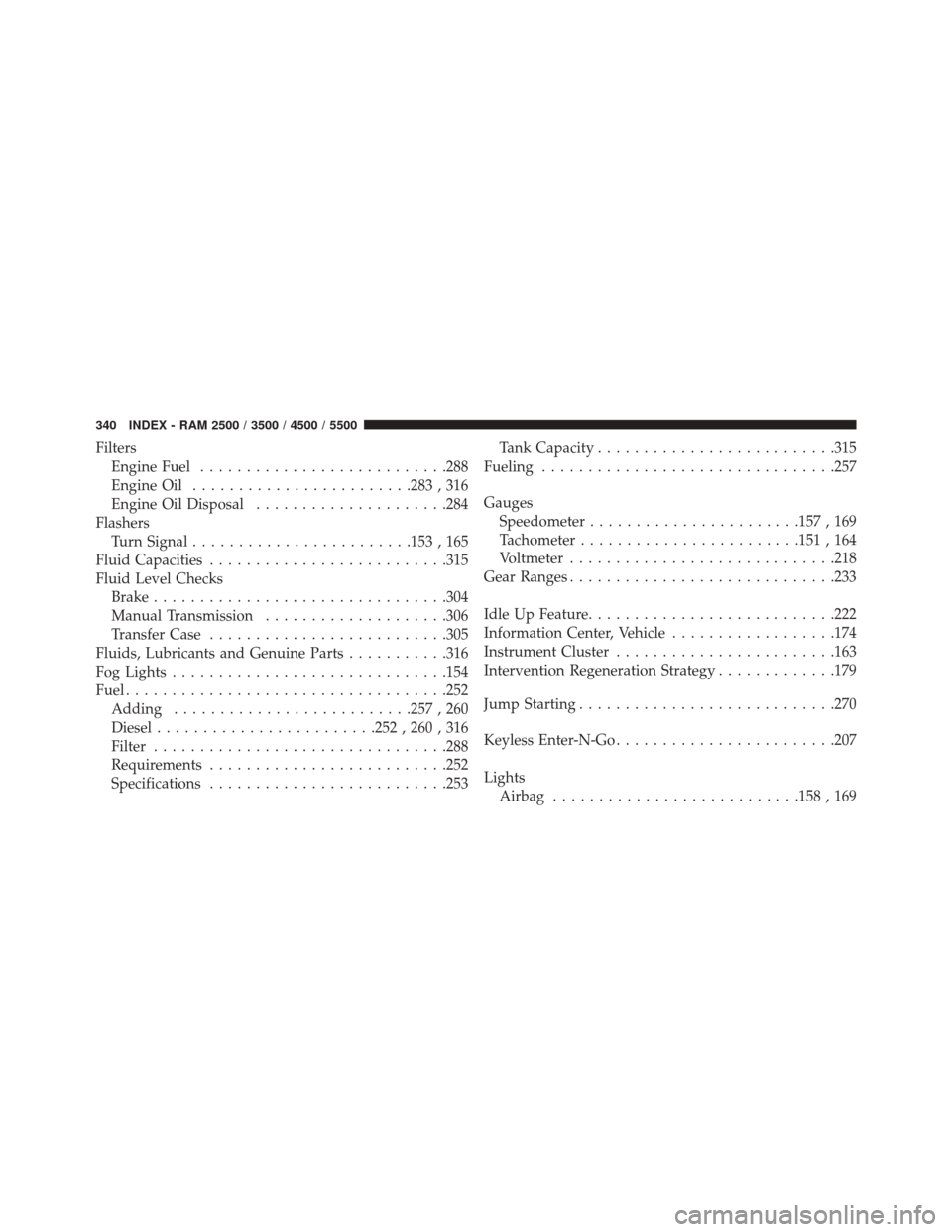
FiltersEngine Fuel .......................... .288
Engine Oil ....................... .283 , 316
Engine Oil Disposal .....................284
Flashers Turn Signal ....................... .153 , 165
Fluid Capacities ......................... .315
Fluid Level Checks Brake ............................... .304
Manual Transmission ....................306
Transfer Case ......................... .305
Fluids, Lubricants and Genuine Parts ...........316
Fog Lights ............................. .154
Fuel .................................. .252
Adding ......................... .257 , 260
Diesel ....................... .252 , 260 , 316
Filter ............................... .288
Requirements ......................... .252
Specifications ......................... .253Tank Capacity
......................... .315
Fueling ............................... .257
Gauges Speedometer ...................... .157 , 169
Tachometer ....................... .151 , 164
Voltmeter ............................ .218
Gear Ranges ............................ .233
Idle Up Feature .......................... .222
Information Center, Vehicle ..................174
Instrument Cluster ....................... .163
Intervention Regeneration Strategy .............179
Jump Starting ........................... .270
Keyless Enter-N-Go ....................... .207
Lights Airbag .......................... .158 , 169
340 INDEX - RAM 2500 / 3500 / 4500 / 5500