Fuel system Ram 1500 2015 Diesel Supplement
[x] Cancel search | Manufacturer: RAM, Model Year: 2015, Model line: 1500, Model: Ram 1500 2015Pages: 347, PDF Size: 2.02 MB
Page 214 of 347
•A 12 Volt heater built into the fuel filter housings aid in
preventing fuel gelling. It is controlled by a built-in
thermostat.
• A heated intake air system both improves engine
starting and reduces the amount of white smoke
generated by a warming engine.
Normal Starting Procedure — Engine Manifold Air
Temperature Above 66° F (19° C)
Observe the instrument panel cluster lights when starting
the engine.
1. Always apply the parking brake.
2. Shift into PARK for an automatic transmission. For vehicles equipped with a manual transmission, fully
press and hold the clutch pedal and shift into NEU-
TRAL. 3. Turn the ignition switch to the ON position and watch
the instrument panel cluster lights.
CAUTION!
If the “Water in Fuel Indicator Light” remains on, DO
NOT START the engine before you drain the water
from the fuel filters to avoid engine damage. Refer to
“Maintenance Procedures/Draining Fuel/Water Sepa-
rator Filter” in “Maintaining Your Vehicle” for fur-
ther information.
4. Turn the ignition switch to the START position and crank the engine. Do not press the accelerator during
starting.
212 STARTING AND OPERATING
Page 218 of 347
NOTE:Excessive white smoke and poor engine perfor-
mance will result if manifold heaters are not recycled.
2. Heat generated by the manifold heaters dissipates rapidly in a cold engine. If more than two minutes
pass between the time the “Wait To Start” telltale turns
off and the engine is started, recycle the manifold
heaters by turning the ignition switch to the OFF
position for at least five seconds and then back ON.
3. If the vehicle is driven and vehicle speed exceeds 19 mph (31 km/h) before the manifold heater post-
heat (after start) cycle is complete, the manifold heat-
ers will shut off.
4. If the engine is started before the “Wait To Start” telltale turns off, the preheat cycle will turn off.
5. If the engine is cranked for more than 10 seconds, the post-heat cycle will turn off. NOTE:
•
Engine idle speed will automatically increase to 1,000
RPM and engage the Variable Geometry Turbocharger
at low coolant temperatures to improve engine warm-
up.
• When a diesel engine is allowed to run out of fuel or
the fuel gels at low temperatures, air is pulled into the
fuel system. If your engine has run out of fuel, refer to
“Maintenance Procedures/Priming If The Engine Has
Run Out Of Fuel” in “Maintaining Your Vehicle” for
further information.
• If the engine stalls, or if the ignition switch is left ON
for more than two minutes after the “Wait To Start”
telltale goes out, reset the grid heaters by turning the
ignition switch to the OFF position for at least five
seconds and then back ON. Repeat steps 1 through 5 of
“Starting Procedure – Engine Manifold Air Tempera-
ture Below 66°F (19°C).”
216 STARTING AND OPERATING
Page 219 of 347
Starting Fluids
WARNING!
Starting fluids or flammable liquids must never be
used in the Cummins® diesel engine (see Warning
label). Never pour diesel fuel, flammable liquid, start-
ing fluids (ether) into the air cleaner canister, air intake
piping, or turbocharger inlet in an attempt to start the
vehicle. This could result in a flash fire and explosion
causing serious personal injury and engine damage.
The engine is equipped with an automatic electric air
preheating system. If the instructions in this manual are
followed, the engine should start in all conditions.
WARNING!
•Do not leave children or animals inside parked
vehicles in hot weather. Interior heat build up may
cause serious injury or death.
• When leaving the vehicle, always make sure the
ignition is in the OFF position, remove the key fob
from the vehicle, and lock the vehicle.
(Continued)
4
STARTING AND OPERATING 217
Page 221 of 347
Cold Weather Precautions
Operation in ambient temperature below 32°F (0°C) may
require special considerations. The following charts sug-
gest these options:
Fuel Operating Range
NOTE:Use “Ultra Low Sulfur Diesel Fuels” ONLY.
*No. 1 Ultra Low Sulfur Diesel Fuel should only be used
where extended arctic conditions (-10°F/-23°C) exist. NOTE:
•
Use of Climatized Ultra Low Sulfur Diesel Fuel or
Number 1 Ultra Low Sulfur Diesel Fuel results in a
noticeable decrease in fuel economy.
• Climatized Ultra Low Sulfur Diesel Fuel is a blend of
Number 2 Ultra Low Sulfur and Number 1 Ultra Low
Sulfur Diesel Fuels which reduces the temperature at
which wax crystals form in fuel.
• The fuel grade should be clearly marked on the pump
at the fuel station.
• The engine requires the use of “Ultra Low Sulfur
Diesel Fuel”. Use of incorrect fuel could result in
engine and exhaust system damage. Refer to “Fuel
Requirements” in “Starting And Operating” for fur-
ther information.
• Commercially available fuel additives are not neces-
sary for the proper operation of your Cummins®
Fuel Operating Range Chart
4
STARTING AND OPERATING 219
Page 224 of 347
varnish to form on piston rings, engine valves, and
injector nozzles. Also, the unburned fuel can enter the
crankcase, diluting the oil and causing rapid wear to the
engine.
If the engine is allowed to idle, under some conditions
the idle speed may increase to 900 RPM then return to
normal idle speed. This is normal operation.
NOTE:For EVIC/DID messages related to the vehicle’s
exhaust system, refer to “Electronic Vehicle Information
Center (EVIC)” or “Driver Information Display (DID)”
for further information.
Idle-Up Feature — Automatic Transmission Only
The driver-controlled high idle speed feature will help
increase cylinder temperatures and provide additional
cab heat, however, excessive idling may still cause the
exhaust aftertreatment system to not properly regenerate.
Extended periods of idle time should be avoided. The Idle-Up feature uses the speed control switches to
increase engine idle speed and quickly warm the vehi-
cle’s interior.
1. With the transmission in PARK, the parking brake
applied, and the engine running, press the speed
control switch to the ON position, then press the SET
switch.
2. The engine RPM will go up to 1100 RPM. To increase the RPM, press and hold the ACCEL/RESUME switch
and the idle speed will increase to approximately 1500
RPM. To decrease the RPM, press and hold the DECEL
switch and the idle speed will decrease to approxi-
mately 1100 RPM.
3. To cancel the Idle–Up feature, either press the CAN- CEL switch, press the ON/OFF switch, or press the
brake pedal.
222 STARTING AND OPERATING
Page 227 of 347
Operating Precautions
Avoid Overheating The Engine
The temperature of the engine coolant (antifreeze) (a
mixture of 50% ethylene-glycol and 50% water) must not
exceed the normal range of the temperature gauge 240°F
(116°C) with a 21 psi (145 kPa) coolant pressure cap.
Usually the engine coolant (antifreeze) temperature indi-
cated during operation will be to the left of center in the
normal range of the gauge.
Avoid Low Coolant Temperature Operation
Continual operation at low engine coolant (antifreeze)
temperature below the normal range on the gauge 140°F
(60°C) can be harmful to the engine. Low engine coolant
(antifreeze) temperature can cause incomplete combus-
tion which allows carbon and varnish to form on pistonrings and injector nozzles. Also, the unburned fuel can
enter the crankcase, diluting the lubricating oil and
causing rapid wear to the engine.
Cooling System Tips — Automatic Transmission
To reduce potential for engine and transmission over-
heating in high ambient temperature conditions, take the
following actions:
•
City Driving —
When stopped, shift the transmission into NEUTRAL
and increase engine idle speed.
• Highway Driving —
Reduce your speed.
• Up Steep Hills —
Select a lower transmission gear.
• Air Conditioning —
Turn it off temporarily.
4
STARTING AND OPERATING 225
Page 247 of 347
Truck models with manual transmission are equipped
with a clutch interlocking ignition system. The clutch
pedal must be fully pressed to start the vehicle.
Fully press the clutch pedal before shifting gears. As you
release the clutch pedal, lightly press the accelerator
pedal.
This transmission has a “creeper” first gear which should
be used to start from a standing position when carrying a
payload or towing a trailer. Damage to the clutch can result
from starting in second or third gear with a loaded vehicle.
An unloaded vehicle may be launched in second gear. Use
each gear in numerical order – do not skip a gear.
NOTE:When loaded, pulling a trailer or on a grade, the
truck should always start in first gear and not skip gears.
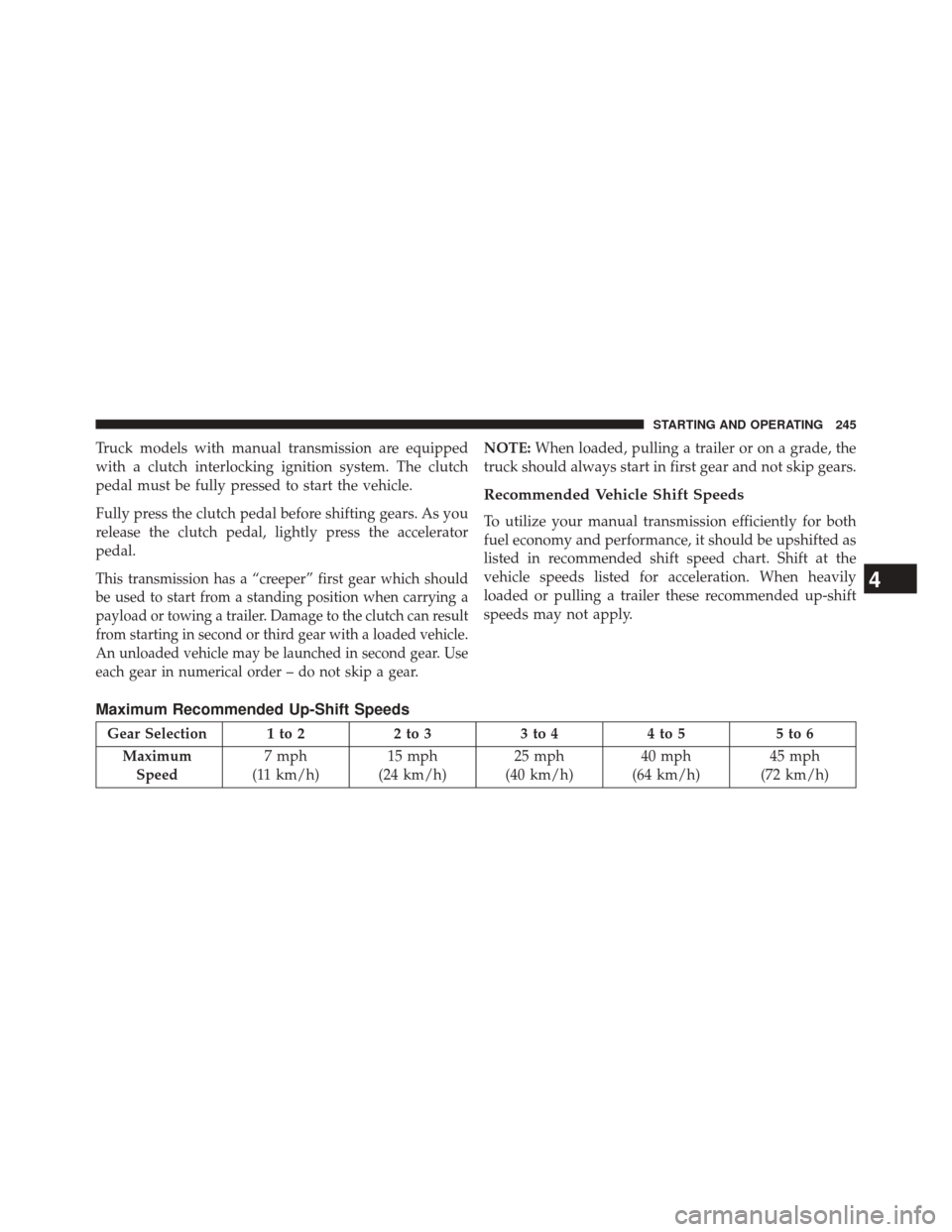
Recommended Vehicle Shift Speeds
To utilize your manual transmission efficiently for both
fuel economy and performance, it should be upshifted as
listed in recommended shift speed chart. Shift at the
vehicle speeds listed for acceleration. When heavily
loaded or pulling a trailer these recommended up-shift
speeds may not apply.
Maximum Recommended Up-Shift Speeds
Gear Selection 1 to 2 2 to 33 to 44 to 5 5 to 6
Maximum Speed 7 mph
(11 km/h) 15 mph
(24 km/h) 25 mph
(40 km/h) 40 mph
(64 km/h) 45 mph
(72 km/h)
4
STARTING AND OPERATING 245
Page 254 of 347
WARNING!
In case of engine runaway due to flammable fumes
from fuel spills or turbocharger oil leaks being
sucked into the engine, do the following to help
avoid personal injury and/or vehicle damage:
1. Turn the ignition switch to the OFF position.
2. Using a CO2 or dry chemical type fire extinguisher,
direct the spray from the fire extinguisher into the
grille on the passenger side so that the spray enters
the engine air intake.
The inlet for the engine air intake is located behind
the passenger side headlamp and receives air
through the grille.
FUEL REQUIREMENTS
Use good quality diesel fuel from a reputable supplier in
your vehicle. Federal law requires that you must fuel this
vehicle with Ultra Low Sulfur Highway Diesel fuel (15
ppm Sulfur maximum) and prohibits the use of Low
Sulfur Highway Diesel fuel (500 ppm Sulfur maximum)
to avoid damage to the emissions control system.
For most year-round service, No. 2 diesel fuel meeting
ASTM (formerly known as the American Society for
Testing and Materials) specification D-975 Grade S15 will
provide good performance. If the vehicle is exposed to
extreme cold (below 20°F or -7°C), or is required to
operate at colder-than-normal conditions for prolonged
periods, use climatized No. 2 diesel fuel or dilute the No.
2 diesel fuel with 50% No. 1 diesel fuel. This will provide
better protection from fuel gelling or wax-plugging of the
fuel filters.
252 STARTING AND OPERATING
Page 255 of 347
WARNING!
Do not use alcohol or gasoline as a fuel blending
agent. They can be unstable under certain conditions
and hazardous or explosive when mixed with diesel
fuel.
Diesel fuel is seldom completely free of water. To prevent
fuel system trouble, drain the accumulated water from
the fuel/water separator using the fuel/water separator
drain provided on both fuel filters. If you buy good
quality fuel and follow the cold weather advice above,
fuel conditioners should not be required in your vehicle.
If available in your area, a high cetane “premium” diesel
fuel may offer improved cold-starting and warm-up
performance.
CAUTION!
If the “Water in Fuel Indicator Light” remains on, DO
NOT START engine before you drain the water from
the fuel filter(s) to avoid engine damage. Refer to
“Maintenance Procedures/Draining Fuel/Water Sepa-
rator Filter” in “Maintaining Your Vehicle” for fur-
ther information.
Fuel Specifications
The Cummins® diesel engine has been developed to take
advantage of the high energy content and generally
lower cost No. 2 Ultra Low Sulfur diesel fuel or No. 2
Ultra Low Sulfur climatized diesel fuels. Experience has
shown that it also operates on No. 1 Ultra Low Sulfur
diesel fuels or other fuels within specification.
4
STARTING AND OPERATING 253
Page 256 of 347
NOTE:
•If you accidentally fill the fuel tank with gasoline on
your diesel vehicle, Do not start the vehicle. If you
restart your vehicle you risk damaging the engine and
fuel system. Please call your local dealer for service.
• A maximum blend of 5% biodiesel meeting ASTM
specification D-975 may be used with your Cummins®
diesel engine. (Chassis Cab models not configured
with B20 capability.)
• A maximum blend of 20% biodiesel meeting ASTM
specification D-7467 may be used with your Cum-
mins® diesel engine. (Pickup models and Chassis Cab
models configured with B20 Capability.)
• In addition, commercially available fuel additives are
not necessary for the proper operation of your Cum-
mins® diesel engine. However, if seasonably adjusted
fuel is not available and you are operating below 20°F (-6°C), Mopar® Premium Diesel Fuel Treatment (or
equivalent) may be beneficial to avoid fuel gelling.
• No. 1 Ultra Low Sulfur diesel fuel should only be used
where extended arctic conditions (-10°F or -23°C) exist.
Bio-Diesel Fuel Requirements
Chassis Cab Models
A maximum blend of 5% biodiesel meeting ASTM speci-
fication D975 may be used with your Cummins diesel
engine. If operation with Biodiesel blends greater than
5% but not greater than 20% (B6-B20) is desired, the truck
must first be reconfigured by an authorized Ram dealer
and the provisions in the following section must be
adhered to.
254 STARTING AND OPERATING