heating Ram 1500 2015 Diesel Supplement
[x] Cancel search | Manufacturer: RAM, Model Year: 2015, Model line: 1500, Model: Ram 1500 2015Pages: 347, PDF Size: 2.02 MB
Page 49 of 347
•Engine Temperature Warning Light
This light warns of an overheated engine condi-
tion. As temperatures rise and the gauge ap-
proaches H,this indicator will illuminate and a
single chime will sound after reaching a set threshold.
Further overheating will cause the temperature gauge to
pass H,a continuous chime will occur until the engine is
allowed to cool.
If the light turns on while driving, safely pull over
and stop the vehicle. If the A/C system is on, turn it
off. Also, shift the transmission into PARK and idle
the vehicle. If the temperature reading does not
return to normal, turn the engine off immediately and
call for service. Refer to “If Your Engine Overheats”
in “What To Do In Emergencies” for further
information. •
Electric Power Steering Malfunction Warning Light
This telltale is on when the Electric Power
Steering is not operating and needs service.
• Trailer Brake Disconnected Warning Light
This telltale is on when the Trailer Brake has
been disconnected.
7. Audio/Phone Information And Sub-menu Information
Whenever there are sub-menus available, the position
within the sub-menu is shown here.
3
UNDERSTANDING YOUR INSTRUMENT PANEL 47
Page 77 of 347
STARTING PROCEDURES
Before starting your vehicle, adjust your seat, both inside
and outside mirrors, and fasten your seat belts.
The starter is allowed to crank for up to 30-second
intervals. Waiting a few minutes between such intervals
will protect the starter from overheating.
WARNING!
•When leaving the vehicle, always make sure the
ignition is in the OFF position, remove the Key Fob
from the vehicle, and lock the vehicle.
(Continued)
WARNING! (Continued)
•Never leave children alone in a vehicle, or with
access to an unlocked vehicle. Leaving children in
a vehicle unattended is dangerous for a number of
reasons. A child or others could be seriously or
fatally injured. Children should be warned not to
touch the parking brake, brake pedal or the shift
lever/transmission gear selector.
• Do not leave the Key Fob in or near the vehicle (or
in a location accessible to children), and do not
leave the ignition (of a vehicle equipped with
Keyless Enter-N-Go™) in the ACC or ON/RUN
mode. A child could operate power windows, other
controls, or move the vehicle.
NOTE: Engine start up in very low ambient temperature
could result in evident white smoke. This condition will
disappear as the engine warms up.
4
STARTING AND OPERATING 75
Page 81 of 347
Starting Fluids
The engine is equipped with a glow plug preheating
system. If the instructions in this manual are followed,
the engine should start in all conditions and no type of
starting fluid should be used.
WARNING!
•Do not leave children or animals inside parked
vehicles in hot weather. Interior heat build up may
cause serious injury or death.
• When leaving the vehicle, always make sure the
ignition is in the OFF position, remove the key fob
from the vehicle, and lock the vehicle.
(Continued)
WARNING! (Continued)
•Never leave children alone in a vehicle, or with
access to an unlocked vehicle. Allowing children to
be in a vehicle unattended is dangerous for a
number of reasons. A child or others could be
seriously or fatally injured. Children should be
warned not to touch the parking brake, brake pedal
or the transmission gear selector. Do not leave the
key fob in or near the vehicle (or in a location
accessible to children), and do not leave the igni-
tion (of a vehicle equipped with Keyless Enter-N-
Go™) in the ACC or ON/RUN mode. A child could
operate power windows, other controls, or move
the vehicle.
4
STARTING AND OPERATING 79
Page 82 of 347
NORMAL OPERATION
Observe the following when the diesel engine is operat-
ing.
•All message center lights are off.
• Malfunction Indicator Light (MIL) is off.
• Engine Oil Pressure telltale is not illuminated.
• Voltmeter operation:
The voltmeter may show a gauge fluctuation at various
engine temperatures. This is caused by the glow plug
heating system. The number of cycles and the length of
the cycling operation is controlled by the engine control
module. Glow plug heater operation can run for several
minutes, once the heater operation is complete the volt-
meter needle will stabilize.
Cold Weather Precautions
Operation in ambient temperature below 32°F (0°C) may
require special considerations. The following charts sug-
gest these options:
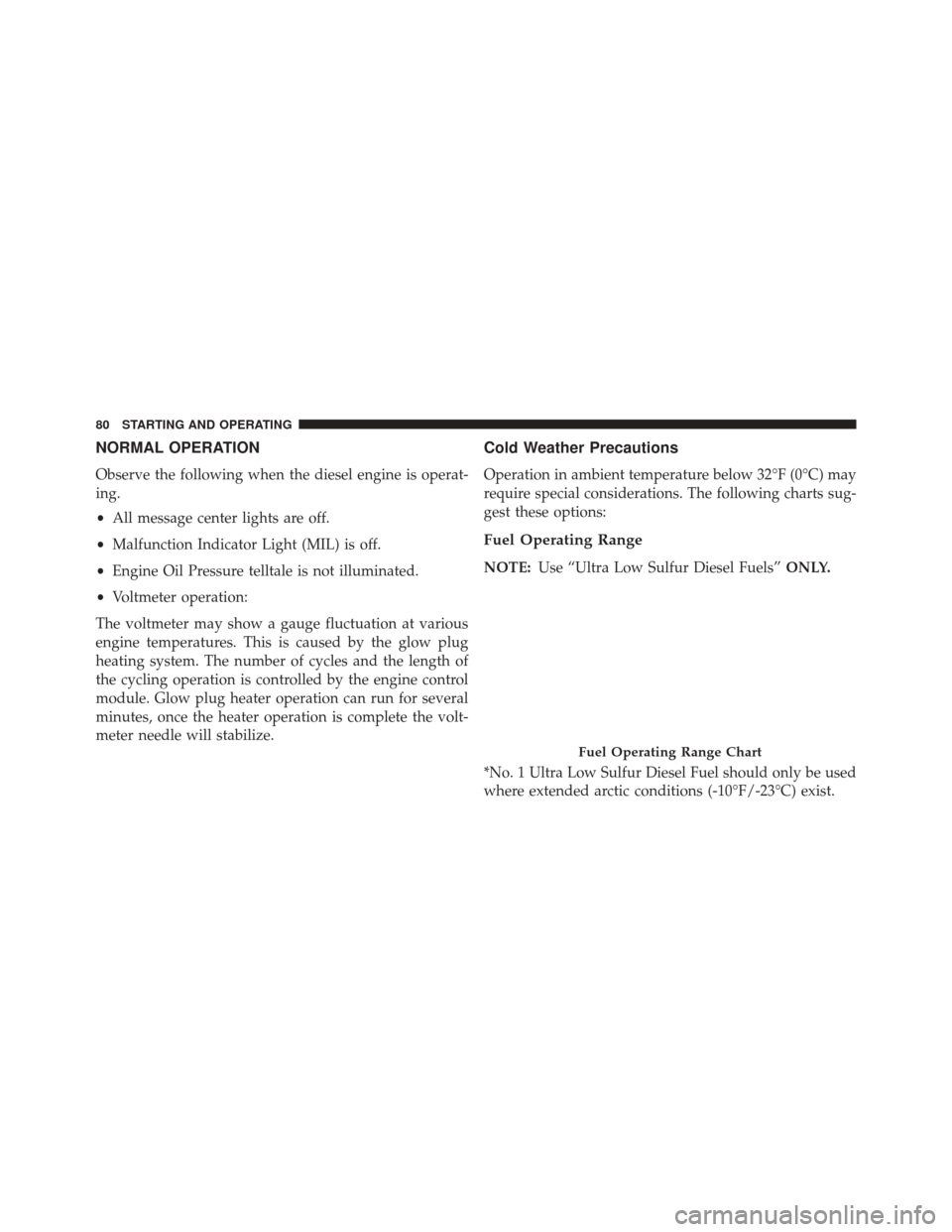
Fuel Operating Range
NOTE: Use “Ultra Low Sulfur Diesel Fuels” ONLY.
*No. 1 Ultra Low Sulfur Diesel Fuel should only be used
where extended arctic conditions (-10°F/-23°C) exist.
Fuel Operating Range Chart
80 STARTING AND OPERATING
Page 85 of 347
NOTE:Under certain conditions the engine fan will run
after the engine is turned off. These conditions are under
high load and high temperature conditions.
Cooling System Tips — Automatic Transmission
To reduce the potential for engine and transmission
overheating in high ambient temperature conditions,
take the following actions:
• City Driving — When stopped, shift the transmission
into NEUTRAL and increase engine idle speed.
• Highway Driving — Reduce your speed.
• Up Steep Hills — Select a lower transmission gear.
• Air Conditioning — Turn it off temporarily.
NOTE: If the coolant temperature is too high the A/C
will automatically turn off.
Do Not Operate The Engine With Low Oil
Pressure
If the low oil pressure warning light turns on while
driving, stop the vehicle and shut down the engine as
soon as possible. A chime will sound when the light turns
on.
NOTE: Do not operate the vehicle until the cause is
corrected. This light does not show how much oil is in the
engine. The engine oil level must be checked under the
hood.
CAUTION!
If oil pressure falls to less than normal readings, shut
the engine off immediately. Failure to do so could
result in immediate and severe engine damage.
4
STARTING AND OPERATING 83
Page 100 of 347
3. Stop filling the DEF tank immediately when any of thefollowing happen: DEF stops flowing from the fill
bottle into the DEF tank, DEF splashes out the filler
neck, or a DEF pump nozzle automatically shuts off.
4. Reinstall cap onto DEF tank.
Filling The Def Tank In Cold Climates
Since DEF will begin to freeze at 12°F (-11°C), your
vehicle is equipped with an automatic DEF heating
system. This allows the DEF injection system to operate
properly at temperatures below 12°F (-11°C). If your
vehicle is not in operation for an extended period of time
with temperatures below 12°F (-11°C), the DEF in the
tank may freeze. If the tank is overfilled and freezes, it
could be damaged. Therefore, do not overfill the DEF
tank. Extra care should be taken when filling with portable
containers to avoid overfilling. Note the level of the DEF
gauge in your instrument cluster. On pickup applica-
tions, you may safely add a maximum of 2 gallons of DEF
from portable containers when your DEF gauge is read-
ing ½ full.
98 STARTING AND OPERATING
Page 208 of 347
STARTING PROCEDURES
Before starting your vehicle, adjust your seat, adjust both
inside and outside mirrors, and fasten your seat belts.
The starter should not be operated for more than 15-
second intervals. Waiting a few minutes between such
intervals will protect the starter from overheating.
WARNING!
•Do not leave children or animals inside parked
vehicles in hot weather. Interior heat build up may
cause serious injury or death.
• When leaving the vehicle, always make sure the
ignition is in the OFF position, remove the key fob
from the vehicle, and lock the vehicle.
(Continued)
WARNING! (Continued)
•Never leave children alone in a vehicle, or with
access to an unlocked vehicle. Allowing children to
be in a vehicle unattended is dangerous for a
number of reasons. A child or others could be
seriously or fatally injured. Children should be
warned not to touch the parking brake, brake pedal
or the transmission gear selector. Do not leave the
key fob in or near the vehicle (or in a location
accessible to children), and do not leave the igni-
tion (of a vehicle equipped with Keyless Enter-N-
Go™) in the ACC or ON/RUN mode. A child could
operate power windows, other controls, or move
the vehicle.
206 STARTING AND OPERATING
Page 219 of 347
Starting Fluids
WARNING!
Starting fluids or flammable liquids must never be
used in the Cummins® diesel engine (see Warning
label). Never pour diesel fuel, flammable liquid, start-
ing fluids (ether) into the air cleaner canister, air intake
piping, or turbocharger inlet in an attempt to start the
vehicle. This could result in a flash fire and explosion
causing serious personal injury and engine damage.
The engine is equipped with an automatic electric air
preheating system. If the instructions in this manual are
followed, the engine should start in all conditions.
WARNING!
•Do not leave children or animals inside parked
vehicles in hot weather. Interior heat build up may
cause serious injury or death.
• When leaving the vehicle, always make sure the
ignition is in the OFF position, remove the key fob
from the vehicle, and lock the vehicle.
(Continued)
4
STARTING AND OPERATING 217
Page 227 of 347
Operating Precautions
Avoid Overheating The Engine
The temperature of the engine coolant (antifreeze) (a
mixture of 50% ethylene-glycol and 50% water) must not
exceed the normal range of the temperature gauge 240°F
(116°C) with a 21 psi (145 kPa) coolant pressure cap.
Usually the engine coolant (antifreeze) temperature indi-
cated during operation will be to the left of center in the
normal range of the gauge.
Avoid Low Coolant Temperature Operation
Continual operation at low engine coolant (antifreeze)
temperature below the normal range on the gauge 140°F
(60°C) can be harmful to the engine. Low engine coolant
(antifreeze) temperature can cause incomplete combus-
tion which allows carbon and varnish to form on pistonrings and injector nozzles. Also, the unburned fuel can
enter the crankcase, diluting the lubricating oil and
causing rapid wear to the engine.
Cooling System Tips — Automatic Transmission
To reduce potential for engine and transmission over-
heating in high ambient temperature conditions, take the
following actions:
•
City Driving —
When stopped, shift the transmission into NEUTRAL
and increase engine idle speed.
• Highway Driving —
Reduce your speed.
• Up Steep Hills —
Select a lower transmission gear.
• Air Conditioning —
Turn it off temporarily.
4
STARTING AND OPERATING 225
Page 240 of 347
If the transmission temperature exceeds normal operat-
ing limits, the powertrain controller will modify the
transmission shift schedule and expand the range of
torque converter clutch engagement. This is done to
prevent transmission damage due to overheating.
If the transmission becomes extremely hot or is in danger
of overheating, the “Transmission Temperature Warning
Light” may illuminate and the transmission may operate
differently until the transmission cools down.
NOTE:Use caution when operating a heavily loaded
vehicle at low speeds (such as towing a trailer up a steep
grade, or in stop-and-go traffic) during hot weather. In
these conditions, torque converter slip can impose a
significant additional heat load on the cooling system.
Downshifting the transmission to the lowest possible
gear (when climbing a grade), or shifting to NEUTRAL
(when stopped in heavy traffic) can help to reduce this
excess heat generation. During cold temperatures, transmission operation may
be modified depending on engine and transmission
temperature as well as vehicle speed. This feature im-
proves warm up time of the engine and transmission to
achieve maximum efficiency. Engagement of the torque
converter clutch is inhibited until the transmission fluid
is warm (refer to the “Note” under “Torque Converter
Clutch” in this section). On Pickup models with 68RFE
transmission, top overdrive gear is also inhibited until
the transmission fluid is warm, and during extremely
cold temperatures (-16°F [-27°C] or below), operation
may briefly be limited to first and direct gears only. On
trucks with AS69RC transmission, fifth and sixth gears
may be inhibited briefly on cold starts below 41°F (5°C),
and during very cold temperatures (-4°F [-20°C] or
below), operation may briefly be limited to third gear
only. During this condition, the ability of the vehicle to
238 STARTING AND OPERATING