tow Ram 1500 2015 Owners Manual
[x] Cancel search | Manufacturer: RAM, Model Year: 2015, Model line: 1500, Model: Ram 1500 2015Pages: 871, PDF Size: 24.83 MB
Page 550 of 871
vehicle becomes free, the driver of the previously stuck
vehicle should signal they are free and should hit their
brakes stopping both vehicles. The driver of the pull-
ing vehicle should let off the throttle without using the
brakes, once signaled by the other driver. This se-
quence is important to avoid having the recovered
vehicle hit the pulling vehicle.
WARNING!
Never use tow straps with end hooks or link two
straps with a clevis pin. These heavy metal objects
could become projectiles if a strap breaks, which
could cause severe injury. Never leave more than two
or three feet of slack in the strap. More slack than this
greatly increases the risk of injury and vehicle dam-
age. Always keep everyone at least 30 feet away from
a strapping or winching situation.
•Winching (Refer To “Winch Operation” For Addi-
tional Information)–Winching is most commonly
used in the following situations: there is no support
vehicle available, a high controlled force is required to
recover the vehicle, there is a high risk of environmental
or vehicle damage, or where nothing else seems to work.
A winch can deliver a high pulling force with a great
deal of control. It allows you to walk the vehicle out of
the situation in a slow controlled manner. This control
works well for avoiding further vehicle damage. Once
you decide it is time to use the winch look for a good
anchor point. It needs to be strong enough to hold more
than the vehicle’s weight and provide a direction of pull
as straight as possible. Use block and tackle if necessary
to improve the angle of pull or increase the winch’s
pulling force. If the anchor point is a tree use a strap
around its base and hook the cable to the strap. If it is
another vehicle, then place that vehicle in PARK and
block the front tires. If you cannot find an anchor point
548 STARTING AND OPERATING
Page 551 of 871
within reach try using your spare tire by burying it.
Once you have determined an anchor point hook up the
cable, ensuring there are a least five wraps of cable left
on the drum, and place a floor mat or something else
over the strung out cable. Placing something over the
strung out cable helps keep the cable on the ground if it
breaks. Next, place the vehicle in first gear and apply a
very light throttle as you power the winch in. Be careful
not to allow slack in the cable as you recover the vehicle.
Do not try to guide the cable into the drum. If it starts to
bunch up on one end, let it. You can re-spool the cable
afterwards. Never use a winch cable as a tow strap and
always stand back while winching.
WARNING!
Winch cables are under high tension when in use and
can become a projectile if they fail. Never stand over
(Continued)
WARNING!(Continued)
or straddle the winch cable. Never jerk or overload
the winch cable. Never stand in front of the vehicle
while winching. Failure to follow these instructions
can result in serious or fatal injury.
After Driving Off-Road
Off-road operation puts more stress on your vehicle than
does most on-road driving. After going off-road, it is
always a good idea to check for damage. That way you
can get any problems taken care of right away and have
your vehicle ready when you need it.
•Completely inspect the underbody of your vehicle.
Check tires, body structure, steering, suspension, and
exhaust system for damage.
5
STARTING AND OPERATING 549
Page 564 of 871
WARNING!(Continued)
•Never wrap wire rope back onto itself. Always use
a choker chain, wire choker rope or tree trunk
protector on the anchor.
•Never attach a recovery strap to the winch hook to
increase the length of a pull.
•Never attempt to tow a vehicle with the recovery
strap attached directly to the winch hook.
•Never use%bungee%straps that develop tremendous
and potentially dangerous amounts of force when
stretched.
•Always disconnect the remote control when not in
use.
•Never winch when there are less than five wraps of
wire rope around the winch drum.
(Continued)
WARNING!(Continued)
•Always pass remote control through a window to
avoid pinching lead in door, when using remote
inside a vehicle.
•Never leave the remote control plugged into the
winch while free spooling, rigging or sitting idle.
General Information
Practice using your winch before you get stuck. Some key
points to remember when using your winch are:
•Always take your time to assess the situation and plan
your pull carefully.
•Always take your time when using a winch.
•Use the right equipment for the situation.
562 STARTING AND OPERATING
Page 574 of 871
WARNING!
To prevent serious injury, NEVER put your fingers
inside the hook area as you are powering-in.
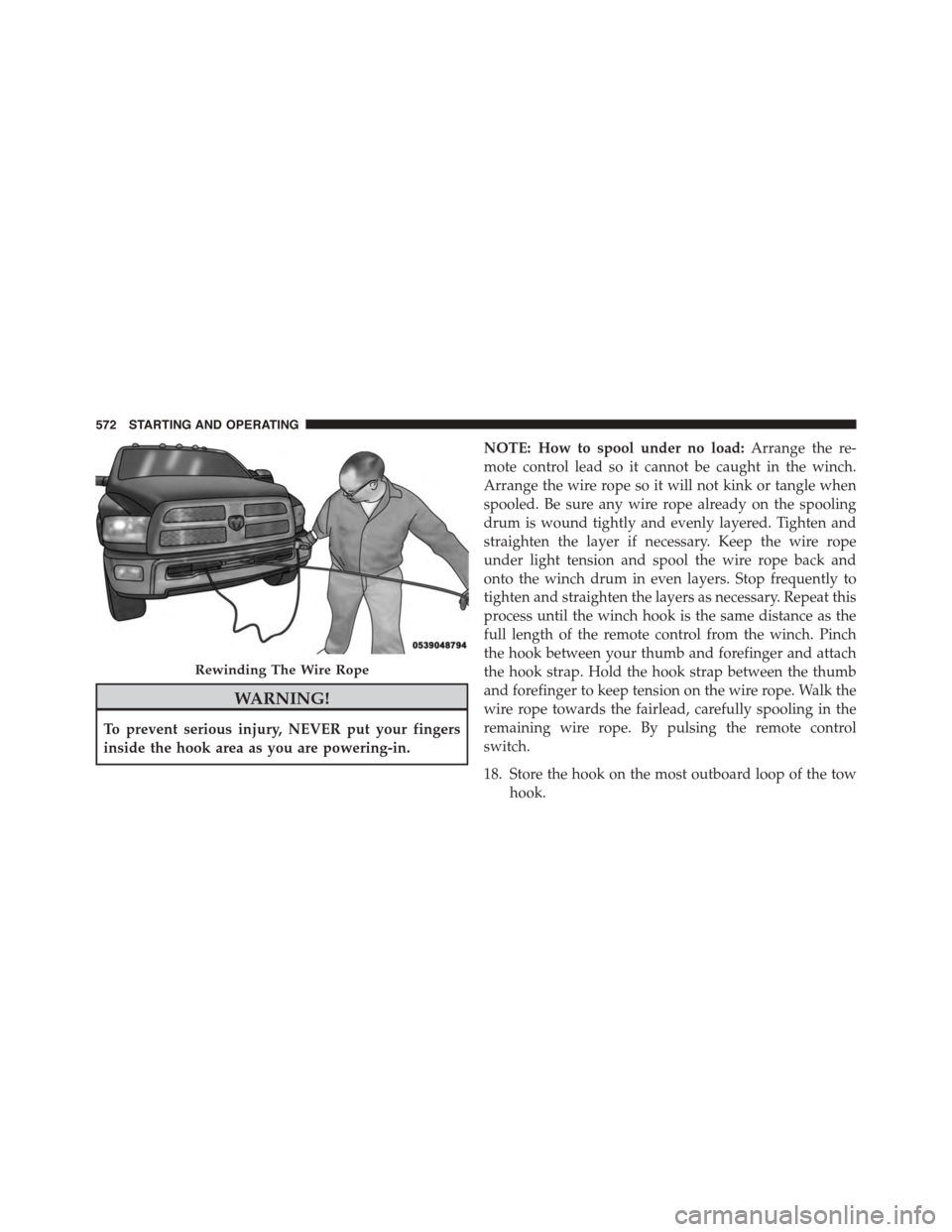
NOTE: How to spool under no load:Arrange the re-
mote control lead so it cannot be caught in the winch.
Arrange the wire rope so it will not kink or tangle when
spooled. Be sure any wire rope already on the spooling
drum is wound tightly and evenly layered. Tighten and
straighten the layer if necessary. Keep the wire rope
under light tension and spool the wire rope back and
onto the winch drum in even layers. Stop frequently to
tighten and straighten the layers as necessary. Repeat this
process until the winch hook is the same distance as the
full length of the remote control from the winch. Pinch
the hook between your thumb and forefinger and attach
the hook strap. Hold the hook strap between the thumb
and forefinger to keep tension on the wire rope. Walk the
wire rope towards the fairlead, carefully spooling in the
remaining wire rope. By pulsing the remote control
switch.
18. Store the hook on the most outboard loop of the tow
hook.
Rewinding The Wire Rope
572 STARTING AND OPERATING
Page 577 of 871
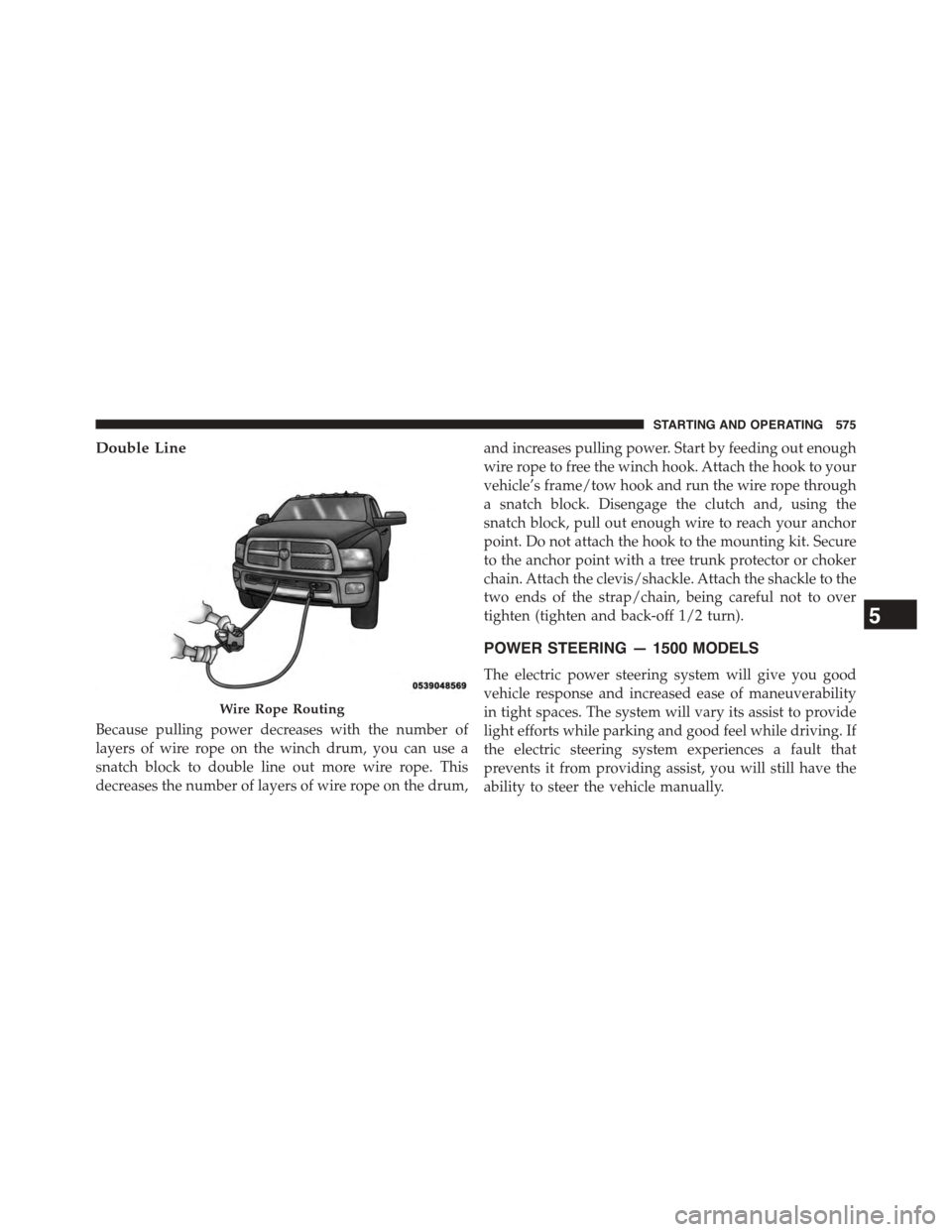
Double Line
Because pulling power decreases with the number of
layers of wire rope on the winch drum, you can use a
snatch block to double line out more wire rope. This
decreases the number of layers of wire rope on the drum,
and increases pulling power. Start by feeding out enough
wire rope to free the winch hook. Attach the hook to your
vehicle’s frame/tow hook and run the wire rope through
a snatch block. Disengage the clutch and, using the
snatch block, pull out enough wire to reach your anchor
point. Do not attach the hook to the mounting kit. Secure
to the anchor point with a tree trunk protector or choker
chain. Attach the clevis/shackle. Attach the shackle to the
two ends of the strap/chain, being careful not to over
tighten (tighten and back-off 1/2 turn).
POWER STEERING — 1500 MODELS
The electric power steering system will give you good
vehicle response and increased ease of maneuverability
in tight spaces. The system will vary its assist to provide
light efforts while parking and good feel while driving. If
the electric steering system experiences a fault that
prevents it from providing assist, you will still have the
ability to steer the vehicle manually.
Wire Rope Routing
5
STARTING AND OPERATING 575
Page 581 of 871
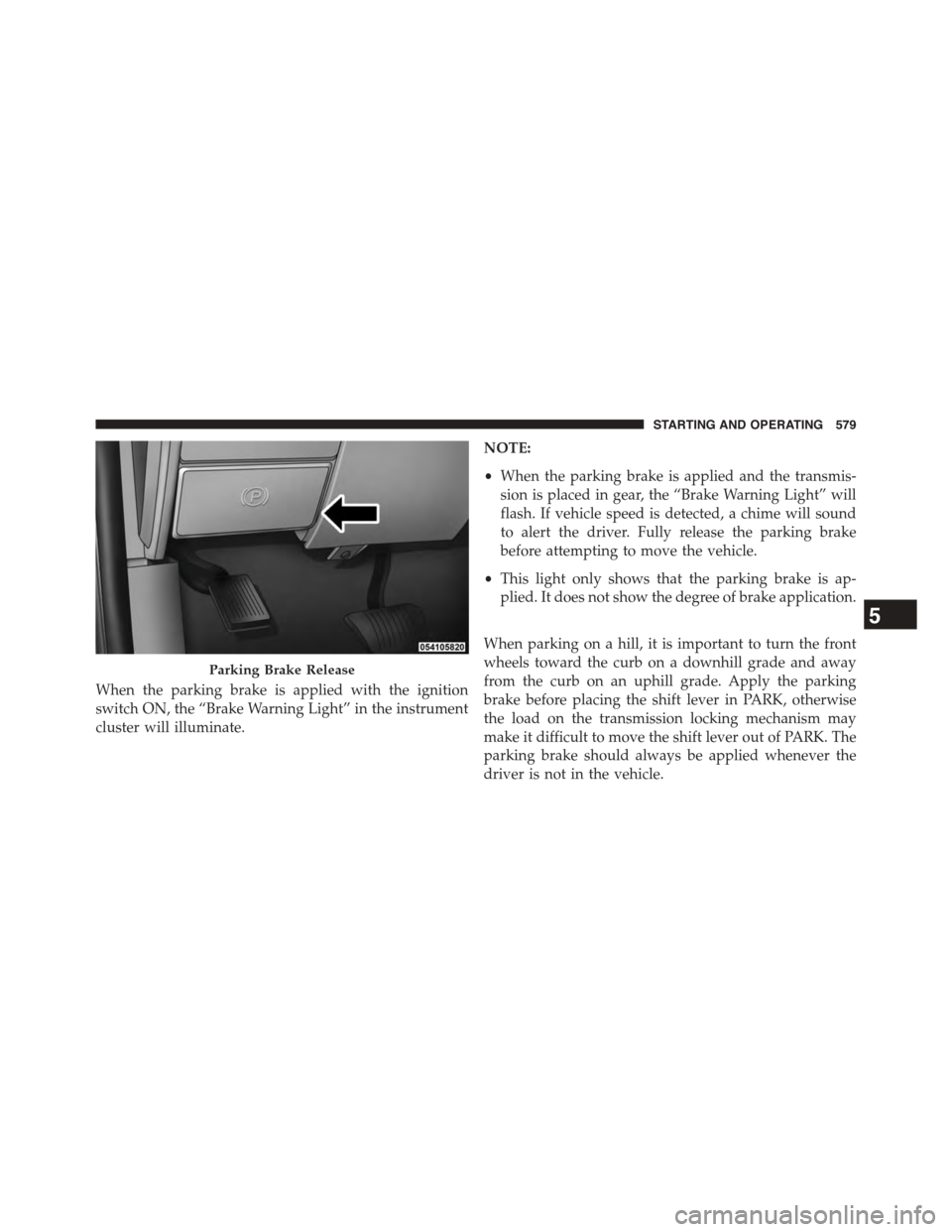
When the parking brake is applied with the ignition
switch ON, the “Brake Warning Light” in the instrument
cluster will illuminate.
NOTE:
•When the parking brake is applied and the transmis-
sion is placed in gear, the “Brake Warning Light” will
flash. If vehicle speed is detected, a chime will sound
to alert the driver. Fully release the parking brake
before attempting to move the vehicle.
•This light only shows that the parking brake is ap-
plied. It does not show the degree of brake application.
When parking on a hill, it is important to turn the front
wheels toward the curb on a downhill grade and away
from the curb on an uphill grade. Apply the parking
brake before placing the shift lever in PARK, otherwise
the load on the transmission locking mechanism may
make it difficult to move the shift lever out of PARK. The
parking brake should always be applied whenever the
driver is not in the vehicle.
Parking Brake Release
5
STARTING AND OPERATING 579
Page 588 of 871
Towing And Hauling With HSA
The HSA system does not know if your vehicle is loaded
or towing a trailer unless the TOW/HAUL switch, lo-
cated on the center stack, is selected. When activated, the
“TOW/HAUL Indicator Light” will illuminate in the
instrument cluster. Refer to “Automatic Transmission” in
“Starting and Operating” for further information. In
order to accommodate the extra weight entailed under
towing and hauling conditions and to increase driver
comfort while launching on a hill, the system recognizes
when the TOW/HAUL switch is activated and compen-
sates by releasing brake pressure at a slower rate while
throttle is applied in order to prevent the vehicle from
rolling down the hill.
WARNING!
•If you use a trailer brake controller with your
trailer, your trailer brakes may be activated and
deactivated with the brake switch. If so, when the
brake pedal is released, there may not be enough
brake pressure to hold the vehicle and trailer on a
hill and this could cause a collision with another
vehicle or object behind you. In order to avoid
rolling down the incline while resuming accelera-
tion, manually activate the trailer brake or apply
more vehicle brake pressure prior to releasing the
brake pedal. Always remember the driver is re-
sponsible for braking the vehicle.
(Continued)
586 STARTING AND OPERATING
Page 594 of 871
NOTE:
•The “ESC Activation/Malfunction Indicator Light”
and the “ESC OFF Indicator Light” come on momen-
tarily each time the ignition switch is turned ON.
•Each time the ignition is turned ON, the ESC system
will be ON even if it was turned off previously. Except
for when the vehicle is started while in 4WD Low
Range.
•The ESC system will make buzzing or clicking sounds
when it is active. This is normal; the sounds will stop
when ESC becomes inactive following the maneuver
that caused the ESC activation.
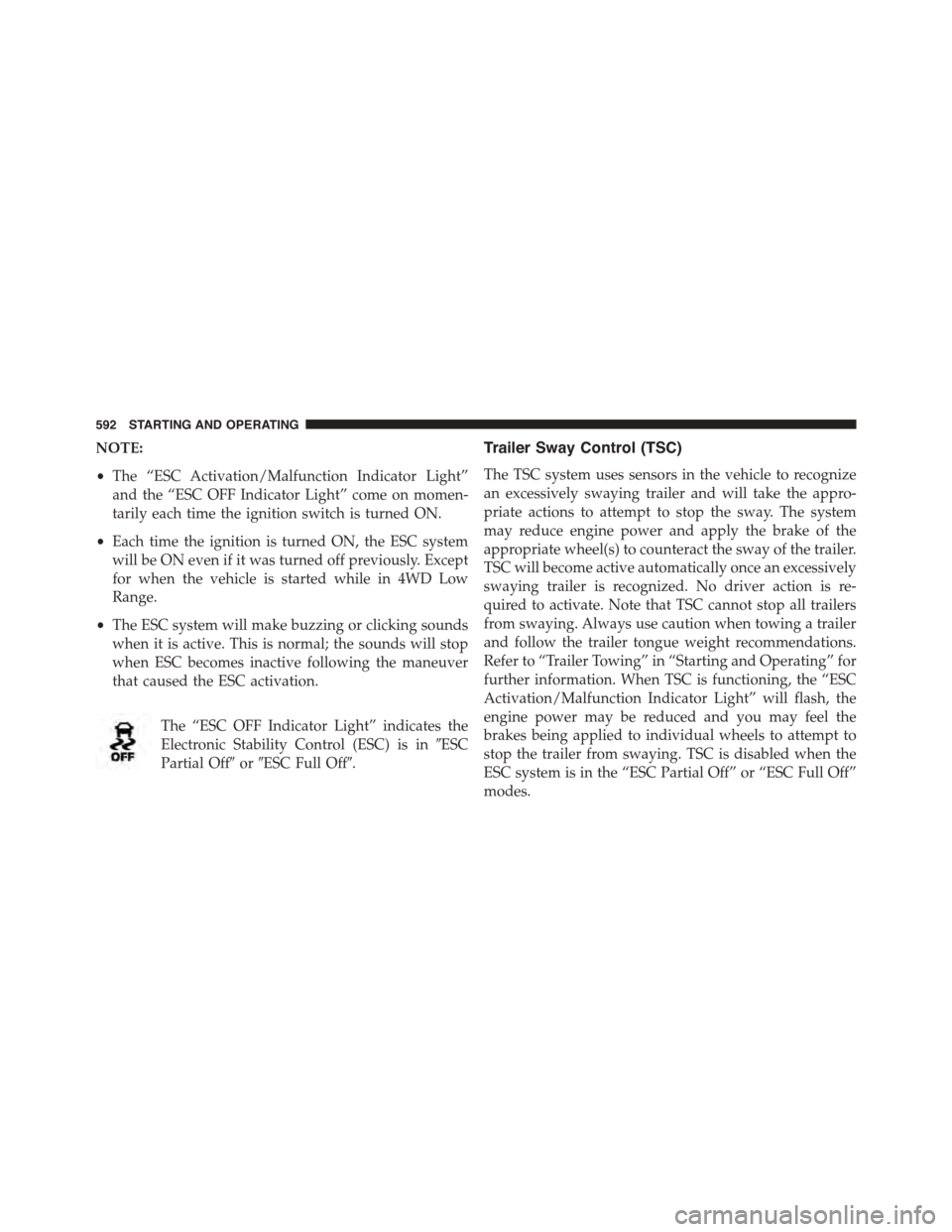
The “ESC OFF Indicator Light” indicates the
Electronic Stability Control (ESC) is in#ESC
Partial Off#or#ESC Full Off#.
Trailer Sway Control (TSC)
The TSC system uses sensors in the vehicle to recognize
an excessively swaying trailer and will take the appro-
priate actions to attempt to stop the sway. The system
may reduce engine power and apply the brake of the
appropriate wheel(s) to counteract the sway of the trailer.
TSC will become active automatically once an excessively
swaying trailer is recognized. No driver action is re-
quired to activate. Note that TSC cannot stop all trailers
from swaying. Always use caution when towing a trailer
and follow the trailer tongue weight recommendations.
Refer to “Trailer Towing” in “Starting and Operating” for
further information. When TSC is functioning, the “ESC
Activation/Malfunction Indicator Light” will flash, the
engine power may be reduced and you may feel the
brakes being applied to individual wheels to attempt to
stop the trailer from swaying. TSC is disabled when the
ESC system is in the “ESC Partial Off” or “ESC Full Off”
modes.
592 STARTING AND OPERATING
Page 607 of 871
3. Tire size designed for your vehicle.
4. Cold tire inflation pressures for the front, rear, and
spare tires.
Loading
The vehicle maximum load on the tire must not exceed
the load carrying capacity of the tire on your vehicle. You
will not exceed the tire’s load carrying capacity if you
adhere to the loading conditions, tire size, and cold tire
inflation pressures specified on the Tire and Loading
Information placard and in the “Vehicle Loading” section
of this manual.
NOTE:Under a maximum loaded vehicle condition,
gross axle weight ratings (GAWRs) for the front and rear
axles must not be exceeded. For further information on
GAWRs, vehicle loading, and trailer towing, refer to
“Vehicle Loading” in this section.
To determine the maximum loading conditions of your
vehicle, locate the statement “The combined weight of
occupants and cargo should never exceed XXX lbs or
XXX kg” on the Tire and Loading Information placard.
The combined weight of occupants, cargo/luggage and
trailer tongue weight (if applicable) should never exceed
the weight referenced here.
Steps For Determining Correct Load Limit
1. Locate the statement “The combined weight of occu-
pants and cargo should never exceed XXX lbs or
XXX kg” on your vehicle’s placard.
2. Determine the combined weight of the driver and
passengers that will be riding in your vehicle.
3. Subtract the combined weight of the driver and pas-
sengers from XXX lbs or XXX kg.
5
STARTING AND OPERATING 605
Page 608 of 871
4. The resulting figure equals the available amount of
cargo and luggage load capacity. For example, if
“XXX” amount equals 1,400 lbs (635 kg) and there will
be five 150 lb (68 kg) passengers in your vehicle, the
amount of available cargo and luggage load capacity
is 650 lbs (295 kg) (since 5 x 150 lbs (68 kg) = 750 lbs
(340 kg), and 1400 lbs (635 kg) – 750 lbs (340 kg) =
650 lbs [295 kg]).
5. Determine the combined weight of luggage and cargo
being loaded on the vehicle. That weight may not
safely exceed the available cargo and luggage load
capacity calculated in step 4.
NOTE:
•If your vehicle will be towing a trailer, load from your
trailer will be transferred to your vehicle. The follow-
ing table shows examples on how to calculate total
load, cargo/luggage, and towing capacities of your
vehicle with varying seating configurations and num-
ber and size of occupants. This table is for illustration
purposes only and may not be accurate for the seating
and load carry capacity of your vehicle.
•For the following example, the combined weight of
occupants and cargo should never exceed 865 lbs
(392 kg).
606 STARTING AND OPERATING