wheel Ram 1500 2015 Owners Manual
[x] Cancel search | Manufacturer: RAM, Model Year: 2015, Model line: 1500, Model: Ram 1500 2015Pages: 871, PDF Size: 24.83 MB
Page 542 of 871
CAUTION!
Winching or rocking the vehicle off hard objects
increases the risk of underbody damage.
Hill Climbing
Hill climbing requires good judgment and a good under-
standing of your abilities and your vehicle’s limitations.
Hills can cause serious problems. Some are just too steep
to climb and should not be attempted. You should always
feel confident with the vehicle and your abilities. You
should always climb hills straight up and down. Never
attempt to climb a hill on an angle.
•Before Climbing A Steep Hill– As you approach a
hill consider its grade or steepness. Determine if it is
too steep. Look to see what the traction is on the hill
side trail. Is the trail straight up and down? What is on
top and the other side? Are there ruts, rocks, branches
or other obstacles on the path? Can you safely recover
the vehicle if something goes wrong? If everything
looks good and you feel confident, then change trans-
mission into a lower gear, shift the transfer case into 4L
(Low) and proceed with caution. You should use first
gear and 4L (Low Range) for very steep hills.
•Driving Up Hill– Once you have determined your
ability to proceed and have shifted into the appropri-
ate gear, line your vehicle up for the straightest pos-
sible run. Accelerate with an easy constant throttle and
apply more power as you start up the hill. Do not race
forward into a steep grade, the abrupt change of grade
could cause you to lose control. If the front end begins
to bounce, ease off the throttle slightly to bring all four
tires back on the ground. As you approach the crest of
the hill ease off the throttle and slowly proceed over
the top. If the wheels start to slip as you approach the
crest of a hill, ease off the accelerator and maintain
headway by turning the steering wheel no more than
a¼turn quickly back and forth. This will provide a
540 STARTING AND OPERATING
Page 543 of 871
fresh#bite#into the surface and will usually provide
enough traction to complete the climb. If you do not
make it to the top, place the vehicle in REVERSE and
back straight down the grade using engine resistance
along with the vehicle brakes.
WARNING!
Never attempt to climb a hill at an angle or turn
around on a steep grade. Driving across an incline
increases the risk of a roll over, which may result in
severe injury or death.
•Driving Down Hill– Before driving down a steep hill
you need to determine if it is too steep for a safe
descent. What is the surface traction? Is the grade too
steep to maintain a slow controlled descent? Are there
obstacles? Is it a straight descent? Is there plenty of
distance at the base of the hill to regain control if the
vehicle descends too fast? If you feel confident in your
ability to proceed then make sure you are in 4L (Low
Range) with the transmission in first gear (manually
select first gear on automatic transmissions) and pro-
ceed with caution. Allow engine braking to control the
descent and apply your brakes if necessary, but do not
allow the tires to lock.
WARNING!
Do not descend a steep grade in NEUTRAL. Use
vehicle brakes in conjunction with engine braking.
Descending a grade too fast could cause you to lose
control and be seriously injured or killed.
•Driving Across An Incline– If at all possible avoid
driving across an incline. If it is necessary, know your
vehicle’s abilities. Driving across an incline places
more weight on the down hill wheels, which increases
the possibilities of a down hill slide or rollover. Make
sure the surface has good traction with firm and stable
5
STARTING AND OPERATING 541
Page 548 of 871
off-road driving without the ability to recover your
vehicle from a situation. Having another vehicle with
you usually works best for most situations. The first
thing to do is assess the situation. Why are you stuck?
Are you hung up on something? Would it be easier to go
forward or to go backward? Can you still move the
vehicle? Is there an anchor point to winch to? Are you
alone or do you have another vehicle to help? Is there
high risk of vehicle damage during the recovery process?
Answering these questions will help you determine the
best method of recovery. If you can still move the vehicle
slightly and the only issue is slick ground, then rock
cycling your vehicle would be the first choice. If you have
ample room, an additional vehicle and there is low risk of
vehicle impingement on the surroundings, then using a
tow strap to the vehicle tow hooks would be fast and
easy. If the vehicle is severely hung up or in a situation
where great care needs to be taken during the recovery,
then nothing can do the job better than a winch. If you are
severely hung up on something you should jack the
vehicle up and stack something under the wheels to
allow the vehicle to roll off the object without causing
further damage. This should be tried before attempting
any recovery method.
CAUTION!
Pulling the vehicle off an obstacle, without first
clearing the object, may result in additional under-
body damage.
•Rock Cycling Your Vehicle– Rock cycling your ve-
hicle is one of the easiest, fastest and most commonly
used methods. This simply involves shifting your
vehicle from DRIVE to REVERSE, while applying
throttle after each shift. During this process, for addi-
tional traction, try turning your steering wheel quickly
left and right no more than a¼turn. If you are stuck
in mud, sand, or snow try spinning your tires during
546 STARTING AND OPERATING
Page 552 of 871
•Inspect the radiator for mud and debris and clean as
required.
•Check threaded fasteners for looseness, particularly on
the chassis, drivetrain components, steering, and sus-
pension. Retighten them, if required, and torque to the
values specified in the Service Manual.
•Check for accumulations of plants or brush. These
things could be a fire hazard. They might hide damage
to fuel lines, brake hoses, axle pinion seals, and
propeller shafts.
•After extended operation in mud, sand, water, or
similar dirty conditions, have the radiator, fan, brake
rotors, wheels, brake linings, and axle yokes inspected
and cleaned as soon as possible.
WARNING!
Abrasive material in any part of the brakes may cause
excessive wear or unpredictable braking. You might
not have full braking power when you need it to
prevent a collision. If you have been operating your
vehicle in dirty conditions, get your brakes checked
and cleaned as necessary.
•If you experience unusual vibration after driving in
mud, slush or similar conditions, check the wheels for
impacted material. Impacted material can cause a
wheel imbalance and freeing the wheels of it will
correct the situation.
550 STARTING AND OPERATING
Page 553 of 871
LIMITED-SLIP DIFFERENTIAL
The limited-slip differential provides additional traction
on snow, ice, mud, sand and gravel, particularly when
there is a difference between the traction characteristics
of the surface under the right and left rear wheels. During
normal driving and cornering, the limited-slip unit per-
forms similarly to a conventional differential. On slip-
pery surfaces, however, the differential delivers more of
the driving effort to the rear wheel having the better
traction.
The limited-slip differential is especially helpful during
slippery driving conditions. With both rear wheels on a
slippery surface, a slight application of the accelerator
will supply maximum traction. When starting with only
one rear wheel on an excessively slippery surface, slight
momentary application of the parking brake may be
necessary to gain maximum traction.
WARNING!
On vehicles equipped with a limited-slip differential
never run the engine with one rear wheel off the
ground since the vehicle may drive through the rear
wheel remaining on the ground. You could lose
control of the vehicle.
Care should be taken to avoid sudden accelerations when
both rear wheels are on a slippery surface. This could
cause both rear wheels to spin, and allow the vehicle to
slide sideways on the crowned surface of a road or in a
turn.
DRIVING ON SLIPPERY SURFACES
Acceleration
Rapid acceleration on snow covered, wet, or other slip-
pery surfaces may cause the driving wheels to pull
erratically to the right or left. This phenomenon occurs
5
STARTING AND OPERATING 551
Page 554 of 871
when there is a difference in the surface traction under
the rear (driving) wheels.
WARNING!
Rapid acceleration on slippery surfaces is dangerous.
Unequal traction can cause sudden pulling of the rear
wheels. You could lose control of the vehicle and
possibly have a collision. Accelerate slowly and
carefully whenever there is likely to be poor traction
(ice, snow, wet mud, loose sand, etc.).
Traction
When driving on wet or slushy roads, it is possible for a
wedge of water to build up between the tire and road
surface. This is known as hydroplaning and may cause
partial or complete loss of vehicle control and stopping
ability. To reduce this possibility, the following precau-
tions should be observed:
•Slow down during rainstorms or when the roads are
slushy.
•Slow down if the road has standing water or puddles.
•Replace tires when tread wear indicators first become
visible.
•Keep tires properly inflated.
•Maintain sufficient distance between your vehicle and
the vehicle in front of you to avoid a collision in a
sudden stop.
Your vehicle may be equipped with a Limited Slip
Differential (LSD) that reduces, but does not eliminate,
the amount of wheel slip across a given axle for im-
proved handling.
552 STARTING AND OPERATING
Page 557 of 871
OFF-ROAD DRIVING TIPS
Care should be taken when attempting to climb steep
hills or driving diagonally across a hill or slope. If natural
obstacles force you to travel diagonally up or down a hill,
choose a mild angle and keep as little side tilt as possible.
Keep the vehicle moving and make turns slowly and
cautiously.
If you must back down a hill, back straight down using
REVERSE gear. Never back down in NEUTRAL or diago-
nally across the hill.
When driving over sand, mud, and other soft terrain,
shift to low gear and drive steadily. Apply the accelerator
slowly to avoid spinning the wheels.
Do not reduce the tire pressures for this type of driving.
After Driving Off-Road
Off-road operation puts more stress on your vehicle than
does most on-road driving. After going off-road, it is
always a good idea to check for damage. That way you
can get any problems taken care of right away and have
your vehicle ready when you need it.
•Completely inspect the underbody of your vehicle.
Check tires, body structure, steering, suspension, and
exhaust system for damage.
•Inspect the radiator for mud and debris and clean as
required.
•Check threaded fasteners for looseness, particularly on
the chassis, drivetrain components, steering, and sus-
pension. Retighten them, if required, and torque to the
values specified in the Service Manual.
•Check for accumulations of plants or brush. These
things could be a fire hazard. They might hide damage
to fuel lines, brake hoses, axle pinion seals, and
propeller shafts.
5
STARTING AND OPERATING 555
Page 558 of 871
•After extended operation in mud, sand, water, or
similar dirty conditions, have the radiator, fan, brake
rotors, wheels, brake linings, and axle yokes inspected
and cleaned as soon as possible.
WARNING!
Abrasive material in any part of the brakes may cause
excessive wear or unpredictable braking. You might
not have full braking power when you need it to
prevent a collision. If you have been operating your
vehicle in dirty conditions, get your brakes checked
and cleaned as necessary.
•If you experience unusual vibration after driving in
mud, slush or similar conditions, check the wheels for
impacted material. Impacted material can cause a
wheel imbalance and freeing the wheels of it will
correct the situation.
WINCH USAGE — POWER WAGON ONLY — (IF
EQUIPPED)
Things To Know Before Using Your Winch
General Winch Information
Your vehicle is equipped with an electric vehicle recovery
winch. This winch uses the electrical power from the
vehicle charging system to power a motor that winds
wire rope into the winch drum via planetary gear reduc-
tion. By nature, a winch is capable of generating very
high forces and should be used with care. Do not operate
the winch without reading and understanding the com-
plete winch owner’s manual.
Tensioning The Wire Rope
The winch rope must be properly tensioned before use.
Follow the instructions below to tension the rope:
1. Un-spool the wire rope leaving five wraps of rope on
the winch drum.
556 STARTING AND OPERATING
Page 568 of 871
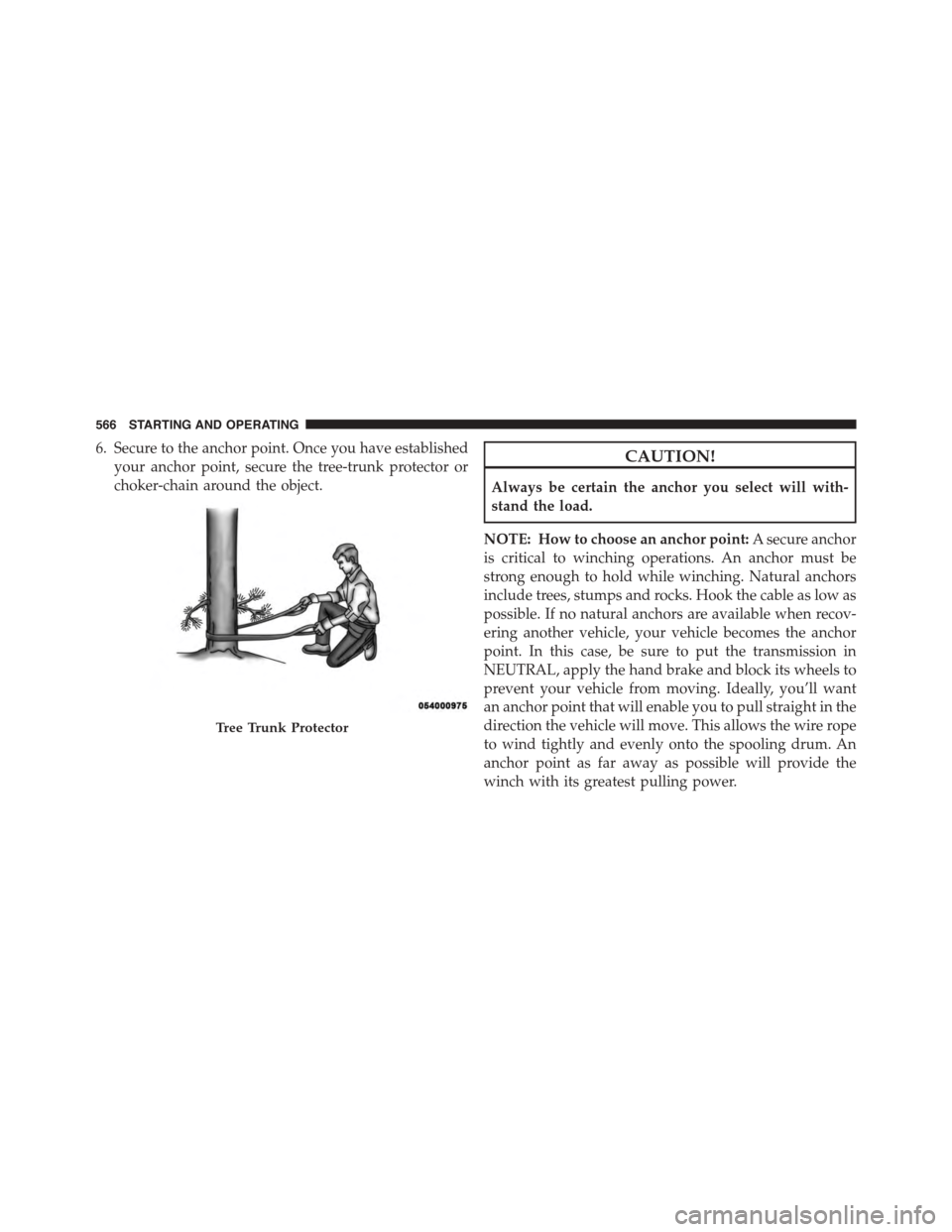
6. Secure to the anchor point. Once you have established
your anchor point, secure the tree-trunk protector or
choker-chain around the object.
CAUTION!
Always be certain the anchor you select will with-
stand the load.
NOTE: How to choose an anchor point:A secure anchor
is critical to winching operations. An anchor must be
strong enough to hold while winching. Natural anchors
include trees, stumps and rocks. Hook the cable as low as
possible. If no natural anchors are available when recov-
ering another vehicle, your vehicle becomes the anchor
point. In this case, be sure to put the transmission in
NEUTRAL, apply the hand brake and block its wheels to
prevent your vehicle from moving. Ideally, you’ll want
an anchor point that will enable you to pull straight in the
direction the vehicle will move. This allows the wire rope
to wind tightly and evenly onto the spooling drum. An
anchor point as far away as possible will provide the
winch with its greatest pulling power.
Tree Trunk Protector
566 STARTING AND OPERATING
Page 579 of 871
If for some reason the power assist is interrupted, it will
still be possible to steer your vehicle. Under these condi-
tions, you will observe a substantial increase in steering
effort, especially at very low vehicle speeds and during
parking maneuvers.
NOTE:
•Increased noise levels at the end of the steering wheel
travel are considered normal and do not indicate that
there is a problem with the power steering system.
•Upon initial start-up in cold weather, the power steer-
ing pump may make noise for a short amount of time.
This is due to the cold, thick fluid in the steering
system. This noise should be considered normal, and it
does not in any way damage the steering system.
CAUTION!
Prolonged operation of the steering system at the end
of the steering wheel travel will increase the steering
fluid temperature and it should be avoided when
possible. Damage to the power steering pump may
occur.
Power Steering Fluid Check — 2500/3500 Models
Checking the power steering fluid level at a defined
service interval is not required. The fluid should only be
checked if a leak is suspected, abnormal noises are
apparent, and/or the system is not functioning as antici-
pated. Coordinate inspection efforts through an autho-
rized dealer.
5
STARTING AND OPERATING 577